
Inspiration
We’ve all experienced the hesitation before a purchase—standing in a store or hovering over a checkout button, wondering, “Can I actually afford this?” Most banking apps focus on past spending, but they fail to show the future consequences of today’s decisions. For users managing tight monthly budgets, a single impulse purchase can trigger a chain reaction that leads to missed bills days or weeks later. RegretGuard was inspired by the idea of a “Financial Time Machine”: a system that lets users preview the financial future before committing to a purchase.
What it does
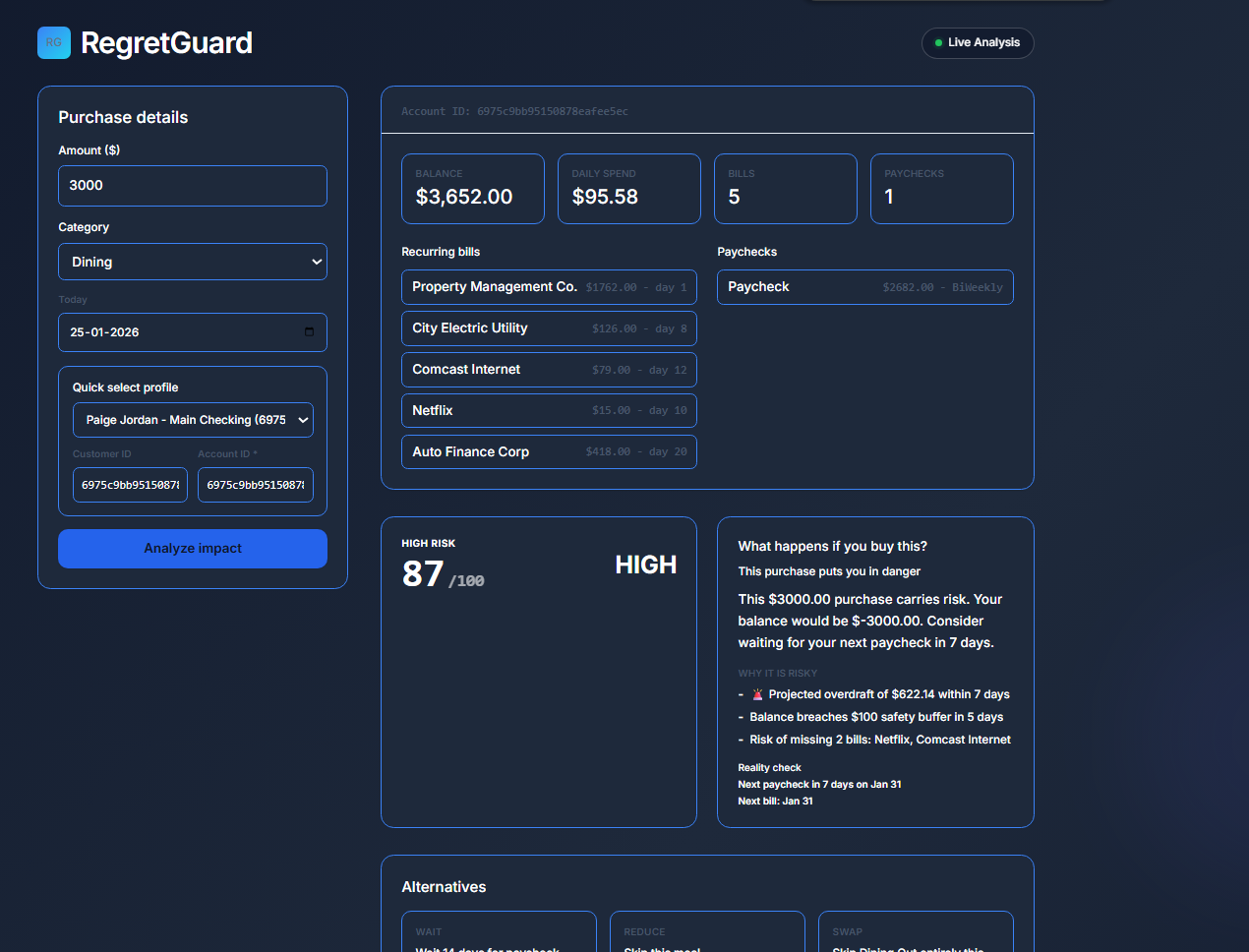
RegretGuard simulates the financial impact of a potential purchase and quantifies the risk of future regret. By analyzing income, fixed expenses, and spending patterns, it forecasts account balances under thousands of possible future scenarios and generates a Regret Risk Score. Instead of simply approving or denying a purchase, RegretGuard explains why a decision may be risky, helping users make informed and confident choices.
How we built it
Data Engine (Nessie API):
We ingest real-time account data, transaction history, and recurring payments to model baseline cash flow using recurring income and fixed expenses.HPC Simulation Layer (NorthMark):
We abstracted a High-Performance Computing workflow that runs 1,000+ Monte Carlo simulations to account for uncertainty in spending and timing.Intelligence Layer (Gemini API):
Deterministic simulation results are translated into empathetic, plain-English advice. The model is constrained by hard financial facts to ensure accuracy.Regret Risk Model:
A weighted multi-factor equation combining buffer encroachment, bill proximity, and spending volatility produces a normalized regret score.
Challenges we ran into
- Making HPC approachable:
Designing an asynchronous simulation system that exposed progress and reliability without overwhelming non-technical users. - Inferring financial structure from raw data:
Automatically distinguishing recurring bills from one-time purchases required robust pattern detection across merchants and dates. - Balancing AI creativity with financial correctness:
Ensuring generative explanations remained grounded in deterministic simulation outputs.
Accomplishments that we're proud of
- Built a scalable Monte Carlo simulation pipeline that feels instantaneous to the user.
- Designed a regret-based financial metric that captures future risk, not just current balance.
- Successfully integrated AI explanations that reduce anxiety rather than amplify it.
- Created a system that shifts financial decision-making from reactive to proactive.
What we learned
We learned that financial stress is driven more by uncertainty than by lack of numerical information. When users can clearly see future outcomes—even probabilistic ones—they make calmer and more rational decisions. High-performance computation becomes truly valuable only when its results are made understandable and human-centered.
What's next for RegretGuard
Next, we plan to:
- Personalize regret models based on long-term user behavior.
- Incorporate external uncertainty signals (e.g., market volatility or paycheck delays).
- Extend simulations across multiple accounts and shared household finances.
- Move from reactive purchase checks to continuous financial foresight that alerts users before risk emerges.
Built With
- fastapi
- gemini-1.5-flash
- gemini-1.5-flash-api
- gemini-2.5-api
- git
- github
- google-genai
- google-genai-sdk
- lucide-react
- monte-carlo-simulation
- nessie-(capital-one)-api
- next.js-14
- npm
- pydantic
- python-3.10
- python-multiprocessing
- react
- rechart
- recharts
- tailwind-css
- typescript
- uvicorn
- vs-code


Log in or sign up for Devpost to join the conversation.