Inspiration
A price tag doesn’t tell me what buying something really means for my budget. I wanted a quick way to see the work behind the price, what might happen if I saved the money instead, and whether an option like buying used or borrowing made more sense. And i dont know if i should buy stuff my self so hopefully this helpss
What it does
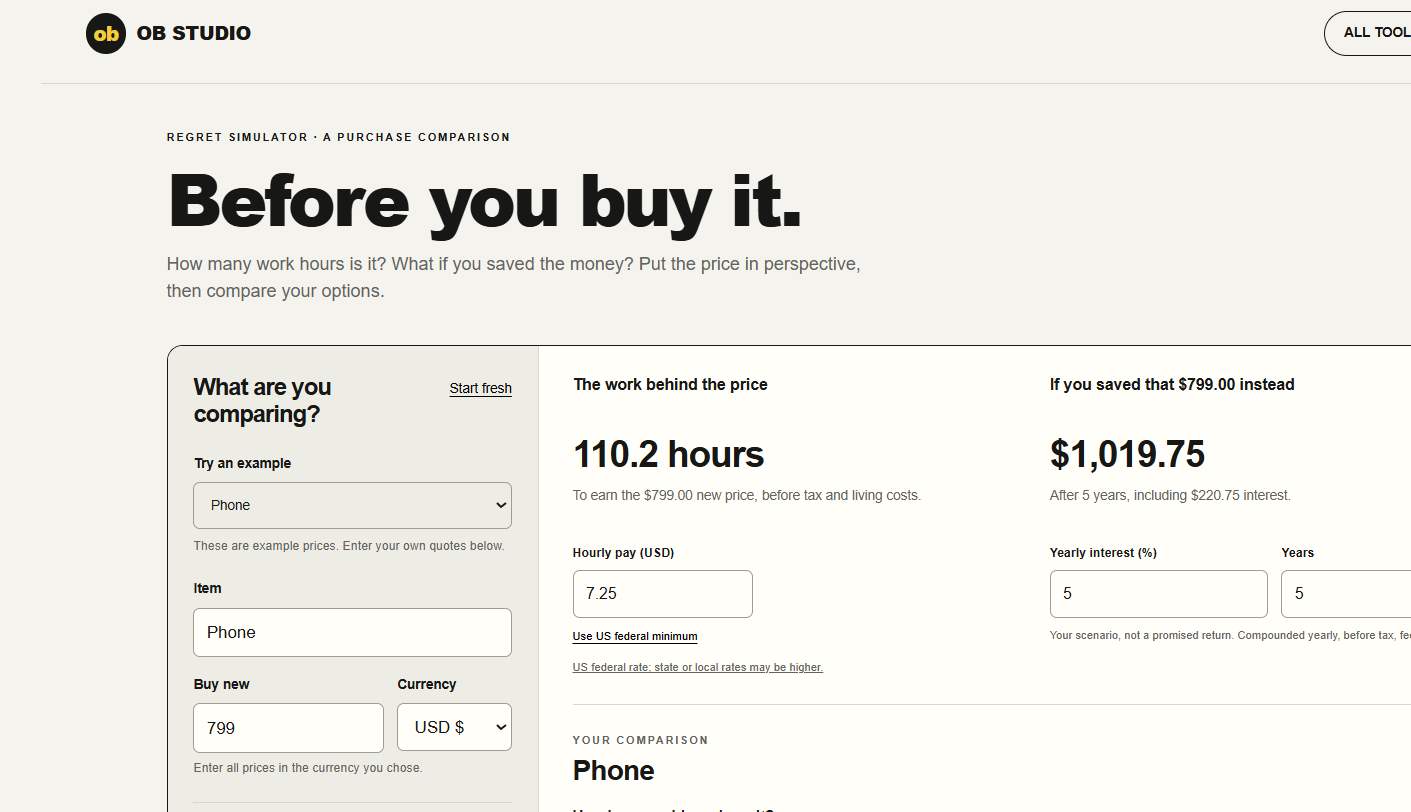
Regret Simulator puts a purchase in perspective. Enter a price and it shows how many hours you would need to work to earn it, using an hourly wage you can change. It also shows a hypothetical compound-interest scenario if you saved that money. You can compare buying new, buying used, repairing, and renting or borrowing over different lengths of time. The numbers help you decide; the app doesn’t claim to know whether you’ll regret a purchase.
How we built it
I built it with HTML, CSS, and JavaScript, with help from OpenAI Codex. The calculations live in a separate JavaScript file so they can be tested. Everything runs in the browser, and the site is hosted as static files on OB Studio. The app itself doesn’t use an AI API.
Challenges we ran into
The first version asked too many questions. Counting how often someone uses a phone, for example, made the tool harder to use without making the answer better. I simplified the comparison and kept rental frequency only where it makes sense. I also fixed large prices that appeared to do nothing, and made sure the savings figure is clearly described as a scenario rather than a guaranteed return.
Accomplishments that we're proud of
I’m proud that the result is understandable without a long setup. The phone example shows work hours and potential savings right away. The camera example shows something more surprising: renting can cost less for six months, while buying used can cost less over a year. You can also save a comparison or share its inputs with a link.
What we learned
I learned that showing clear assumptions is more useful than inventing a “regret score.” A calculation can show the difference in cost, but it can’t know how much convenience, condition, or having an item now matters to someone. Making the tool simpler took more thought than adding more options.
What's next for Regret Simulator
I want to watch people try it with real purchases and improve anything they find confusing. I’d keep the personal tool free. A possible next step is a classroom version with budgeting and compound-interest exercises; I’d test that idea with teachers before charging for it.

Log in or sign up for Devpost to join the conversation.