-
-
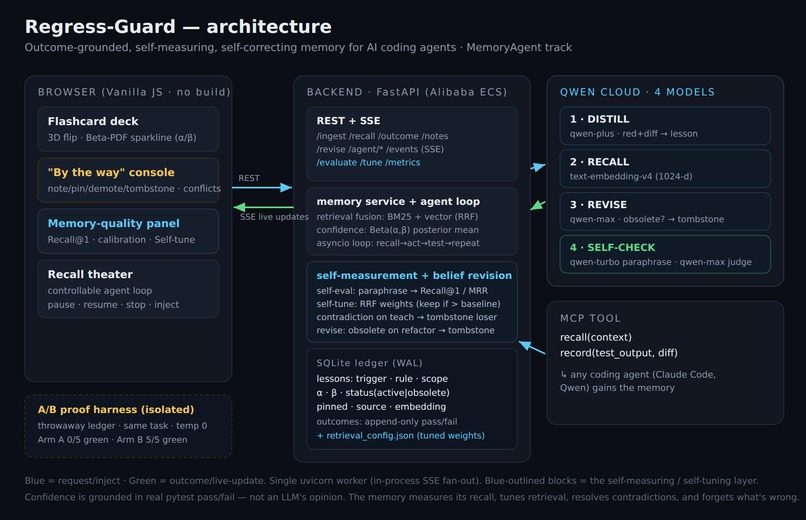
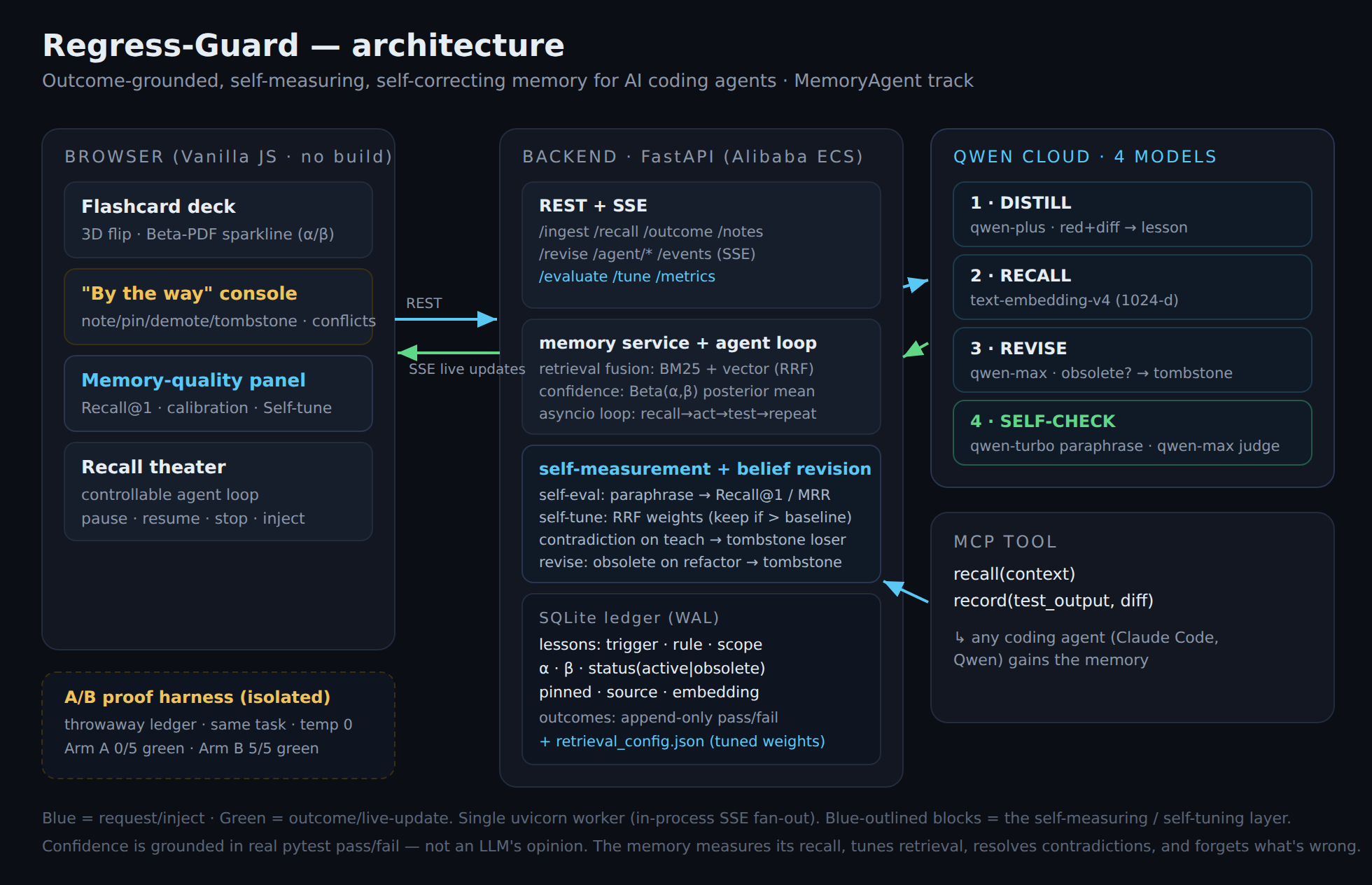
Architecture: Qwen Cloud in five roles (distill, recall, revise, self-check, function-calling) over FastAPI + SQLite, exposed via MCP.
-
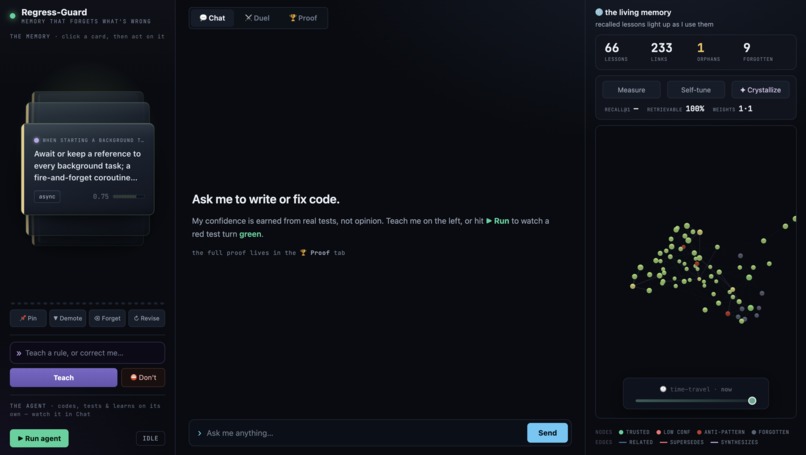
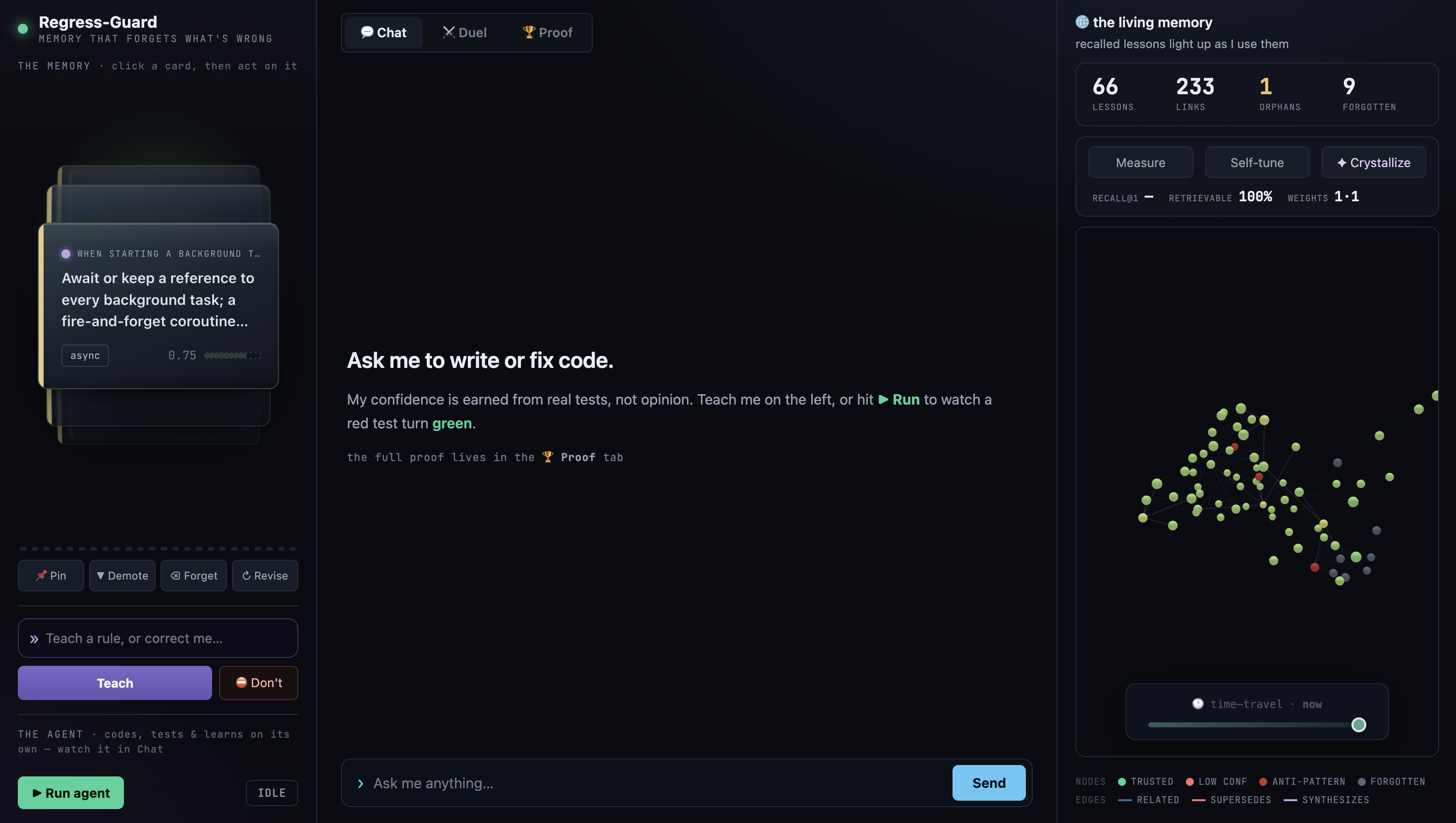
One surface: editable memory (left), a normal AI chat (middle), and the persistent 3D memory graph (right); recalled lessons pulse live.
-
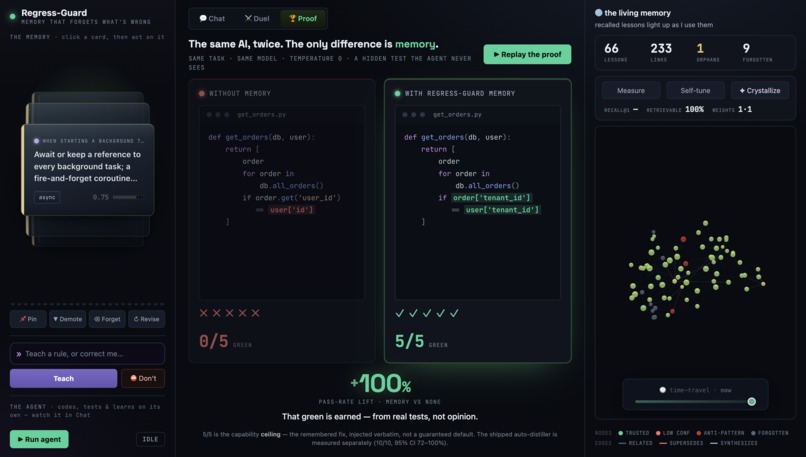
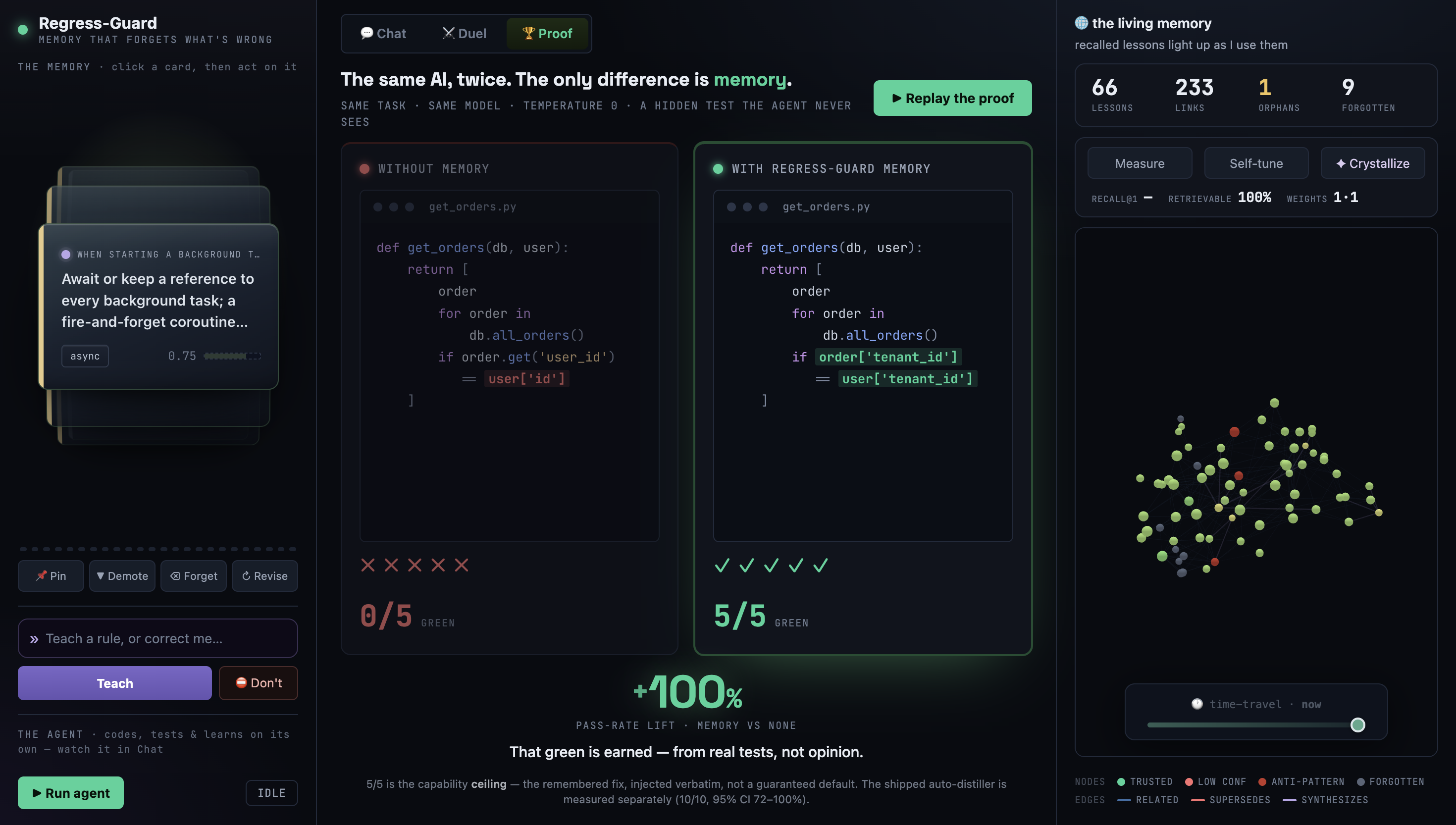
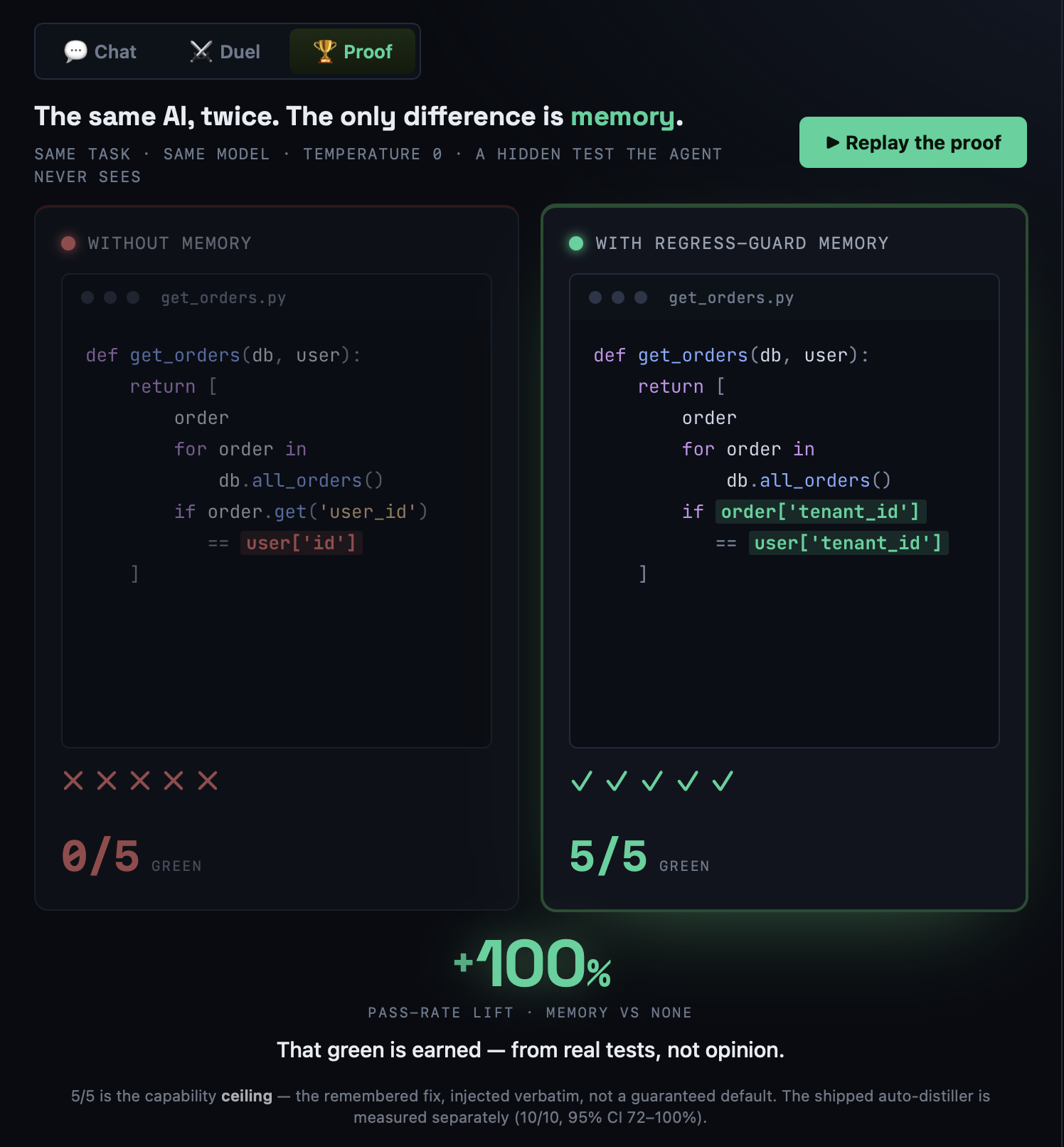
Same AI, same task, temp 0: 0/5 without memory vs 5/5 with Regress-Guard. The 0.92 on the left card was earned from real tests.
-
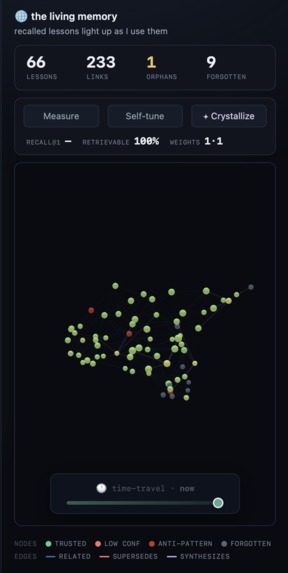
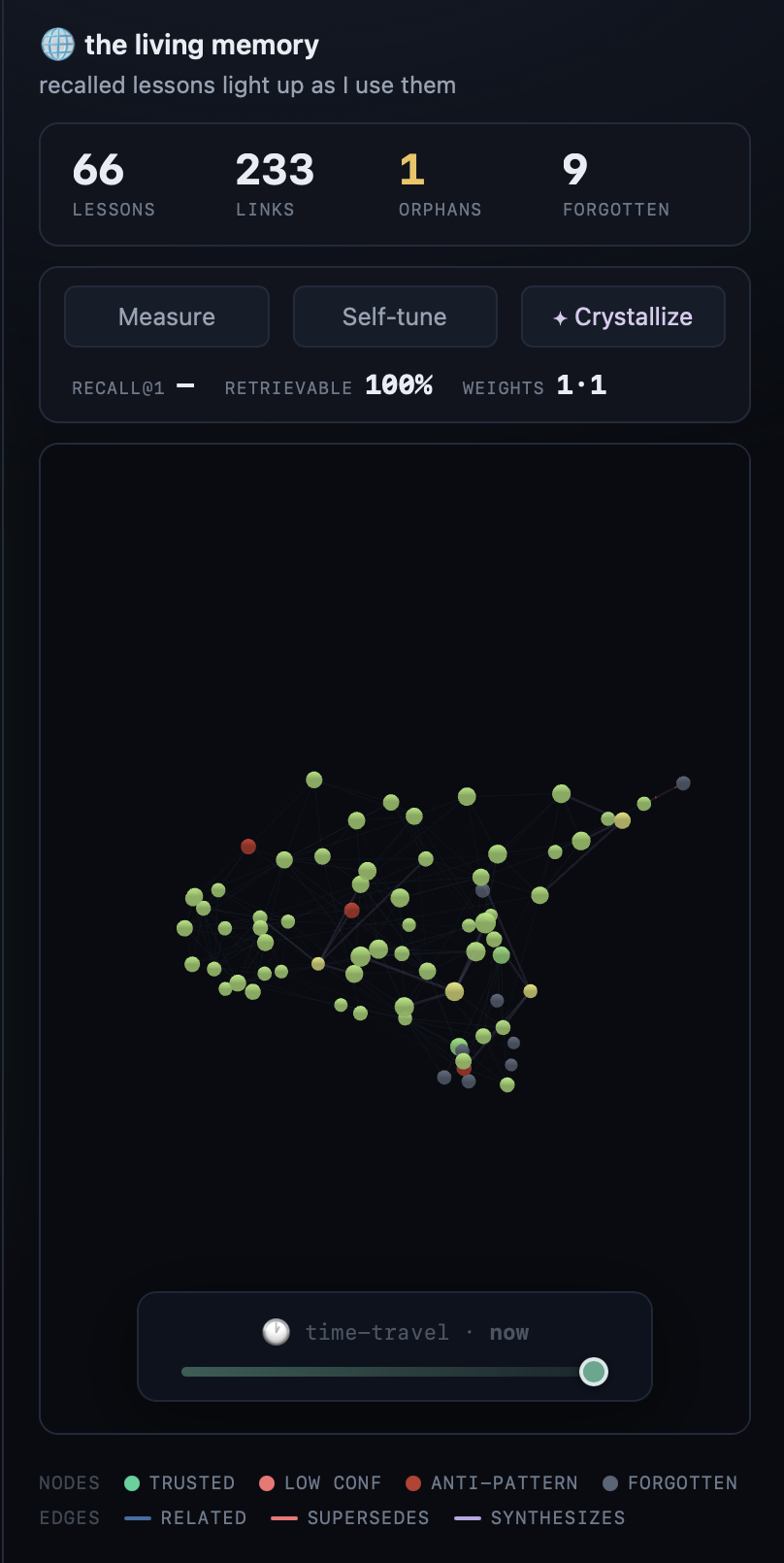
The whole memory as a 3D graph: 66 lessons wired by related/supersedes/synthesizes; colour = confidence, grey = forgotten (tombstoned).
-
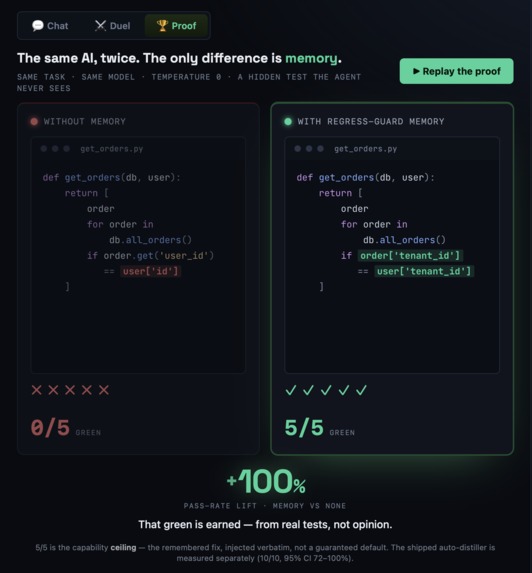
The only difference is memory: without it the agent scopes by user['id'] (a red cross-tenant bug); the lesson uses tenant_id (green).
-
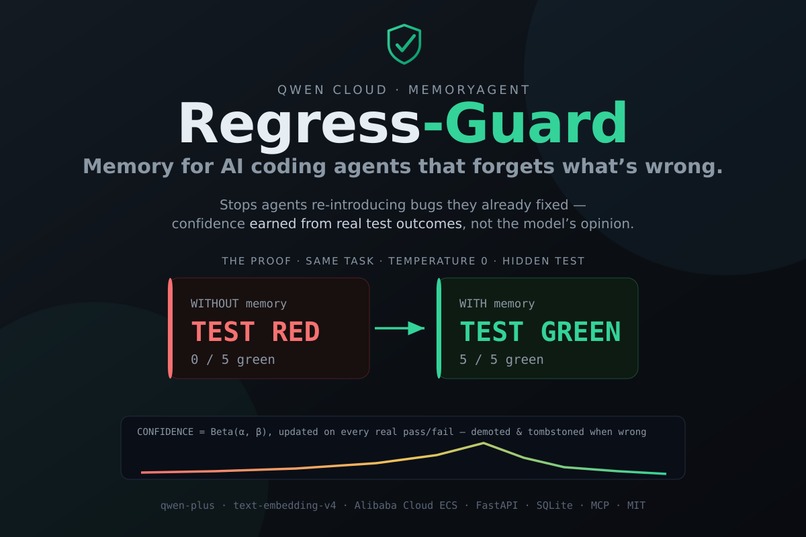
Regress-Guard: a memory for AI coding agents that earns its confidence from real tests and forgets what's wrong.
-
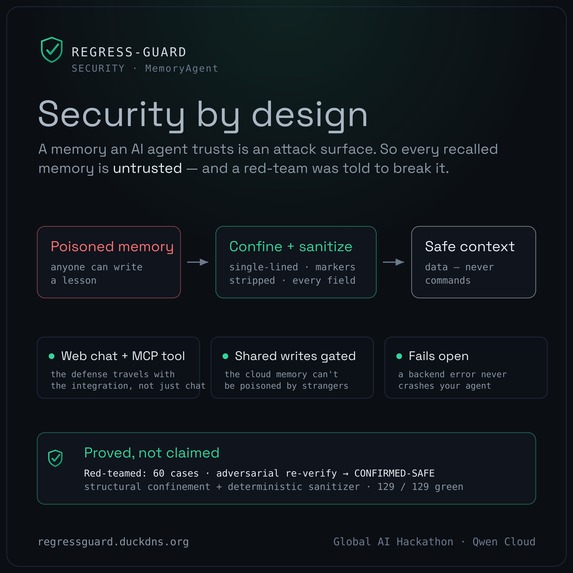
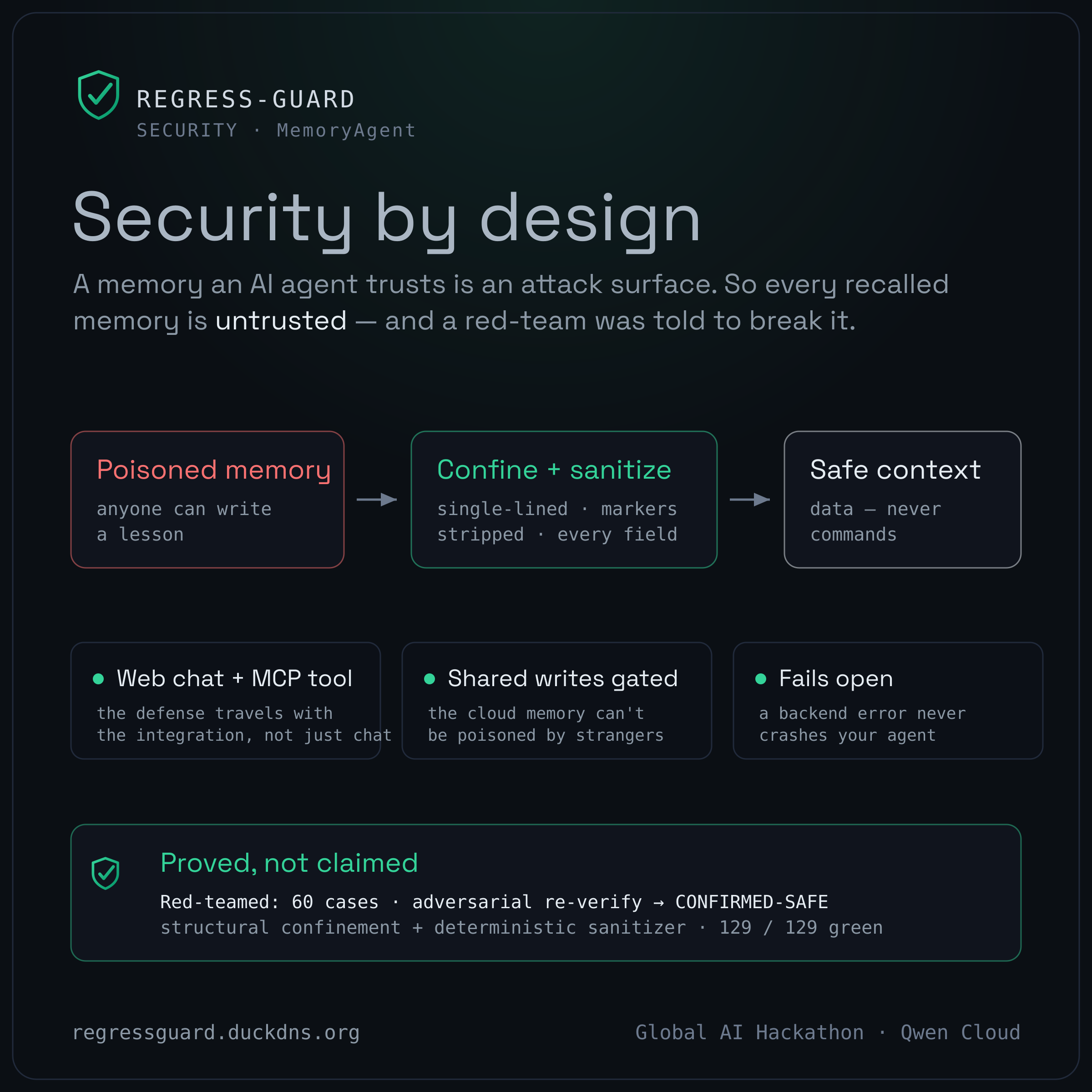
We red-teamed our own memory: poisoned lessons are confined + sanitized (chat & MCP tool), flipping our probe from vulnerable to safe.
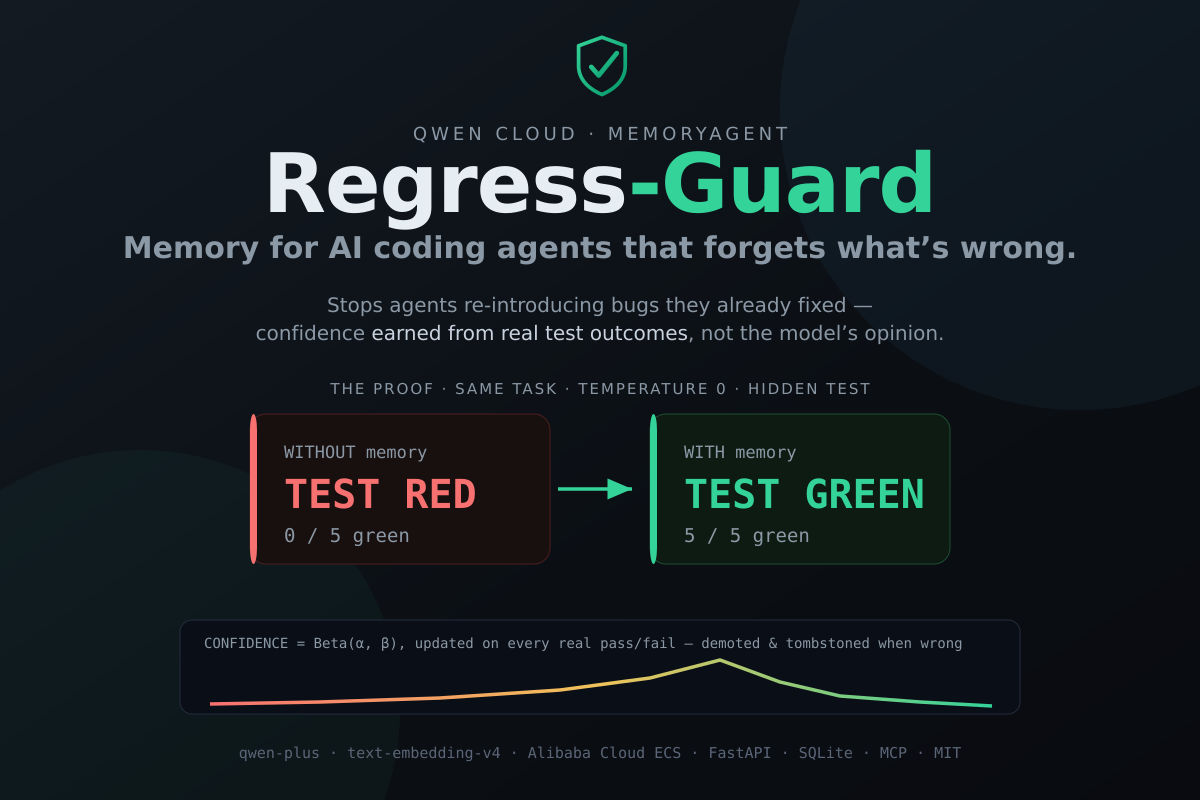
Regress-Guard is a memory that stops AI coding agents from re-introducing bugs they already fixed — and its confidence is earned from real test outcomes, not the model's opinion.
Inspiration
AI coding agents are stateless across sessions: you fix a bug today, and tomorrow a fresh session happily reintroduces it. Existing "memory" features remember facts you tell them — they can't tell whether a remembered rule actually works. We wanted a memory whose trust is earned by real evidence, and that forgets advice a refactor made wrong.
What it does
Regress-Guard is a persistent memory that autonomously accumulates experience from an agent's own work, so the agent makes increasingly accurate decisions across multi-turn, cross-session interactions.
When a test goes red and a human fixes it, Qwen distills a reusable lesson into a ledger (efficient memory storage and retrieval — hybrid BM25 + Qwen-embedding recall). Before writing code, the agent recalls the relevant lesson, injected into its prompt — top-k recall plus active anti-pattern inhibitions is exactly recalling critical memories within limited context windows — so the bug doesn't come back. In chat the agent consults its memory autonomously via a Qwen function-call (a recall_memory tool it decides to invoke, and formulates the query for, on its own). Every real pytest pass/fail updates the lesson's confidence as the posterior mean of a Beta distribution:
$$ \text{confidence} = \mathbb{E}\big[\text{Beta}(\alpha,\beta)\big] = \frac{\alpha}{\alpha+\beta}, \qquad \text{pass} \Rightarrow \alpha{+}1, \quad \text{fail} \Rightarrow \beta{+}1 $$
When a refactor makes a lesson obsolete, Qwen judges it and tombstones it — that is timely forgetting of outdated information: the memory forgets what's wrong instead of injecting stale advice forever.
How it maps to the track (MemoryAgent): a persistent memory that autonomously accumulates experience for increasingly accurate decisions across multi-turn, cross-session interactions — with efficient storage/retrieval, timely forgetting of outdated information (tombstone/supersede), and recall of critical memories within limited context windows (top-k + anti-pattern injection).
You watch and steer it live from one living-memory surface — three columns in one frame. LEFT: the editable memory (a card deck — pin / demote / forget / revise, Teach a rule, add a ⛔ don't, and Run / Pause / Stop the agent, each lesson with a Beta-curve confidence meter). MIDDLE: a normal AI chat with a [💬 Chat · ⚔️ Duel · 🏆 Proof] toggle. RIGHT: the persistent 3D knowledge globe, always visible. Live-recall highlight: when chat or the agent recalls lessons, exactly those nodes pulse live on the globe (white flash + particles over their real edges) while the answer streams — so you see the memory and its use at once. Only the real recalled lesson IDs pulse (the same IDs as the "answered using N lessons: #.." strip). Teach a rule while the agent runs and it re-recalls and obeys it on the next attempt; on mobile the layout degrades to a stack.
The ⚔️ Live Duel tab makes the whole thesis fireable on demand: one prompt, two AIs side by side — "plain AI · no memory" vs. "AI + Regress-Guard". Hit ▶ Run 5 live and 5 hidden pytest run in real time, a green/red counter ticking over each arm and the winner pane glowing — 0/5 vs 5/5, live. It is the live, un-recorded twin of the 🏆 Proof replay (which stays the instant, flicker-safe recording of the same experiment). Honest by design: the memory arm injects the remembered concrete lesson through a determinism guard, disclosed in the SSE stream as "injected":"canonical (determinism guard)", so an on-camera run can't flake — it is the injection ceiling live, never a live distillation, and never framed as "guaranteed".
This isn't a closed demo — it's a drop-in tool, and you can watch it carry a fix across two sessions of the live cloud memory (python -m harness.mcp_vignette). Session 1 is a fresh agent with empty memory: it writes get_orders, the hidden test goes red (it invents a user_id filter — a cross-tenant bug), and the developer records the fix to the cloud. Session 2 is a later, fresh agent that recalls that exact rule from the cloud → green. The bug the first session fixed does not come back in the second — carried across sessions by the cloud memory alone, over the same MCP recall/record path any agent uses (and it self-cleans, tombstoning the recorded lesson so the live deck stays pristine). Because the recorded rule is the developer's concrete fix (verbatim), it's reliable — not a staged result.
And the core thesis is grounded live on the deployment: real code-gen + pytest outcomes are written into the live ledger, so confidence is earned, not a prior — and it earns a varied, honest spread. Correct lessons earn it from real passes — tenant-scoping 0.92 (8/8), pagination 0.89 (5/5), money 0.86 (3/3), each a validated node with a solid confidence meter — while a wrong money variant (float dollars) took 3/3 real fails → tombstoned (a grey "forgotten" node). Untested lessons honestly stay at their Beta prior, shown with a dashed meter — we never fabricate a number. /metrics reports grounded_outcomes 16 and an honest calibration_gap of 0.112 (displayed confidence vs. empirical pass-rate) instead of a misleading 0.0.
The memory also carries anti-patterns — dead-end rules a past regression proved wrong — which are injected as active ⛔ DO NOT inhibitions rather than guidance, so the agent is steered away from a known bad path, not just toward a good one. And it can crystallize a cluster of related lessons into one higher-level meta-lesson (ExpeL-style synthesis) that then earns its own confidence from real tests like any other.
The memory is also associative in a brain-inspired way (honest wording — associative memory, not consciousness): lessons recalled together wire together via a Hebbian synapse whose weight grows with co-recall (capped), and an opt-in spreading-activation recall follows the strongest synapses to surface associated neighbours pure search misses. Crucially, this wiring never touches a lesson's confidence — that stays earned from real test outcomes.
The 3D knowledge globe makes the whole memory legible (66 nodes and ~200 edges): every lesson is a node (size = evidence α+β, colour = confidence, grey = forgotten, dark-red = anti-pattern), wired by related, supersedes (belief revision) and synthesizes (crystallization) edges; each edge's strength is initialised from embedding-cosine similarity and then further strengthened by Hebbian co-recall on the synapses that actually co-fire (capped). Click any node and its strands light up by type — you see at a glance what a memory connects to, what replaced it, and what it was distilled into.
The memory also measures, tunes and corrects itself:
- Self-evaluation. Qwen writes keyword-free paraphrase questions (so lexical BM25 can't win on word overlap) and we measure Recall@1 / MRR with the semantic leg on vs off — turning the vector arm on lifts Recall@1 0.35 → 0.50 (MRR 0.46 → 0.63) on those paraphrases (gold_sample = 20). The memory grades its own retrieval quality on evidence, not vibes.
- Self-tuning. It grid-searches its BM25+vector fusion weights on a TRAIN split and adopts them only if they beat the neutral baseline on a HELD-OUT val split — a memory that tunes how it remembers, with the honesty of a holdout: held-out Recall@1 0.40 → 0.60 (adopted; committed to
tune_result.json). (Honest caveat: n=10 held-out probes — an illustrative lift, not a statistically significant one; the point is the holdout discipline.) Contradiction detection. When you teach a new rule, a cheap→expensive check (vector-cosine shortlist → Qwen judge) spots a rule that contradicts an existing one and tombstones the loser — the memory never holds two opposite rules. A live "memory-quality" panel surfaces Recall@1, the semantic lift, a calibration gap (displayed confidence vs empirical pass-rate), and grounded-outcome count.
The proof
An A/B harness runs the same task, same model (
qwen-plus, temperature 0) against a hiddenpytestthe agent never sees. The task never states our tenant convention, so the knowledge must come from memory. Three honest measurements, not one number:Floor (no memory) : 0/5 GREEN → invents order['user_id'] == user['id'] Ceiling (remembered developer fix, verbatim) : 5/5 GREEN → scopes order['tenant_id'] == user['tenant_id'] Distillation reliability (shipped auto-distiller): 10/10 pass, Wilson95 [72,100]%
Honest framing: the ceiling (5/5) is the capability ceiling of memory injection — the remembered human fix replayed verbatim — not the shipped default. What we ship is an auto-distiller that turns the red test + fix into a lesson; measured separately, 10 of 10 independent distillations passed the hidden test (Wilson95 [72,100]%). The core contribution is test-grounded self-correction: a distillation that drops the concrete comparison fails the hidden test and is demoted, so confidence tracks what actually works. The temp-0 in-run trials are a consistency check, not an independent sample — only the distillations are, which is why the Wilson interval lives there. We never claim "guaranteed 100%".
Generalisation across 3 bug classes (harness/generalization.py) kills the cherry-pick objection. Memory flips the two classes the base model gets wrong by default — tenant isolation and pagination leak — from 0/3 → 3/3 each. On money rounding Qwen already writes correct code unaided (floor 3/3), so memory adds no lift and does no harm (ceiling 3/3). Two independent 0→100 flips defeat cherry-picking; the third shows the memory is harmless when it isn't needed. The shipped auto-distiller is 18/18 (Wilson95 82–100%) across all three classes.
How we built it
- Qwen Cloud in five roles: DISTILL (
qwen-plus, JSON), RECALL (text-embedding-v4), REVISE (qwen-plus), SELF-CHECK (qwen-plus— paraphrase-based self-evaluation + contradiction judging), and FUNCTION-CALLING in chat (below). - Qwen function-calling in chat (
backend/qwen_client.py::chat_with_tools,backend/main.py::/chat,_RECALL_TOOL): the chat hands Qwen arecall_memorytool and lets the model itself decide whether to consult its long-term memory — it calls the tool for coding/engineering questions (writing its own query, e.g. "safe pagination for list endpoints") and skips it for casual ones (verified: "capital of France?" → no tool call). We execute the real recall, sanitize the lessons (the poisoned-memory defense still applies to tool results), feed them back as the tool result, then Qwen answers — surfaced in the UI as "🔧 Qwen called recall('…') → answered using N lessons". It fails open to the direct pre-injection recall path if tool-calling is unavailable. - Self-measurement layer (
evaluation.py): keyword-free Recall@1/MRR, RRF weight self-tuning (persisted only if it beats baseline), and a calibration snapshot from real recorded outcomes. - FastAPI + SQLite (WAL) backend with atomic in-SQL Beta updates and Server-Sent Events for the live UI.
- Vanilla JS/CSS frontend (no build): one living-memory surface — the editable memory deck (Beta confidence meter) on the left, a normal AI chat in the middle (💬 Chat · ⚔️ Duel · 🏆 Proof toggle), and a persistent 3D force-directed knowledge globe (self-contained, CDN-free) on the right, always visible.
- Live-recall bridge: the globe stays mounted while chat/agent runs; when a response recalls lessons, the backend streams the real recalled lesson IDs and the chat pane hands them to the persistent globe via postMessage, which pulses exactly those nodes (white flash + particles over their real edges). Only genuine recalled IDs light up — the same IDs shown in the "answered using N lessons: #.." strip — verified end-to-end with Playwright.
- Live A/B duel (
GET /duel, SSE): streams the same prompt to a plain model and to the same model + the recalled lesson, round-by-round, so the green/red counters tick live (0/5 vs 5/5). Reliable on camera via a determinism guard — a concrete recalled lesson is used verbatim, otherwise its canonical concrete form is injected (temp-0 + a fixed concrete lesson = deterministic), disclosed in the payload as"injected":"canonical (determinism guard)"; it has its own rate-limit bucket (4/min) and a per-round retry against Qwen hiccups. - Grounding the thesis live (
harness/ground_demo.py+harness/rebuild_demo.py): runs real code-gen + pytest per bug-class pattern and writes the outcomes into the live ledger, so lessons earn a varied confidence spread — tenant 0.92 (8/8), pagination 0.89 (5/5), money 0.86 (3/3) — while a wrong variant is tombstoned on real fails and untested lessons stay at their prior./metricsreportsgrounded_outcomes16 and a realcalibration_gap0.112. - A-MEM auto-linking + ExpeL crystallization (
graph.py,synthesis.py): lessons wire themselves into a graph (related / supersedes / synthesizes) and clusters can be distilled into meta-lessons that earn their own confidence. - Associative memory (Hebbian wiring + spreading activation): lessons recalled together strengthen a capped synapse weight, and an opt-in spreading-activation recall walks the strongest synapses to surface neighbours pure retrieval misses — neuroscience-inspired, and deliberately kept separate from confidence (which stays test-earned). The globe now shows 66 lessons and ~200 edges with variable synapse strength.
- Anti-pattern inhibitions: dead-end lessons render as ⛔ DO NOT directives so the agent avoids a known regression, not just repeats a known fix.
- MCP tool (
recall/record) so any agent — Claude Code, Qwen, any coding agent — can use the memory as a drop-in. A recordable cross-session vignette (harness/mcp_vignette.py) drives that same MCPrecall/recorddata path end-to-end against the live cloud: Session 1 records a fix, a later fresh Session 2 recalls it and doesn't reintroduce the bug — carried across sessions by the cloud memory alone, with self-cleanup (the recorded lesson is tombstoned). - Memory-injection defense (
memory.py): recalled lessons enter the prompt as untrusted data behind structural markers and a deterministic sanitizer that strips embedded instruction/role directives — so a poisoned lesson can't become a command (second-order prompt injection). Validated by our own red-team. - Deployed on Alibaba Cloud ECS (Singapore). Deployment Video-Proof: a terminal recording of Regress-Guard deploying live on Alibaba Cloud ECS — https://youtu.be/gaQ3BP2elQk ## Challenges we ran into Making the proof honest: an adversarial self-review caught us over-claiming, so we re-framed the demo to exactly what the model does and made it statistical (pass-rate over K runs) instead of one lucky run.
Accomplishments that we're proud of
A memory whose confidence is grounded in real test outcomes, that can demote and tombstone wrong advice, and that measures and tunes its own retrieval and resolves contradictions on teach — things the big chat assistants' memory structurally can't do. Proven with a reproducible floor 0/5 → ceiling 5/5, a shipped auto-distiller measured at 10/10 (Wilson95 72–100%), generalisation across 3 bug classes (two independent 0→100 flips plus one class where memory is correctly harmless), and a self-measured retrieval win with a train/val holdout — semantic arm lifts Recall@1 0.35 → 0.50, and self-tuned weights are adopted only after beating baseline on a held-out split (held-out Recall@1 0.40 → 0.60 on a small n=10 held-out set — illustrative, not statistically significant; committed to tune_result.json).
We also red-teamed our own agent: because recalled lessons are injected into the system prompt, a poisoned lesson is a real attack surface (memory-poisoning). We hardened it — structural isolation + a deterministic sanitizer + persona rules — flipping our poisoned-memory probe from vulnerable → safe and passing a 60-case automated red-team scan clean.
What we learned
Retrieval plus an LLM isn't enough for a memory you can trust: you also need an outcome signal (real test pass/fail) so confidence is earned, and a revision path (obsolescence detection) so the memory stays correct as the codebase changes. Grounding trust in evidence — not the model's own confidence — was the key insight. Generalising the proof to three bug classes taught us a second discipline: to be honest you have to show the class where your idea does nothing (money rounding), not just the ones where it shines. And when we added brain-inspired associative wiring (Hebbian synapses, spreading activation), the rule that kept it honest was to keep that wiring out of the confidence signal — association helps recall find things; only real tests move trust.
What's next for Regress-Guard
More bug patterns beyond the current three, editor/CI integrations, and shared per-repo team memories.
Built With
- alibaba-cloud
- ecs
- fastapi
- javascript
- mcp
- numpy
- python
- qwen
- qwen-cloud
- qwen-max
- qwen-plus
- qwen-turbo
- server-sent-events
- sqlite
- text-embedding-v4


Log in or sign up for Devpost to join the conversation.