-
-
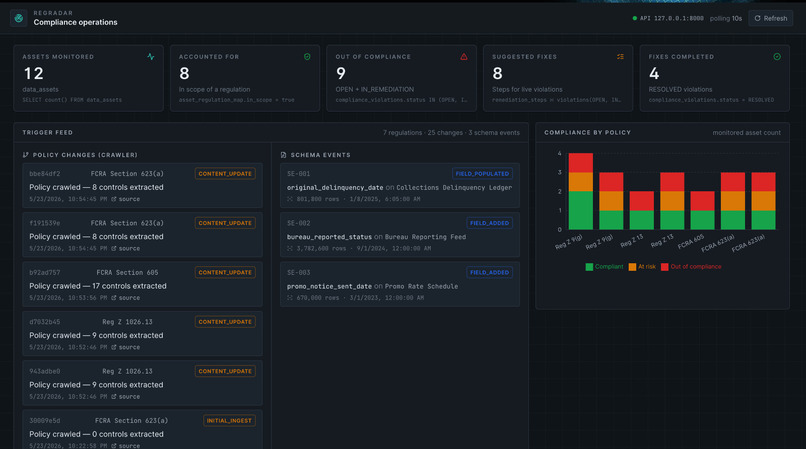
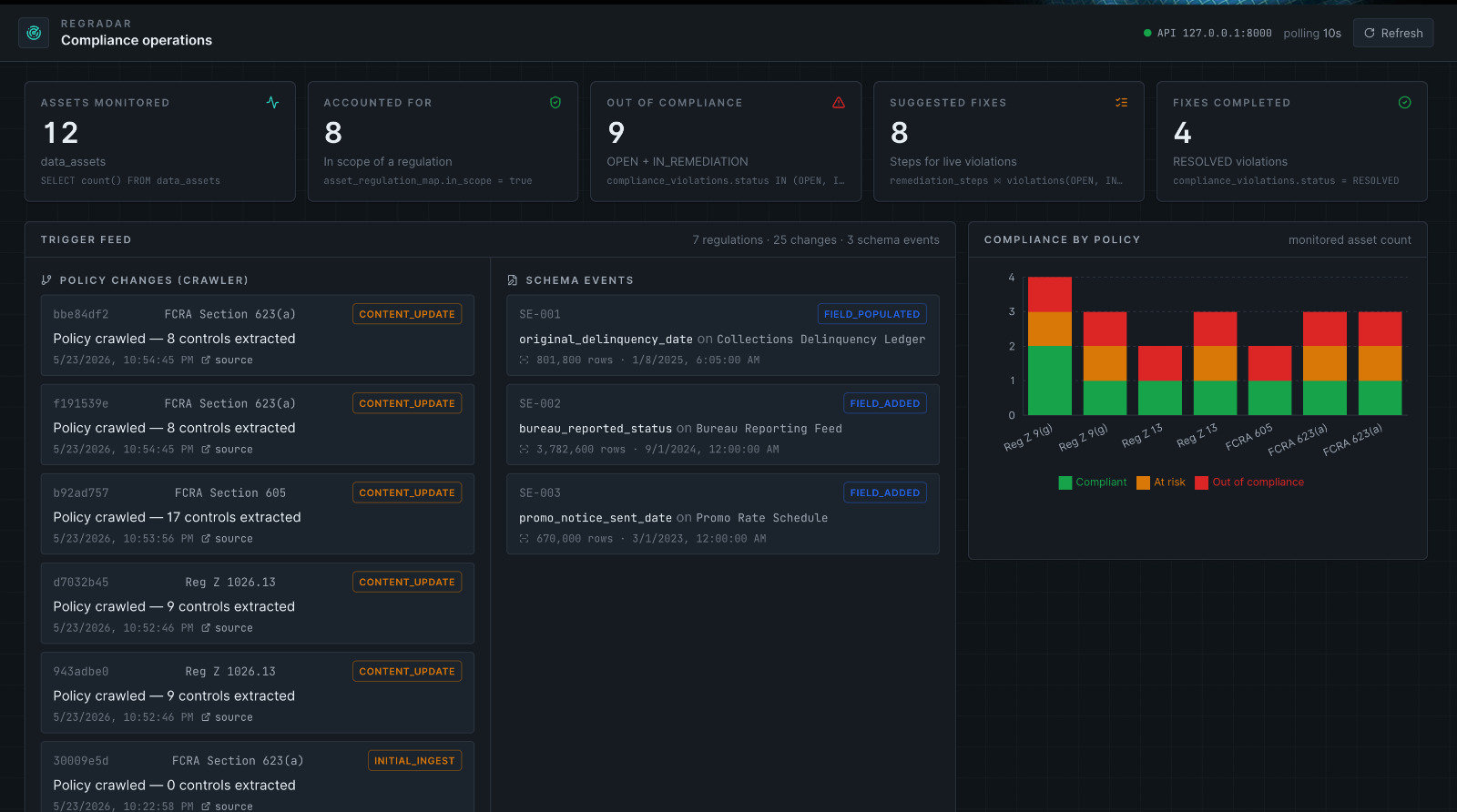
regRadar dashboard - showing violations
-
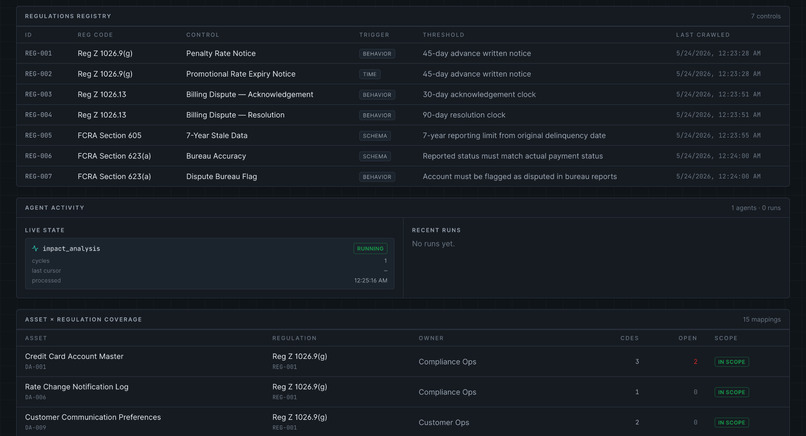
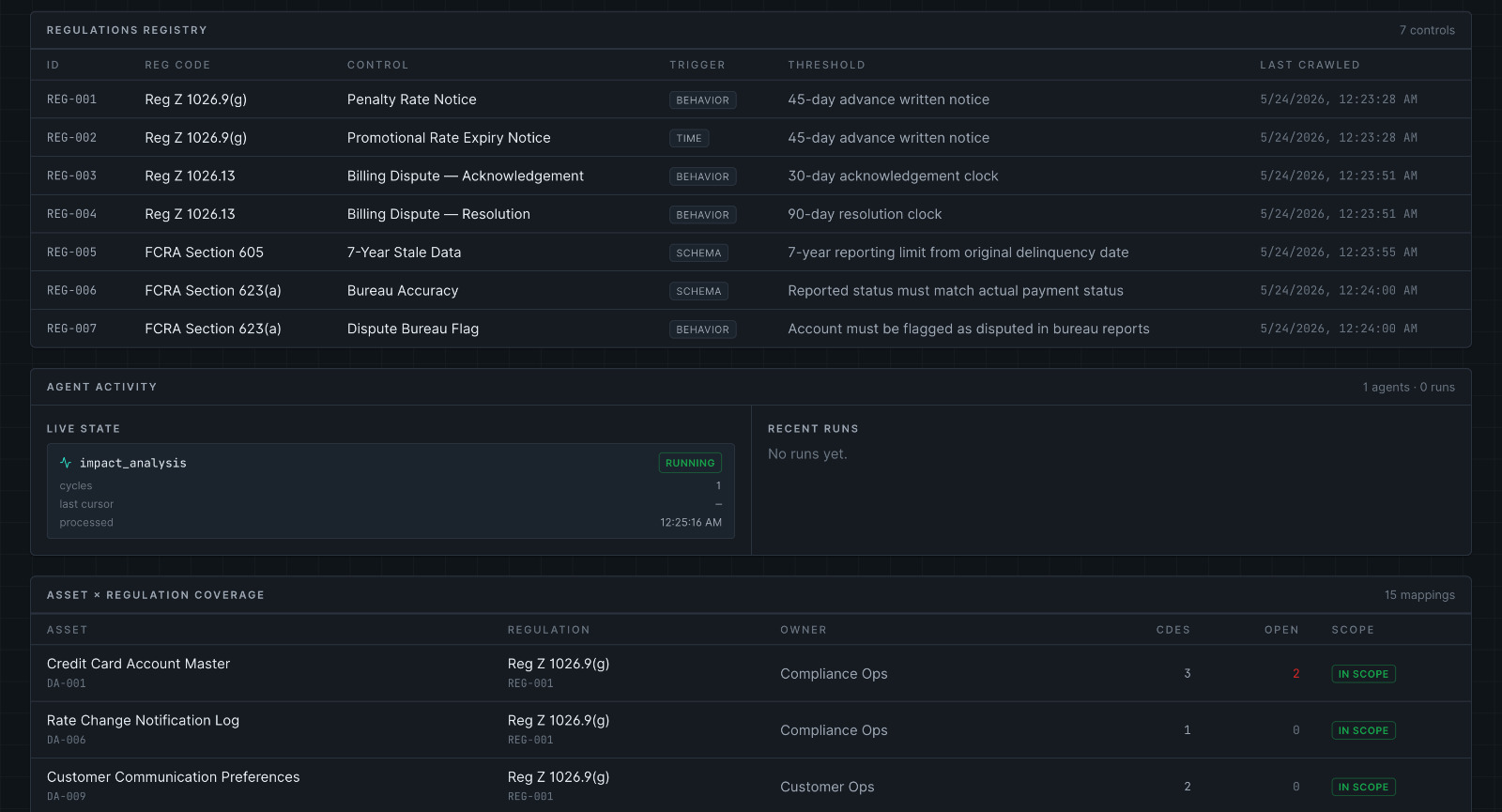
Regulations tracking and Agent Status
-
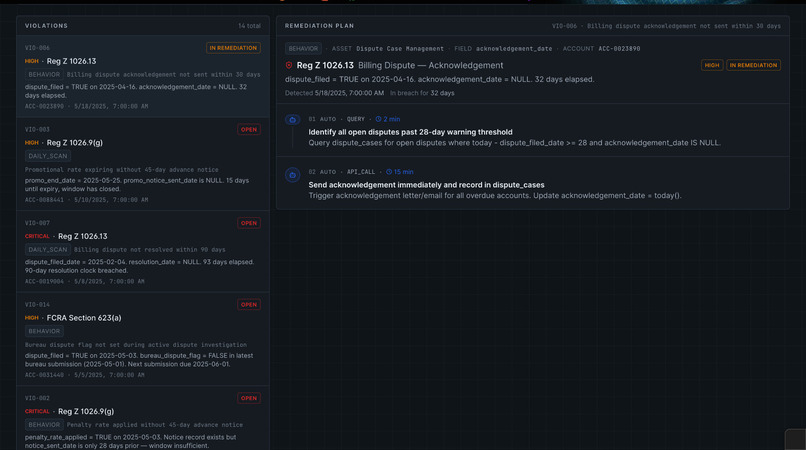
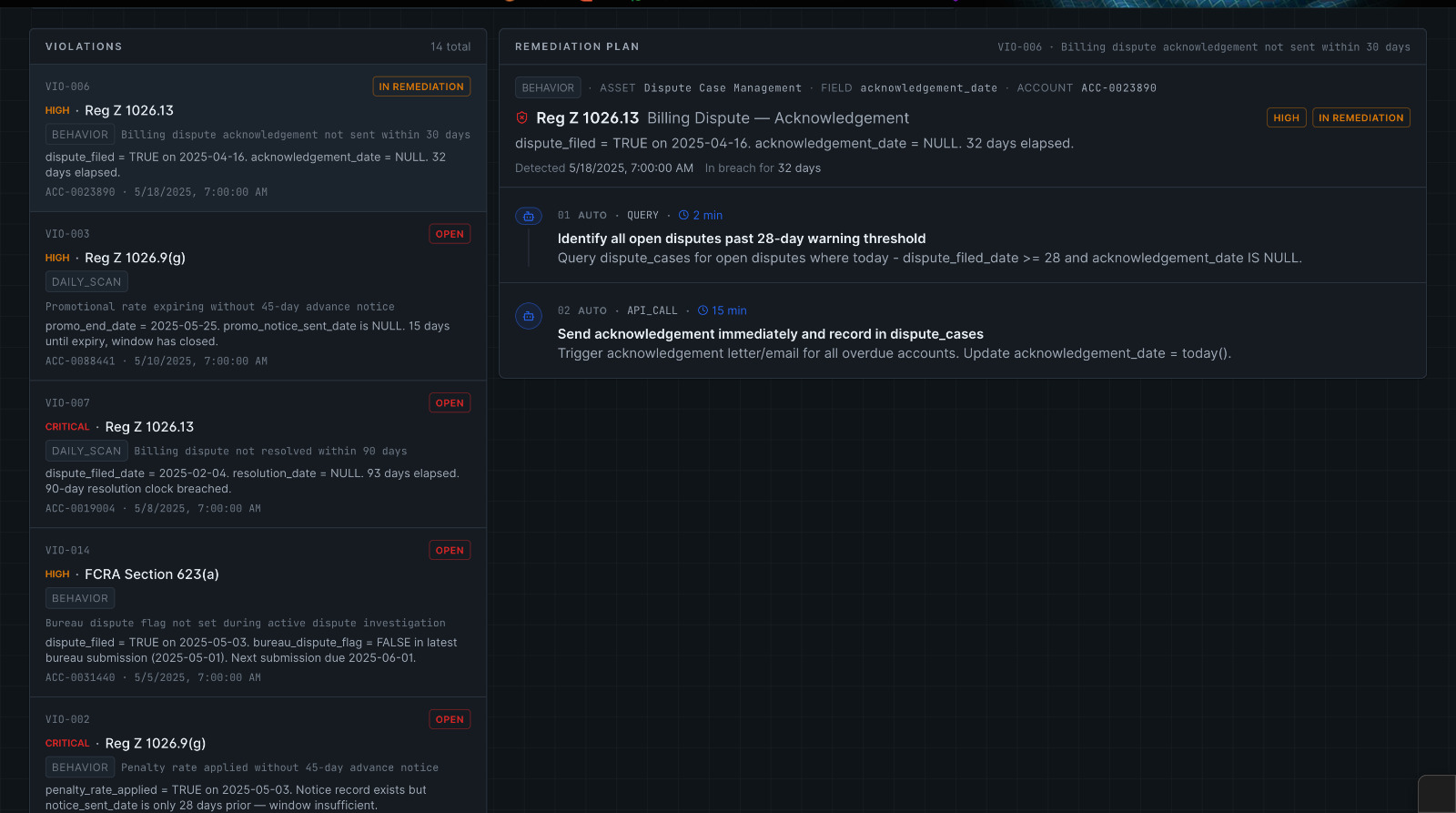
remediation plans and progress
-
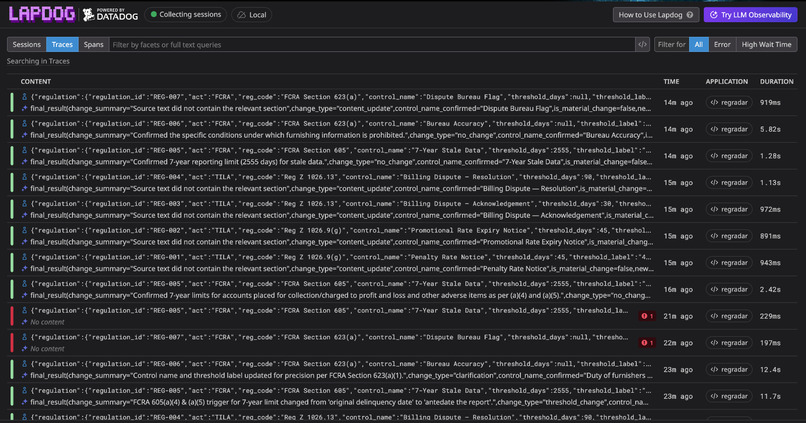
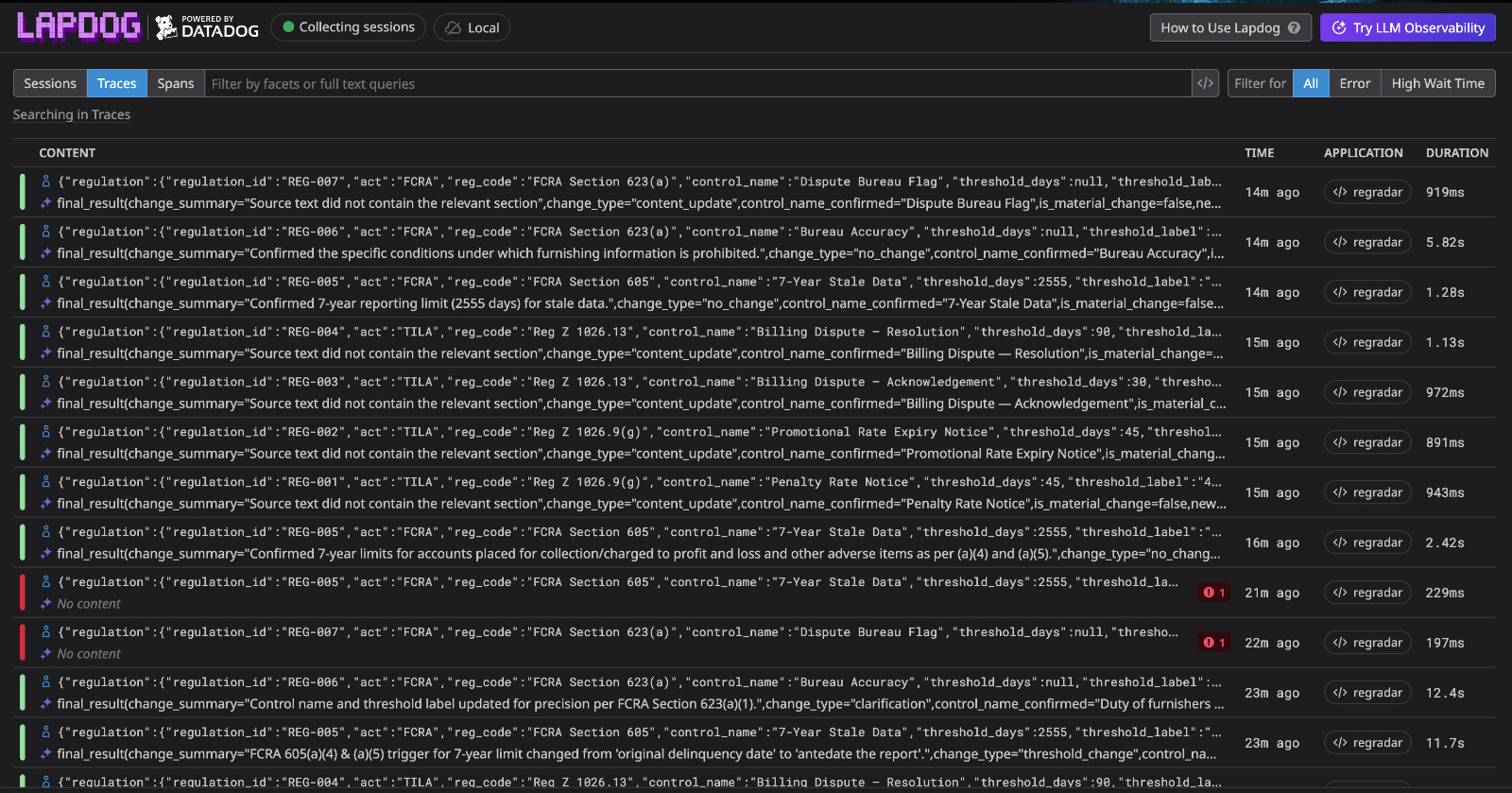
Lapdog traces
Inspiration
A major US bank paid $2M in fines for a compliance breach that was a single SQL query away from detection. The data existed in their own systems the entire time. Nobody was watching it. That gap — between data that exists and compliance that fails — is where RegRadar was born.
What it does
RegRadar is an agentic compliance monitoring system for credit card portfolios. It detects TILA and FCRA violations in real time across six regulatory controls — penalty rate notices, dispute resolution windows, promotional rate expiry, bureau accuracy, stale data reporting, and dispute flagging. Three agents work in parallel: a Policy Crawler that monitors federal regulatory sources hourly and extracts structured compliance conditions from regulation text, a Monitoring Agent that runs deterministic SQL scans across millions of accounts daily at zero LLM cost, and an Impact Analysis Agent that fires the moment a behavior event or data migration lands — catching violations at the second they're created, not years later when an examiner finds them. Detected violations are automatically matched to step-by-step remediation playbooks with human approval gates before any destructive action executes.
How we built it
ClickHouse as the core data store — portfolio data, compliance controls, audit trail, and embeddings all in one place. Four policy embeddings cover all six regulatory controls using DeepMind text-embedding-004. The Impact Analysis Agent uses Gemini 2.0 Flash with function calling for exactly one LLM call per event — to classify what changed, map a new field to relevant regulations, or scope affected accounts. Everything after that call is deterministic SQL. The Monitoring Agent runs entirely without LLM calls. Nimble handles regulatory source ingestion. Datadog fires alerts when violation rates cross threshold. The key architectural decision was drawing a hard line between where AI reasoning applies — at the boundary between unstructured regulatory text and structured schema — and where it doesn't.
Challenges we ran into
Getting the LLM to extract precise, machine-executable compliance conditions from dense regulatory language without hallucinating thresholds or scope boundaries. Designing the schema enrichment trigger path — detecting when a previously NULL field gets backfilled and immediately re-scanning every account it affects, without CDC or Kafka, using only a polling-based schema events table. Balancing agent autonomy with auditability — every action the system takes needs to be defensible in a regulatory examination, which meant building the human approval gate into the remediation flow rather than treating it as optional.
Accomplishments that we're proud of
A single data migration backfilling one date field — original_delinquency_date — immediately surfaced violations that had been invisible for over 400 days. The system caught them within seconds of the migration completing. That's the core promise of RegRadar working exactly as designed. We also kept the LLM footprint intentionally minimal — six regulatory controls, four embeddings, one LLM call per event. The Monitoring Agent runs daily across millions of accounts with zero API cost.
What we learned
Compliance failures are almost never a data problem — the data exists. They're a watching problem. The hardest part of building RegRadar wasn't the AI — it was designing the deterministic layer that runs at scale without LLM calls, because that's where 95% of the actual compliance checking happens. We also learned that schema enrichment is one of the most underappreciated compliance triggers in financial institutions. When a legacy migration backfills a field, it doesn't just add data — it retroactively changes what you're legally obligated to have caught.
What's next for RegRadar
Expanding the regulatory scope beyond TILA and FCRA to cover CARD Act, ECOA, and state-level credit regulations. Building out the full data lineage layer — mapping company-level data attributes across source systems, documenting data steward ownership for every critical data element, and surfacing which team is accountable when a field that drives a compliance obligation has a quality problem. Integrating data steward workflows so that when a new field is added or a population rate drops, the responsible owner is automatically notified and pulled into the remediation loop. The vision is a living compliance graph — every regulation, every data asset, every field, every owner, connected and monitored continuously.


Log in or sign up for Devpost to join the conversation.