-
-
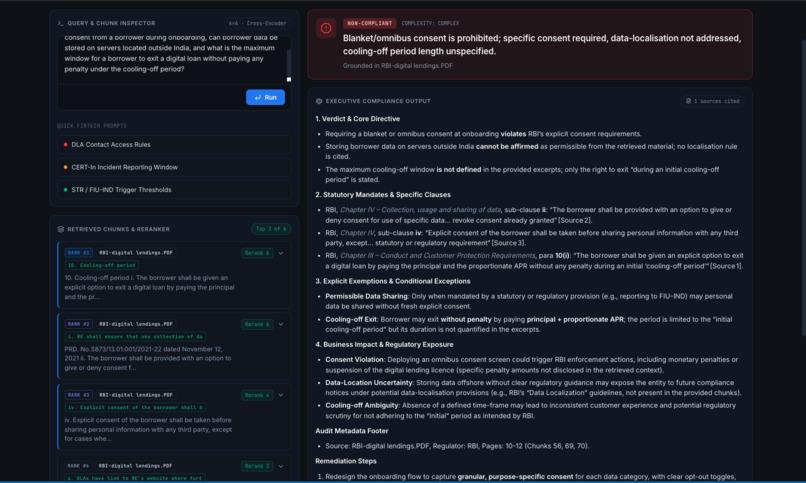
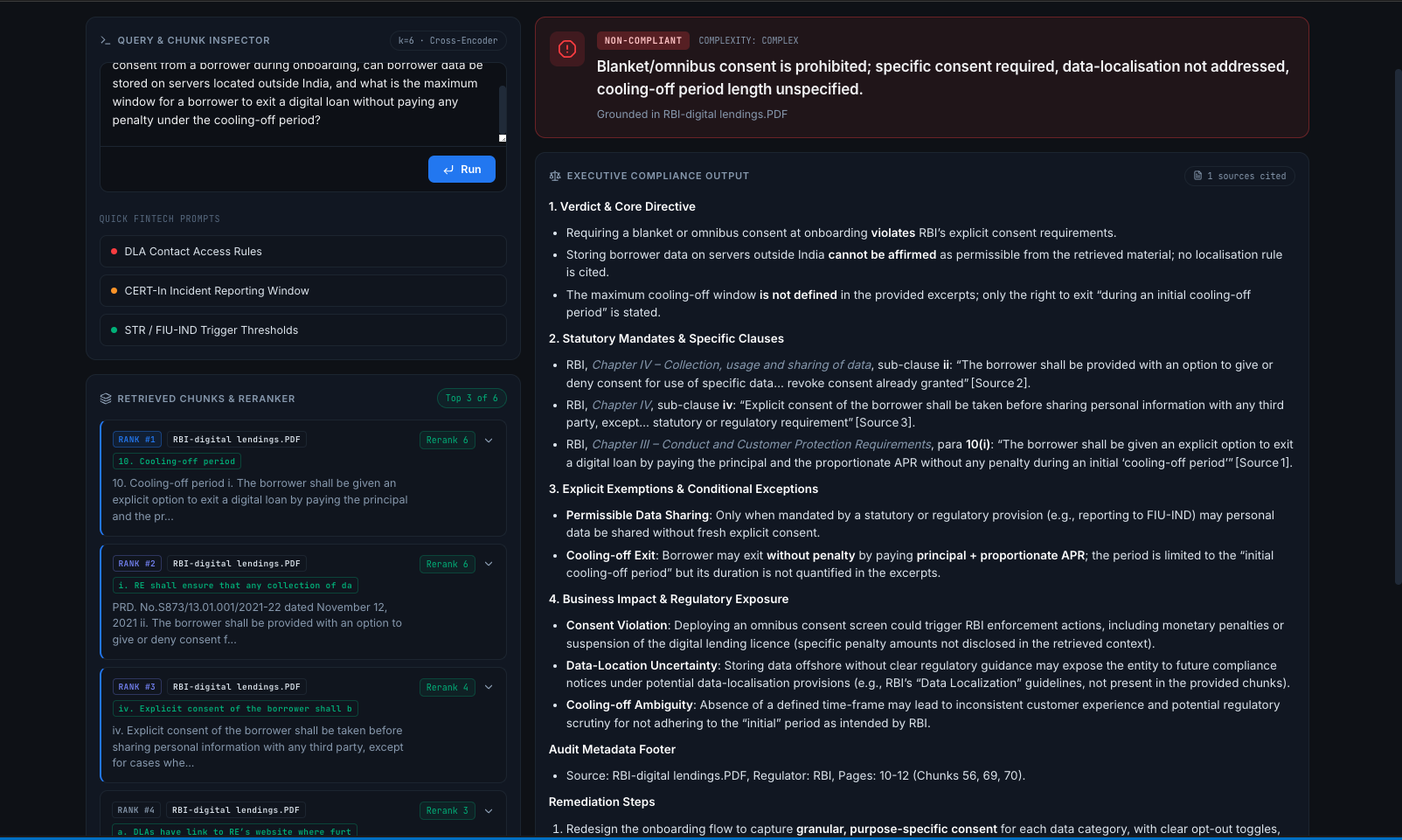
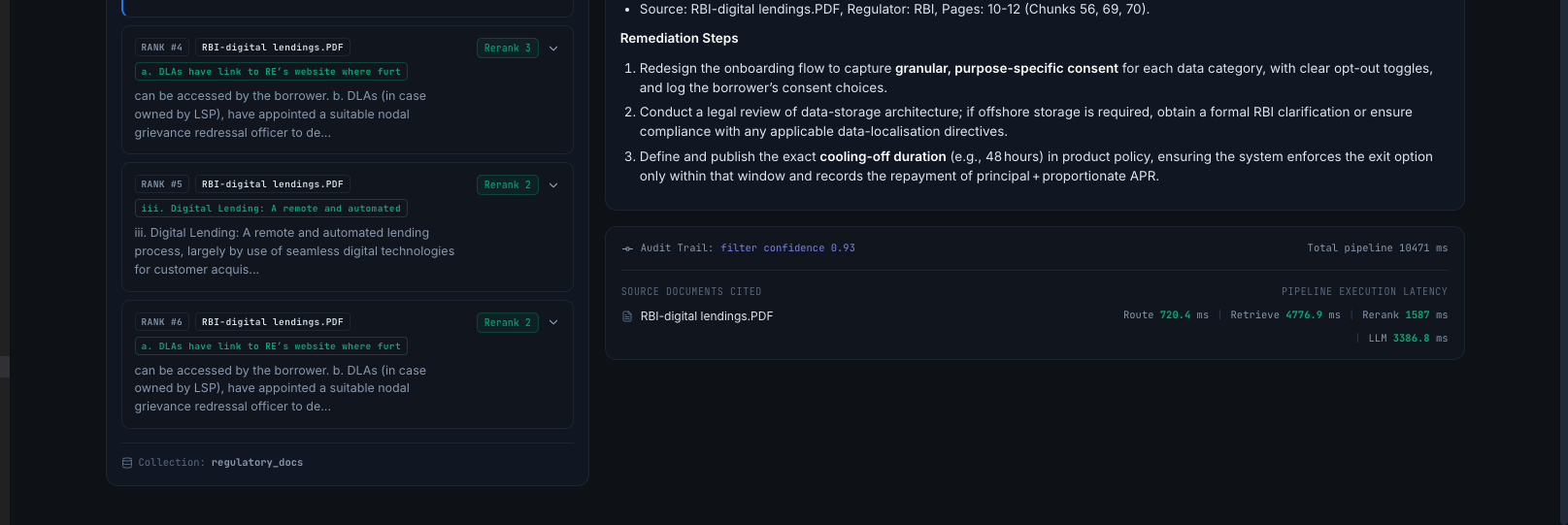
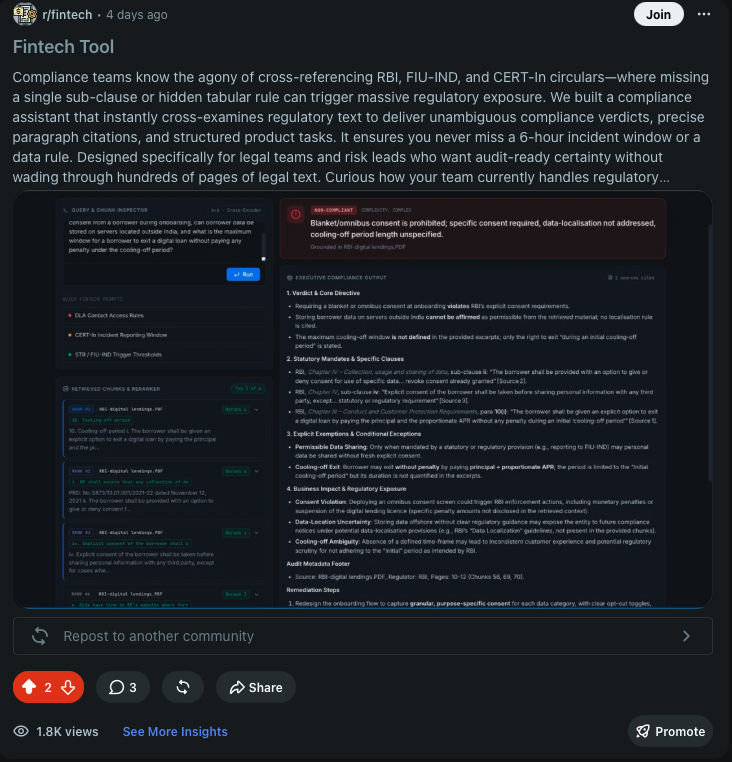
The preview of the app UI
-
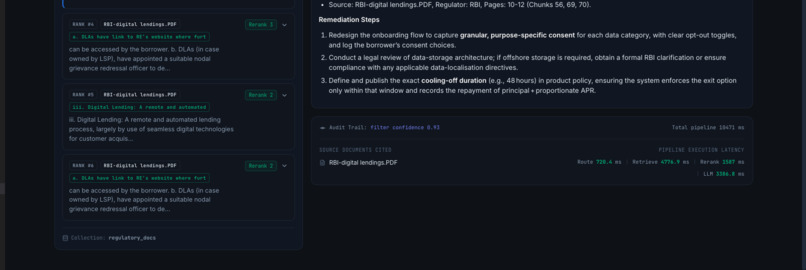
Each retrieval shows how long it took , what were the top ranked chunks with document names as well.
-
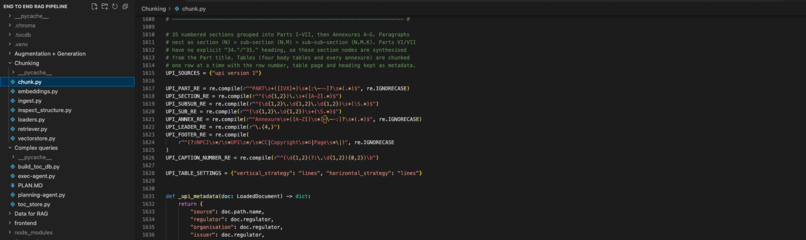
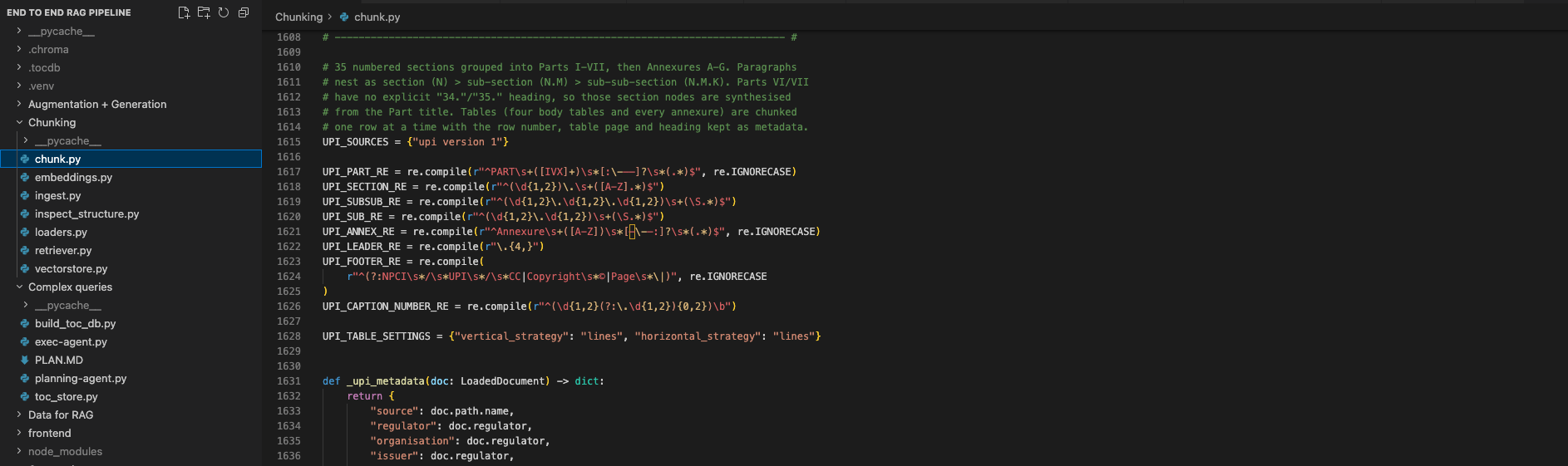
Chunking strategy was different for each doc based on its structure - Adaptive Chunking
-

people on reddit reacting to our product
-

user commenting on his views of our project
-
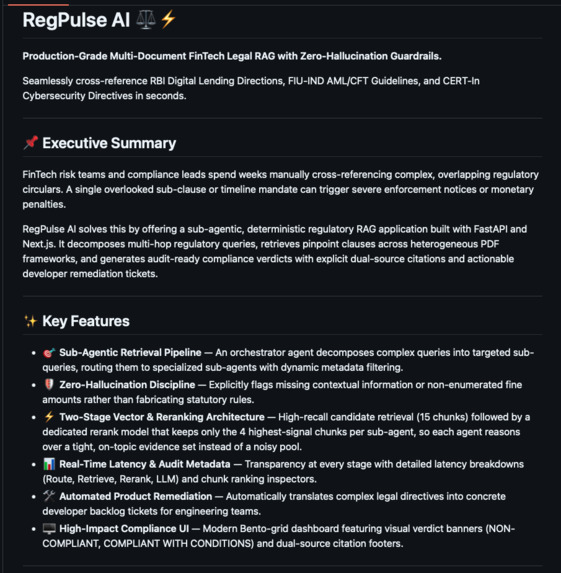
clean GitHub visuals.
-
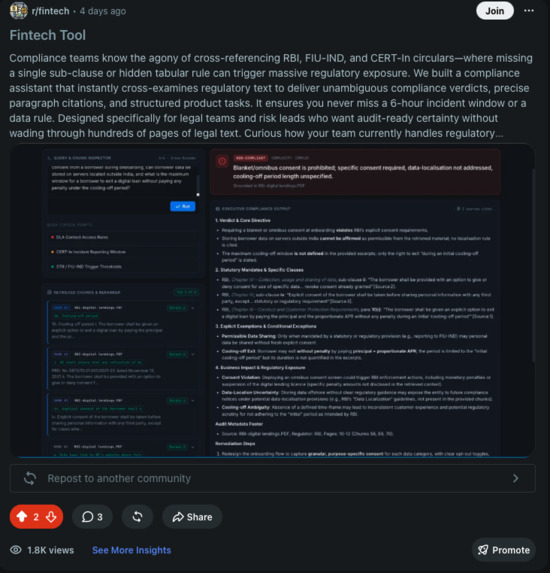
Our post on fintech communities hit 1.8k views with many people's DMs to me on the product


Inspiration
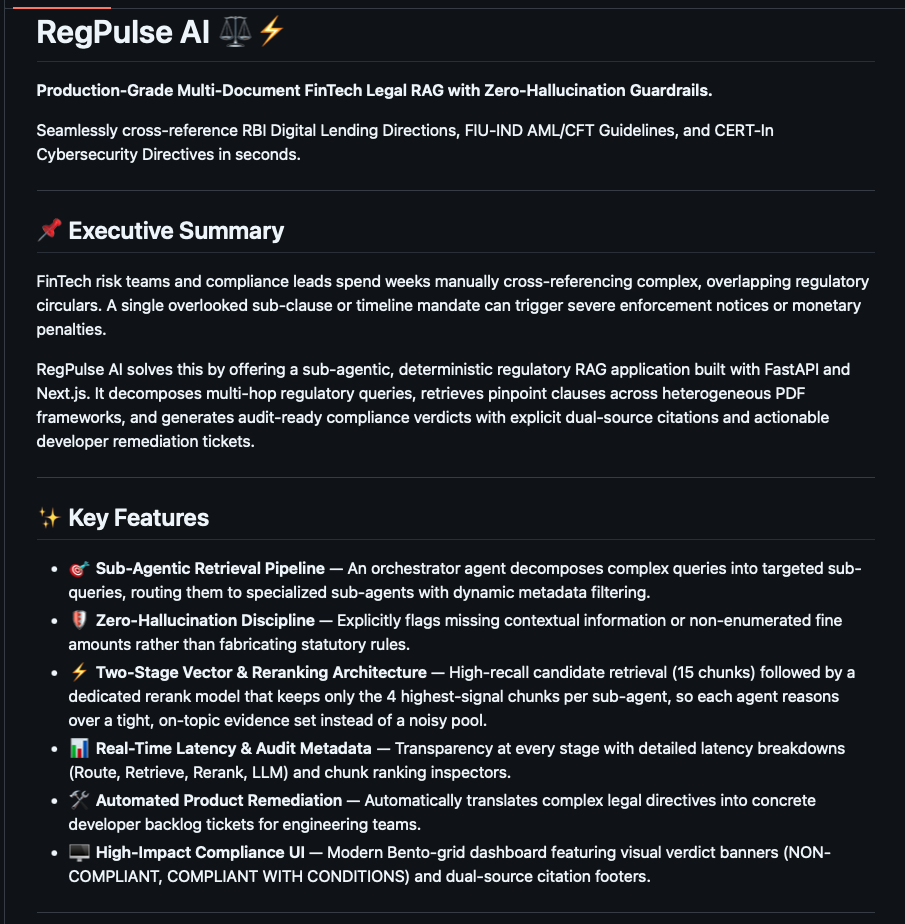
Scrolling through compliance, fintech, and risk management communities on Reddit (like r/fintech and r/SideProject), I constantly saw compliance officers and risk leads venting about the same nightmare: reading hundreds of pages across overlapping regulatory circulars (RBI Digital Lending, FIU-IND AML/CFT, CERT-In Cyber Directives) just to check if a product feature was compliant. A single missed sub-clause or timeline mandate could lead to devastating enforcement notices or regulatory fines. I realized existing search tools and generic LLM wrappers hallmarked far too easily and couldn't handle multi-document legal synthesis. I was inspired to build a deterministic, zero-hallucination regulatory RAG application that risk teams could actually trust with complex legal questions.
What it does
RegPulse AI is an enterprise-grade regulatory RAG application built with FastAPI and a minimalist React/Next.js frontend. It allows risk leads and compliance officers to query complex, cross-regulatory scenarios in plain English and receive: Instant Risk Verdicts: High-visibility visual risk flags (such as NON-COMPLIANT or COMPLIANT WITH CONDITIONS) for fast triage. Pinpoint Dual-Source Citations: Exact chapter, paragraph, and page-level statutory citations merged across multiple PDF frameworks simultaneously. Zero-Hallucination Discipline: Strict boundaries that explicitly call out when specific penalty details or timelines are absent from retrieved statutory chunks. Actionable Engineering Remediation: Automated translation of legal mandates into concrete technical tickets for product and development teams.
How we built it
As an AI engineer who knows how to write clean code, I designed the architecture myself while leveraging AI coding agents (Cursor and Claude Code) to accelerate core development: Sub-Agentic Architecture: Formulated an orchestrator agent that decomposes complex multi-hop user prompts into sub-queries targeted at specific regulatory topics or chapters. Two-Stage Retrieval Pipeline: Integrated dense vector retrieval alongside a Cross-Encoder reranker (K=20 candidate retrieval reranked down to top-5) to maximize precision. Backend & Frontend: Built a high-performance FastAPI backend coupled with a responsive Next.js frontend featuring Bento grid layouts, real-time pipeline latency metrics (Route, Retrieve, Rerank, LLM), and interactive chunk ranking inspectors.
Challenges we ran into
Handling Complex Multi-Document Queries: Queries spanning RBI, FIU-IND, and CERT-In simultaneously often suffered from semantic dilution in standard bi-encoders. We solved this by implementing a sub-agentic routing loop and dynamic metadata filtering. Balancing Context Depth & LLM Token Costs: Fetching dozens of heavy legal chunks caused context degradation and bloated API usage costs. We engineered an adaptive thresholding mechanism—applying strict metadata filters when sub-agent confidence was high, and falling back to broader retrieval (K=20) only when needed. Validating Against Real Users: Building in a vacuum wasn't an option. We actively engaged with compliance leads and Reddit risk communities while iterating on the UI, ensuring that visual alerts (like the red risk verdict banner) matched actual operational triage workflows.
Accomplishments that we're proud of
Achieved consistent 9.2 to 9.8/10 accuracy scores on complex multi-document edge-case test queries (e.g., cross-referencing RBI direct disbursement rules with FIU-IND CDD/Beneficial Ownership mandates). Implemented bulletproof zero-hallucination guardrails that reliably state "Not specified in retrieved sources" whenever context is missing, rather than fabricating legal rules. Engineered sub-second routing and sub-10s end-to-end multi-doc synthesis pipelines complete with transparent latency breakdowns on the UI.
What we learned
Building RegPulse AI proved that in high-stakes domains like FinTech compliance, UI hierarchy and deterministic trust are just as vital as retrieval accuracy. A compliance officer doesn't just want a block of text; they need an unambiguous risk verdict upfront, exact paragraph-level receipts, and actionable remediation steps. By combining disciplined sub-agent orchestration with clean visual feedback, we showed that AI can transform tedious regulatory research into instant, audit-ready confidence.
What's next for RegPulse AI
Automated Audit Report Generator: One-click PDF export functionality for compliance verdicts to streamline executive board reporting. GraphRAG Integration: Knowledge graph graph-topology expansion to dynamically map complex parent-subsidiary corporate structures against regulatory liabilities. Real-time Regulatory Webhooks: Automated scraping and chunking pipeline to ingest new RBI/FIU circulars the moment they are published. Inclusion of docs for organization specific rules as well to match organization product rules with the ones issued by the government to automate the full pipeline(note for this we need access to the docs of the company and communicate with compliance teams)


Log in or sign up for Devpost to join the conversation.