-
-
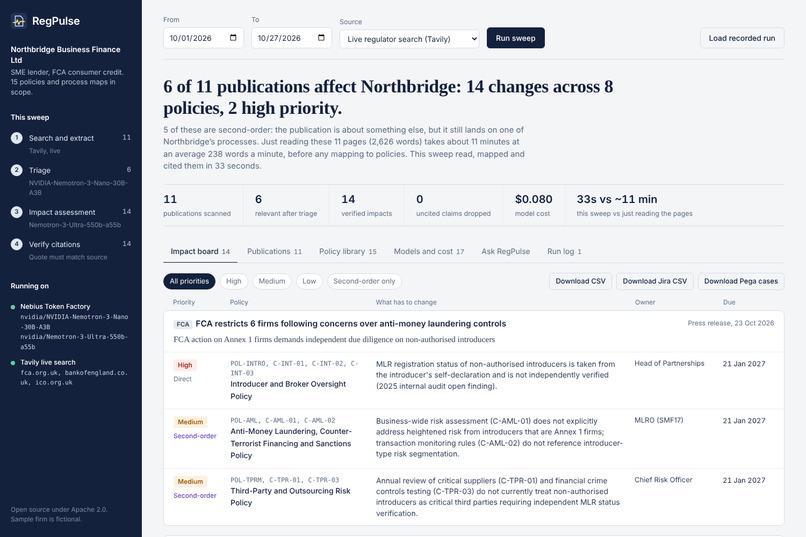
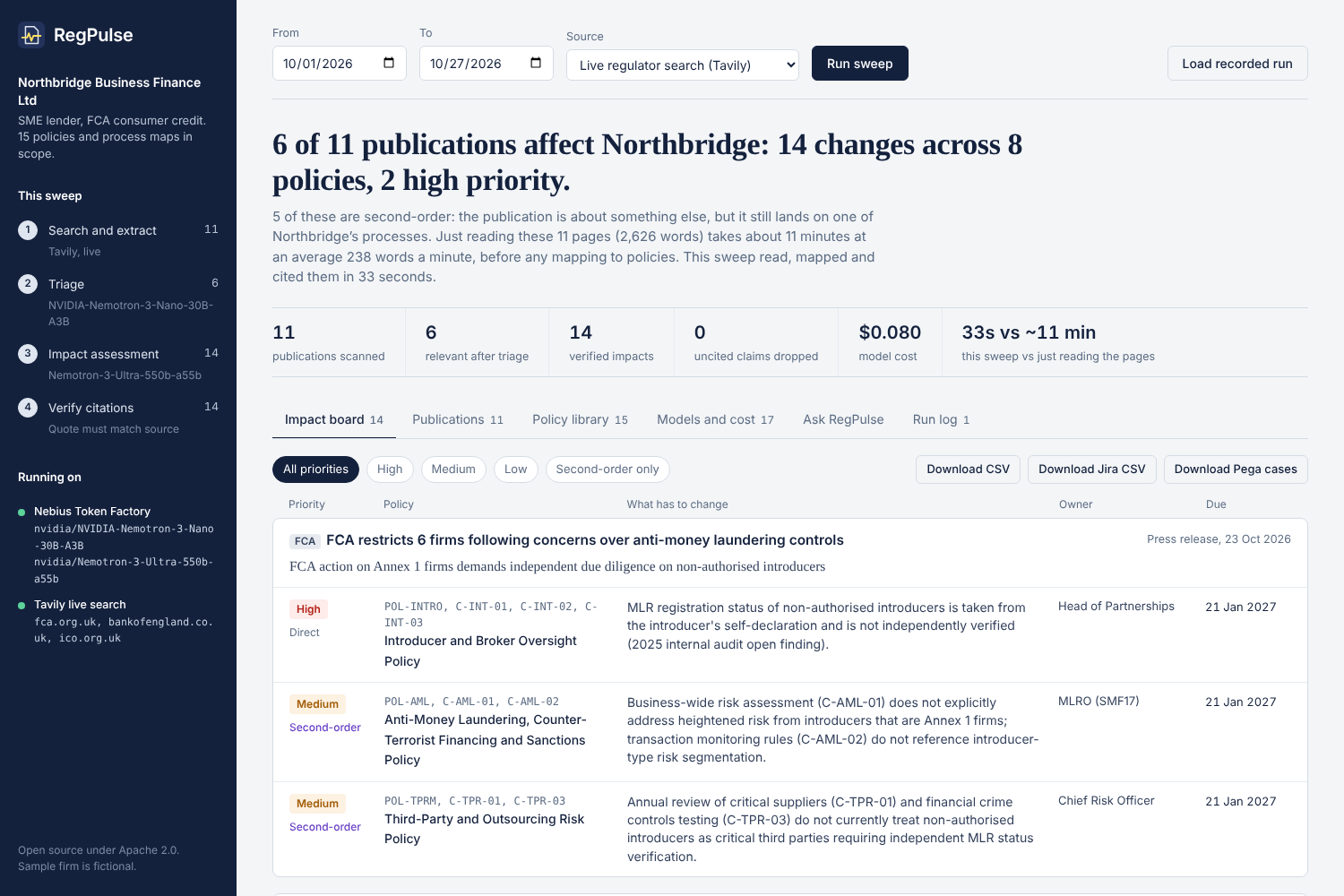
Impact Board
-
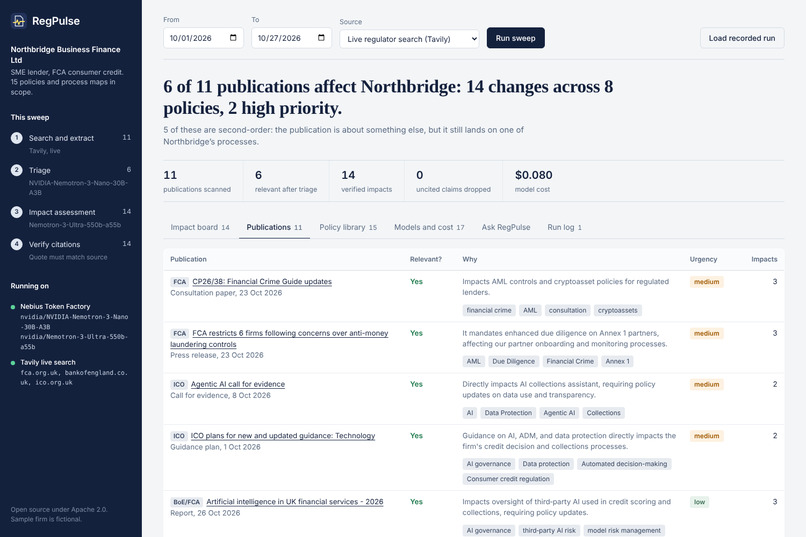
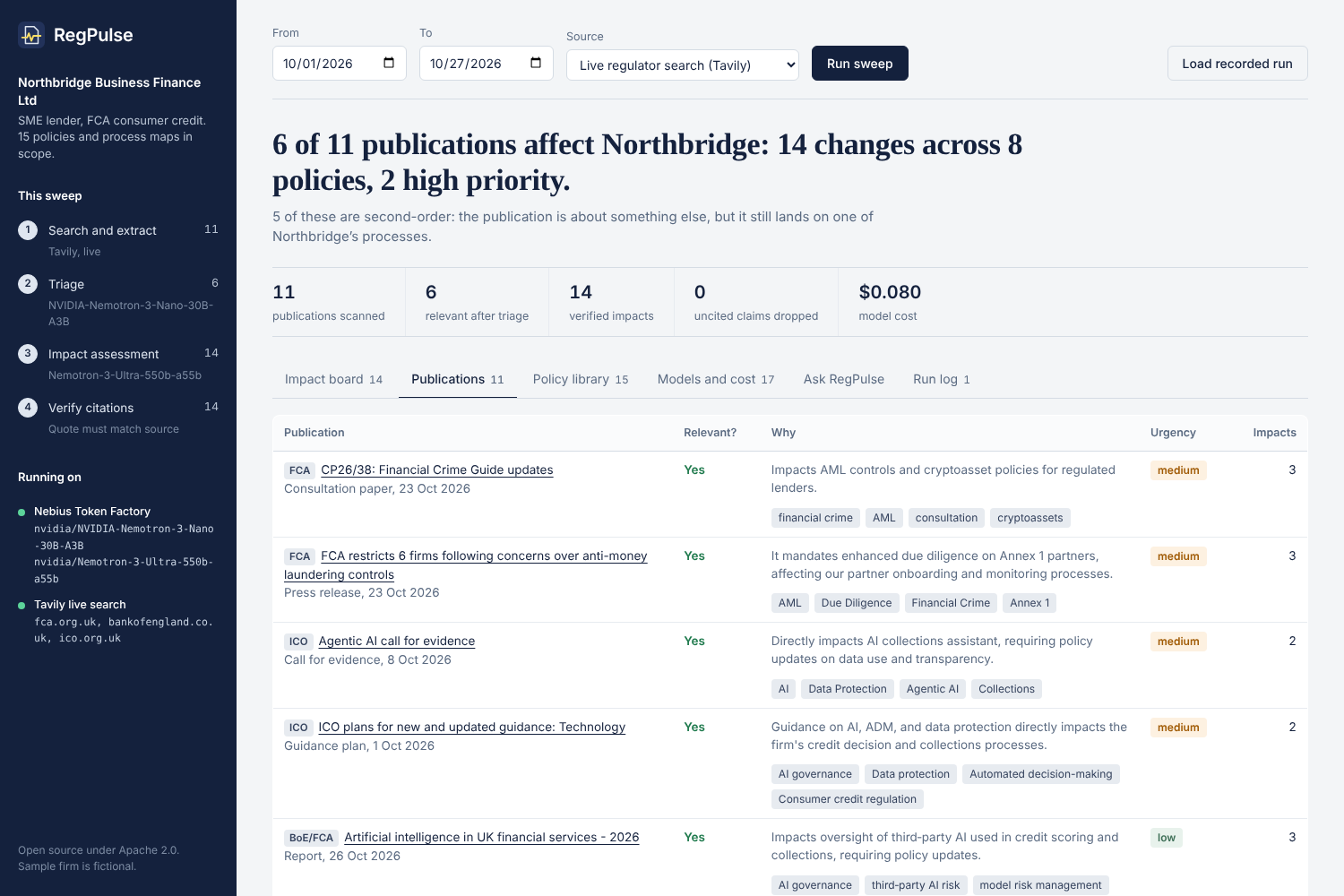
Triage
-
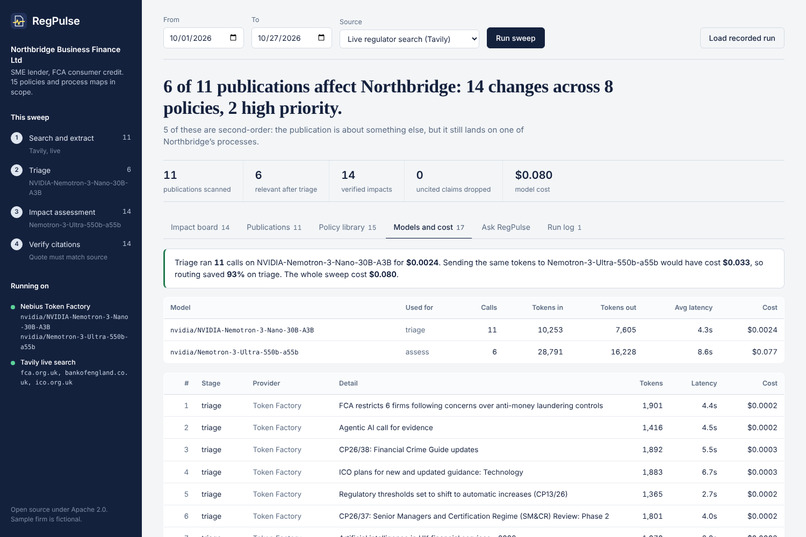
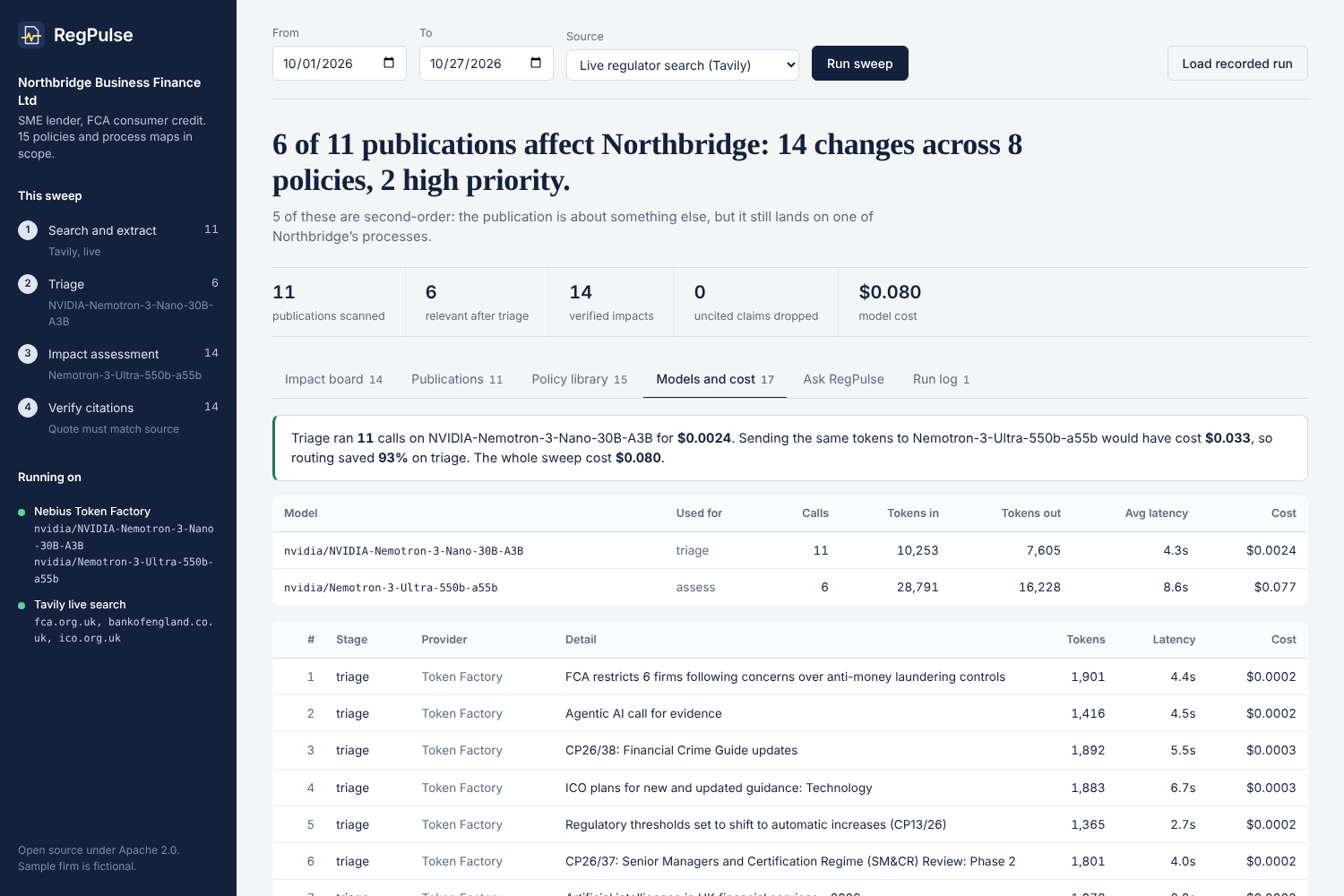
Models and Cost
-
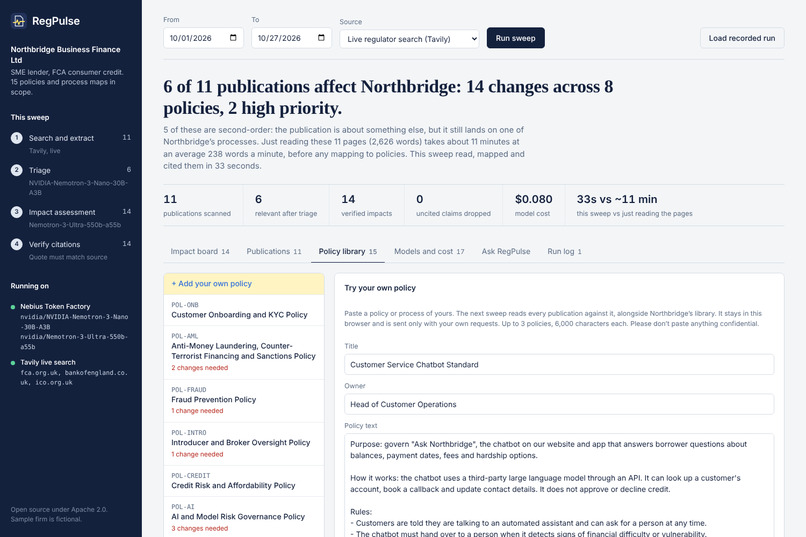
Your own policy
-
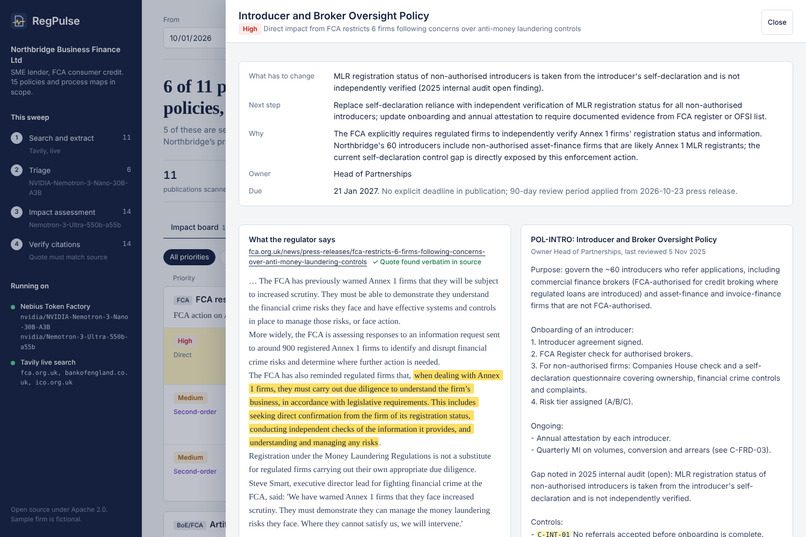
Evidence
Inspiration
I'm a Pega Lead System Architect and I work with UK lenders. Every regulatory change programme I've seen starts the same way: someone reads the week's FCA, PRA and ICO publications by hand and decides, in a spreadsheet, what matters. The obvious items get caught. The ones that arrive sideways slip through, like an FCA action against other firms that quietly changes how you should vet your own partners.
What it does
RegPulse runs a sweep over any date window:
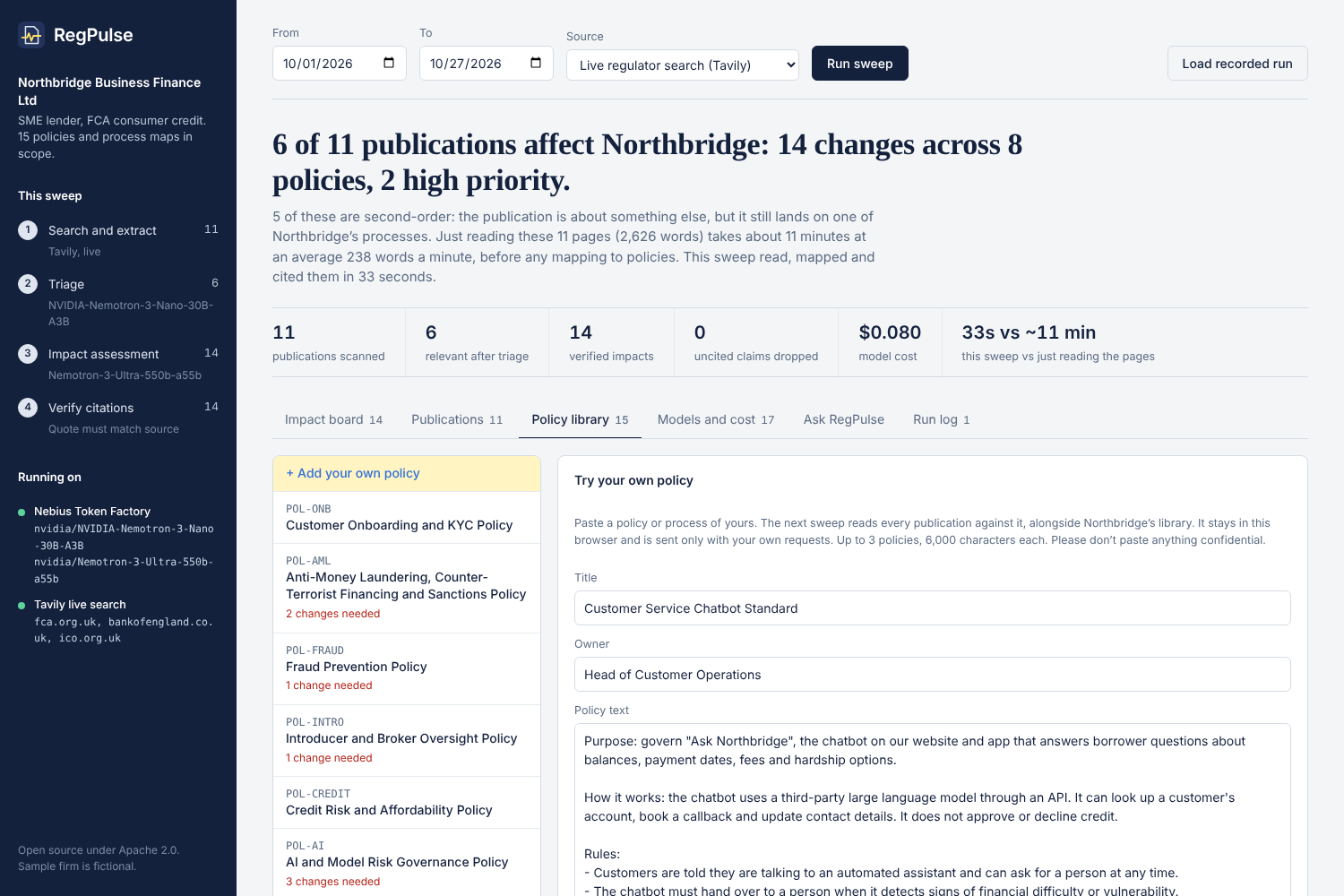
- Search and extract. Tavily searches fca.org.uk, bankofengland.co.uk and ico.org.uk, then extracts clean text from each publication.
- Triage. Nemotron Nano reads every publication against the firm's profile and decides whether it applies.
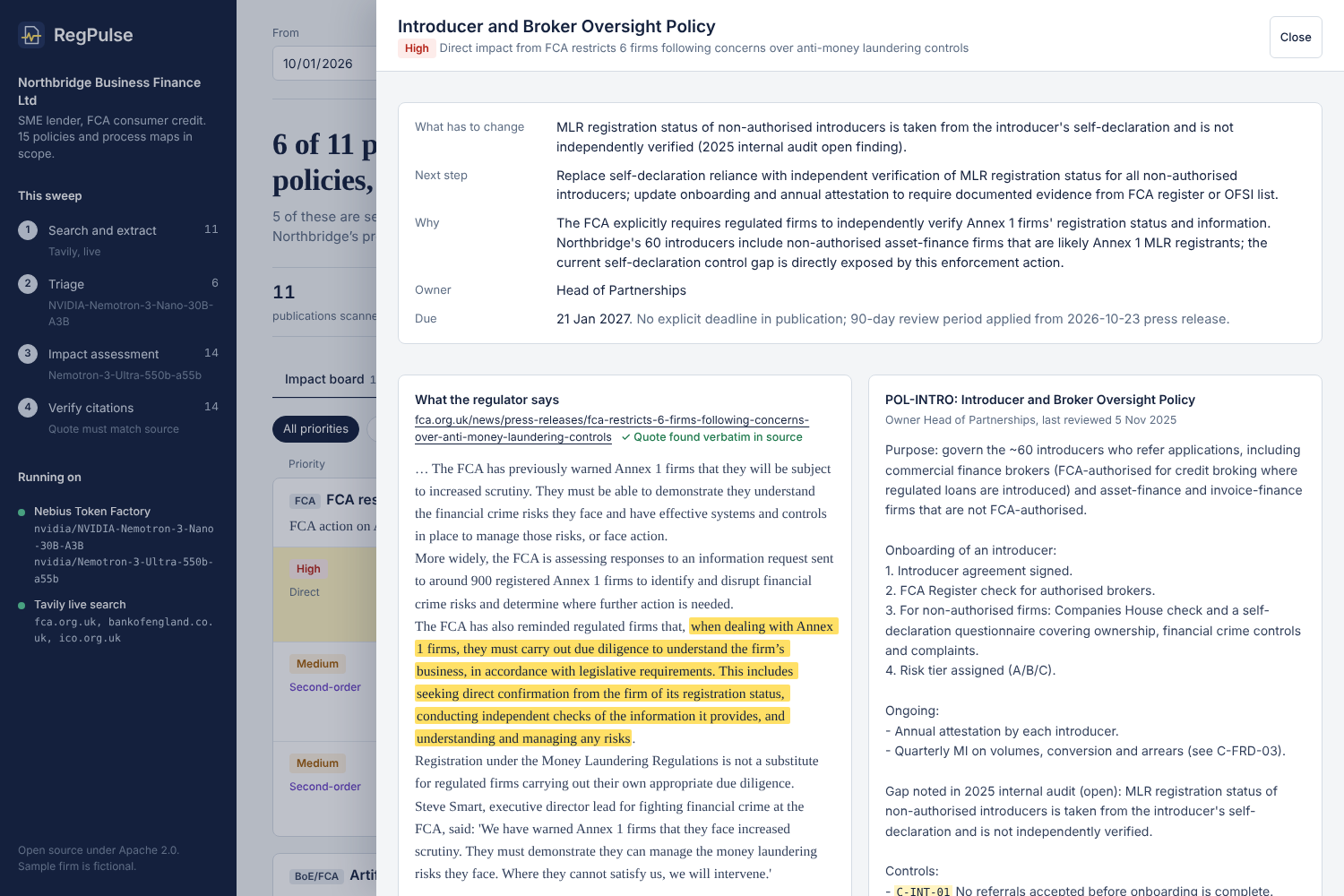
- Impact assessment. Nemotron Ultra reads each relevant publication against the firm's whole policy library. For the demo that's 15 policies and process maps for Northbridge, a fictional Manchester SME lender. Each impact it returns names the policy and controls, whether the impact is direct or second-order, the gap, the next step, the owner, a due date and a verbatim quote.
- Verify. Code checks every quote against the source text. No quote, no finding.
You then get an evidence view with the regulator's sentence highlighted next to the affected policy, one-click change tickets, CSV, Jira and Pega case export, and a Q&A panel that answers with citations. With Try your own policy you can paste up to three of your own policies, and the next sweep checks every publication against them too.
On the October 2026 corpus, RegPulse scanned 11 publications and kept 6. It found 14 changes across 8 policies, 2 of them high priority, in 33 seconds for about $0.08. The top finding: an FCA press release about restrictions on six unregulated lenders also reminds regulated firms to check the registration status of the Annex 1 firms they deal with. RegPulse linked that to an open audit point in Northbridge's introducer policy and quoted the FCA's own sentence.
For scale: just reading those 11 publication pages (2,626 words) takes about 11 minutes at an average 238 words a minute, before any mapping to policies. The full consultation documents behind them are far longer.
How we built it
- Models: two Nemotron tiers on Nebius Token Factory, called directly through the OpenAI-compatible API.
nvidia/NVIDIA-Nemotron-3-Nano-30B-A3Bhandles high-volume triage.nvidia/Nemotron-3-Ultra-550b-a55bhandles the reasoning: one publication against 15 policies, about 12k tokens of context per call.
- Search: Tavily Search and Extract over the three regulators' domains, with filters that drop warning lists, glossary pages and duplicates.
- App: Next.js 15 and TypeScript. The sweep streams progress as NDJSON so each stage shows live. Deployed on Vercel.
- Telemetry: every call is logged with model, tokens, latency and cost. Sending triage to Nano instead of Ultra cut that stage's cost by 93%.
- Guardrails: word-level quote verification, a check that the policy and control IDs exist, merging of duplicate impacts, and rate limits that keep the public demo within budget.
Challenges we ran into
- Citations the code can trust. In the first real run Ultra invented a policy ID and stitched separate bullet points into one "quote". We added word-level verification and a stricter prompt. That run dropped 4 uncited claims; the tuned run dropped none.
- Severity inflation. At first, 9 of 15 impacts came back "high". An explicit rubric brought it down to 2, both of which a compliance lead would agree with.
- Scope. Nano flagged a PRA consultation for a firm that is FCA-only. Stating the firm's regulatory perimeter in the triage prompt fixed it.
- Noisy live search. Regulator sites return warning lists, glossary entries and board pages. We filter those before any model sees them.
Accomplishments that we're proud of
- It finds second-order impacts a human reviewer would recognise, not just keyword matches.
- A full sweep costs cents ($0.08 on the October corpus, $0.15 for a 14-publication live sweep), and every claim can be traced to the source.
- Findings export as Pega DX API case payloads and as Jira tickets, so they can open real regulatory-change work.
- Anyone can test it on their own material: paste a policy and run a sweep.
What we learned
A small model for volume and a large model for reasoning is a good split. Rules enforced in code (no quote, no finding) are far more reliable than the same rules written into a prompt.
What's next for RegPulse
Upload whole policy libraries (PDF and Word); weekly scheduled sweeps on Nebius Serverless Jobs; push cases straight into Pega or Jira; more sources, including the PRA Rulebook, the Financial Ombudsman Service and the CMA.
Built With
- nebius-token-factory
- next.js
- node.js
- nvidia-nemotron
- react
- tavily
- typescript
- vercel

Log in or sign up for Devpost to join the conversation.