-
-
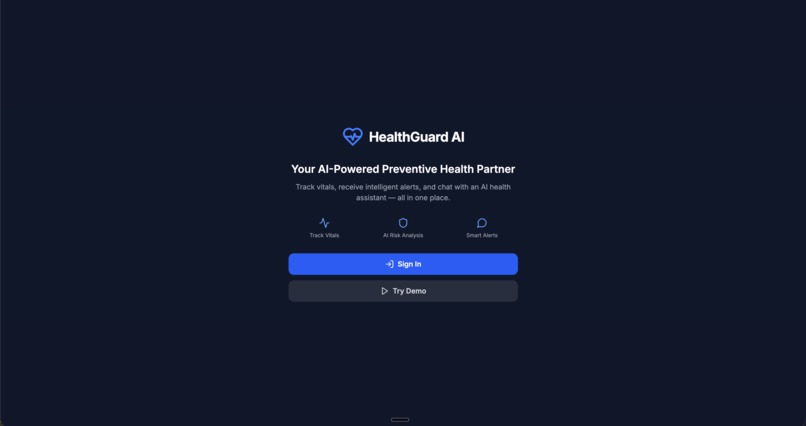
Login Page
-
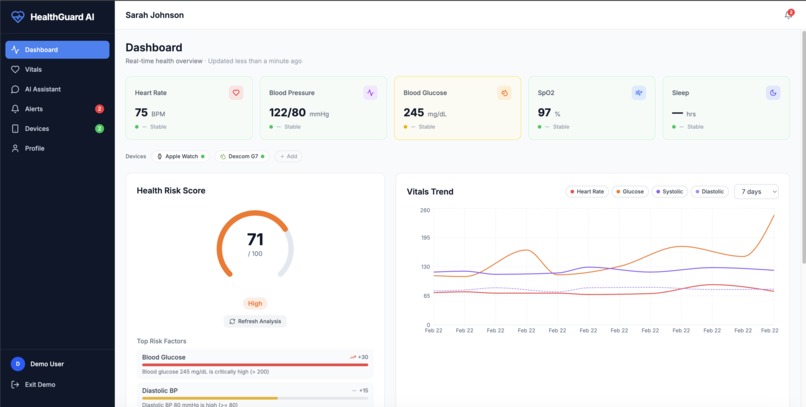
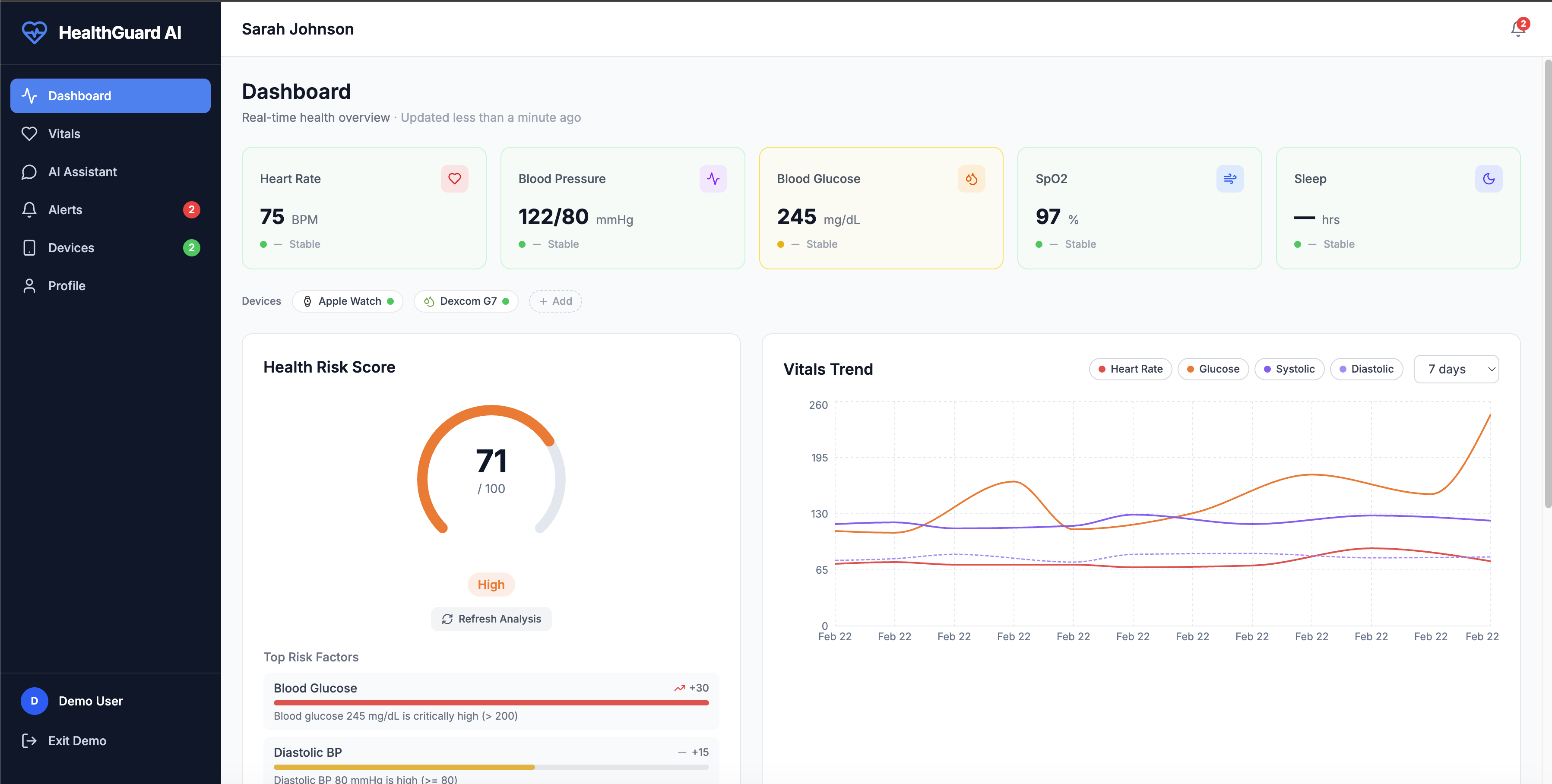
Dashboard
-
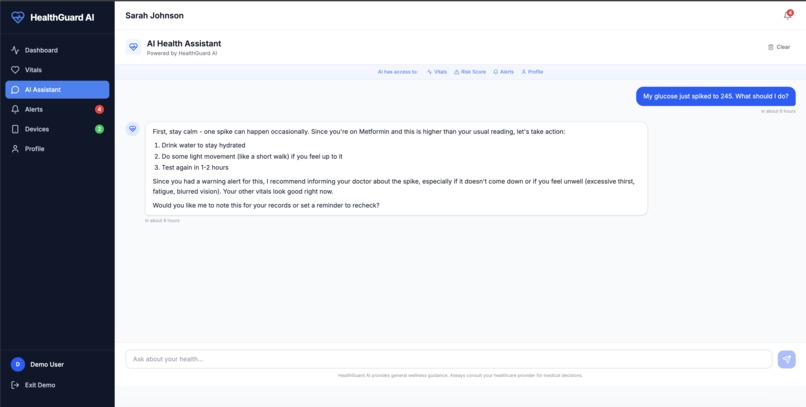
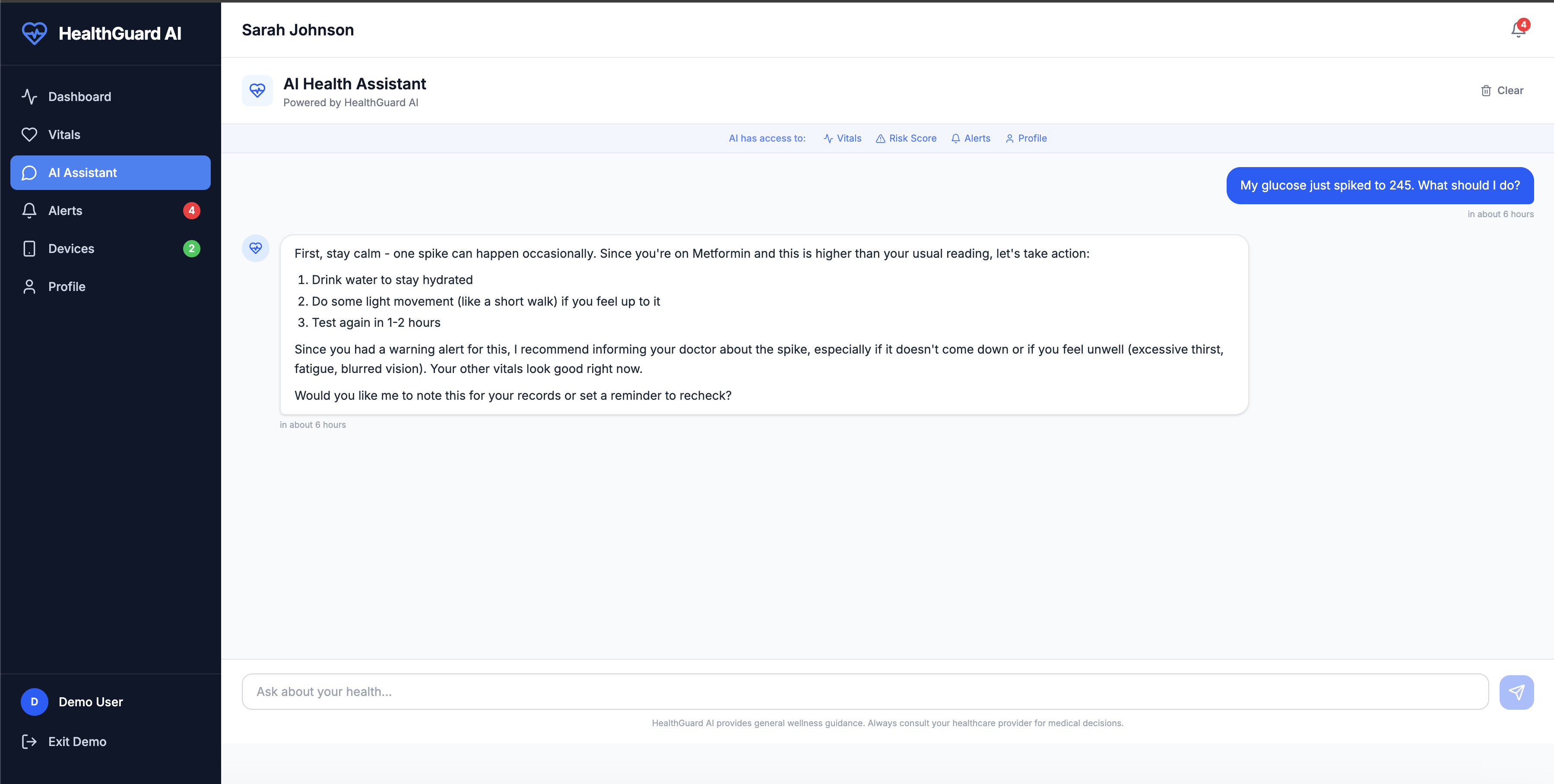
AI Chatbot
Inspiration
Chronic conditions like diabetes and hypertension affect over 130 million Americans, yet most health monitoring is still reactive — people only find out something's wrong after a crisis. We kept asking: what if your health data could warn you before things go sideways? Wearable devices already collect incredible amounts of data, but most of it just sits in siloed apps. We wanted to build something that brings it all together, makes sense of it with AI, and actually does something about it — not just show you charts, but tell you what they mean and loop in your doctor when it matters.
What it does
HealthGuard AI is a web-based health monitoring platform designed for patients managing chronic conditions. It connects to the wearable devices you already own — Apple Watch, Fitbit, WHOOP, Oura Ring, Dexcom CGM, and Garmin — and aggregates your vitals into a single, clean dashboard.
Under the hood, an AI risk engine continuously analyzes your trends. It combines rule-based medical thresholds with a large language model to predict potential health complications 24–72 hours out — things like glucose trajectory heading toward a diabetic episode, or blood pressure patterns that suggest a hypertensive crisis.
When something looks concerning, the system fires smart alerts — not generic "heart rate high" notifications, but context-aware messages like "Your glucose has been climbing for 3 hours and you may have missed your afternoon Metformin." Critical alerts can be shared with caregivers or clinicians with full context.
There's also a conversational AI health assistant that knows your profile, your vitals, your medications, and your recent alerts. You can ask it plain-English questions about your health data and get personalized, actionable answers.
How we built it
The frontend is a React app built with Vite and styled with Tailwind CSS. We used Recharts for all data visualizations — the vitals trend charts, the risk score gauge, and the health timeline. The sidebar layout and design system were built to feel like a modern health-tech product, not a hackathon prototype.
The backend is Node.js with Express, using SQLite for fast zero-config data storage. Real-time features like live alert notifications and device sync status updates run through Socket.io.
For AI, we used Featherless AI's serverless inference platform with the DeepSeek-V3 model, accessed through an OpenAI-compatible SDK. The AI powers three features: predictive risk analysis, context-aware alert generation, and the virtual health assistant chatbot.
Authentication is handled by Auth0 with a full login flow, and we built a device connection system that simulates real wearable pairing with status progression and live data syncing.
Challenges we ran into
The biggest challenge was dashboard performance. The AI risk analysis call to Featherless could take several seconds, especially on cold model starts, which made the dashboard feel frozen. We solved this by splitting the page into progressive loading layers — vitals and charts render instantly from the database while AI insights load asynchronously with a shimmer animation and a 5-minute cache.
Getting the demo flow right was harder than expected. We replaced a basic button panel with a guided demo stepper that walks through a scripted narrative, which made the presentation much smoother but required careful orchestration of backend events, Socket.io emissions, and frontend state.
Concurrency was another consideration. DeepSeek-V3 on Featherless uses all 4 concurrency slots, meaning we couldn't run parallel AI calls. We had to be deliberate about when we triggered AI features so they didn't step on each other during the demo.
Accomplishments that we're proud of
The device connection experience feels real. When you pair a device, it transitions through pairing → syncing → connected with smooth animations, and vitals from that device immediately appear on the dashboard. It sells the vision of the product.
The AI risk engine is genuinely useful. It doesn't just check if a number is out of range — it looks at 7-day trends, considers compound risks across multiple vitals, weighs the patient's specific conditions, and generates predictions with reasoning you can actually read and understand.
The whole app looks and feels like a real product. Auth0 login, polished UI, real-time updates, device ecosystem — it's not a wireframe or a slide deck. You can log in and use it.
What we learned
Featherless AI's OpenAI-compatible API made swapping inference providers painless — the OpenAI SDK just works with a different base URL. That flexibility is powerful for hackathons where you might need to pivot quickly.
Progressive loading changes everything for AI-powered apps. Users will tolerate a 5-second AI response if the rest of the page is already interactive, but they won't tolerate a 5-second blank screen.
Building a good demo is its own engineering problem. The guided demo mode took real effort but was worth every minute — being able to walk through a scripted story with one button press made the presentation dramatically better than ad-libbing through a live app.
What's next for HealthGuard AI
The immediate next step is mobile push notifications — the alert system is built, it just needs a delivery channel beyond the browser. We'd also integrate with real wearable APIs through Apple HealthKit, Google Health Connect, and Fitbit's Web API to replace the simulated device connections with actual data pipelines.
Longer term, we want to explore multi-patient views for clinicians and caregivers, so a doctor could monitor a panel of patients with HealthGuard AI flagging who needs attention. We'd also like to fine-tune a smaller model specifically for health risk prediction to reduce latency and improve accuracy over the general-purpose LLM approach.
Built With
- auth0
- axios
- date-fns
- deepseek-v3
- express.js
- featherlessai
- lucide-react
- node.js
- react
- recharts
- socket.io
- sqlite
- tailwindcss
- vite

Log in or sign up for Devpost to join the conversation.