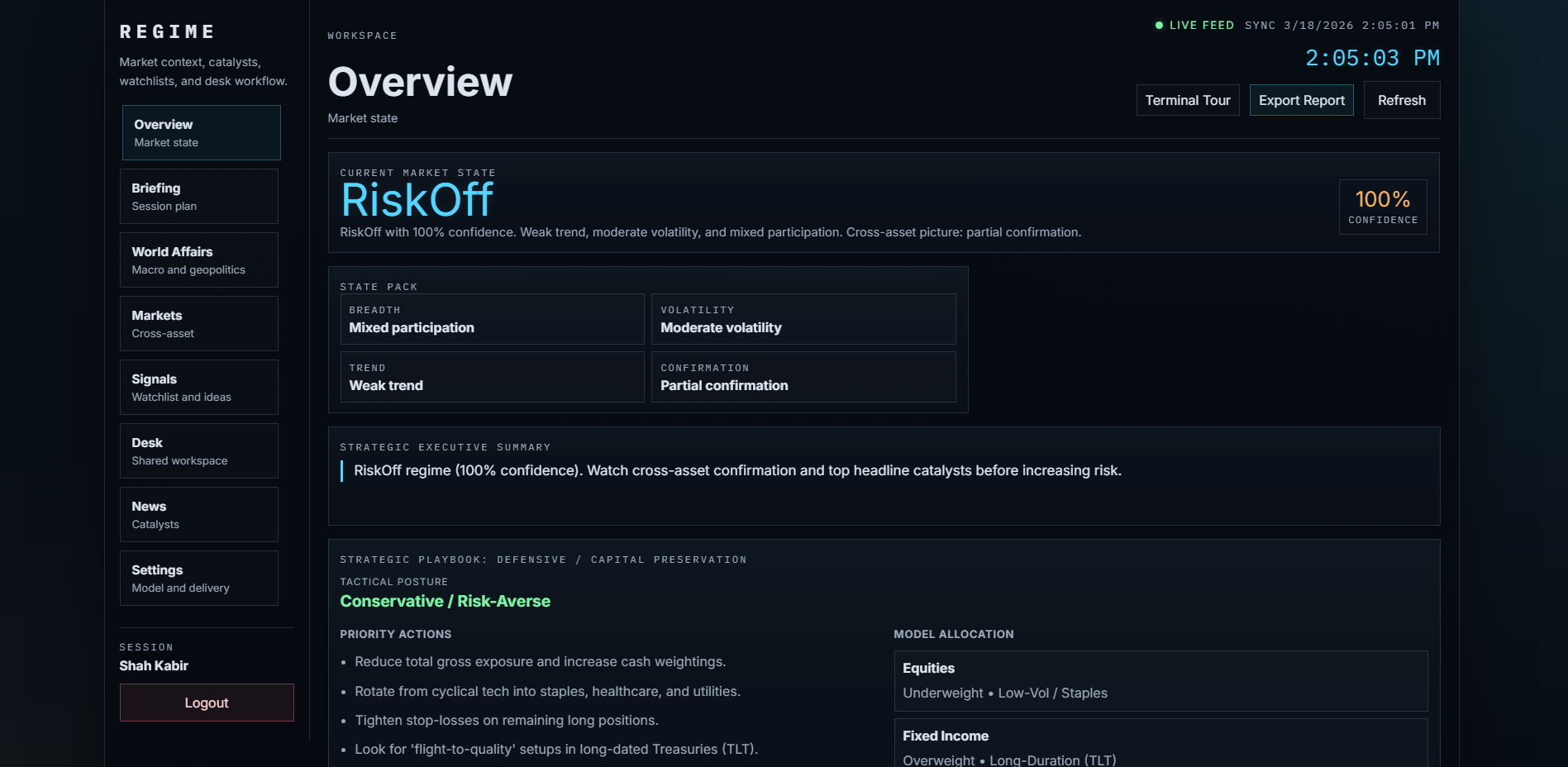
Devpost About The Project
Inspiration
Modern markets are shaped by macro shocks, cross-asset moves, and nonstop headline flow, but most retail and independent traders still piece that context together manually across too many tools. We wanted to build a terminal that makes market regime, risk, and watchlist context easier to understand and act on. The goal behind Regime was to turn scattered market signals into a cleaner daily operating picture: what environment are we in, what matters now, what could change it, and how does that affect the names I actually care about?
What it does
Regime is an AI-powered market intelligence terminal for traders and investment teams. It detects the current market regime, explains the signal with a structured scorecard, tracks macro and cross-asset conditions, monitors a watchlist, and generates actionable briefings. Users can see whether the environment is risk-on or risk-off, understand the major drivers behind that call, review world and macro themes, inspect watchlist exposures, and recover a curated starter watchlist for immediate onboarding. The platform also includes authenticated diagnostics and operational visibility so the system is demoable and usable as a real application rather than just a static prototype.
How we built it
We built Regime as a full-stack application with a FastAPI and SQLModel backend and a Next.js frontend. The frontend is strictly API-driven and renders the product as a market terminal experience. The backend handles authentication, watchlists, briefings, AI analysis, shared workspace logic, and market-state computation. We used machine learning and rules-based market context layers to classify regime conditions and explain them through a scorecard and narrative summary. For infrastructure, we migrated the project database from Supabase to DigitalOcean Managed PostgreSQL and prepared the app for deployment on DigitalOcean App Platform so the stack matches the hackathon environment.
Challenges we ran into
The biggest challenge was keeping the product coherent while combining several moving parts: authentication, watchlist state, AI-generated commentary, market-state classification, and production deployment. We also had to solve infrastructure migration work during the build, moving persistence from Supabase to DigitalOcean PostgreSQL without breaking the app. Another challenge was making the application resilient enough for a hackathon demo. AI features can fail or return slowly, so we had to build fallback behavior, better empty states, and diagnostics so the app still feels trustworthy under degraded conditions.
Accomplishments that we're proud of
We are proud that Regime feels like a real product rather than a thin demo. It has a working full-stack architecture, persistent user state, authenticated workflows, watchlist management, AI-assisted briefings, a clearer regime explanation layer, and an operational diagnostics surface. We are also proud of the onboarding improvements, especially the starter watchlist flow, because it makes the product immediately usable for new users and judges. Finally, the DigitalOcean migration is a major accomplishment because it turns the project into a genuine DigitalOcean deployment story instead of a local-only prototype.
What we learned
We learned that product polish matters as much as model quality in an applied AI project. A strong prediction or briefing is not enough unless the user can understand the context, recover from failures, and trust what the system is showing them. We also learned how important deployment realism is: database migration, secret handling, health visibility, and graceful degradation all become central once you move beyond a mockup. On the technical side, we learned a lot about balancing deterministic market-state logic with AI-generated summaries so the system remains useful even when the AI layer is unavailable.
What's next for Regime
The next step is to make Regime even more production-ready. We want to add scheduled briefing generation, more robust background job handling for AI-heavy tasks, richer alerting around regime changes and catalysts, and stronger team workflows for shared research. We also want to deepen explainability, expand export and sharing options, and continue hardening infrastructure on DigitalOcean. Longer term, the vision is for Regime to become a daily operating system for traders who want macro awareness, watchlist intelligence, and clearer decision support in one place.
Built With
- clerk
- digitalocean
- fastapi
- next.js
- pandas
- postgresql
- scikit-learn
- sqlmodel

Log in or sign up for Devpost to join the conversation.