-
-
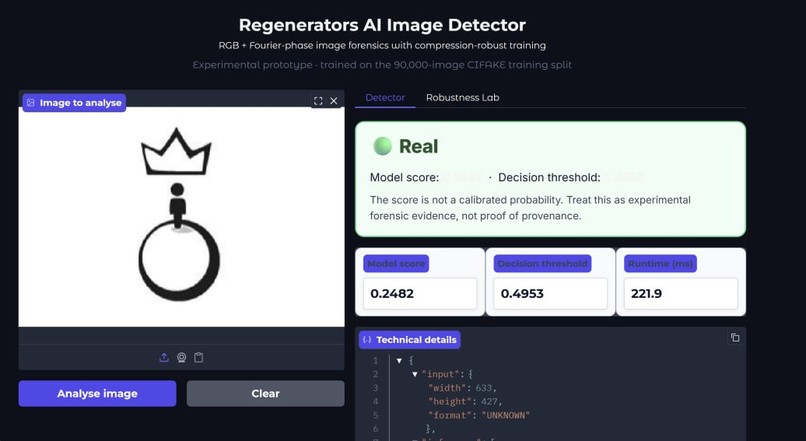
Initial UI
-
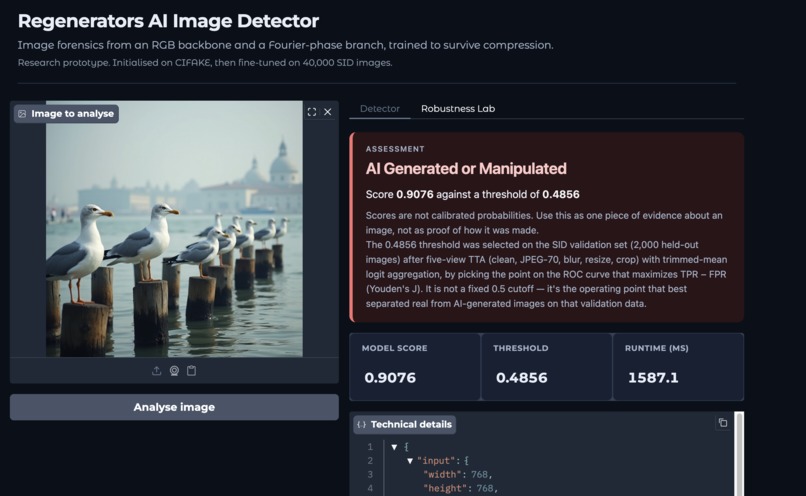
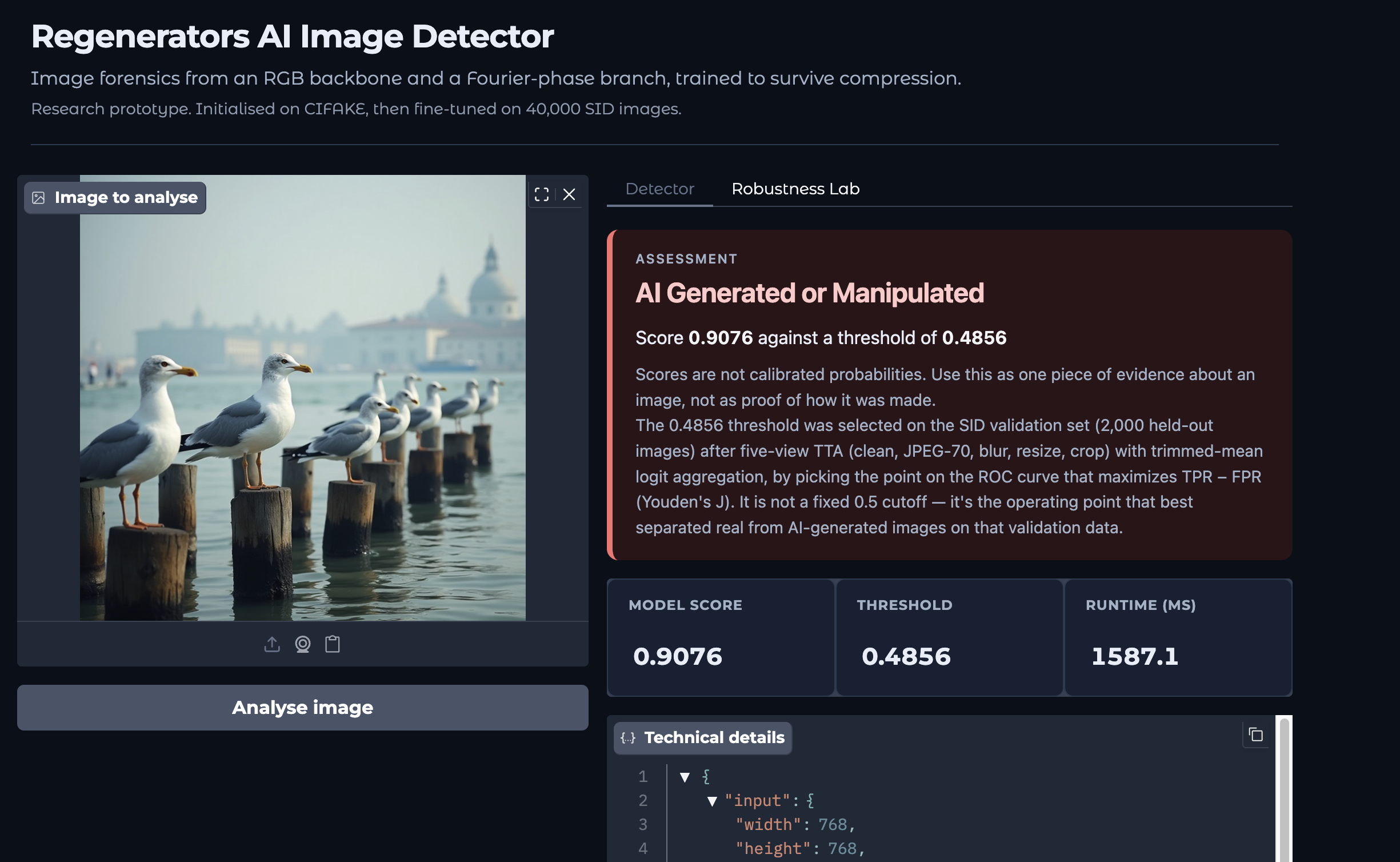
Final UI, detects fake image
-
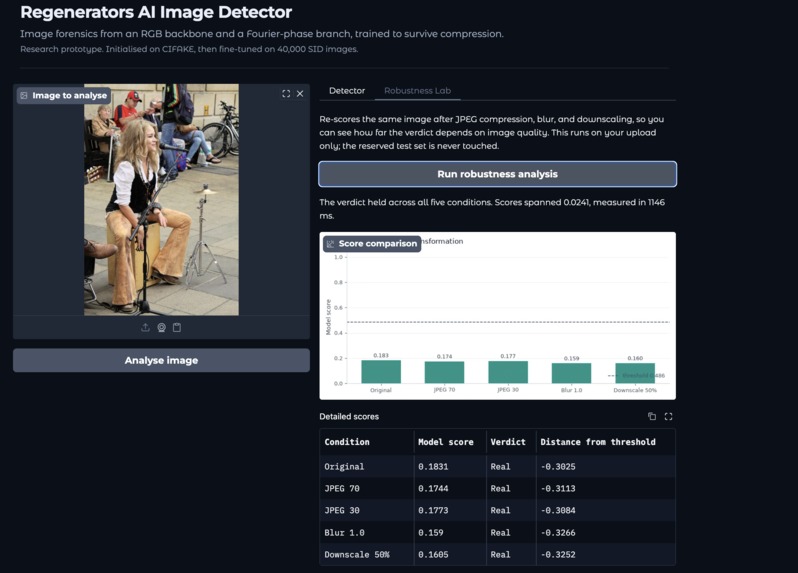
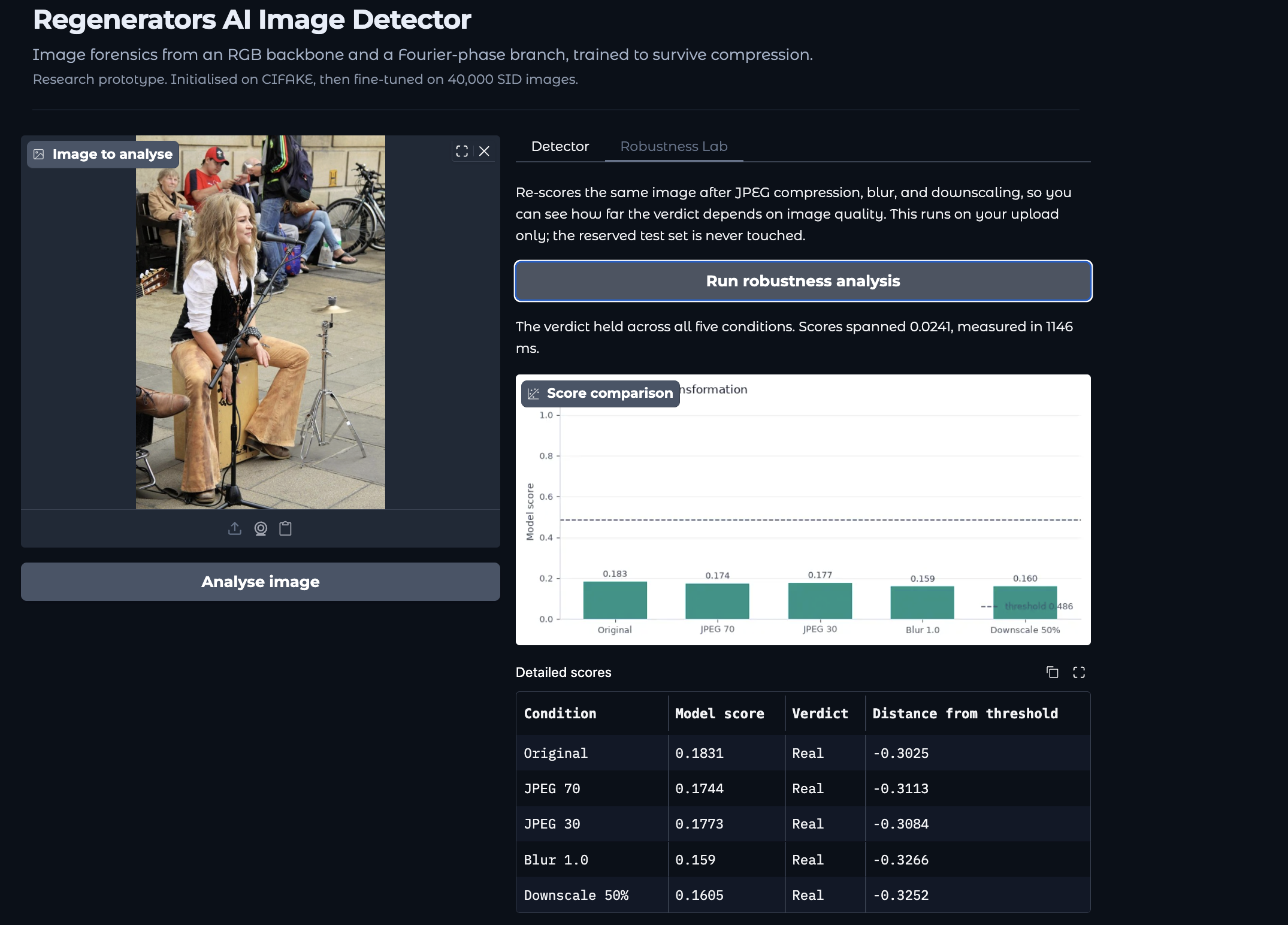
Final UI, identifies real image, robustness analysis included.
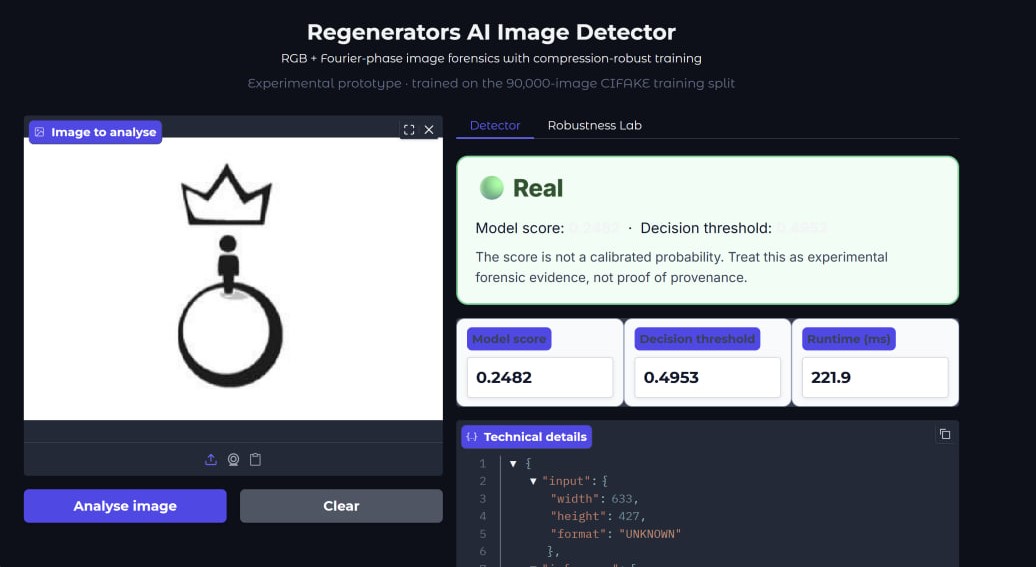
regenerators: Robust AI-Generated Image Detection App
How our solution addresses the problem statement
The problem statement encompasses not just detecting AI-generated images, but also detecting them under robust, realistic scenarios. Images can be JPEG-compressed, blurred, colour adjusted — how will we ensure the detection model remains largely accurate after different transformations and redistributions? Our team seeks to answer this.
This project addresses that in three ways:
- Robust feature representation. Detection combines a Swin-Tiny vision-transformer RGB branch with a learned Fourier phase-spectrum branch (
PhaseEncoderinmodel.py), fused before classification. Phase-spectrum artefacts left by generative up-sampling/decoding are complementary to RGB texture cues, so the fusion is more resilient to post-processing than an RGB-only classifier. - Parameter-efficient, staged fine-tuning. Rather than fully fine-tuning the backbone (expensive and prone to overfitting on a limited-generator dataset), LoRA adapters (
LoRALinear/inject_lorainmodel.py) are injected into the backbone's attention projections. The model is first trained on CIFAKE, then LoRA-adapted onto a balanced SID-Set subset covering real, fully-synthetic, and tampered images, thus carrying forward general "is this AI-generated" knowledge while cheaply specializing to harder, manipulation-style cases. - Robustness-aware training and inference. Training uses paired clean/degraded views with a consistency loss (
losses.py,consistency_weight/consistency_alphain the configs) so the model's predictions stay stable under JPEG re-compression, blur, resize, noise, colour jitter, and cropping. At inference,inference_policy.pyruns deterministic five-view test-time augmentation (clean, JPEG-70, blur-1.0, resize-0.5, crop-0.8) and aggregates logits with a trimmed mean, with the decision threshold selected on a held-out validation split rather than hand-picked. The result (sid_local_lora_best.pt) reaches 0.9474 AUROC on a clean SID holdout and 0.9359 mean AUROC across the full degradation suite (worst condition 0.9049), which is documented and reproducible viareports/metrics/,evaluate.py, andpredict.py.
User Interface
Although this is not in scope, we decided to have the detector deployed as a Gradio web app (demo.py/demo_app.py) with an "Analyse image" action and a /robustness lab so the degradation robustness claim can be inspected interactively, not just read from a metrics file.
Robustness Evaluation Summary
The deployed checkpoint (with five-view trimmed-mean TTA, threshold 0.4401) was scored against its clean test images and against 14 additional degradation conditions applied to the same images,
reports/metrics/sid_local_lora_tta_test_robustness.json. A representative subset:
| Condition | AUROC | Balanced acc. | F1 | Precision | Recall | FPR |
|---|---|---|---|---|---|---|
| Clean | 0.9474 | 0.868 | 0.871 | 0.850 | 0.894 | 0.158 |
| JPEG-70 | 0.9394 | 0.870 | 0.869 | 0.871 | 0.868 | 0.129 |
| JPEG-50 | 0.9332 | 0.855 | 0.844 | 0.916 | 0.782 | 0.072 |
| Blur (σ=1.0) | 0.9469 | 0.876 | 0.870 | 0.915 | 0.829 | 0.077 |
| Blur (σ=2.0) | 0.9049 | 0.830 | 0.808 | 0.923 | 0.719 | 0.060 |
| Resize ×0.5 | 0.9528 | 0.883 | 0.884 | 0.875 | 0.892 | 0.127 |
| Resize ×0.25 | 0.9181 | 0.844 | 0.834 | 0.889 | 0.785 | 0.098 |
| Gaussian noise (σ=0.05) | 0.9285 | 0.845 | 0.849 | 0.826 | 0.874 | 0.184 |
| Crop 80% | 0.9462 | 0.874 | 0.871 | 0.893 | 0.850 | 0.102 |
| Colour jitter | 0.9474 | 0.867 | 0.871 | 0.843 | 0.901 | 0.168 |
Across the full 15-condition suite, mean AUROC is 0.9359 and the worst condition is heavy blur (σ=2.0) at 0.9049 AUROC; the strongest condition is a 2× downscale (resize ×0.5) at 0.9528 AUROC. AUROC degrades gracefully (≤0.05 absolute drop) under everything except aggressive blur, aggressive JPEG (quality 30), and aggressive downscaling (×0.25), the three transforms that most directly erase the high-frequency evidence the phase branch relies on.
Error analysis note
| Source class | Clean accuracy | Worst-condition accuracy | Worst condition |
|---|---|---|---|
| Real photos (OpenImages) | 0.842 | 0.811 | Gaussian noise (σ=0.10) |
| Fully synthetic images | 0.998 | 0.928 | JPEG quality 30 |
| Locally tampered images | 0.790 | 0.452 | Blur (σ=2.0) |
- False positives (FP) are real images flagged as AI-generated. Noise is the dominant FP driver; blur and aggressive JPEG/resize actually reduce the false-positive rate because the model becomes more conservative once high-frequency detail is destroyed.
- False negatives are concentrated almost entirely in tampered images, not fully synthetic ones. Fully synthetic generation is detected reliably (95–99.8% accuracy in every condition tested) because it leaves a strong, global generative signature. Local tampering leaves a much smaller, spatially confined signature that is the first thing degraded by blur, heavy JPEG, or downscaling. Tampered-image accuracy falls from 0.790 (clean) to 0.452 (heavy blur), 0.548 (JPEG-30), and 0.576 (resize ×0.25). This shows the model's weakness: a strong full-synthesis detector and a comparatively weak local-manipulation detector once the image has been re-processed.
- Precision/recall trade-off: For clean data, precision 0.850 vs. recall 0.894 — more false accusations of real content than missed fakes, which is the wrong direction since a false "AI-generated" label carries reputational risk. Raising the decision threshold would move precision up and recall down along the curve reported above, but that recall loss might deteriorate with the already-weak tampered class. A precision-first deployment should therefore consider a class-aware threshold or a secondary tamper-specific check rather than a single global cutoff, so that suppressing false positives on real photos doesn't further starve recall on manipulated images.
Development tools used
- Local CLI development: Python 3.12.14, with
scripts/setup_linux.shandscripts/setup_windows.ps1provisioning a matching virtual environment on Linux and Windows, andscripts/verify_environment.py/scripts/check_training_readiness.pygating runs before they start. - Jupyter Notebook (
COLAB_TRAINING.md,notebooks/demo.ipynb) for GPU training and for hosting the same Gradio demo, since the primary development machine is CPU-only. - Git for versioning the deployed model checkpoint alongside code.
- pytest for the automated test suite (
tests/), run before every training or deployment change. - TensorBoard for monitoring training/validation curves during LoRA fine-tuning.
Models or APIs used
- Backbone:
swin_tiny_patch4_window7_224.ms_in1k, an ImageNet-1k pretrained Swin Transformer Tiny loaded throughtimm, adapted with LoRA rather than fully fine-tuned. - Custom heads: a convolutional
PhaseEncoderover the image's Fourier phase spectrum and a fusion/classification head defined inmodel.py(AIGCDetector), trained from scratch on top of the frozen-plus-LoRA backbone. - Hugging Face Hub (
datasets/huggingface-hublibraries) is used as the API surface for streaming and materializing the SID-Set dataset (scripts/build_sid_subset.py,configs/sid_streaming_lora.yaml) — no external inference API is called; all models run locally/on the training GPU.
Libraries and frameworks used
- PyTorch / torchvision: model definition, training loop, and image transforms (installed separately per platform/CUDA build). timm: pretrained Swin Transformer backbone.
- Hugging Face
datasetsandhuggingface-hub: streaming/loading SID-Set and caching Hub assets. - albumentations and opencv-python-headless: training-time and benchmark image augmentations (JPEG, blur, resize, noise, colour, crop).
- scikit-learn and torchmetrics: AUROC, average precision, F1, balanced accuracy, and threshold selection (
metrics.py). - pandas and NumPy: manifest building/merging and numerical processing across
scripts/build_manifest.py,scripts/build_wildfake_manifest.py, anddata_pipeline.py. - PyYAML: experiment configuration files under
configs/. - safetensors: safe checkpoint serialization.
- Gradio: the web demo and its
/analyseand/robustnessAPI endpoints (demo.py,demo_app.py,demo_inference.py). - matplotlib/seaborn: metrics and robustness-curve plotting.
- TensorBoard: training curve logging.
- pytest: the automated test suite.
Datasets and assets used
- CIFAKE — fast-iteration dataset (32×32, CIFAR-derived, via
scripts/download_cifake.sh): initial large-scale real-vs-AI-generated image pretraining set; the CIFAKE-only checkpoint reached 0.9970 AUROC on its held-out test split (configs/full_cifake_lora.yaml). - SID_Set — full-resolution real/synthetic pairs, via
scripts/build_sid_subset.py: the primary fine-tuning and evaluation dataset, providing real, fully-synthetic, and locally-tampered images; a balanced 40,000-image subset (configs/sid_local_lora.yaml) produces the deployed checkpoint, evaluated on a stratified 2,000-image model-selection split and a separate 2,000-image holdout (scripts/split_sid_validation.py). - WildFake — an additional multi-generator dataset integrated through
scripts/build_wildfake_manifest.pyfor multi-source robustness experiments (configs/multisource_phase_robust.yaml), preserving the publisher's official train/test split and excluding hackathon-reserved sources (COCO val2017, DALL-E Advanced).- All datasets are used within the public/research licensing terms; no proprietary or scraped data is included.
- Trained model checkpoints (Git LFS-tracked, see
ARTIFACTS.md): the deployed checkpoints/sid_local_lora/sid_local_lora_best.pt` (LoRA-adapted Swin-Tiny + phase encoder + fusion head, 6 epochs on the SID subset, initialized from the CIFAKE checkpoint), plus retained legacy checkpoints from earlier CIFAKE-only and rank-4 LoRA experiments. - Reproducible metric reports under
reports/metrics/: clean and degradation-suite AUROC/F1/balanced-accuracy results and inference-policy validation, versioned alongside the code that produced them.


Log in or sign up for Devpost to join the conversation.