-
-
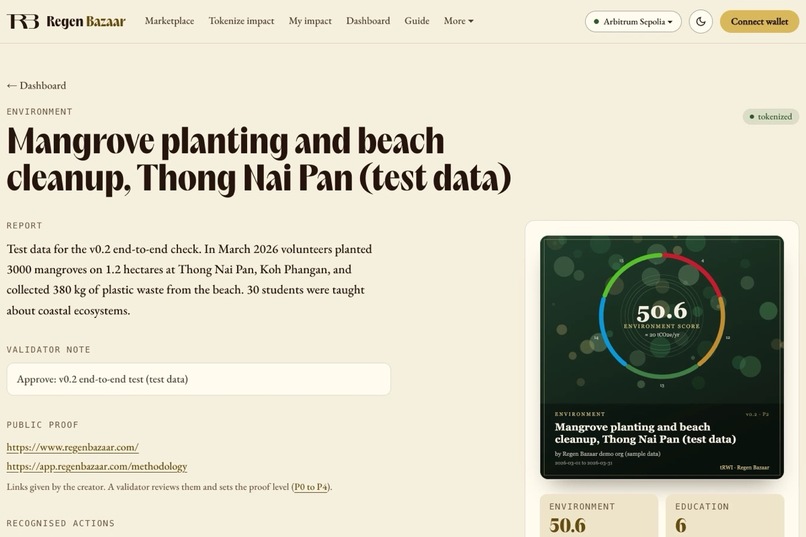
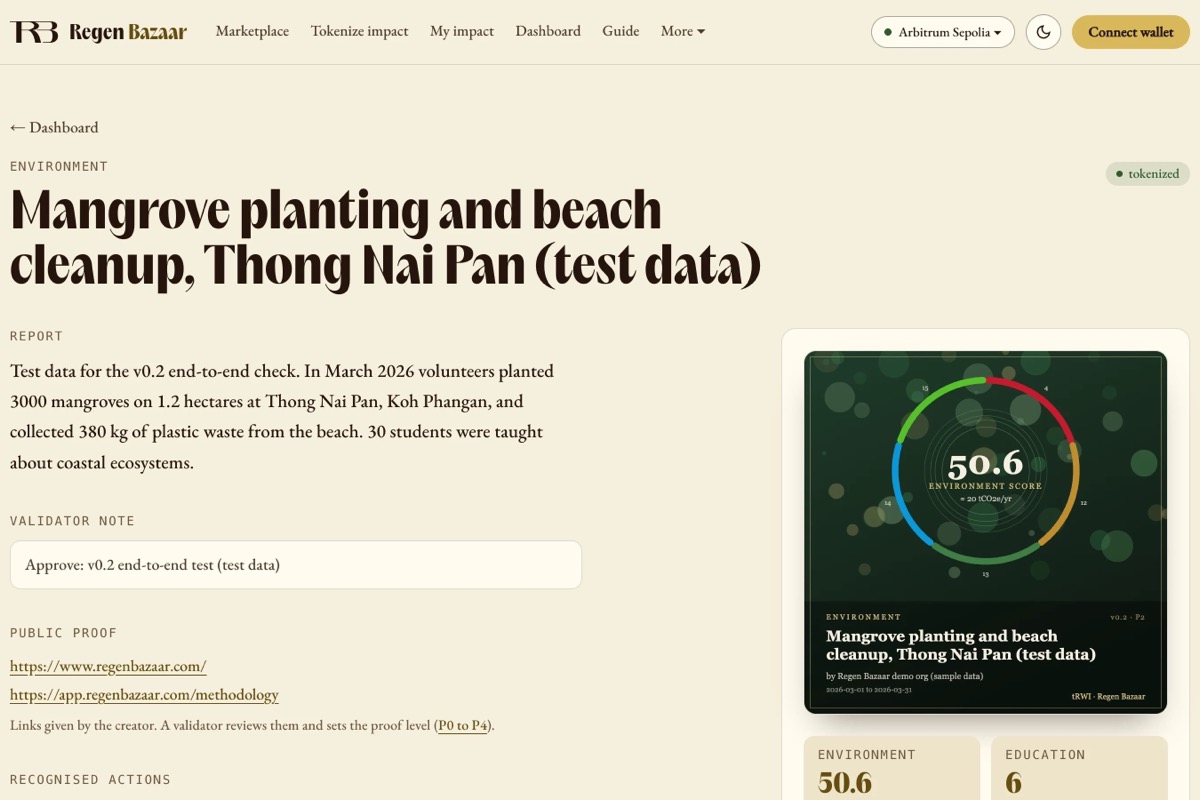
A verified report (test data): mangrove planting and beach cleanup, in plain language
-
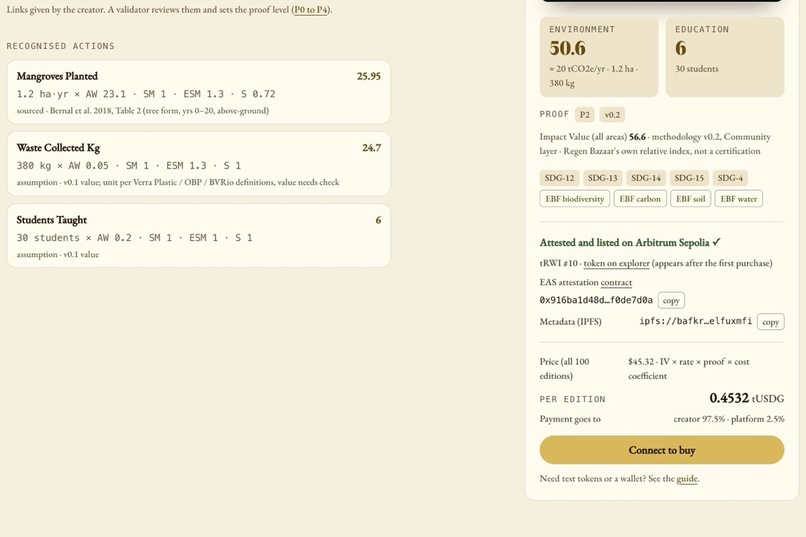
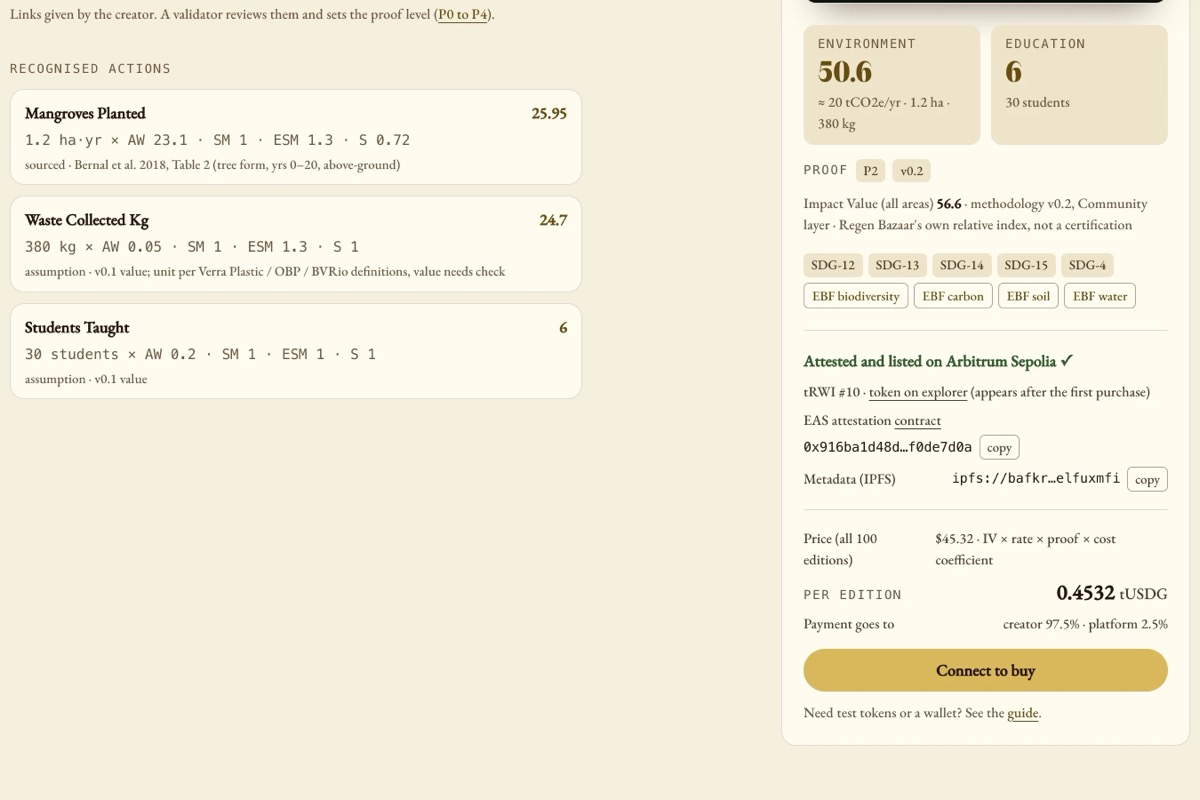
Each action with its formula and source, the proof level, the EAS attestation and the price
-
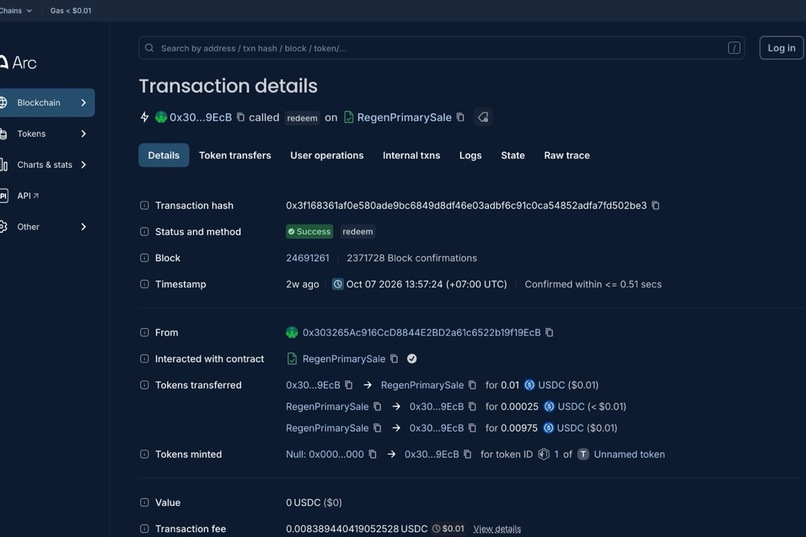
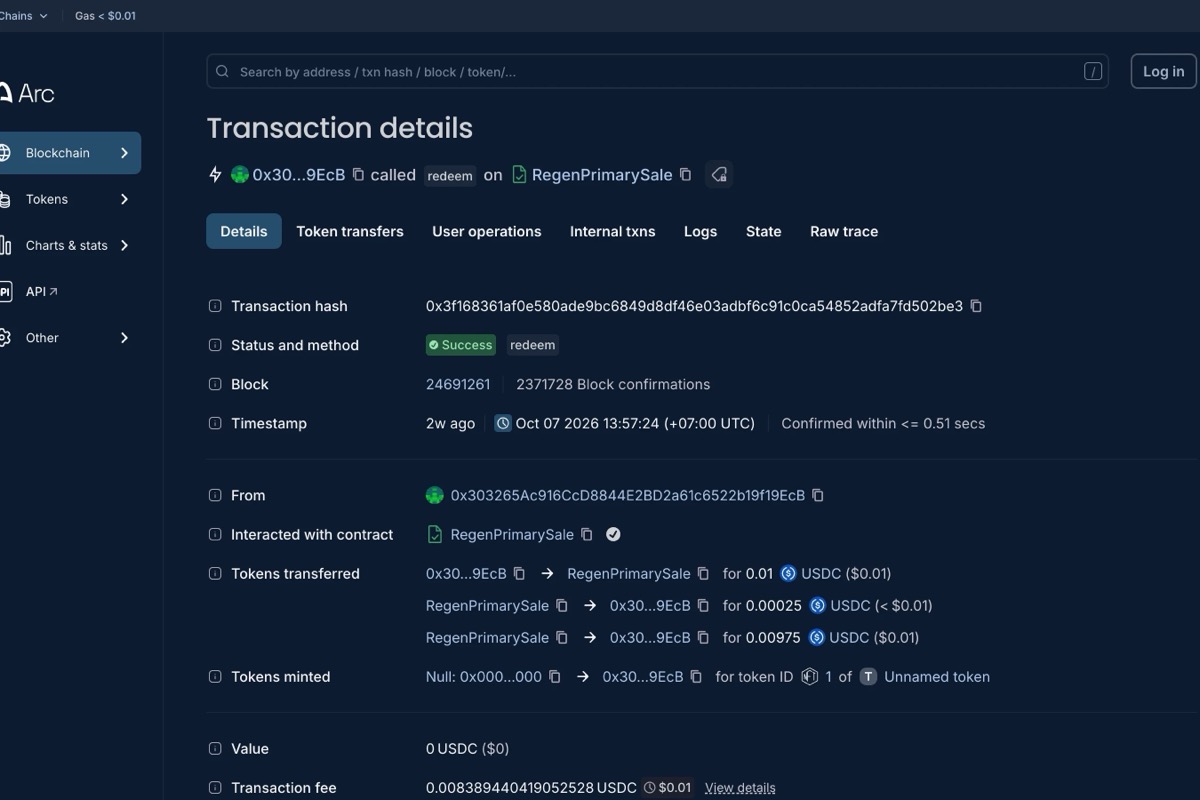
Arc mainnet: test purchase in USDC, payment split and edition minted in one transaction
-
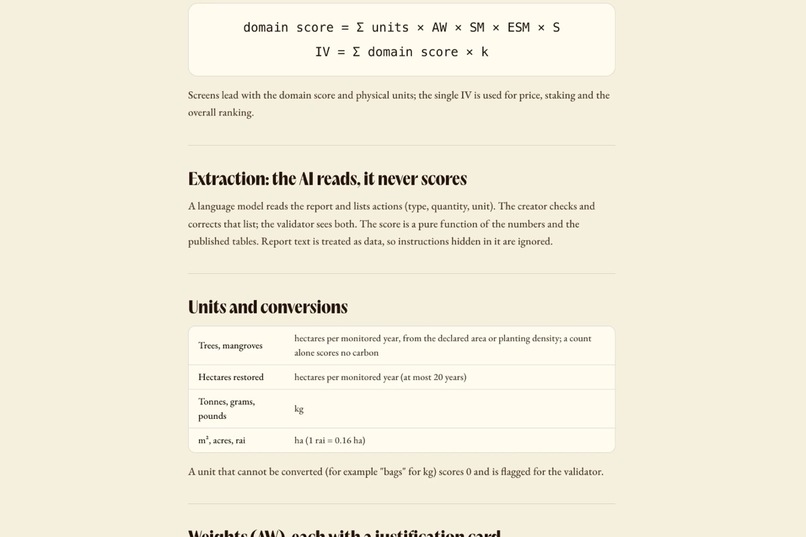
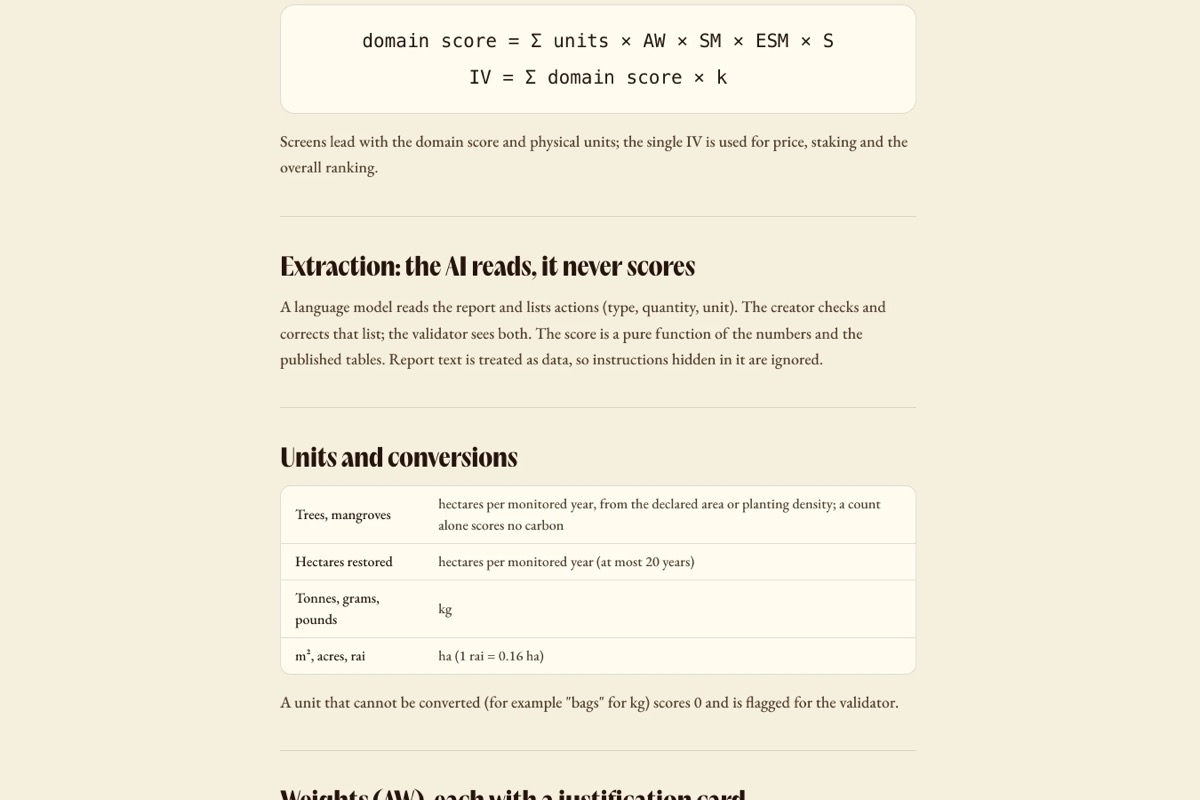
Methodology v0.2: deterministic scoring; the AI extracts facts and never scores
-
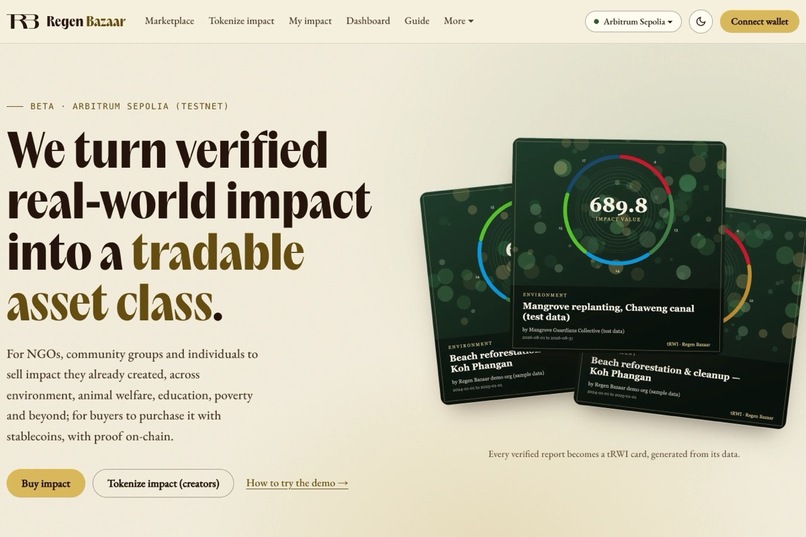
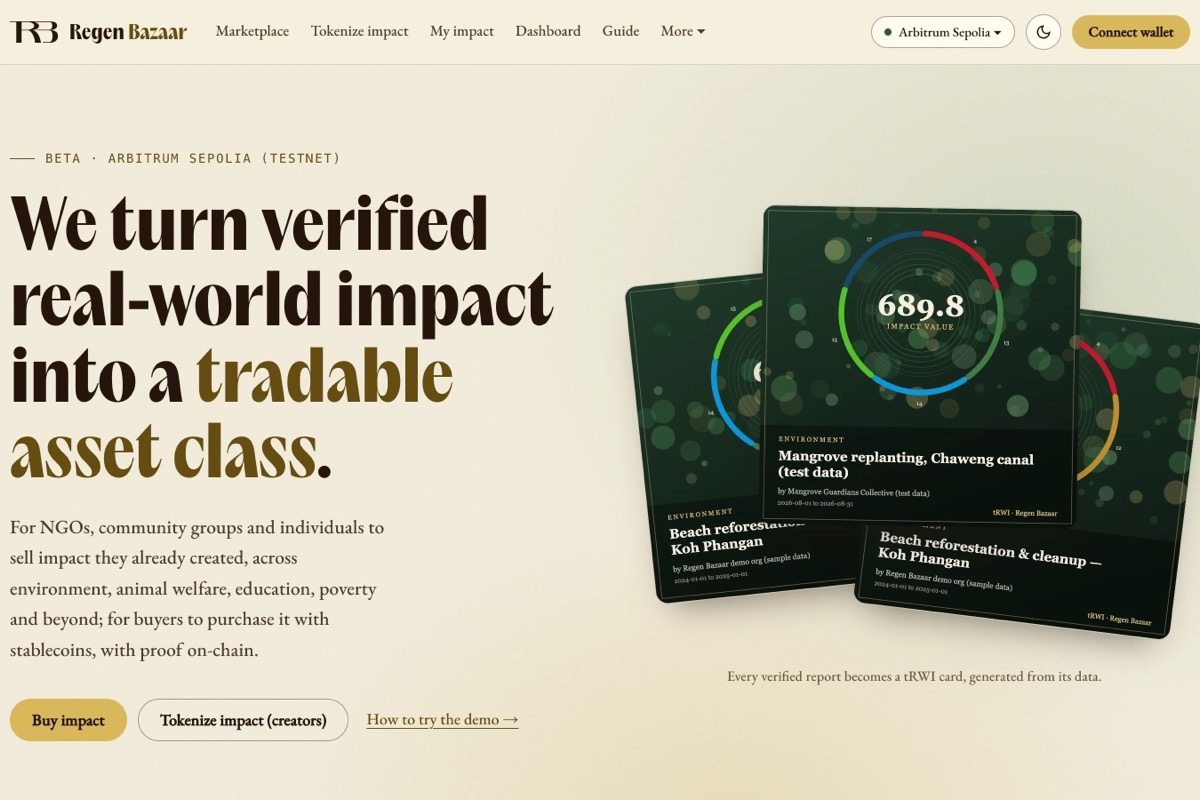
Regen Bazaar beta: verified real-world impact, paid to the people who did the work
-
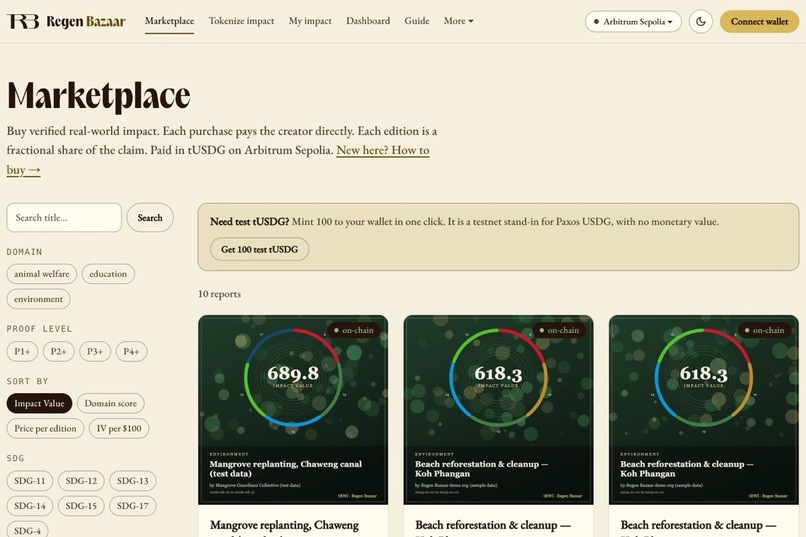
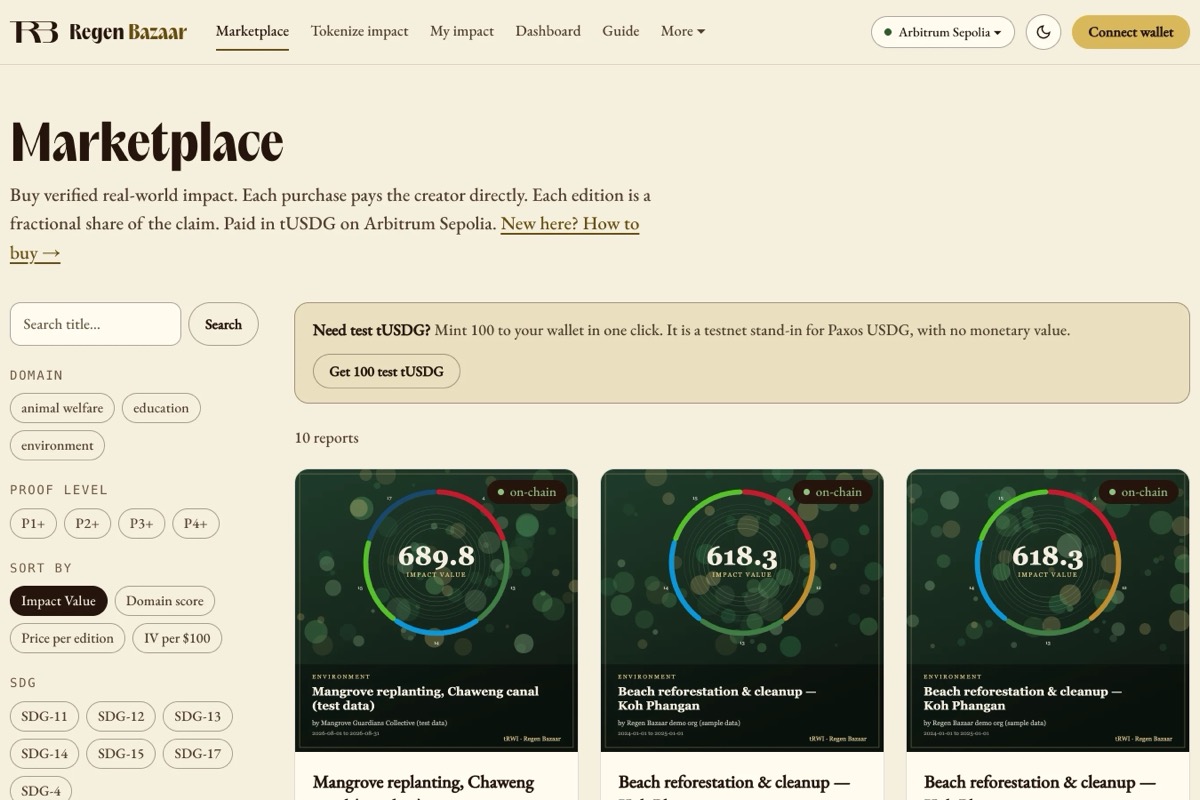
Marketplace: filter by impact area, proof level and SDG
Track: Climate Data & Environmental Monitoring
Why this track
The track describes our problem in one line: environmental data is fragmented and difficult to verify. A lot of hands-on climate work is done by small groups and individuals: beach cleanups, mangrove planting, reef cleanups. The result is real, but the record of it is a few photos and a chat message. No one can check it, reuse it or pay for it, so the work depends on volunteers' spare time and stops when that runs out.
Regen Bazaar covers two items from the track's build list. It is a climate data verification platform: a report becomes physical units, a reproducible score, a proof level set by a person and an on-chain attestation. It is also a climate data marketplace: verified results are sold, and the payment goes to whoever did the work. The sale is what keeps the data coming.
How it works
- A creator (an NGO, an informal group or one person) writes what they did in plain language, where, and links to the evidence.
- A language model reads the report and lists the actions it states, each with a quantity and a unit. The creator corrects the list. The model never sets a score.
- Methodology v0.2 turns each action into physical units, such as hectares per monitored year or kilograms of waste, and scores it with published weights. The same report and table version always give the same number.
- A validator reviews the evidence and sets a proof level from P0 to P4. P0 is never listed. The proof level moves the price and never the score.
- The claim is attested on-chain with the Ethereum Attestation Service and its metadata is pinned to IPFS. The report is listed on one network only, split into 100 editions.
- A buyer pays in a stablecoin (in native CELO on the Celo testnet). In the same transaction the contract pays the creator 97.5% and the platform 2.5% (95 / 2.5 / 2.5 when a partner brought the report) and mints the editions to the buyer. A buyer can retire an edition: it is burned and the chain records who retired it.
Where the AI stops
The hackathon pairs AI and blockchain, so we drew a hard line between them. The model (Claude Sonnet) does one job: it turns free text into structured facts, which the creator and a validator can see and correct. The number that sets the price comes from a deterministic formula and public tables, so a judge can recompute it by hand. Report text is treated as data, so an instruction hidden in a report cannot change the outcome.
Counting each result once
Double counting is the classic way environmental claims lose trust. We block it at three levels:
- Methodology: lines of the same action are added up before scoring, so splitting a report changes nothing; a tree count alone scores no carbon, only area per monitored year does; work already registered with a carbon standard scores no carbon here.
- Market: one report is listed on one network, so the same work cannot be sold twice across chains.
- Chain: each listing is tied to one attestation, and retired editions can never be resold.
What runs today
- App: https://app.regenbazaar.com, with a network switcher for Arbitrum Sepolia, Celo Sepolia and Robinhood Chain testnet. The full path from a plain-language report to a purchase that pays the creator works on all three.
- Arc mainnet: the sale layer only. Six contracts are source-verified, and one test purchase of an edition for Circle USDC shows the split working with real money: https://explorer.arc.io/tx/0x3f168361af0e580ade9bc6849d8df46e03adbf6c91c0ca54852adfa7fd502be3
- Methodology v0.2, with a public card for every weight marked as sourced, derived or assumption: https://app.regenbazaar.com/methodology
- Open data: https://app.regenbazaar.com/api/impact returns every listing as JSON (actions, units, score, proof level, methodology version), so researchers and AI agents can read it without scraping.
- Contracts in Solidity with Foundry: an ERC-1155 token minted at purchase, an EAS resolver that accepts only authorised attesters, and a sale contract that checks a signed voucher and splits the payment in one call. 75 tests, fuzz tests included. Web app in Next.js with Postgres and a Ponder indexer per network.
- Partner share: an organisation that brought or verified a report gets a fixed share of each sale, on-chain, in the same transaction. Live on all three testnets. The first partner we are connecting is DeCleanup, which proves cleanups with geotagged before and after photos, at 2.5% of each sale.
Who uses it
- Creators need only a wallet. There is no certification fee up front; they are paid on the first sale.
- Buyers, whether people, companies or AI agents, get an on-chain record of exactly which result they paid for.
- Partners earn a share for bringing verified work.
- Researchers get structured, versioned field data through a public API.
Limits
- This is a beta. Listings use test data, and there are no production users or revenue yet.
- The score (Impact Value) is our own relative index. It is not a third-party standard, not a credit, and it gives a buyer no emissions claim. Many weights are still marked as assumptions and need review by domain experts.
- Validators today are the Regen Bazaar team.
- We do not list made-up work on mainnet. The first mainnet listing waits for a real creator.
Next
Open testing with real creators, the first real reports, a community of validators, and the sale layer on mainnet where creators and buyers already are. Roadmap: https://app.regenbazaar.com/roadmap
Team
Paul Burg, solo founder, Da Nang, Vietnam.
Built With
- arbitrum
- arc
- celo
- claude
- erc-1155
- ethereum-attestation-service
- foundry
- ipfs
- next.js
- ponder
- postgresql
- robinhood-chain
- solidity
- typescript
- usdc

Log in or sign up for Devpost to join the conversation.