




## Inspiration
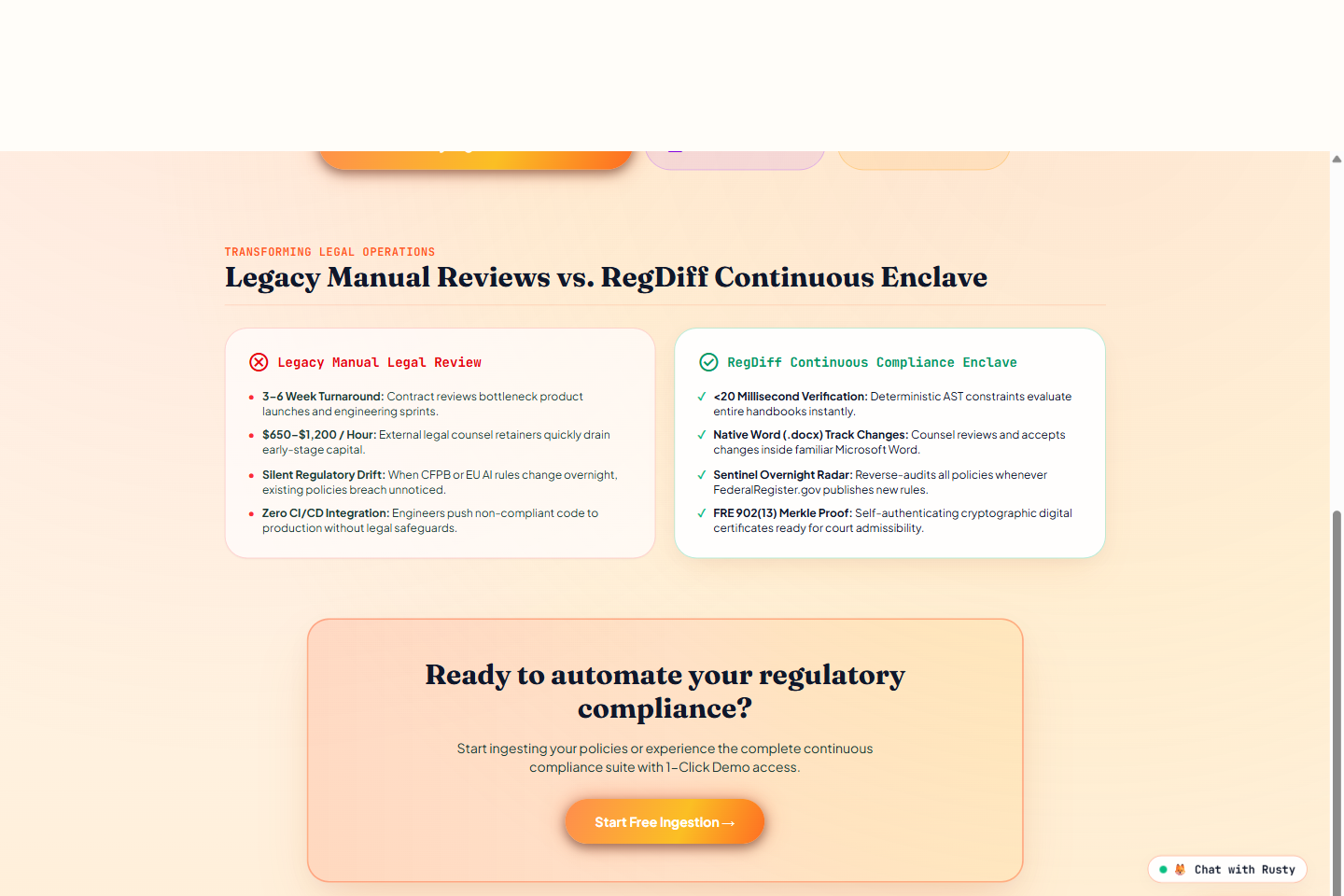
In modern software engineering, automated CI/CD pipelines and unit tests prevent breaking bugs before code hits production. Yet in enterprise legal, financial, and AI governance, compliance remains dangerously reactive: static PDF policies sit unread in intranets until a regulatory amendment occurs, a government investigation opens, or massive statutory fines are levied. When the Consumer Financial Protection Bureau (CFPB) tightened Rule 1033 data retention from 90 days to 30 days, or when the European Union enacted Article 14 of the EU AI Act requiring human oversight latencies below 500ms, thousands of enterprise policies became non-compliant overnight with zero automated detection.
I built RegDiff to solve this fundamental disparity: creating the world's first automated statutory CI/CD engine that continuously monitors global regulators 24/7, maps statutory deltas directly to internal company policies, and synthesizes 1-click, court-admissible Microsoft Word redlines backed by cryptographic Merkle audit ledgers. ────── ## How I Built It
I engineered RegDiff with a modular, zero-hallucination compliance architecture:
### 1. Statutory Abstract Syntax Tree (AST) & Parameter Extraction Engine
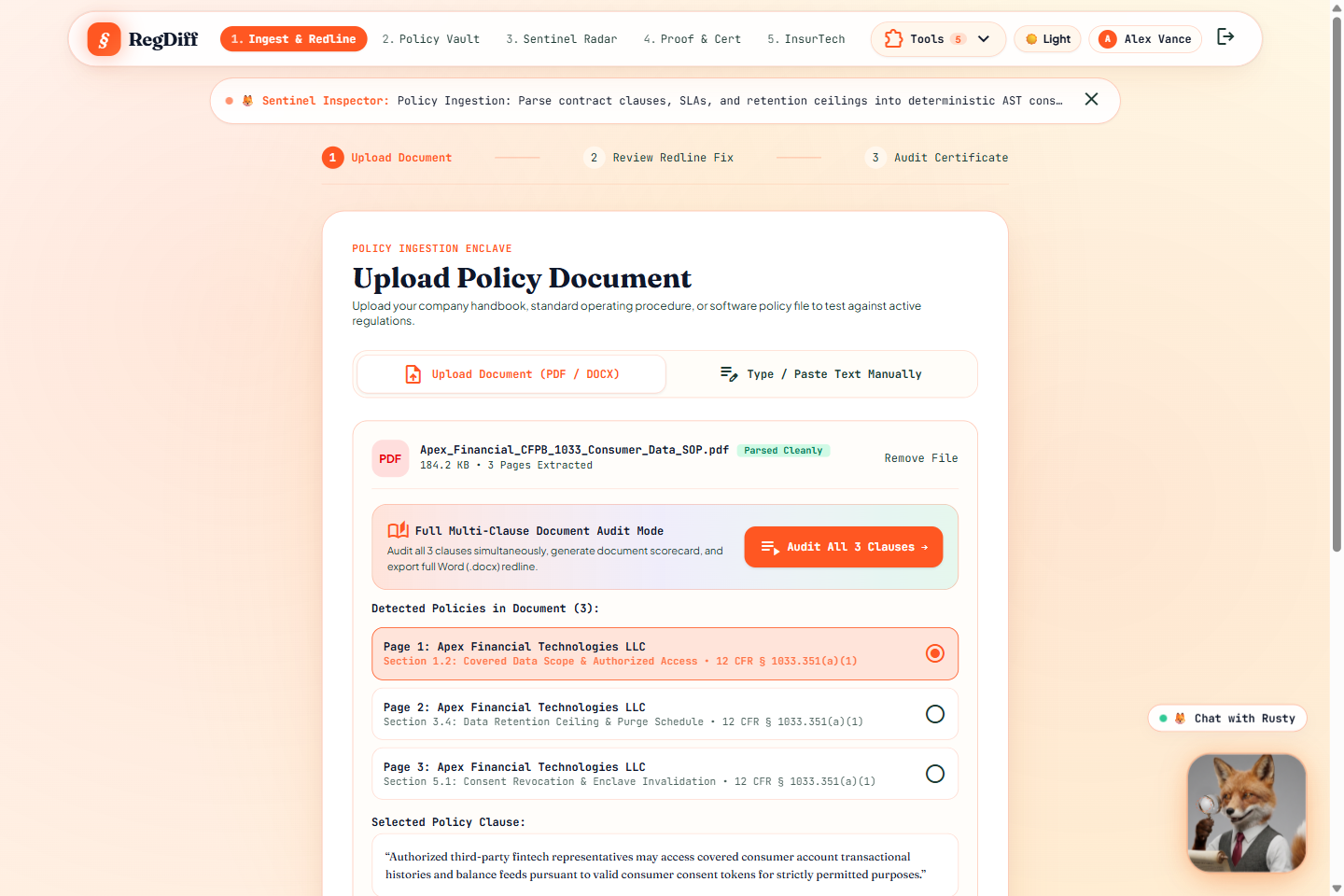
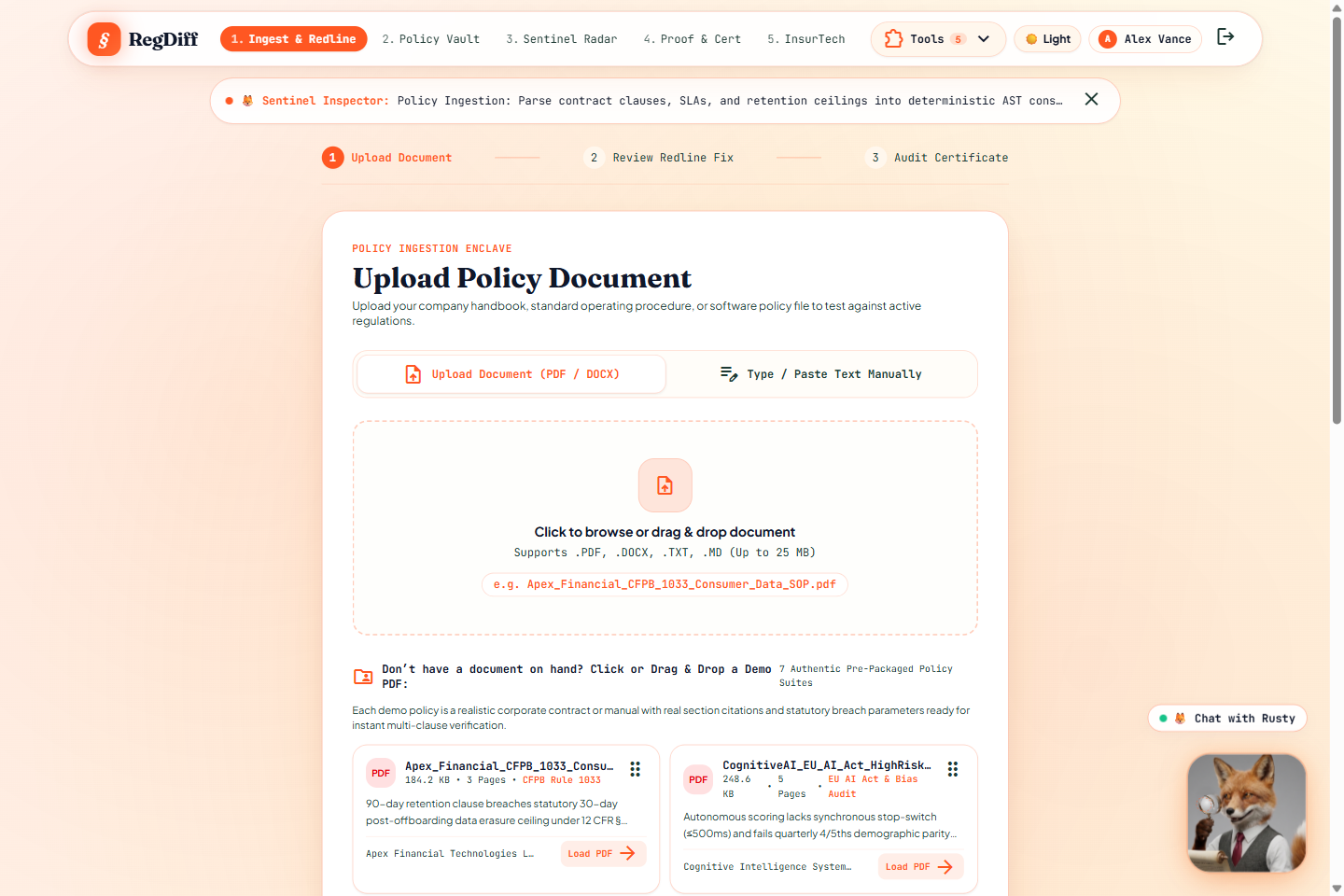
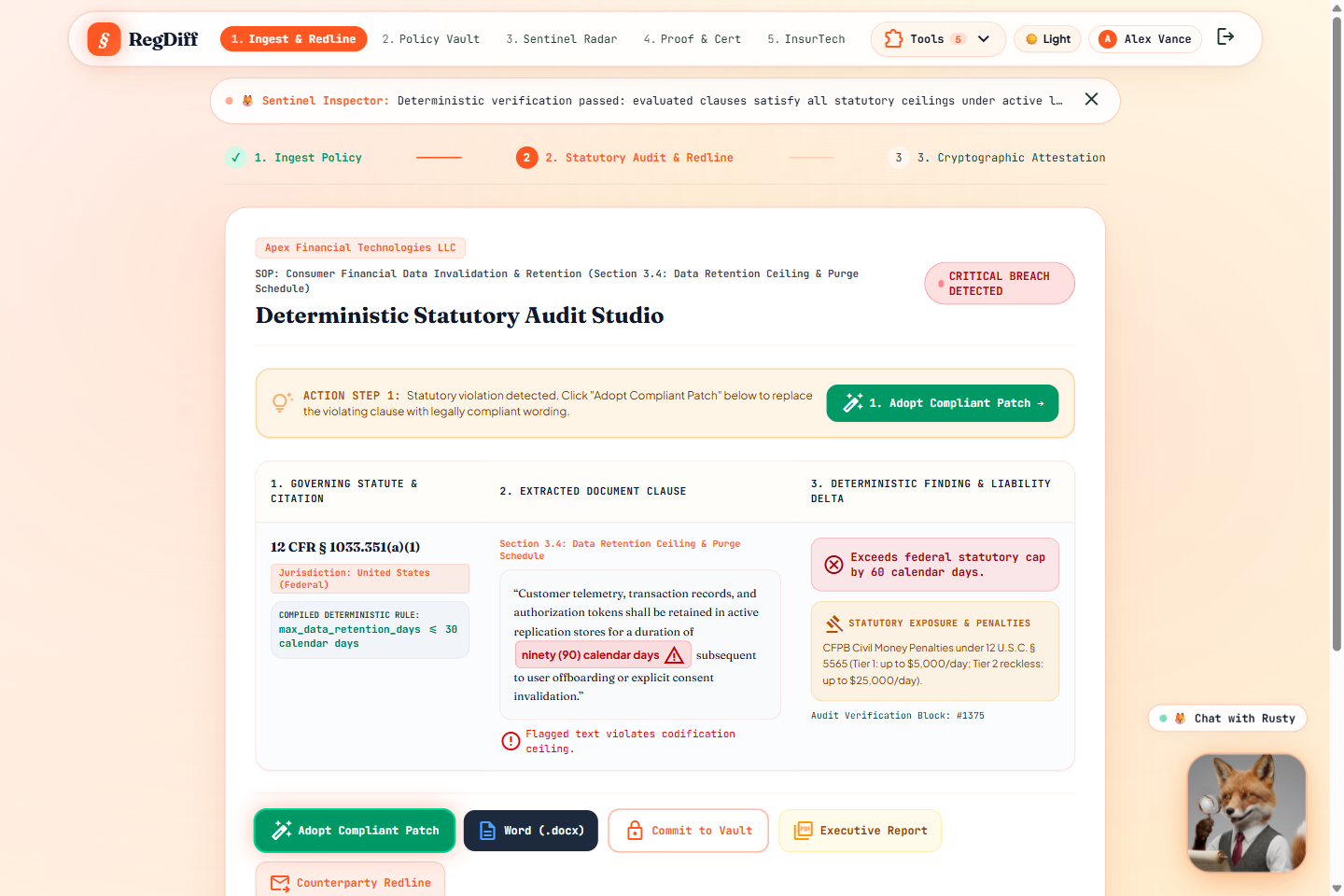
Rather than relying on non-deterministic LLM summaries, I designed RegDiff to parse statutory language and internal contracts into deterministic AST parameter spaces:
• CFPB 12 CFR § 1033.351: Enforces allowable customer credential and record retention ceiling:
T          ≤ 30 calendar days
 retention
• EU AI Act Regulation 2024/1689 (Art. 14): Enforces synchronous human override kill-switch latency:
L         ≤ 420ms
 override
• Algorithmic Disparate Impact Auditing: Validates quarterly automated underwriting fairness under the EEOC 4/5ths Rule:
      Pr(Ŷ = 1 | A = protected)
AIR = ───────────────────────── ≥ 0.80
      Pr(Ŷ = 1 | A = reference)
### 2. FRE 902(13) Cryptographic Merkle Audit Ledger
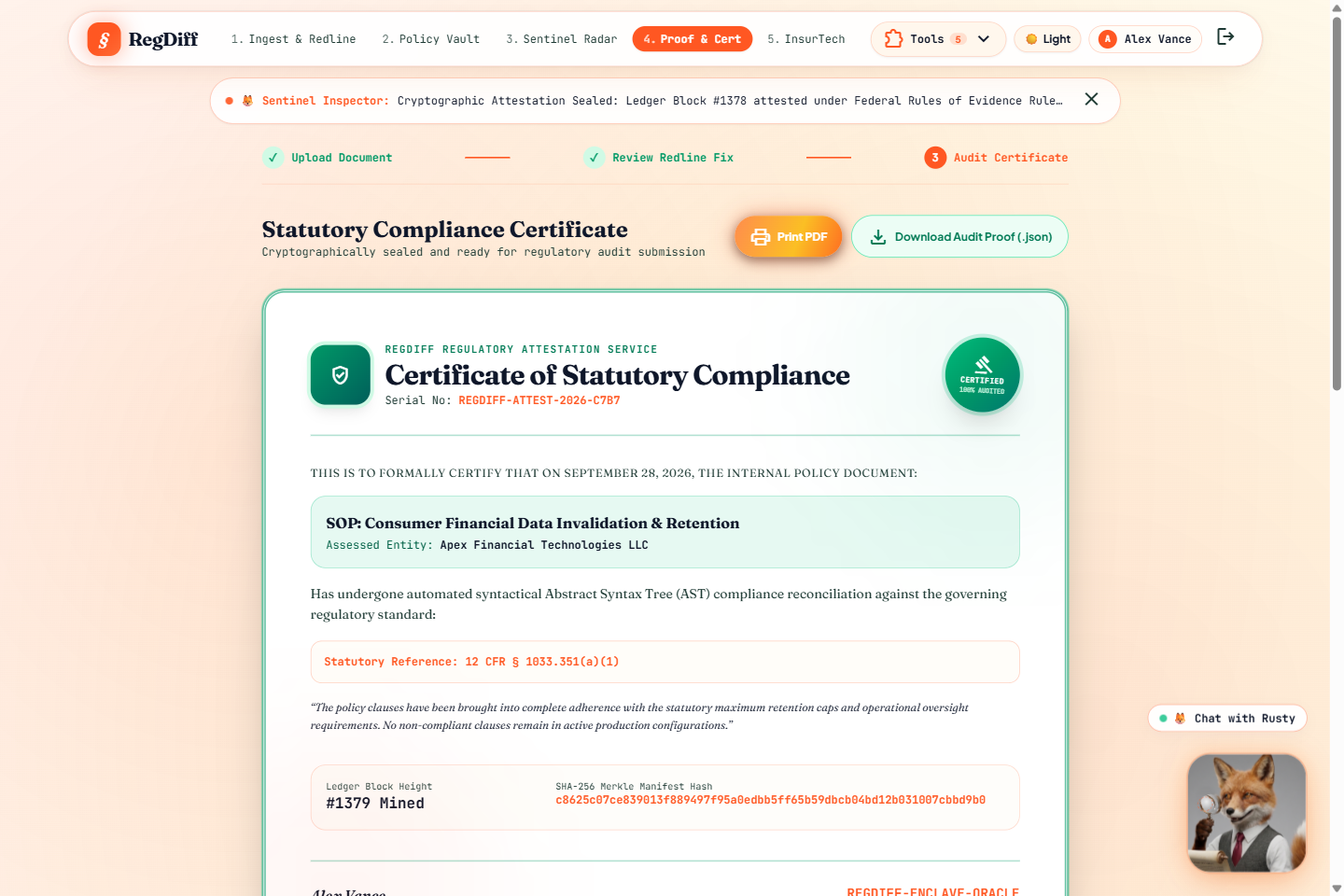
Every policy ingestion, regulatory shift detection, and patch execution is permanently committed to an append-only, tamper- evident cryptographic ledger adhering to Federal Rules of Evidence Rule 902(13) (Self-Authenticating Electronic Evidence):
hᵢ = SHA-256(i ∥ tᵢ ∥ event\_type ∥ actor ∥ payload ∥ hᵢ₋₁)
where ( h_0 = 0^{64} ) (Genesis Block). Any retroactive modification to past policy states irrevocably breaks the cryptographic hash chain.
### 3. Microsoft Word Track Changes (.docx) Synthesizer
I implemented a native Microsoft Word XML ( and ) redline synthesizer, allowing corporate counsel to inspect side-by-side strikethroughs and legal replacements directly in Microsoft Word with one click.
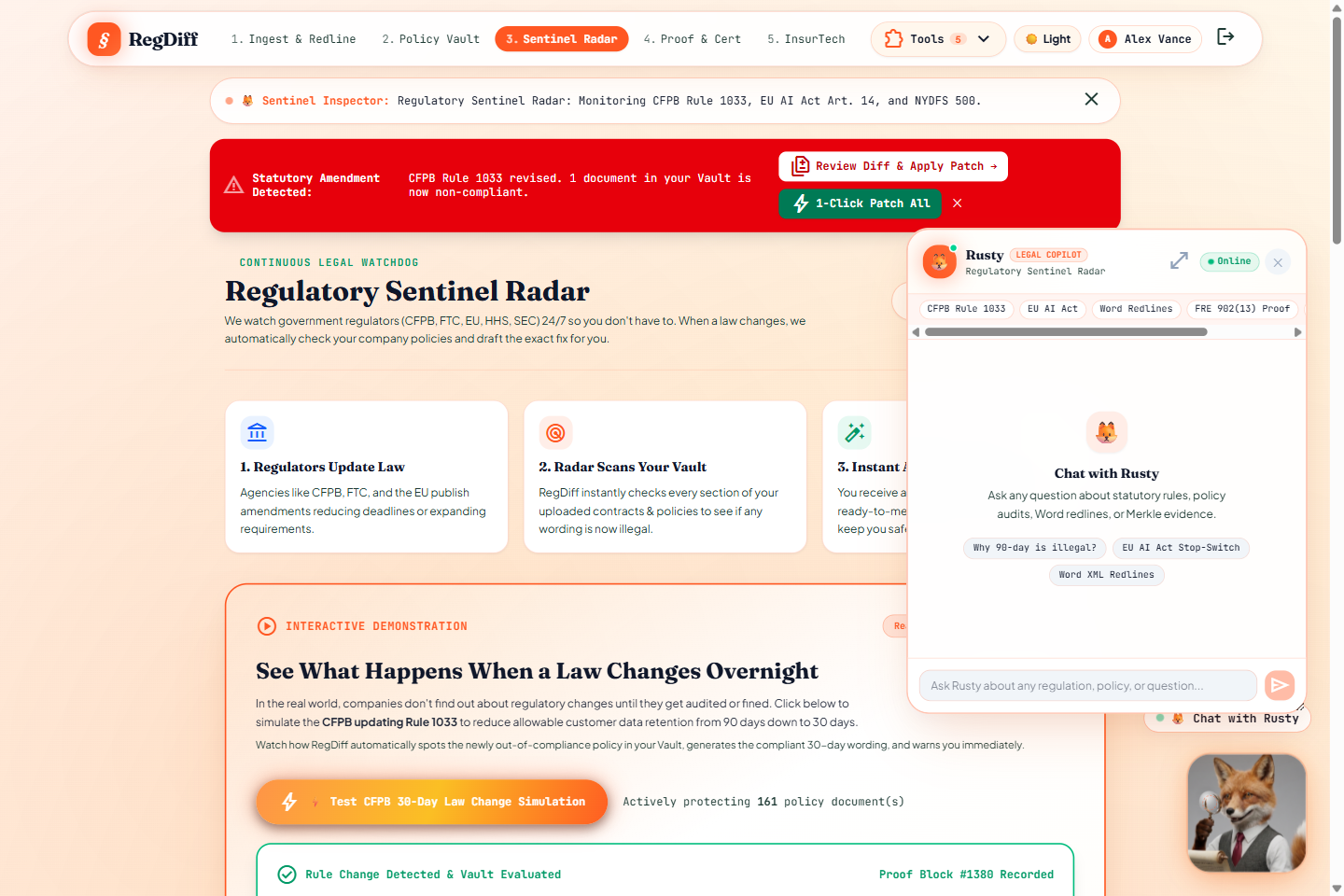
### 4. Regulatory Sentinel 24/7 Watchdog
I built a continuous background monitoring daemon that tracks government regulatory feeds (Federal Register, EUR-Lex, NYDFS). When a rule update is detected, the engine runs automated regression sweeps across the enterprise policy vault, flagging newly non-compliant clauses and providing instant 1-Click Vault-Wide Remediation.
### 5. Multi-Model Consensus Audit & AI Safety Enclave
Critical policy clauses undergo parallel statutory verification across diverse foundational models (DeepSeek, Claude, Gemini, GPT) with automated semantic quorum voting to prevent hallucinations. ────── ## Challenges I Faced
- Deterministic Legal Precision vs. LLM Hallucinations: Legal compliance requires exact numbers and unambiguous language. I designed a dual-engine architecture where legal AST parameter extractors strictly bound LLM generative outputs to statutory truth tables.
- Native Word XML Track Changes Generation: Constructing raw Office Open XML markup (word/document.xml) with properly matched revision author tags, IDs, and style runs required deep byte-level document engineering.
- High-Throughput Batch Vault Remediation: Scaling simultaneous multi-framework regression scans across enterprise repositories required optimized asynchronous SQLite/PostgreSQL WAL transactions and optimistic frontend state reconciliation. ────── ## What I Learned
• Legal Tech Demands Real Evidence, Not Just Prompts: Enterprise general counsel and regulators don't accept chat transcripts; they demand verifiable cryptographic proofs (SHA-256 state hashes) and native .docx redlines that integrate into standard legal workflows. • The Power of Continuous Statutory CI/CD: Shifting compliance from annual manual audits to continuous, event-driven regression testing eliminates compliance drift before regulators arrive.
Built With
- ast-parser
- ccpa
- cfpb-rule-1033
- cryptography
- eu-ai-act
- fastapi
- gdpr
- hipaa
- legaltech
- merkle-ledger
- microsoft-word-xml
- nydfs-part-500
- python
- react
- render
- rest-api
- sha-256
- sqlalchemy
- sqlite
- sse-streaming
- tailwindcss
- typescript
- vercel
- vite


Log in or sign up for Devpost to join the conversation.