-
-
Title card
-
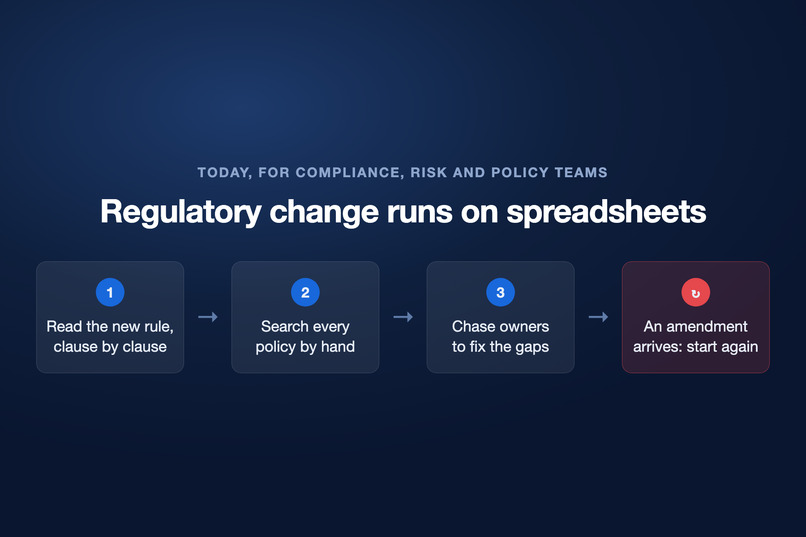
The problem: “Regulatory change runs on spreadsheets”
-
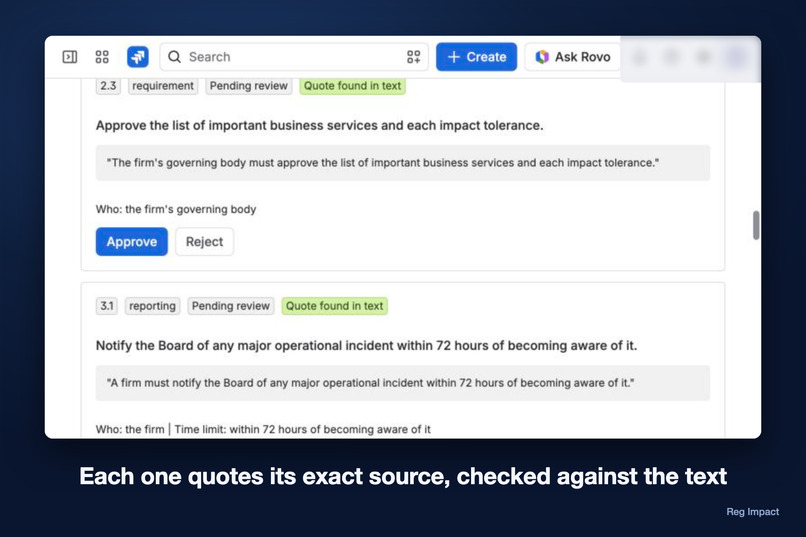
Obligations with verified quotes
-
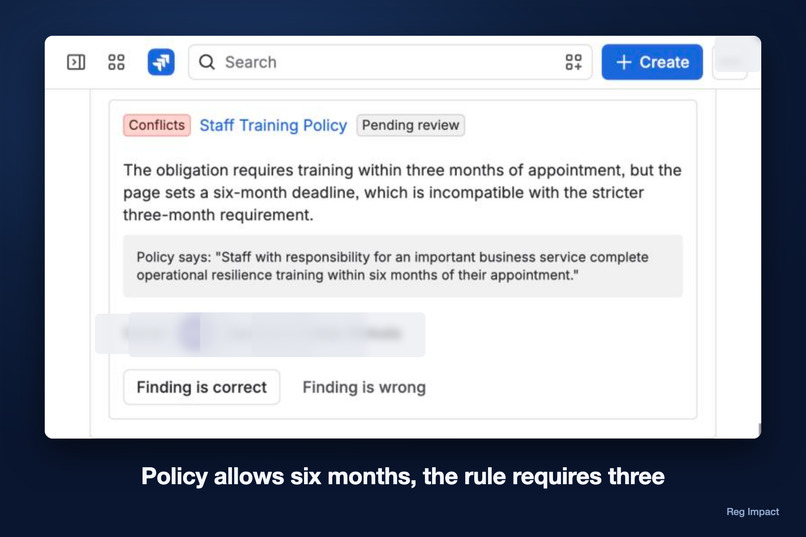
A conflict: the policy allows six months, the rule requires three
-
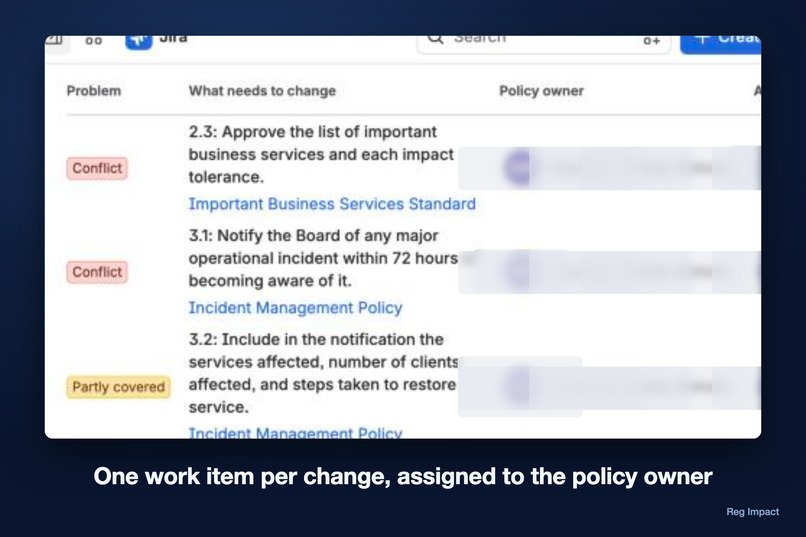
Work items assigned to the policy owners
-
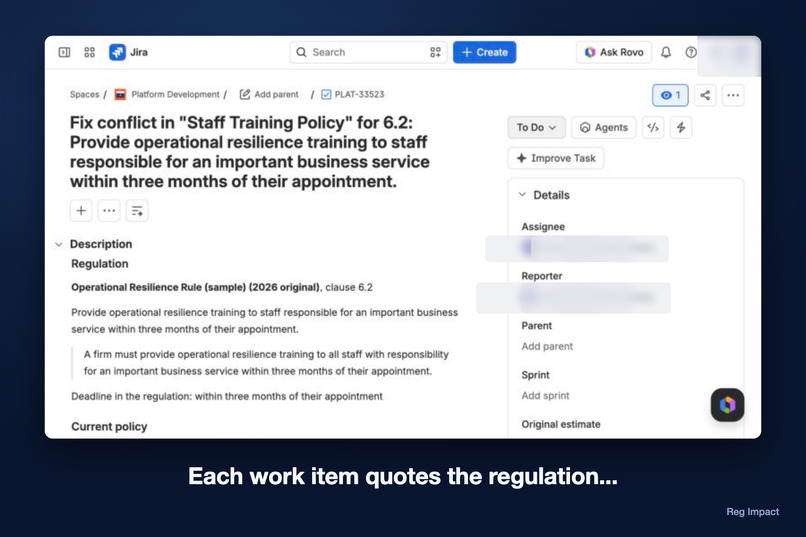
A Jira work item quoting the regulation
-
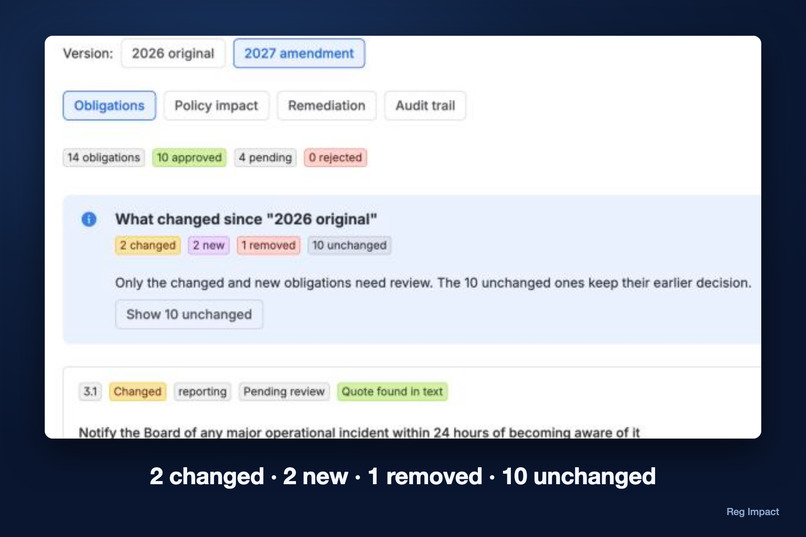
The amendment: 2 changed, 2 new, 1 removed, 10 unchanged
-
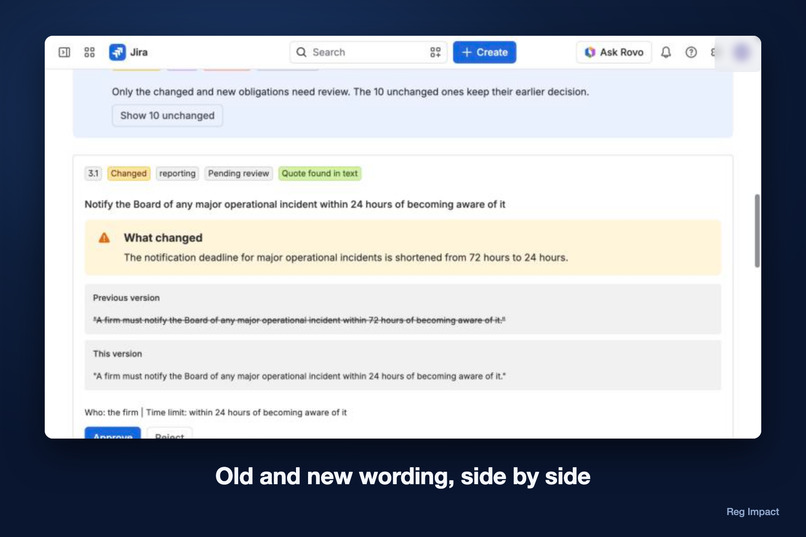
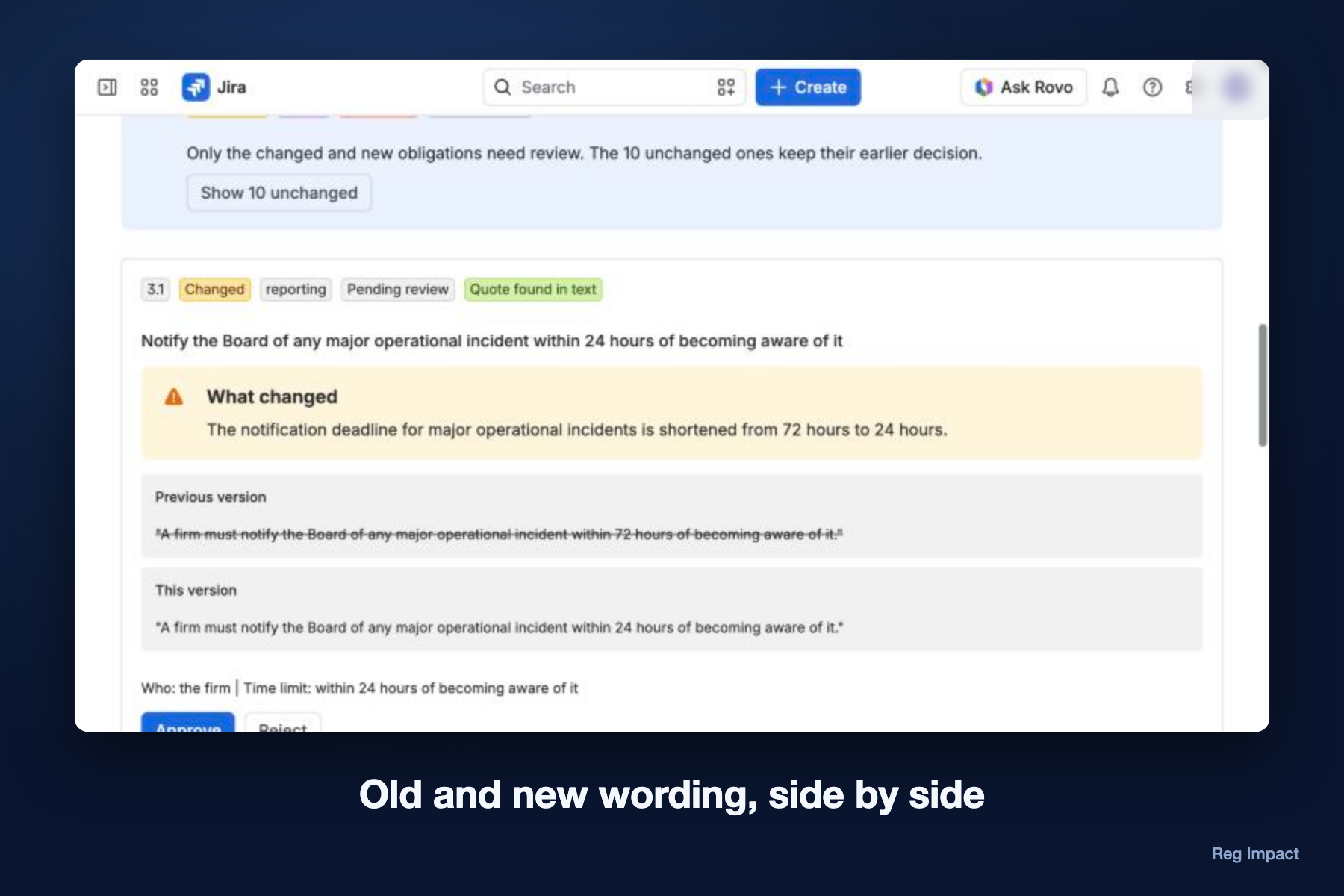
Old and new wording side by side
-
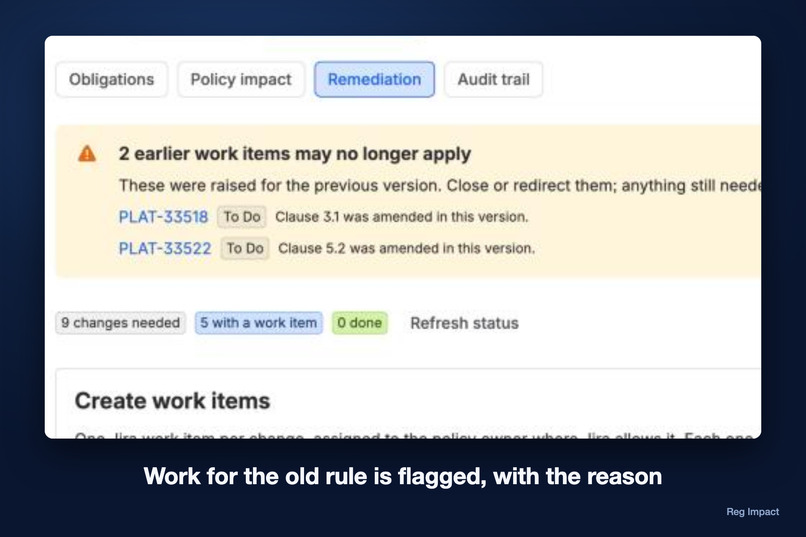
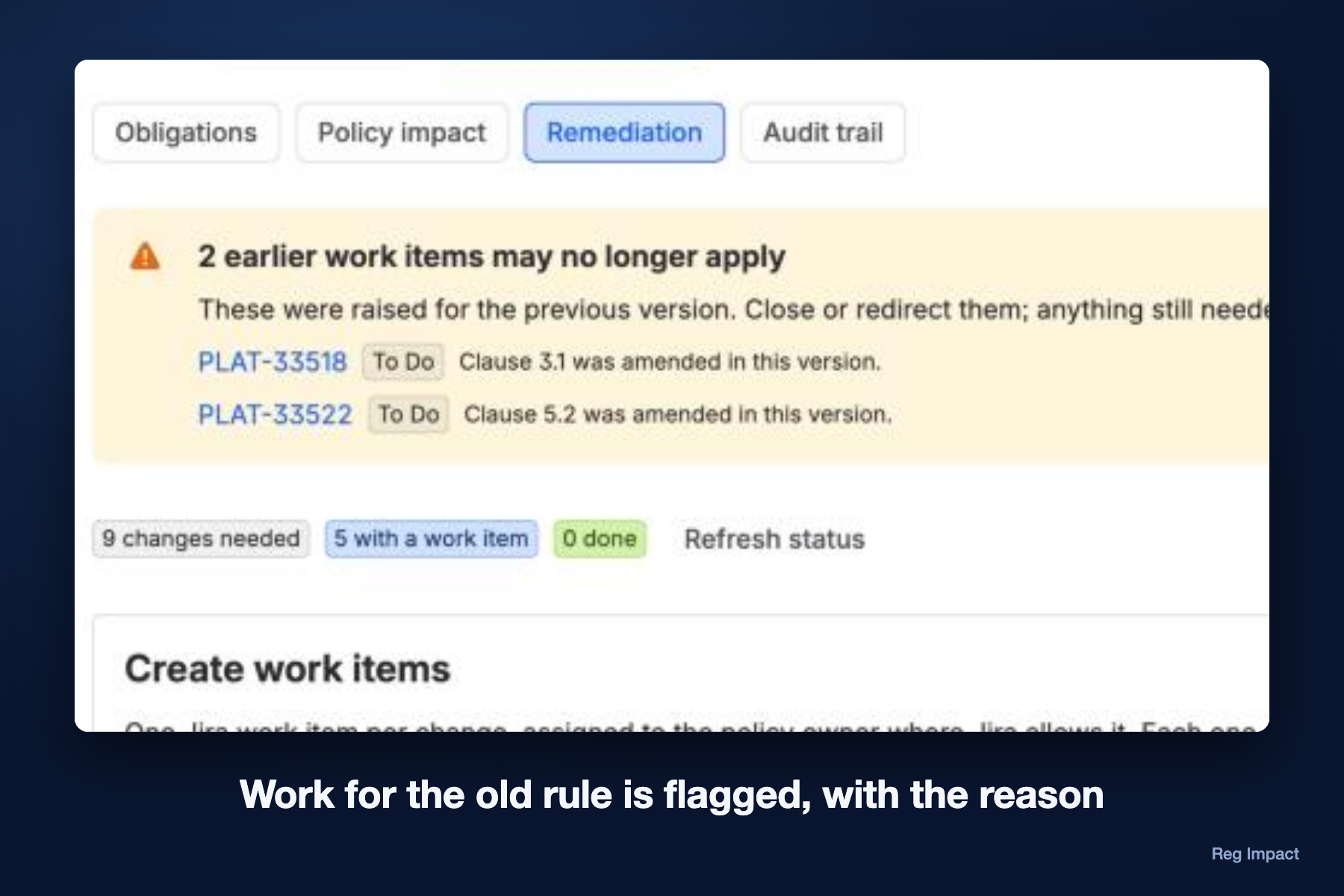
Obsolete work items flagged
-
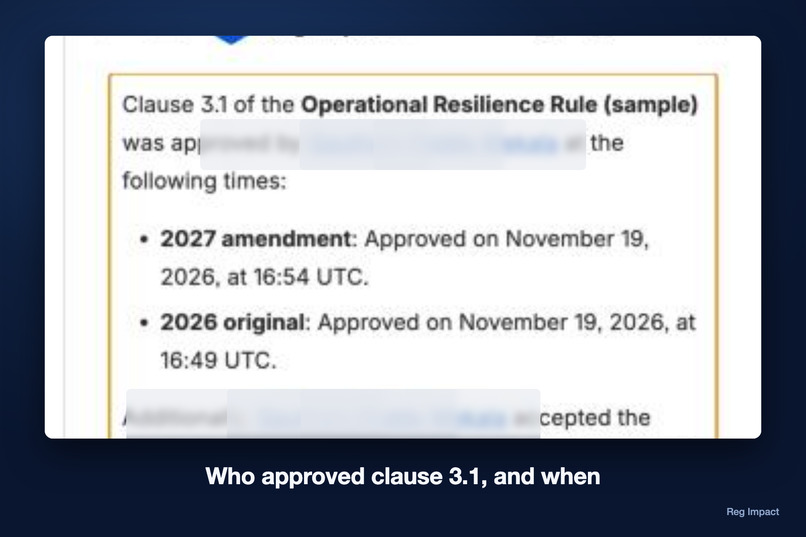
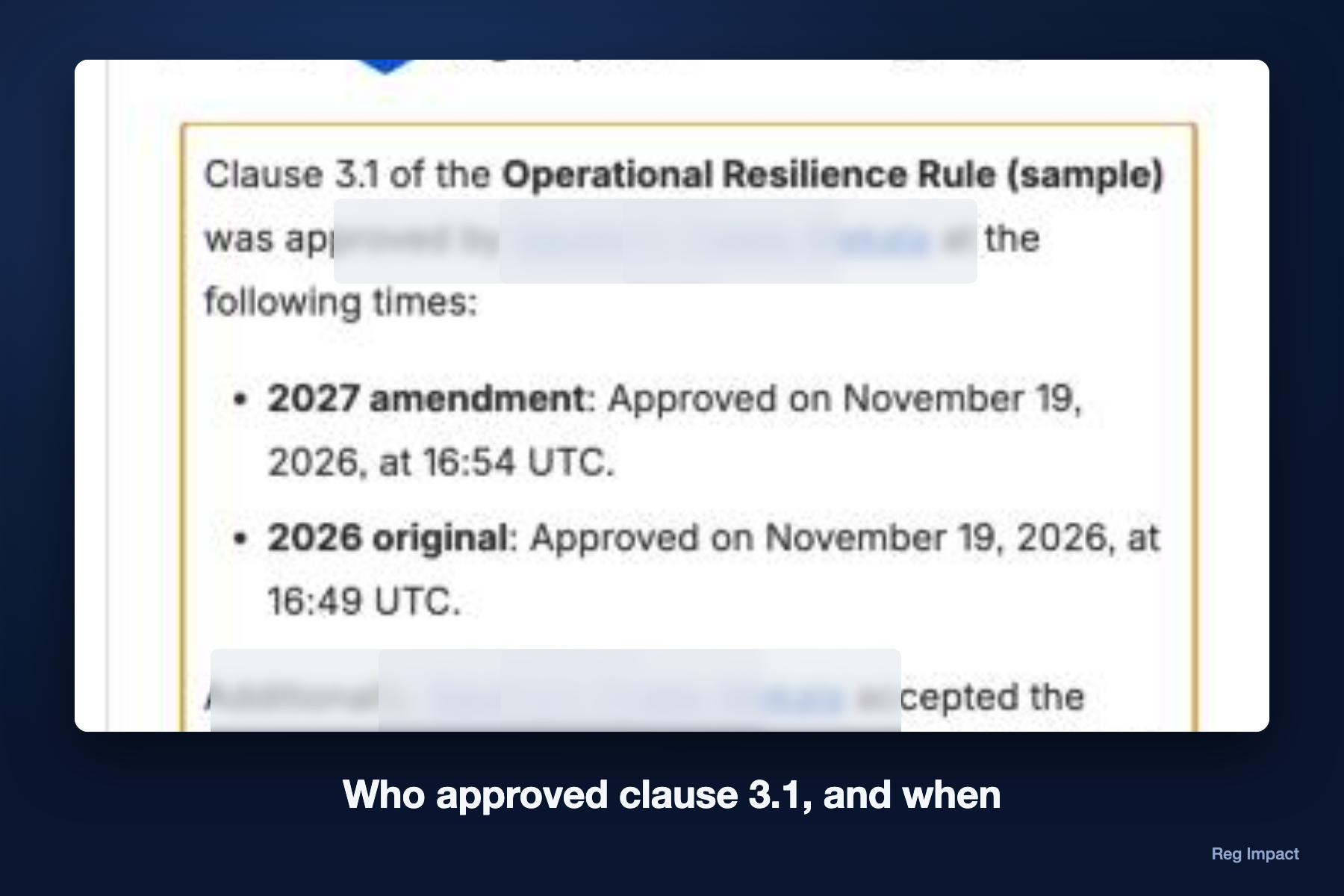
The Rovo agent: who approved clause 3.1
-
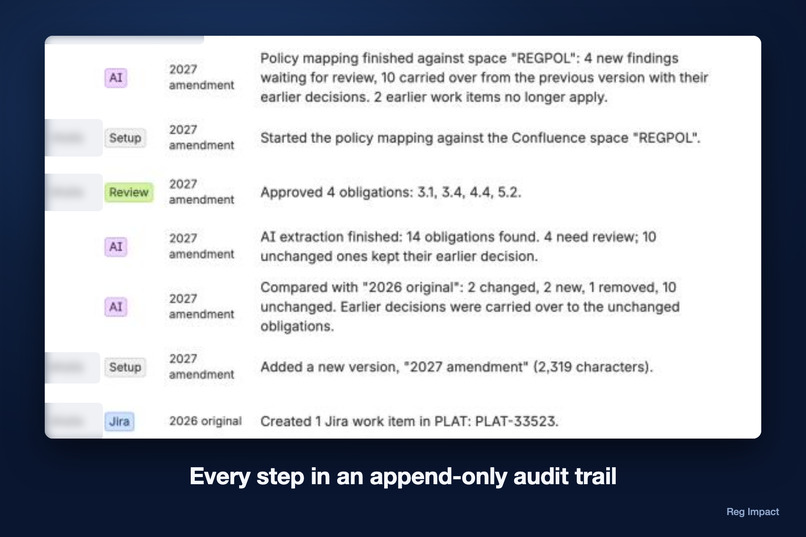
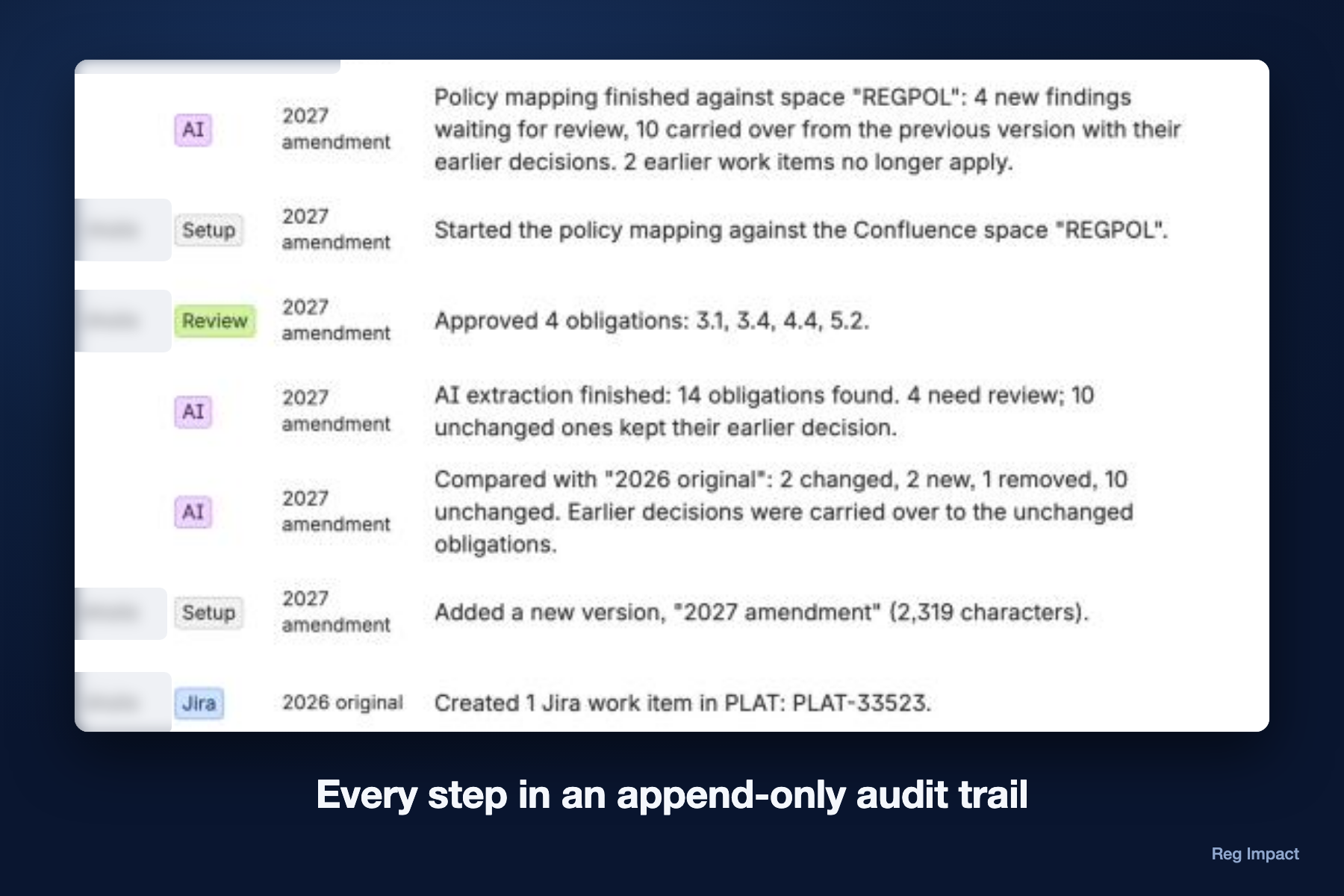
The audit trail
-
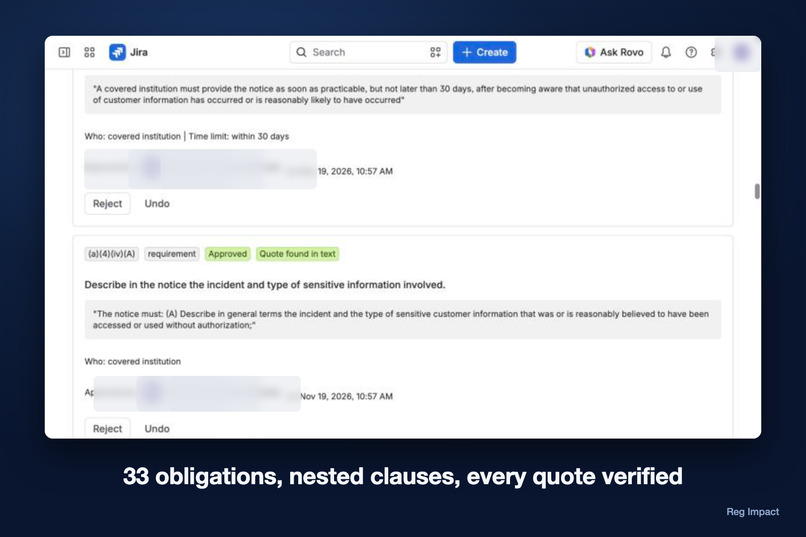
The real regulation (SEC Reg S-P)
-
Under the hood
Inspiration
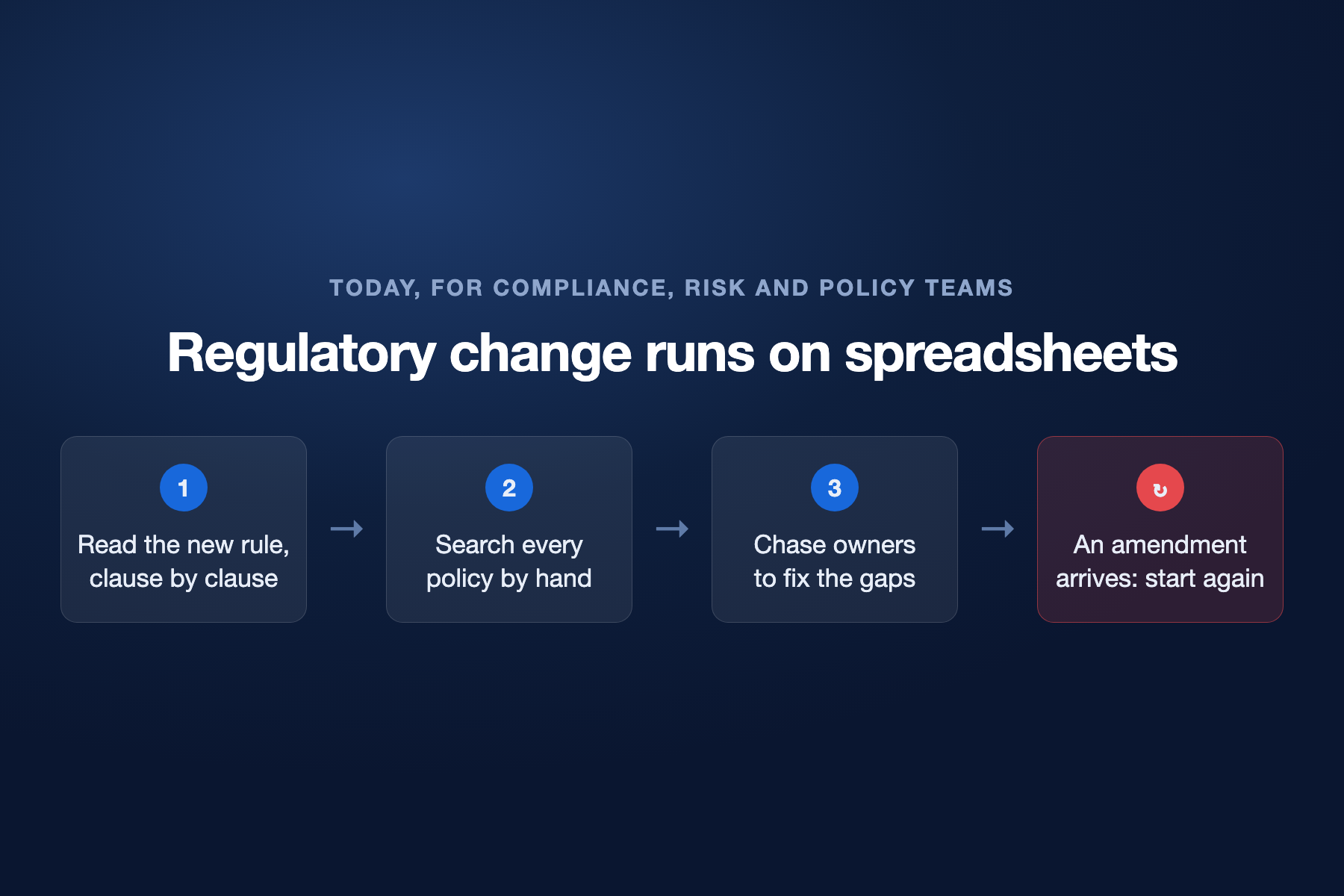
In regulated industries, a new rule or an amendment from a regulator starts a familiar manual loop:
- Read the text clause by clause and list every duty.
- Search the firm's policies for each one.
- Chase the people who own the gaps.
- When the regulator amends the rule, start all over again.
It usually runs on spreadsheets and copy-paste, and the hardest part is the amendment: nobody wants to re-review a whole rule because one sentence changed.
Atlassian already holds both halves of the problem: the policies live in Confluence and the work lives in Jira. We wanted to close the loop where the teams already are, and to make AI help with the reading without ever letting it make the decisions.
What it does
Reg Impact turns a new regulation into reviewed, owned Jira work, and handles each amendment by re-checking only what changed.
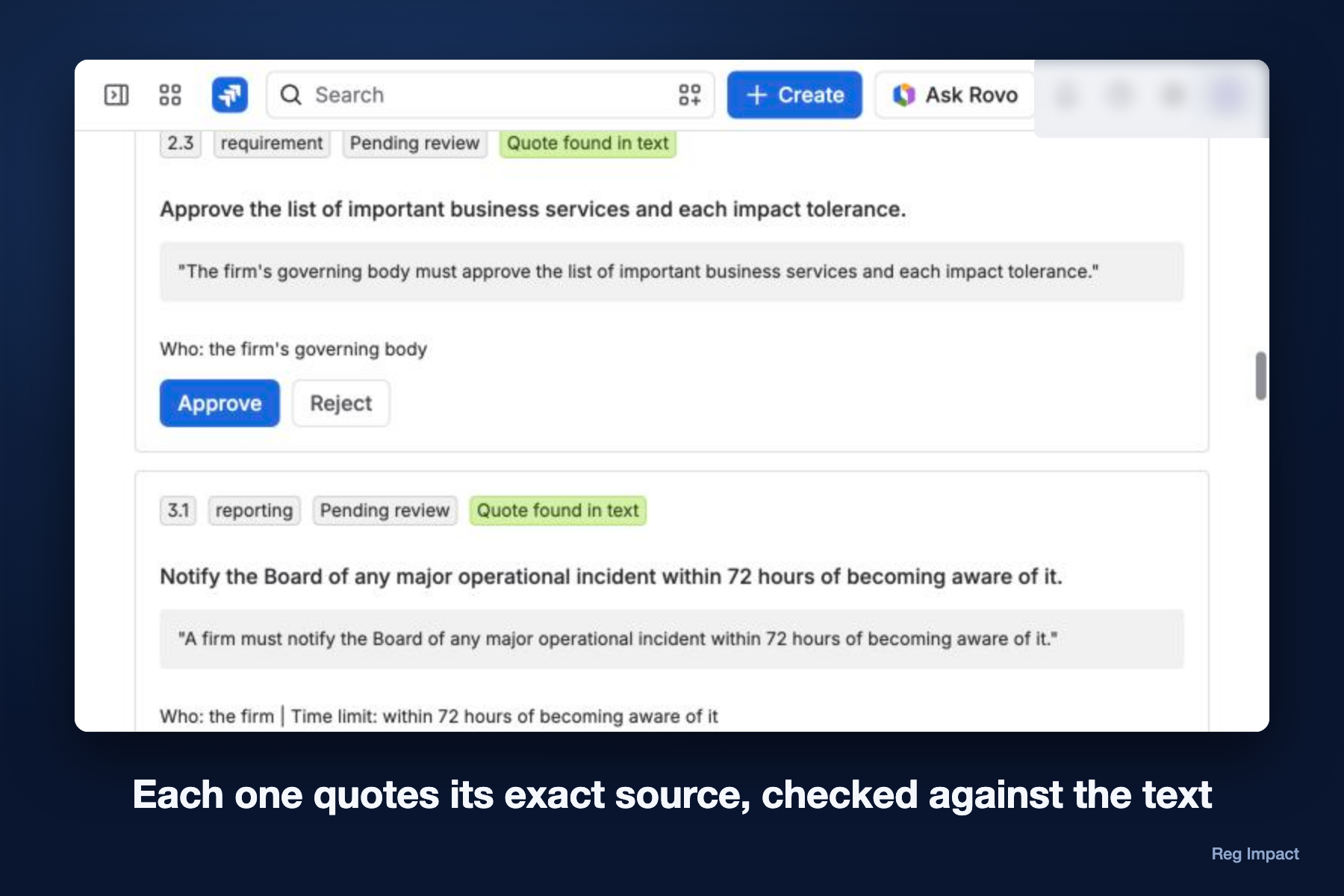
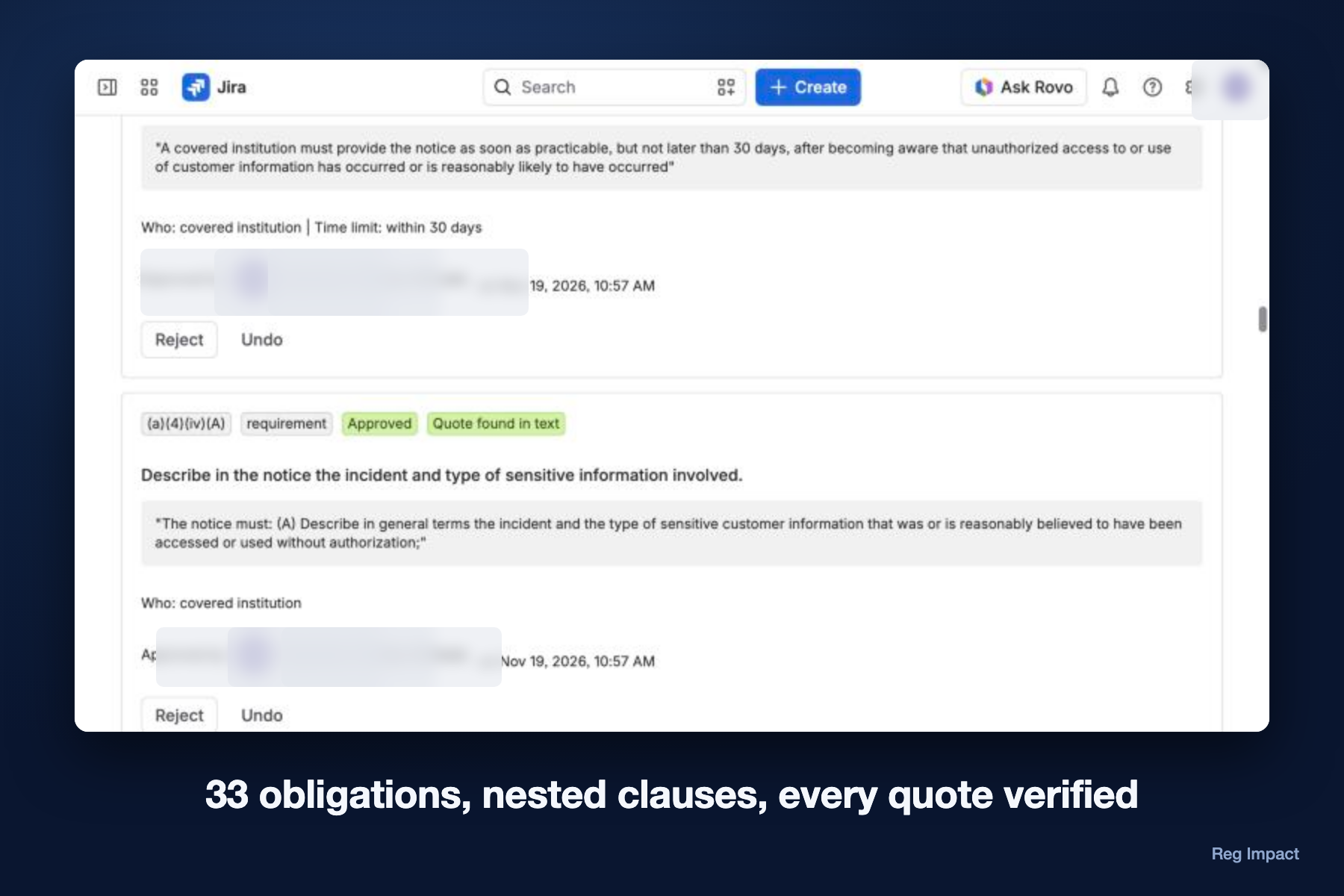
- Extract. Paste a regulation. The AI lists every obligation, with its clause number, who must comply and any time limit, and quotes the exact passage it came from. The app checks every quote against the source text.
- Review. A person approves or rejects each obligation. Nothing unreviewed goes any further.
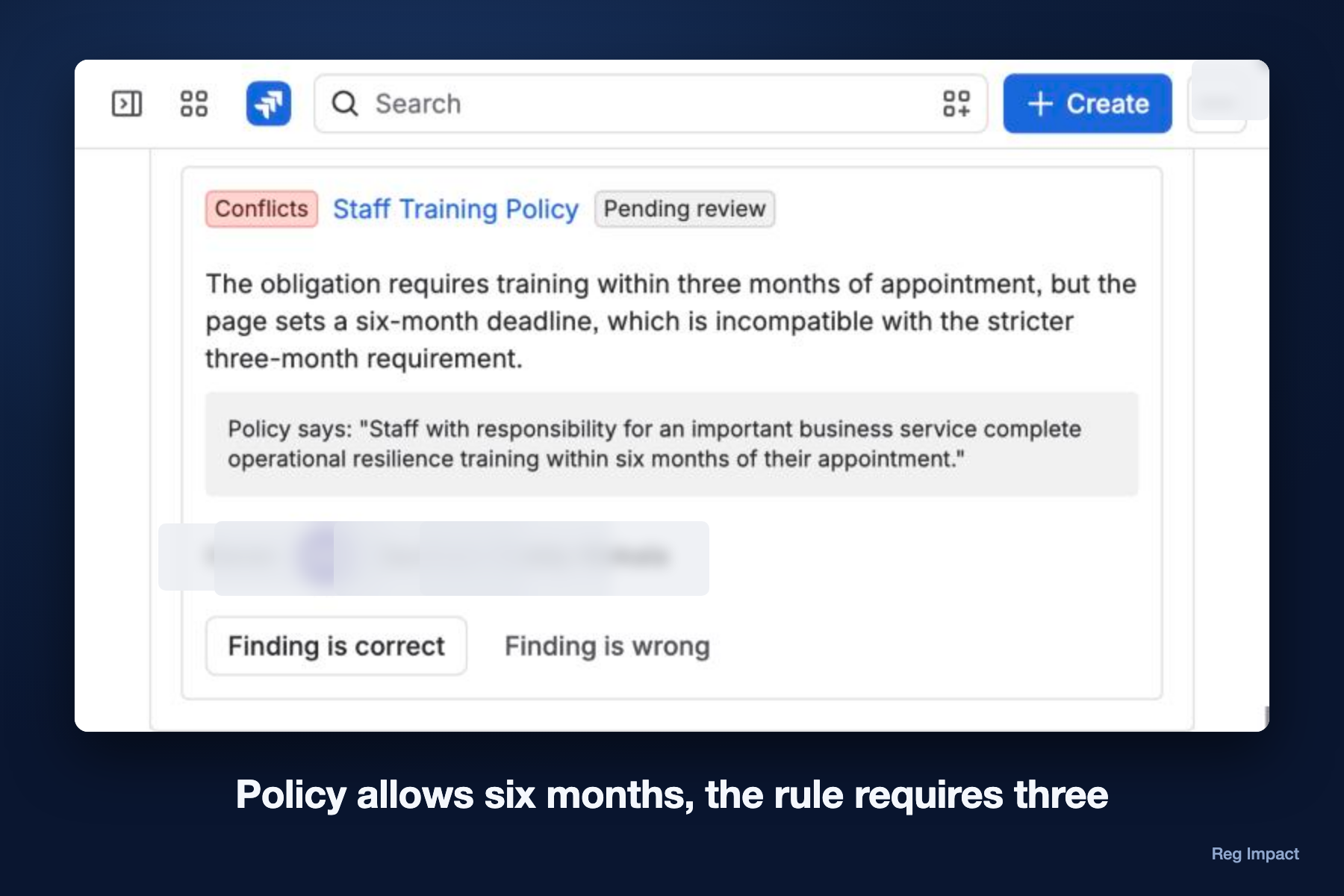
- Map to policies. Each obligation is compared with every page in a Confluence policy space. The result is covered, partly covered (naming the page to extend), conflict (for example "the policy allows six months; the rule requires three") or no policy, with both sides quoted. A reviewer accepts or rejects each finding.
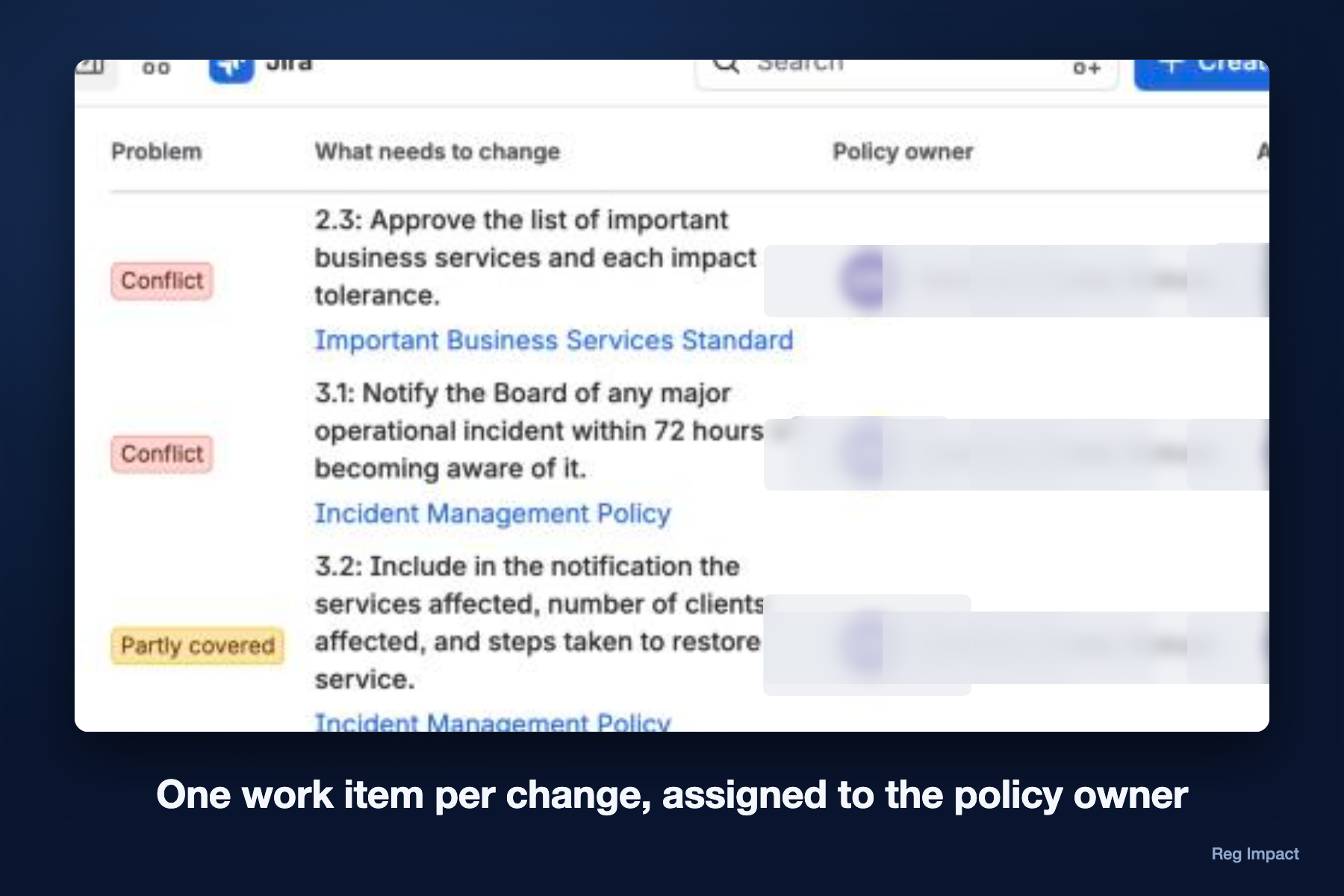
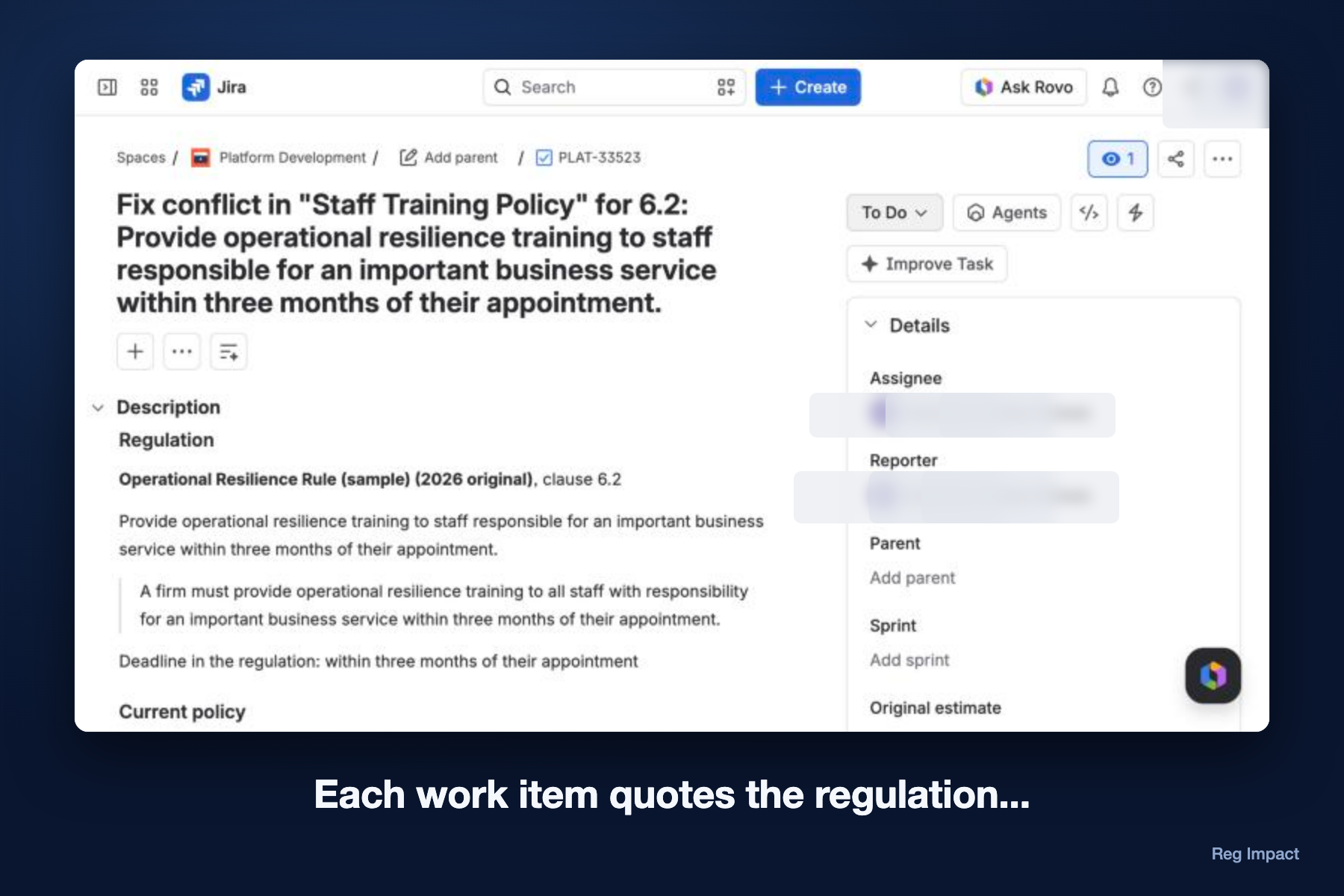
- Remediate. One click creates a Jira work item per conflict or gap. It's assigned to the owner of the policy page, quotes the regulation and the policy, and links to the page. Live status shows in the app.
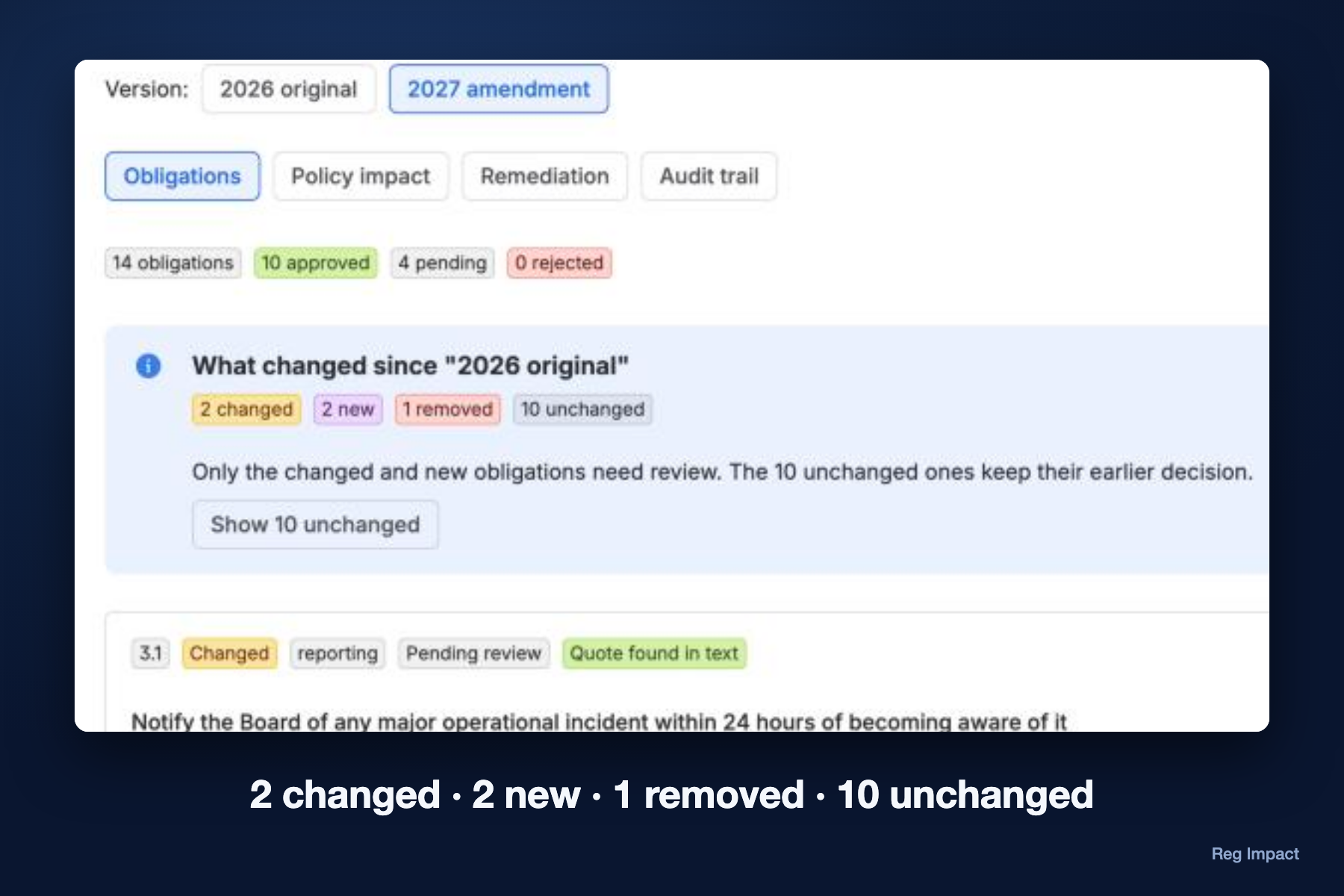
- Amend. Add a new version and Reg Impact compares the two texts clause by clause. You see what changed (old and new wording side by side), what is new and what was removed. Unchanged obligations keep their approvals, findings and work items. Only the changes go back to review, and work items made obsolete by the amendment are flagged, with the reason.
- Audit. Every version, AI run, decision and work item is recorded with who and when, in an append-only trail.
- Ask. The Reg Impact Rovo agent answers questions such as "What changed in the amendment?", "Which policies conflict with the rule?" and "Who approved clause 3.1?", with clause citations and links. It can only read. The same six tools are offered to outside AI clients through Rovo MCP, with a skill.md that explains how to use them.
How we built it
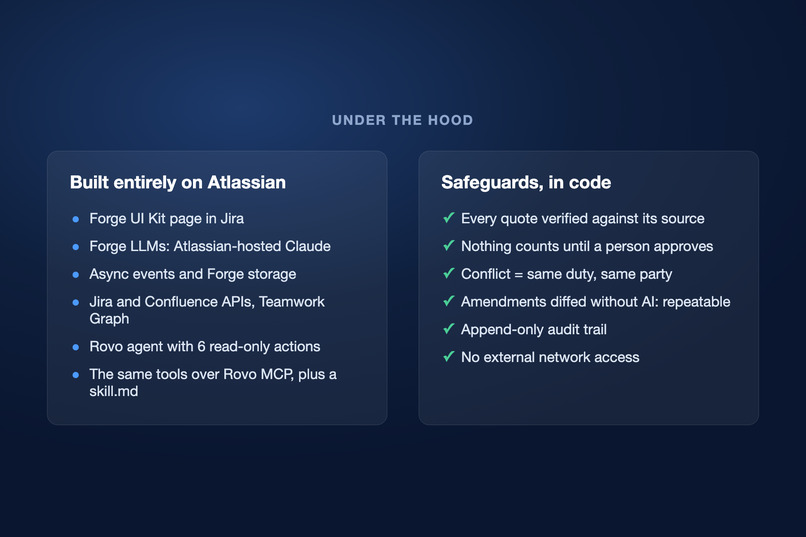
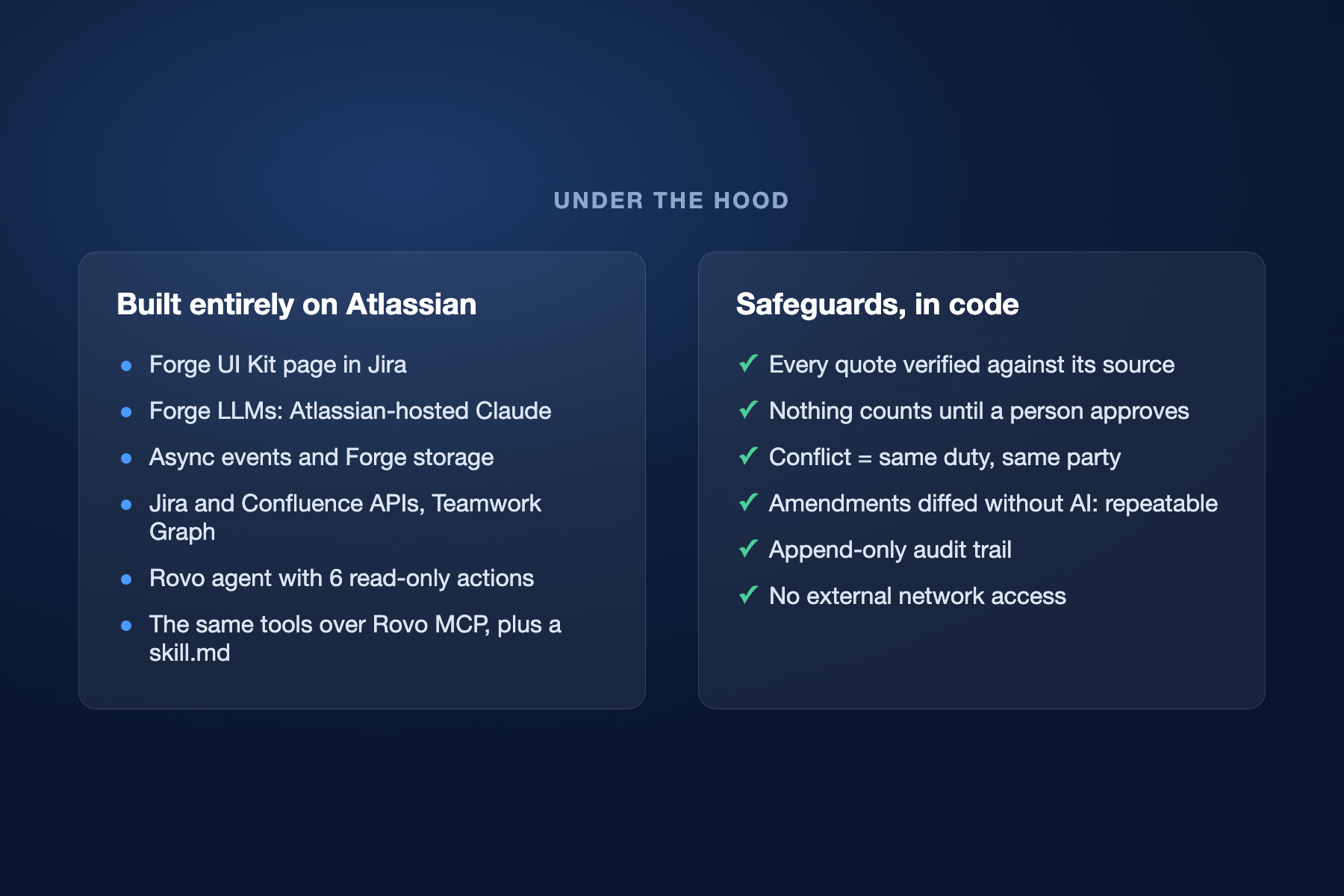
Reg Impact is a Forge app that runs entirely on Atlassian. It declares no external network access.
- Forge UI Kit global page in Jira for intake, review, policy impact, remediation, the audit trail and a guided demo.
- Forge LLMs (Anthropic Claude, hosted by Atlassian) for extraction, policy comparison and amendment summaries, so regulation and policy text never leaves Atlassian's platform. Every call forces structured output through a tool schema.
- Forge async events run the AI work as background jobs of up to 15 minutes, well beyond the 25-second limit for page requests.
- Forge storage holds regulations, versions, obligations, findings, work-item links and the audit trail.
- Confluence and Jira REST APIs read policies, create work items with remote links and read live status.
- Teamwork Graph looks up the owners of, and contributors to, each policy page.
rovo:agentwith six read-onlyactionmodules, androvo:mcpexposing the same actions as tools.
The safeguards live in code, not just in prompts:
- Quote verification. Every obligation and policy quote is checked against its source, and any mismatch is flagged.
- Human approval gates. Only approved obligations are mapped, and only accepted findings become work.
- A same-duty check for conflicts. The model has to confirm that a policy rule governs the same duty, owed to the same party. Anything else is downgraded to "partly covered". The regulation's own definitions are passed in, so a defined term such as "the Board" is read correctly.
- Deterministic amendment diffing. What changed is decided by comparing the two texts, not by the AI, so the result is repeatable and explainable. The model only writes the one-line summary of each change.
- Loud failures. A malformed or cut-off AI reply is retried, then reported as an error. It never becomes a silent "nothing found".
Challenges we ran into
- Silent AI failures. Early on, a malformed structured reply was read as an empty list, producing "0 obligations" or "no policy covers this" that looked plausible. We moved every AI call behind one helper that validates, retries and fails visibly.
- Getting conflicts right. The first version over-reported conflicts: for example, "notify the regulator" contradicting "notify clients", or "the Board" treated as a different party from "the regulator". Tightening the rules then hid useful partial matches. We ended with a balanced rubric plus a same-duty check enforced in code, and tested it on a real regulation as well as our sample.
- Diffing what an AI extracted. The model can quote the same passage slightly differently on two runs, so obligations can't be compared quote-to-quote. Our diff checks each quote against the other version's full text, in both directions, to tell unchanged, changed, new and removed clauses apart.
- Platform realities. We worked around the 25-second resolver limit with queues, intermittent Teamwork Graph errors on new sites with quiet retries, and a Jira install that reports "failed" on brand-new sites before completing. External MCP access is currently refused when an app is installed in both Jira and Confluence, a bug Atlassian has acknowledged; we documented a workaround.
Accomplishments that we're proud of
- Amendment handling with carry-over. Approvals, findings and Jira work survive an amendment, and only what changed goes back to review. That's the part no spreadsheet does.
- It works on a real regulation, not just our sample. On the official text of SEC Regulation S-P (17 CFR 248.30) it found 33 obligations, rebuilt clause references down to (a)(4)(iv)(H) with every quote verified, and correctly left out permissions, rules of interpretation and definitions.
- A judge-ready install. We installed from the sharing link on a brand-new site, and a one-click demo with a step-by-step guide takes a first-time user through the whole flow.
- An agent you can audit. The Rovo agent answers "who approved what, and when" from the audit trail, and it can't change anything.
What we learned
- Check the AI's work in code. Structured output, quote verification and validation in code catch failures that better prompts alone do not.
- Keep the AI out of where determinism matters. Making the amendment diff AI-free made it trustworthy and easy to explain.
- Test on real text early. A real regulation exposed two problems the sample never did.
- Design for the human reviewer. Compliance users need evidence they can check (quotes on both sides) more than a confident answer.
What's next for Reg Impact
- More ways in. Import regulations from PDFs and regulator feeds, not just pasted text.
- Help with the fix. Suggest redlines for policy pages, which a person accepts in Confluence.
- A portfolio view across many regulations and versions.
- A Marketplace listing after the hackathon, and full external MCP access once Atlassian's fix lands.
- Account-closure handling for stored account IDs, ahead of wider distribution.
Built With
- anthropic-claude
- atlassian-forge
- confluence
- confluence-rest-api
- forge-events
- forge-llm
- forge-storage
- forge-ui-kit
- javascript
- jira
- jira-rest-api
- mcp
- node.js
- react
- rovo
- rovo-agents
- rovo-mcp
- teamwork-graph
