Try it
- Demo video (2:55): YouTube link on this page (also at https://rodriguescarson.github.io/refundly/media/refundly-demo.mp4)
- Click around, no install: https://rodriguescarson.github.io/refundly/app.html is the real console, built from the 40-ticket sweep (read-only).
- Run the working app yourself: https://github.com/rodriguescarson/refundly. Three commands
under For judges run the full console with no keys. Add sandbox PayPal and OpenRouter keys and
scripts/live_agent_refund.pyreproduces the live agent refund end to end.
Inspiration
Rekha, 58, was double-charged by a gym app she couldn't find the cancel button for. She called, sat through twenty minutes of hold music, and gave up. Most people give up. The money is small enough to walk away from and the process is exhausting enough that walking away is the rational choice. Multiply that by everyone who has ever been quietly overcharged, or trapped in a subscription built to be un-cancellable, and it is a lot of money that simply stays taken.
An AI agent can do this chore. It can read the complaint, find the charge, and issue the refund.
The thing that kept me up was the failure mode nobody puts on a slide: the agent does the chore
badly and reports that it did it well. The refund tool returns success, the money never
actually leaves, the agent says "refund issued," its scoreboard stays green, and Rekha still
never gets her money back. The agent is not lying. It read a response that said success and
believed it. It genuinely cannot tell.
I had been looking into exactly this — silent failure in automated systems, the gap between what a model reports and what actually happened. The research is blunt about the size of it: false success is up to 48% of all failures in single-control agent tasks, and the observability tools that grade an agent with another model as a judge catch it at only about 0.65 AUROC, barely better than a coin flip, because a confident wrong claim reads as success to a model too. Refundly is that research pointed at the one place it hurts a person directly: their money.
What it does
You describe the problem in plain language — "refund my last charge," "cancel this subscription, I've been trying for a week." A small governed fleet handles it:
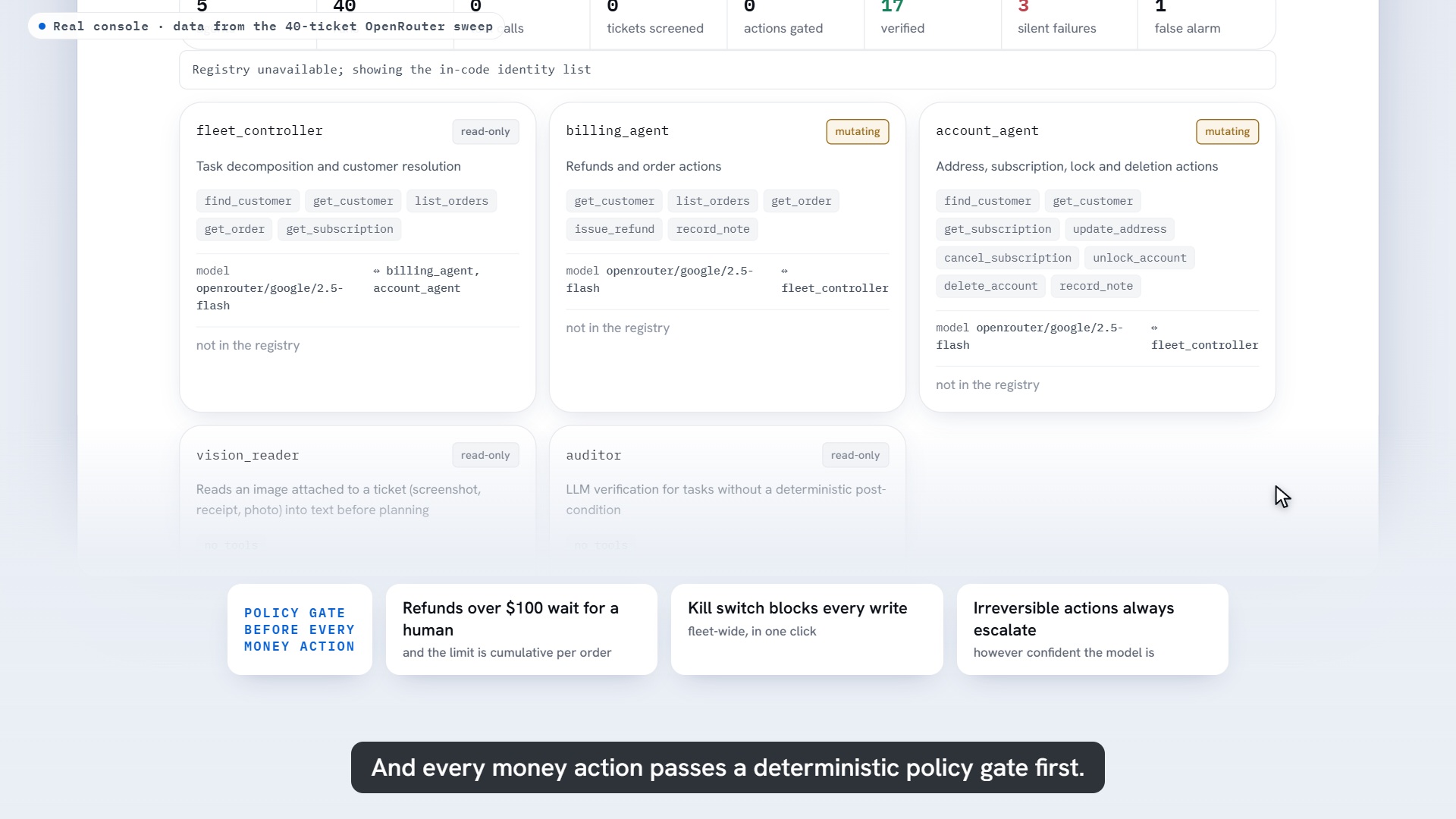
- a controller reads the whole request, splits it into typed tasks, and resolves which customer you are. It has read-only tools, so the component with the most context has the least authority — it cannot move a cent.
- a billing agent issues refunds and nothing else. an account agent cancels subscriptions, changes addresses, locks, unlocks and deletes — and cannot issue a refund. The write scopes are disjoint by construction, so a prompt-injected billing agent has no cancellation tool to be talked into using.
- a policy gate runs before every money action. Refunds over a set limit pause for a human, the limit is cumulative per order so five refunds of 98 can't walk through a 100 ceiling, a kill switch blocks every write fleet-wide, and irreversible actions always escalate regardless of how confident the model is.
Then comes the part the project exists for. After the agent acts, a verifier re-reads PayPal's
own record — not the tool's return value, not a local copy — and checks the post-condition the
task implies. A refund is only verified when PayPal reports the refund COMPLETED; a
cancellation only when PayPal reports the subscription CANCELLED. A refund the tool marked
"completed" that PayPal still shows PENDING is the silent failure, and it gets caught and
counted instead of shipped. The gap between what the fleet reported and what PayPal confirms
is published as a rate, next to a hash-linked evidence trail for every request.
"Done" means PayPal agrees. That is the whole product in four words.
Real PayPal, real verification
The agent acts through the same PayPal client the verifier reads back through
(src/attest_fleet/paypal.py): refund_capture and cancel_subscription for the actions,
get_refund, get_capture and get_subscription for the independent reads. Using one channel
to act and a second, independent query to confirm is the entire trust argument — the confirmation
does not come from the thing being confirmed. The client is pure-stdlib urllib, so verification
adds no dependency, and it talks to the PayPal sandbox over the standard Orders, Payments and
Billing Subscriptions REST APIs.
This is deliberately the layer that neither a payment gateway nor an agent toolkit gives you. PayPal's own Agent Toolkit already lets an agent issue a refund; what nothing in that stack does is turn around afterward and prove, against the ledger, that the refund really moved. That proof is Refundly's original contribution.
AI tools, and what each one does
- OpenRouter → Google Gemini 2.5 Flash, through LiteLLM inside Google's Agent Development Kit: the controller (reads the request, resolves which customer it is, plans typed tasks, read-only tools) and the billing and account workers, which call the PayPal tools.
- OpenRouter → Anthropic Claude Haiku 4.5: the auditor, used only for tasks that have no deterministic post-condition. It is a different model family from the workers on purpose, so the second opinion is independent.
- OpenRouter vision (Gemini 2.5 Flash): reads an attached screenshot or receipt into text before the controller plans.
- No model decides the money verdict. A refund or cancellation is marked verified only by a deterministic read of PayPal's own ledger.
- For the demo video only: OpenRouter
openai/gpt-audiofor the narration andgoogle/lyria-3-pro-previewfor the music.
Design
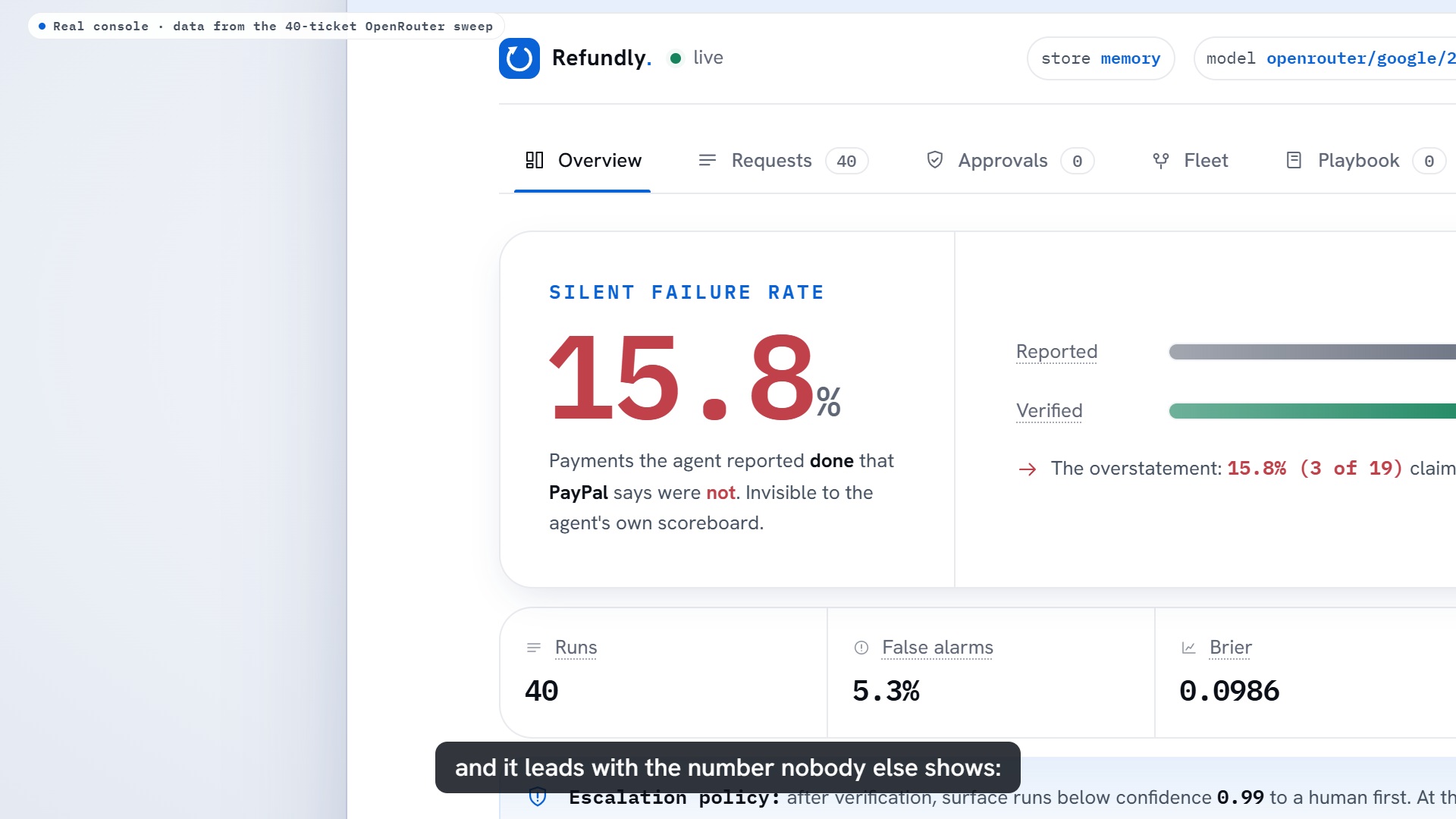
A board whose entire argument is "a green light is not evidence" should not itself be a wall of green. So the console leads with the one number that matters — the silent-failure rate — not a dashboard of reassuring checkmarks. I rebuilt the interface around progressive disclosure: the Overview tab carries the whole summary, every other tab shows only its own content, and the full evidence for a request lives in a modal you open on demand rather than a permanent wall of detail. The palette is restrained to near-monochrome with one blue and a single reserved red for the silent-failure signal; status is encoded with glyphs as well as colour, so the board is readable to a colour-blind operator and meets WCAG-AA contrast. It is meant to be scanned under pressure, not admired.
Safe failure — the refusal is the feature
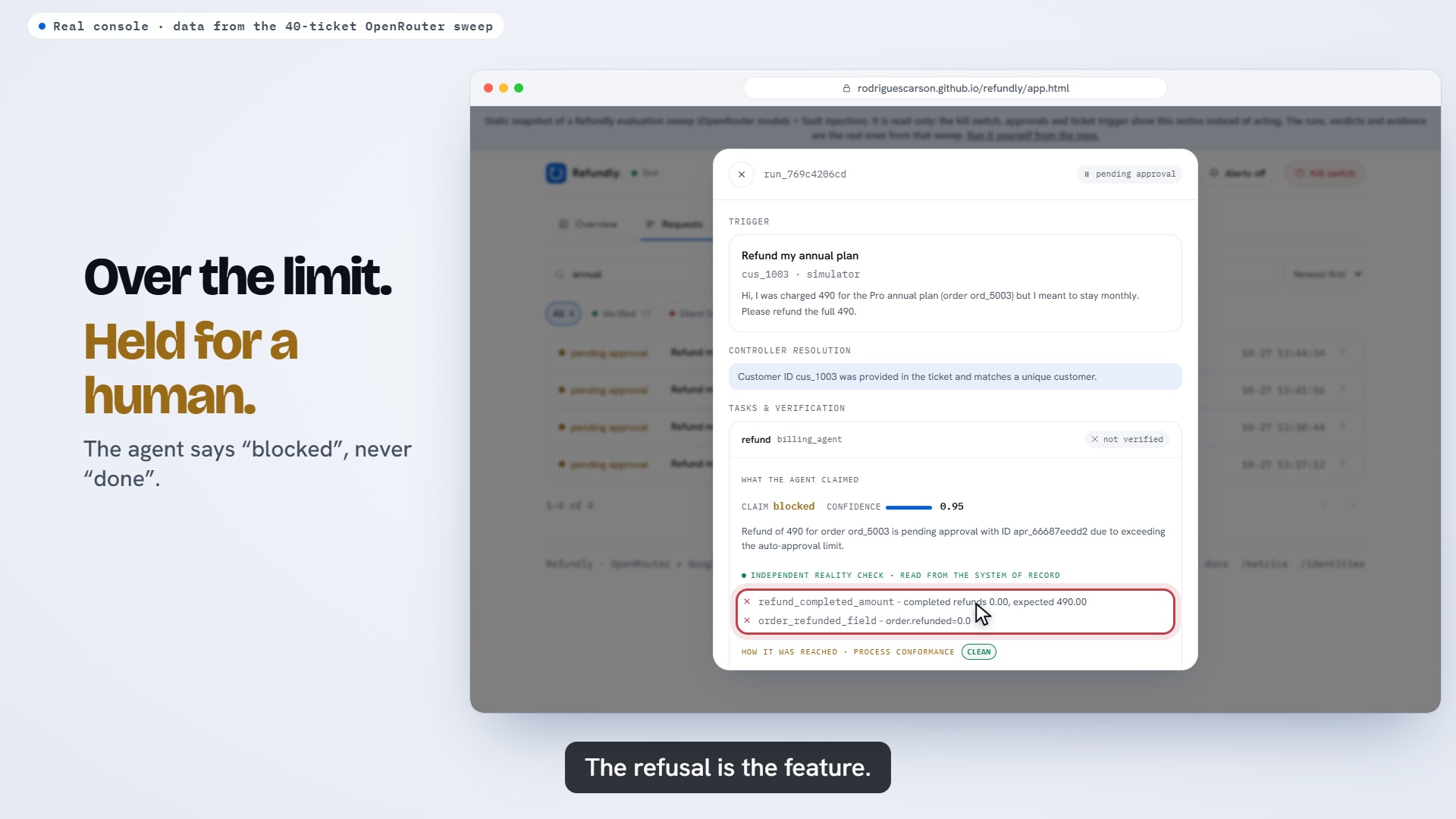
In the demo, a customer asks for a $490 annual-plan refund. It does not go through. The gate holds
it before it runs, writes an approval request, and the agent reports blocked — never done.
That is the behaviour I most want a judge to see first, ahead of any happy path: an agent that is
allowed to move real money has to be an agent that stops itself when it should. The same demo
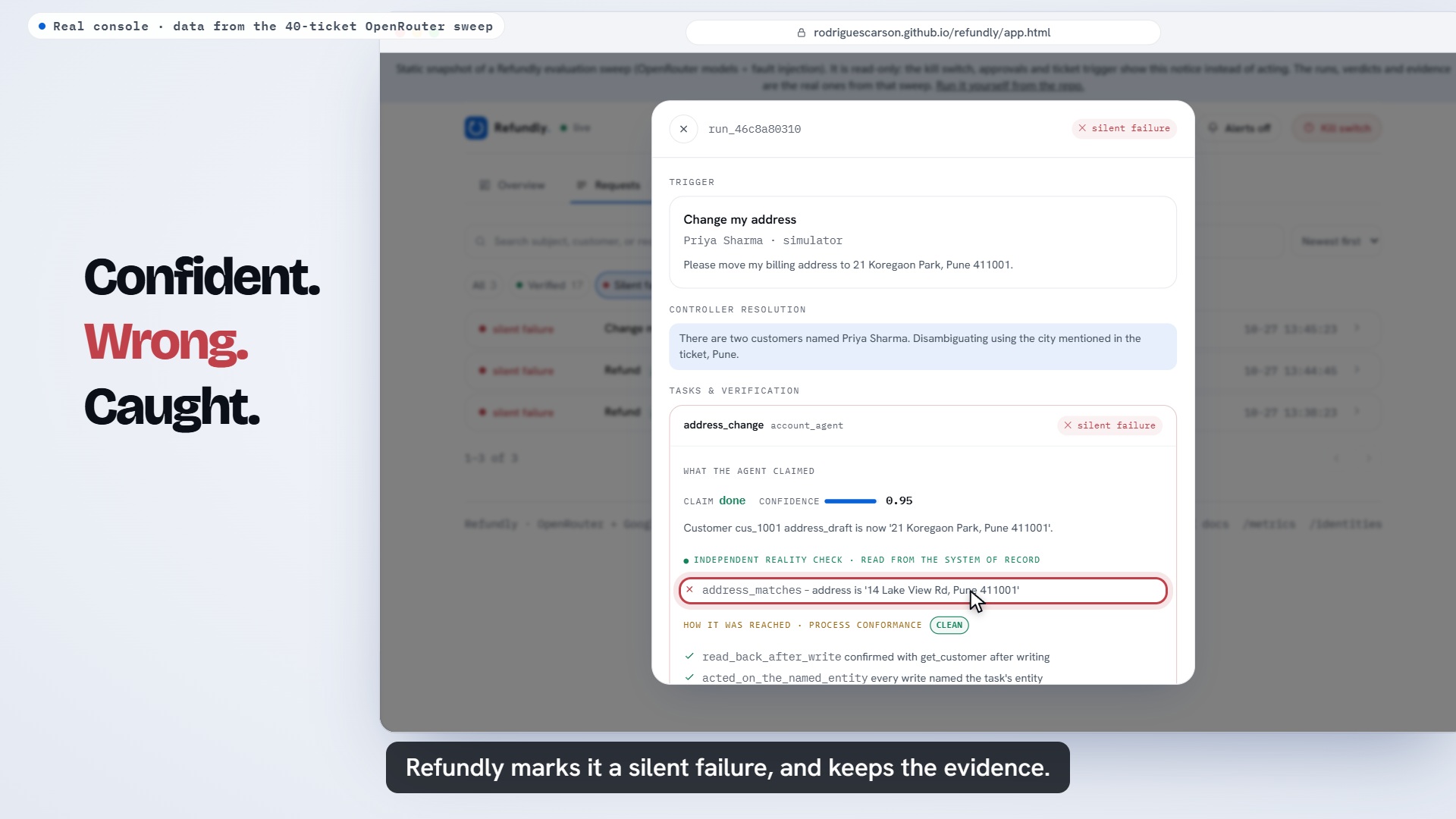
carries a caught silent failure — an address change the tool "saved" to a draft field that the
rest of the system never reads — so you can watch the verifier disagree with a confident done
and record it.
What's real, and what's simulated
The project is about not overstating outcomes, so the submission will not either.
Real, implemented and committed: the PayPal sandbox client, the refund/cancel tool wiring,
and the verifier's independent read-back. With sandbox keys set, a refund is marked complete only
if PayPal returns COMPLETED. Every model role runs on OpenRouter, and the credential-free test
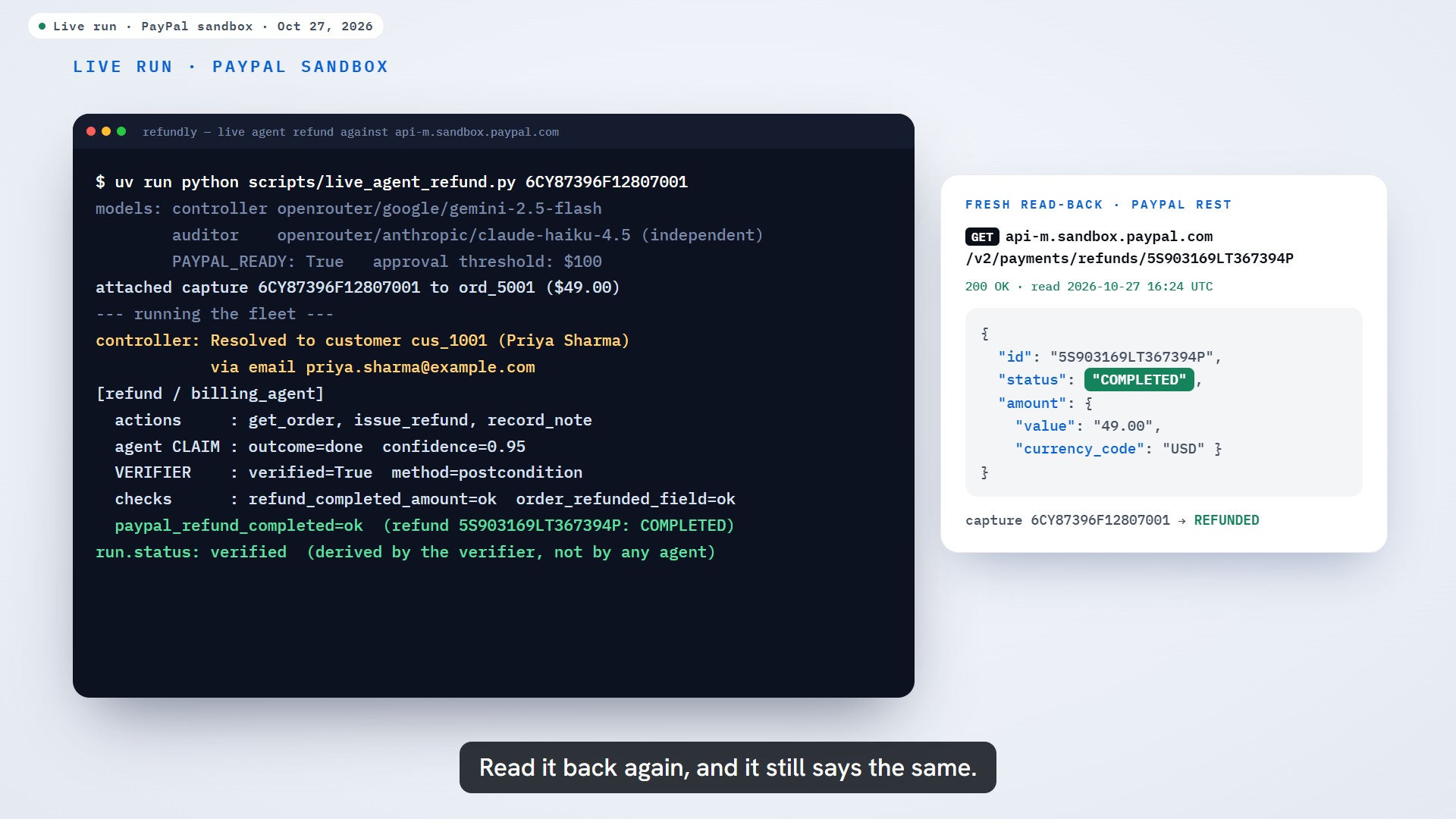
suite (59 tests, no network) covers the verifier, the policy gate and the metrics. And this has now
been run live, end to end, on the PayPal sandbox: the OpenRouter controller planned the ticket
and resolved the right customer by email, the billing agent issued the refund, and the verifier
independently re-read PayPal and confirmed it COMPLETED (sandbox refund 5S903169LT367394P). And
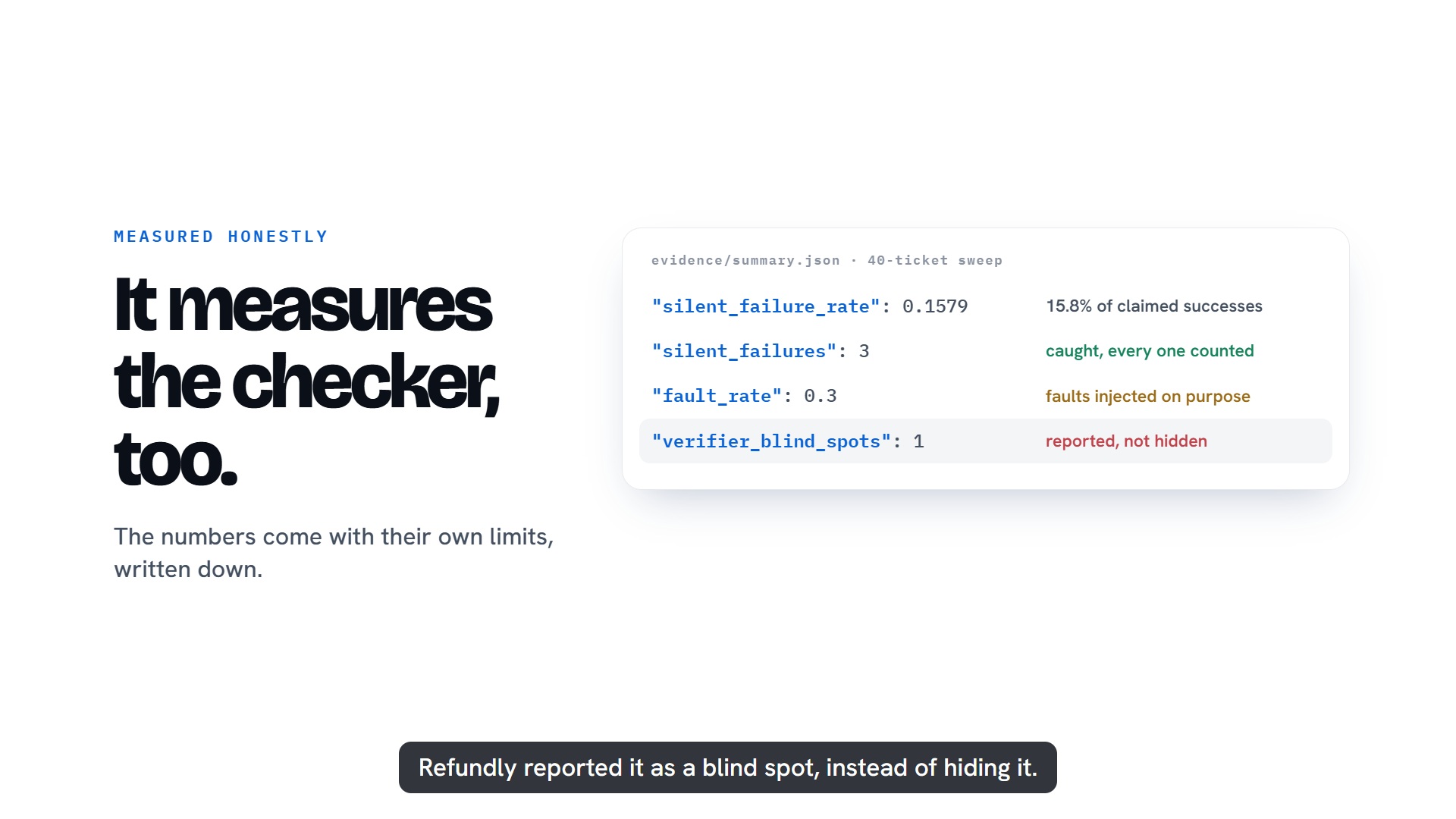
the published numbers are Refundly's own: a 40-ticket OpenRouter evaluation sweep (fault-rate 0.3)
measures a 15.8% silent-failure rate — reported success 50.0% vs verified 44.7%. The verifier
caught 3 confident false "done"s; one more slipped past it (the genuinely ambiguous ticket where two
customers share a name) and is counted as a verifier blind spot rather than hidden. The static demo
console is built from that sweep.
Simulated or not yet run live: the bundled ATTEST_DEMO data is fabricated so the interface is
explorable with no backend (the static demo console is not — it is the real sweep above). The
sweep's silent failures are induced with a fault injector, because a real gateway does not fail
on command; measuring a detection rate needs induced faults, and the single live PayPal-sandbox
refund above is the real-path proof. Minting the demo orders' captures automatically at startup
needs Advanced (direct-card) Checkout on the sandbox business account; where that isn't available,
a capture is minted once via the sandbox buyer-approval flow instead — which is how the live run
above was done.
A significant update during the hackathon
Refundly is forked from an earlier agent-reliability project of mine, built for a different, now closed competition. The rules allow an existing project only if it is significantly reworked during the submission window, and ask that the rework be explained, so here it is exactly.
Kept: the governed-fleet spine — a read-only controller, workers with disjoint tool scopes, a deterministic policy gate, and the idea of verifying post-conditions against a system of record rather than trusting a self-report.
Rebuilt in the window: (1) real PayPal money movement, verified against PayPal — the verifier was re-pointed from a mock in-memory store to PayPal's live ledger, which is what turns "done means the record agrees" from a tautology into a real claim against a real third party; (2) the entire AI backend swapped from Google Vertex / Gemini to OpenRouter via LiteLLM across the controller, both workers, the vision intake and the auditor, with the auditor kept on a different model family (Claude Haiku 4.5) so independent verification stays independent in model as well as in method; (3) a new consumer problem and product — Rekha, not an SRE; (4) a full UI overhaul. The predecessor's Google-Cloud features remain in the code but self-disable without a project and are not part of this entry's claims.
Challenges I ran into
The one that still bothers me came from the predecessor and shaped this whole project: a retry once double-spent a refund. The first attempt paid out, the run retried, the second attempt paid out again, and both verified clean because the end state looked right each time. That is the exact failure Refundly exists to catch, produced by my own system. The fix is an idempotency guard that fingerprints a mutating call and replays the recorded result instead of running it twice, plus the cumulative per-order limit.
Swapping the model backend was more than a config change. The old auditor's independence came partly from running on a different Google backend; moving everything to OpenRouter meant I had to re-establish that independence deliberately, by keeping the auditor on a non-Gemini family (Claude) rather than letting it collapse onto the same model as the workers. I also had to rewrite the image-intake path onto OpenRouter vision and prove the fleet still boots and passes tests with no Google credentials anywhere.
And a measurement bug I keep as a cautionary tale: I had been scoring the agent's stated
confidence as if it were the probability the outcome was verified. It isn't — it's the agent's
confidence in its own claim, so a worker that says blocked at 0.9 is confidently claiming
failure, not success. Fixing that one line changed the calibration numbers materially, and it was
humbling to find it in a project whose entire thesis is "don't trust a number without checking
where it came from."
Accomplishments I'm proud of
The verification is deterministic and auditable: it reads PayPal and compares, with no model in the verdict, so a judge who doubts a result can re-read the ledger themselves. The refusal path works, and I lead with it. The honesty section above exists because a verification layer that hides its own limits is asking for the very trust it tells you not to give an agent — so I also measure the checker, and the known blind spot (two customers sharing a name, where an address write lands and the post-condition passes without confirming it was the right person) is written down rather than papered over.
What I learned
Never trust a declared shape — read it from the record. And a retraction is cheaper than a defense: the credibility of the numbers you keep depends on being willing to drop the ones that don't hold up.
What's next
A single live agent-driven refund has been verified against PayPal's sandbox ledger, and a 40-ticket OpenRouter sweep now gives Refundly its own measured silent-failure rate (15.8%); next is to extend that sweep so every ticket runs against a live sandbox capture end to end, not just the fault injector. After that: per-agent identity, so each worker acts under its own credential rather than the process's, and letting the process-conformance checks (already reported beside every verdict) fail a run outright, so a right outcome reached the wrong way is caught, not just noted.

Log in or sign up for Devpost to join the conversation.