-
-
-
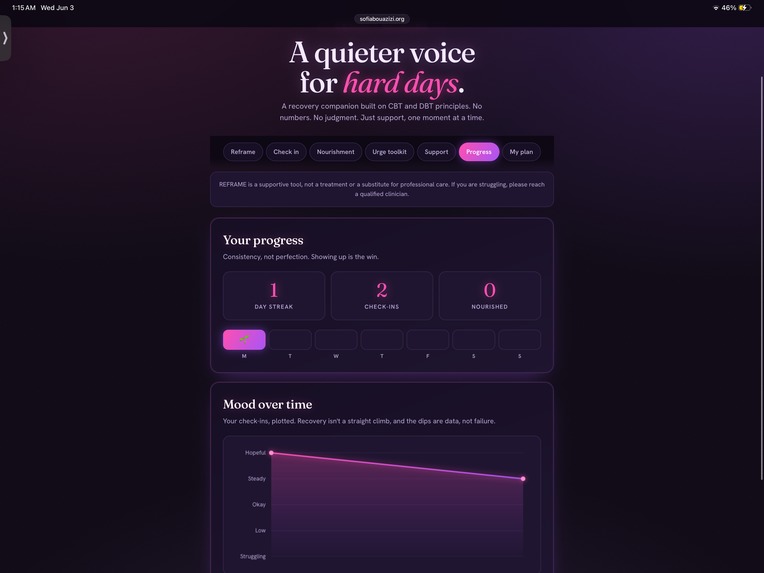
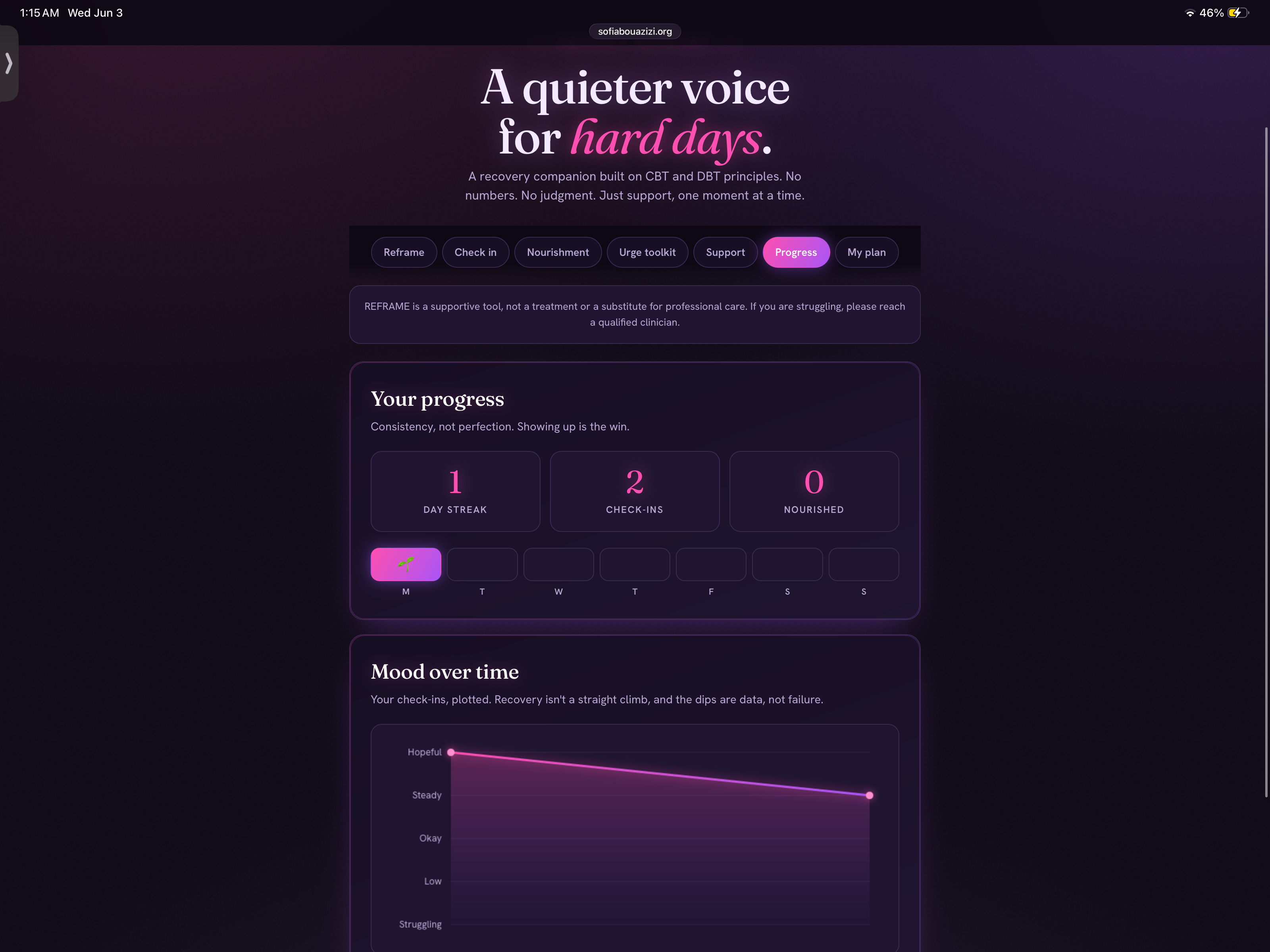
Website visualization for users
-
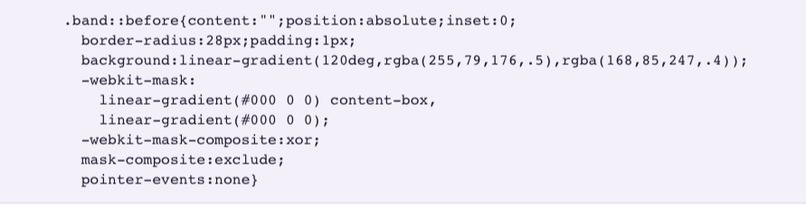
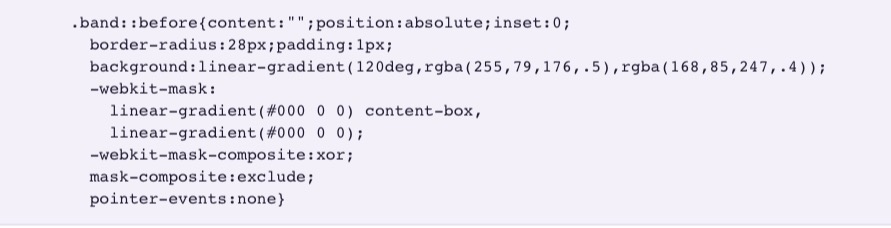
Gradient border via mask compositing Cards get a glowing gradient outline without an extra wrapp
Inspiration
When I was fourteen, my relationship with food nearly cost me my life. By the time I was hospitalized, even a sip of coffee was more than my body could take. What I remember most is not the hospital. It is the hours before it, alone, with a voice telling me I did not deserve to eat and nothing there to answer back. I did not have a companion in those moments. REFRAME is the thing I needed then. Not an app that counts or measures or judges, but a quieter voice for the hardest hours, one that meets the thought instead of the body. We are building it so the next kid does not have to face that voice alone.
What it does
REFRAME is a between-sessions recovery companion built on CBT and DBT principles. You type a hard thought like "I don't deserve to eat today," and it names the cognitive distortion and offers a gentler reframe drawn from a reviewed library, not improvised by a model. It includes mood check-ins, completion-only nourishment tracking with no numbers of any kind, a toolkit of grounding and urge-surfing exercises, fast access to crisis and support contacts, a mood-over-time trend so you can see direction rather than perfection, and a personalized recovery plan written in the user's own words. Crucially, if what someone types signals crisis, the app stops the conversation and routes them straight to real human support.
How we built it
It is a single self-contained web app, no build step, so it runs anywhere for a demo and on any device. The reframe engine is deliberately a curated, distortion-matched library rather than a raw LLM, because letting a generative model freewheel with a vulnerable user is a liability, not a feature. Crisis keyword detection runs before any other logic and bypasses the chatbot entirely. The mood trend is drawn on a canvas with mood self-report on the axis, never a body metric. State is in-memory for the prototype, with secure persistence flagged as a production requirement.
Challenges we ran into
The hardest engineering problem was not technical, it was knowing what to leave out. Several features that demo beautifully, weight graphs, goal weights, calorie tracking, are actively harmful to the people this tool is for, and we had to keep cutting them. Designing an AI product for a population where ordinary helpfulness can backfire forced us to define what the model must never do, then build guardrails around it. Getting the crisis pathway to take priority over every other interaction, rather than living in a settings menu, took real thought.
Accomplishments that we're proud of
We built a recovery tool that refuses to measure bodies, and we are proud of every number we did not put in it. The crisis-first architecture, the reframes grounded in CBT and DBT and kept on rails, and a clean, fully demoable build came together in the time we had. Most of all, we made restraint the product, not a compromise.
What we learned
In mental health software, the most important design decisions are subtractions. We learned that a raw LLM should not be the one talking to an at-risk person, that safety and good UX are not in tension here, and that "helpful" is not a fixed quantity, it depends entirely on who is on the other side of the screen.
What's next for Reframe: Personalized AI for Eating Disorder Recovery
Three things, in order. First, a licensed eating disorder clinician to review the content and sign off, because right now the therapeutic logic is engineer-authored and that is not good enough to ship. Second, verified, region-localized crisis resources and proper secure, private handling of sensitive data. Third, an optional AI reframe layer with hard guardrails sitting behind the curated library, plus eventual care-team integration so the tool reinforces real treatment instead of replacing it.

Log in or sign up for Devpost to join the conversation.