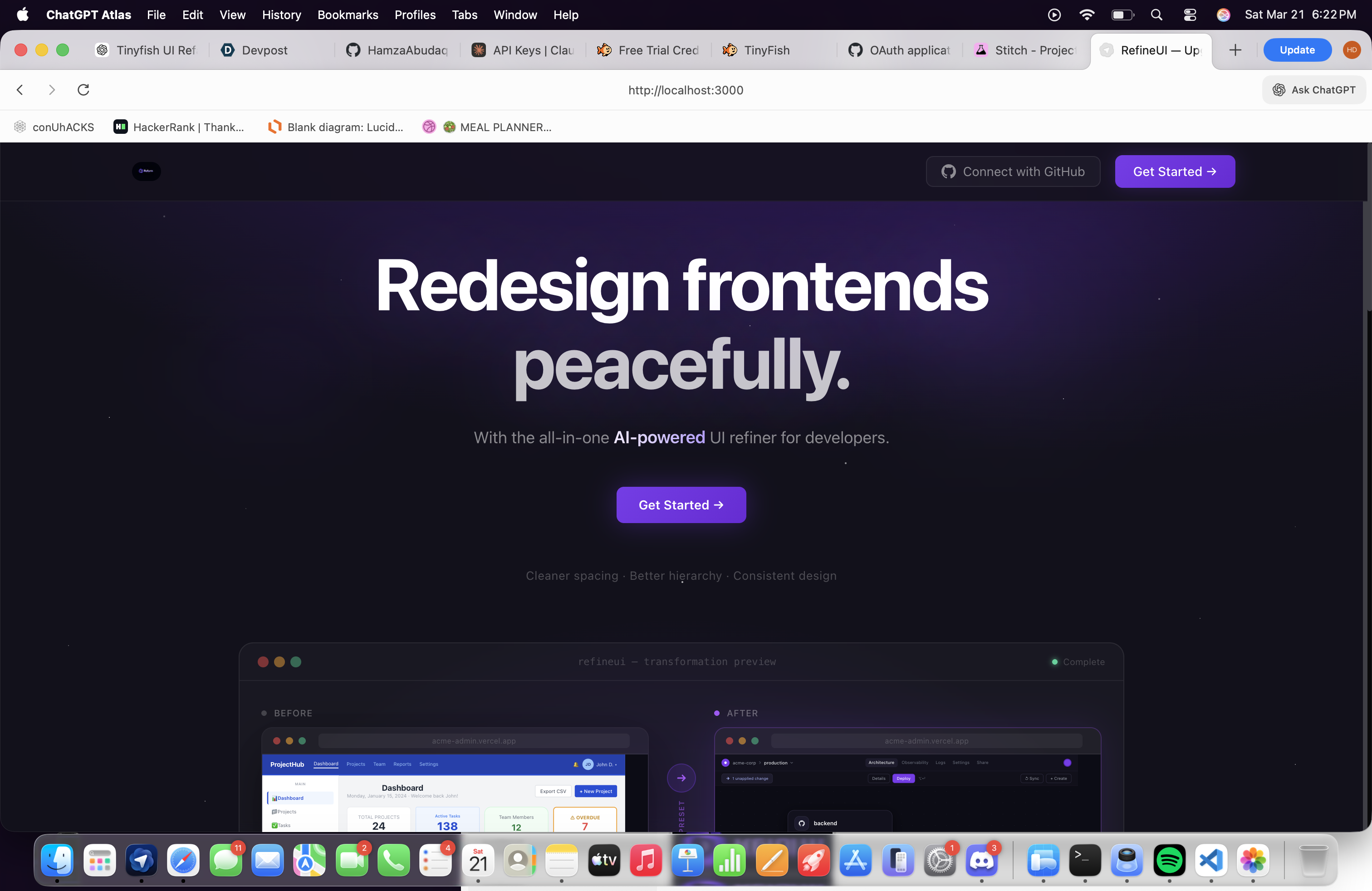
🚀 About the Project
We built Reform to solve a problem we kept running into:
improving UI/UX is slow, subjective, and hard to validate before shipping.
Designers rely on inspiration, developers rely on guesswork, and teams often don’t know if a UI change will actually improve user behavior until after deployment.
We wanted to change that.
💡 Inspiration
We were inspired by how tools like GitHub Copilot automate coding — but there’s no equivalent for UI/UX.
At the same time, the best products in the world (like GitHub, Vercel, Linear) already solved many UX problems.
So we asked:
What if we could learn from the best interfaces, apply those patterns automatically, and predict how users will react before shipping?
That idea became Reform.
🏗️ How We Built It
Reform is a multi-stage AI system:
Project Discovery
- User describes their product
- AI finds ~50 top competitors and selects the most relevant ones
Real UX Analysis (TinyFish)
- Browser agents visit each site
- Simulate real user behavior (scrolling, clicking, navigating)
- Extract structured UX and design data
Design Intelligence Synthesis
- AI merges insights into a unified design system:
- layout patterns
- components
- design tokens (colors, spacing, typography)
- UX flows
- AI merges insights into a unified design system:
UI Transformation Engine
- Applies improvements in a strict order:
- layout → spacing → components → visual polish
- Maps everything to Tailwind-compatible values
- Applies improvements in a strict order:
Code Generation
- Outputs production-ready React + Tailwind code
Simulated User Heatmaps (Key Feature)
- 50 synthetic agents test both the original and improved UI
- Generates:
- attention heatmaps
- engagement predictions
- drop-off risk
- Creates a before vs after behavioral comparison
🧠 What We Learned
- Good UX is not just visual — it’s behavioral
- The best products share consistent, extractable patterns
- Simulating users is far more powerful than just analyzing layouts
- AI becomes much more valuable when it closes the loop:
design → code → user behavior → feedback
⚔️ Challenges We Faced
TinyFish integration
- The SDK had issues with streaming responses, so we had to bypass it and implement direct SSE parsing
Getting structured output
- Ensuring consistent JSON across different websites required strict prompting and normalization
Balancing automation vs control
- We needed deterministic transformation rules while still leveraging AI flexibility
Making results usable
- It’s easy to generate ideas — much harder to generate code-ready, implementable outputs
🔥 What Makes Reform Different
Reform is not:
- a UI generator
- a theme switcher
- a design inspiration tool
Reform is:
- a UX intelligence engine
- a UI refactoring system
- a simulated user testing lab
Most tools say:
“Here’s a better design”
Reform shows:
“Here’s a better design — and here’s how user behavior will change.”
🎯 Final Thought
Our goal is to make UI improvement:
- automatic
- measurable
- fast
- data-driven
Instead of guessing what works, developers can see the impact before they ship.
Built With
- api
- claude
- fastapi
- next.js-14
- pydantic
- python
- react
- tailwind
- tinyfish
- typescript
- uvicorn


Log in or sign up for Devpost to join the conversation.