-
-
REFORM - Rebuild with Real-Time Feedback
Inspiration
ReForm was inspired by a close friend who suffered a shoulder injury during training. Between college responsibilities and the difficulty of scheduling consistent physiotherapy sessions, supervised recovery wasn’t always realistic. What began as a personal problem quickly revealed a larger pattern. When we examined global musculoskeletal data, we saw that recovery challenges affect billions of people across working professionals, athletes, and ageing populations. We realized that recovery doesn’t fail inside clinics — it often fails at home, where real-time supervision is missing. ReForm was built to close that gap.
What it does
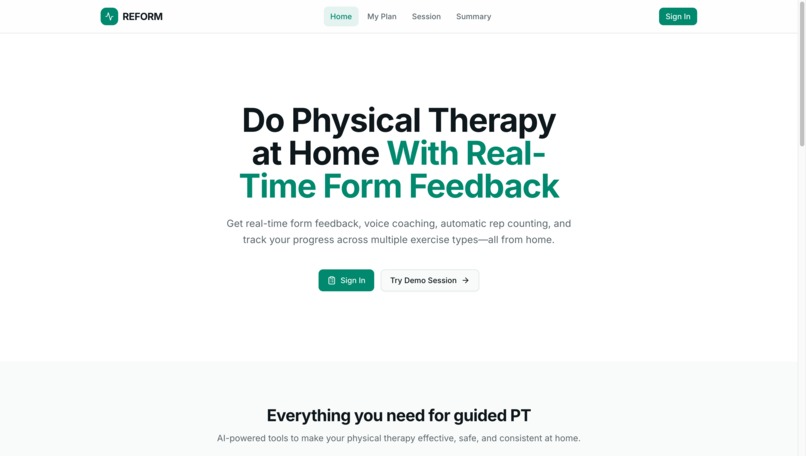
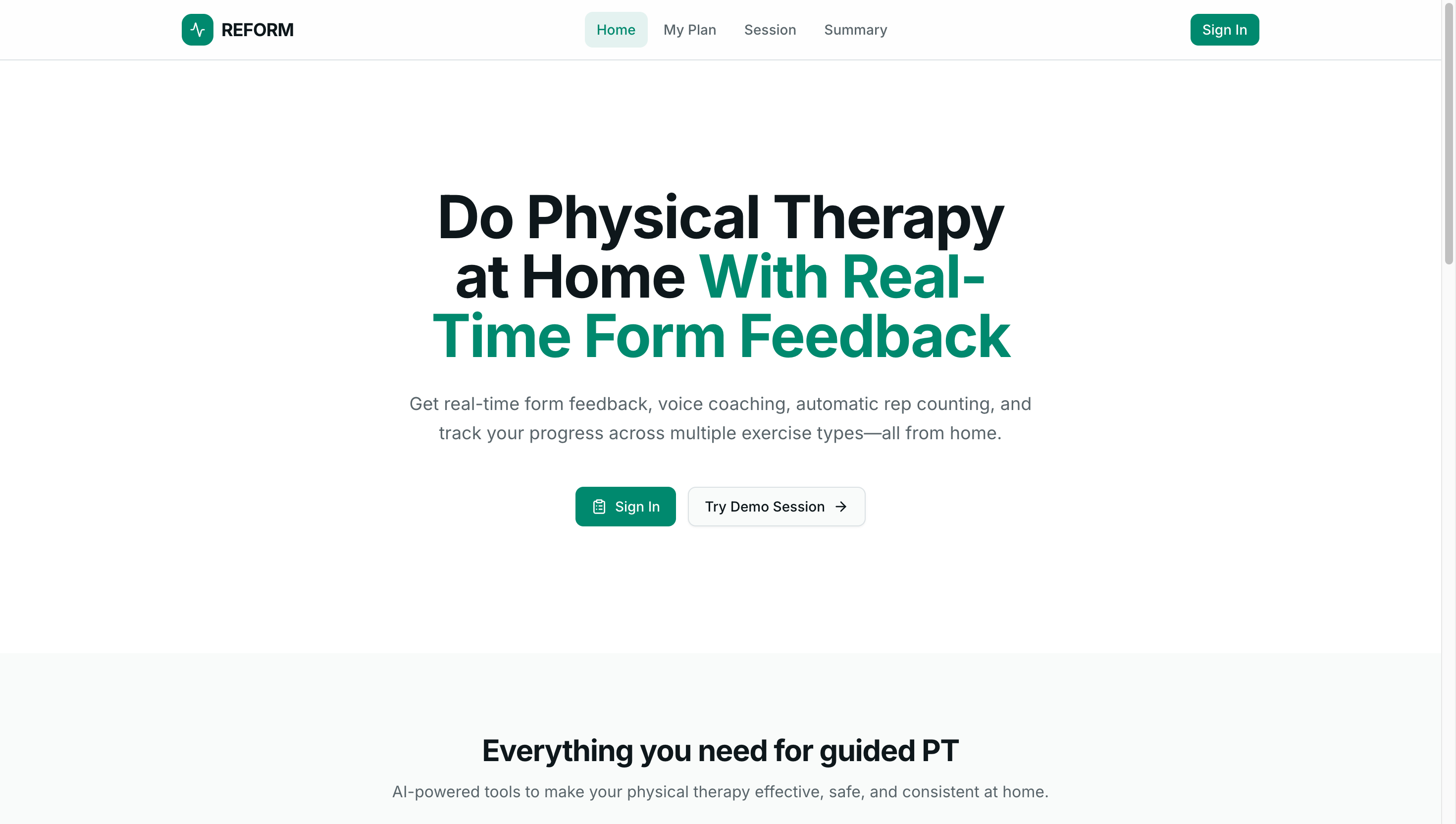
ReForm is a real-time physiotherapy support system that helps users perform rehabilitation exercises safely at home. Using computer vision, ReForm: Tracks joint angles in real time Counts reps and monitors movement accuracy Provides live on-screen corrections Delivers voice-assisted guidance during exercises Allows users to select injury-specific exercises Generates session reports after completion
It transforms unsupervised home rehabilitation into structured, guided recovery using just a phone camera.
How we built it
ReForm uses a real-time pose estimation pipeline to detect body landmarks from a camera feed. From these landmarks, we compute clinically meaningful joint angles such as:
Knee flexion (squats) Shoulder elevation (presses and raises) Hip hinge angle Ankle elevation
These angles are evaluated against functional movement ranges to determine whether the exercise is being performed safely.
The system integrates: Computer vision for pose detection Angle computation logic Rule-based form validation Rep counting logic Voice feedback system UI for scheduling and session selection
The result is a lightweight, real-time recovery assistant accessible through a standard device camera.
Challenges we ran into
One major challenge was ensuring real-time performance without lag. Accurate joint angle computation must happen instantly to provide meaningful feedback. Another challenge was balancing correction sensitivity. Too strict, and users receive excessive warnings. Too lenient, and unsafe movement may pass undetected. We also had to design feedback that is helpful but not overwhelming — combining visual cues with voice guidance in a way that feels supportive rather than distracting.
Accomplishments that we're proud of
Successfully built a working real-time rehabilitation assistant Integrated voice-assisted feedback during live exercise Created injury-based exercise selection Implemented rep counting and session reporting Designed a system that works using only a phone camera Most importantly, our first real user — the friend who inspired this project — loved the concept and found it intuitive and practical.
What we learned
We learned that rehabilitation is not just about movement — it’s about precision, timing, and accessibility. Technically, we gained hands-on experience with: Real-time pose estimation Biomechanics-informed movement logic Human-centered feedback design We also learned how important it is to build responsibly in health-related domains — focusing on safety, clarity, and realistic claims.
What’s next for ReForm
Our next steps include: Personalising movement thresholds by injury type Tracking recovery progress longitudinally Adding clinician dashboards for remote review Expanding exercise libraries Validating the system with physiotherapy professionals
ReForm is a step toward making structured rehabilitation accessible anytime, anywhere.## Inspiration
Built With
- gemini
- mediapipe
- nextjs
- supabase
- tailwind
- vercel

Log in or sign up for Devpost to join the conversation.