-
-
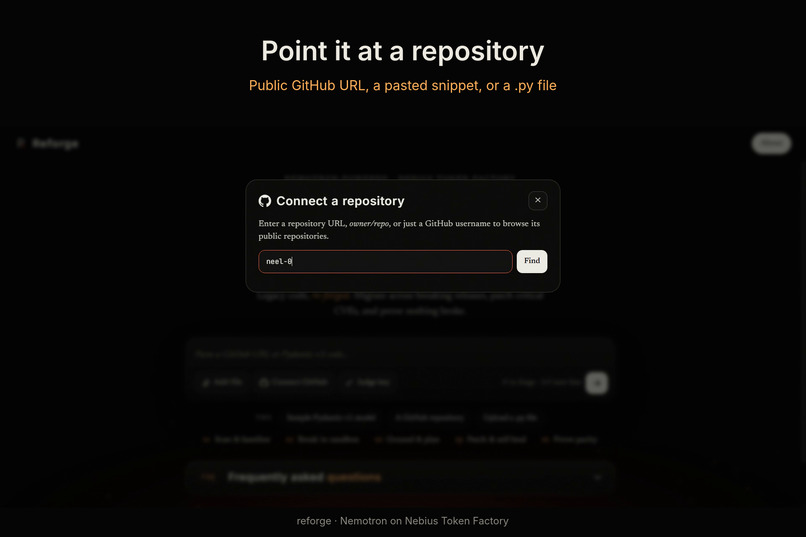
Input repository
-
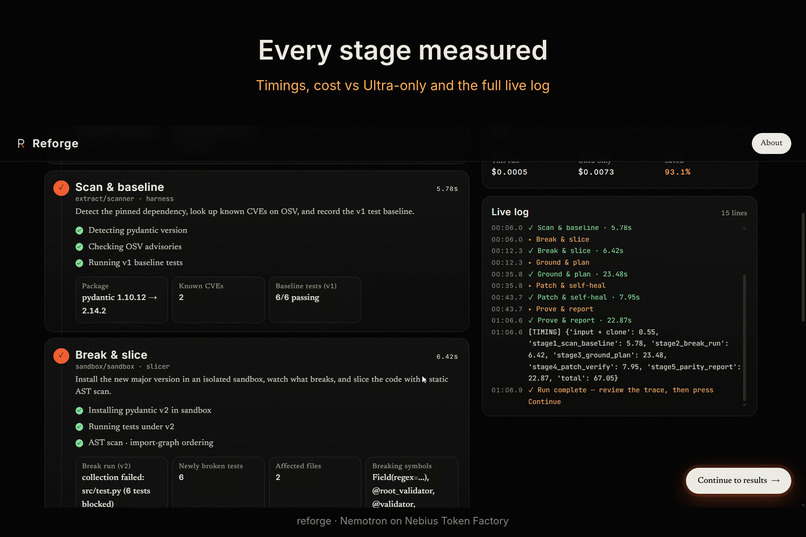
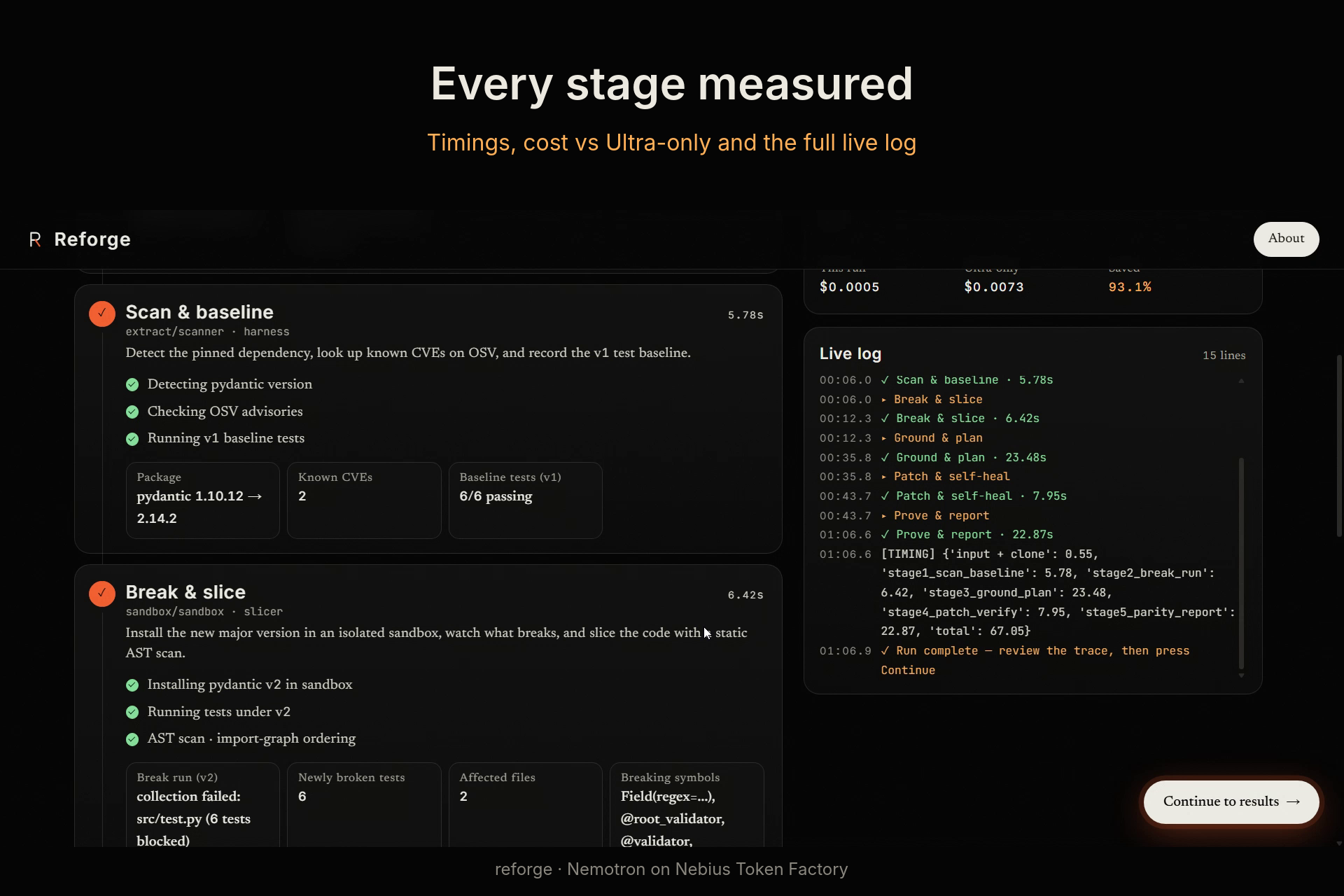
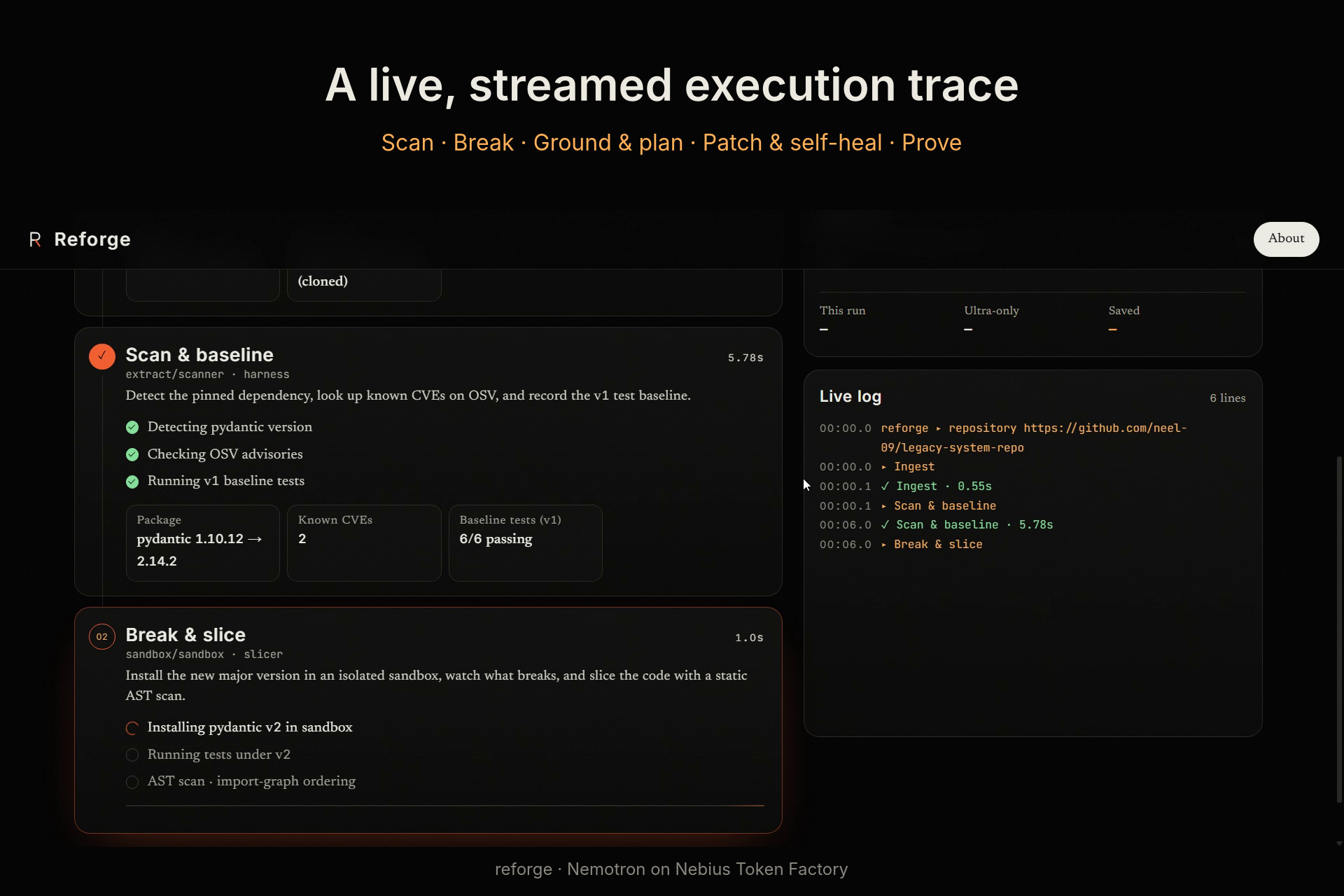
Execution Trace
-
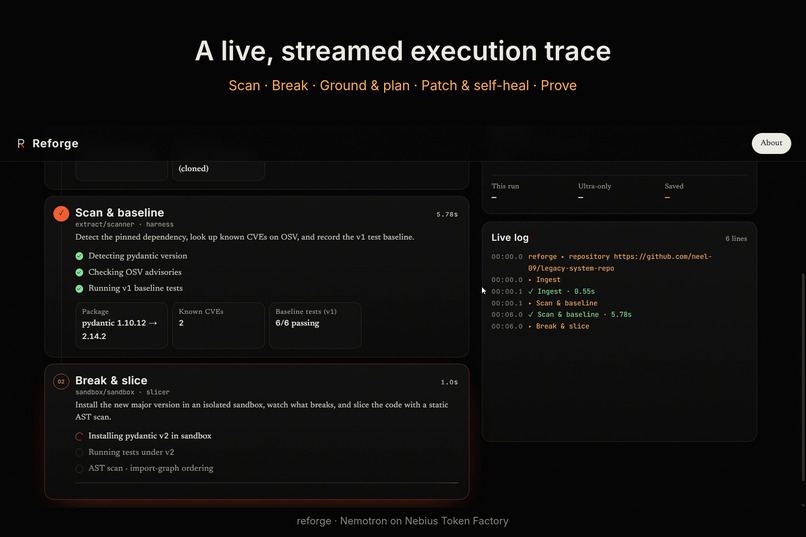
Execution Trace
-
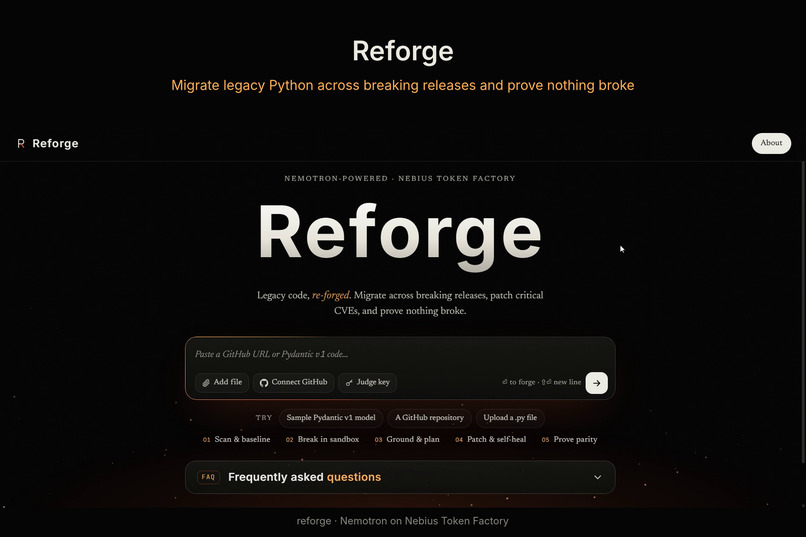
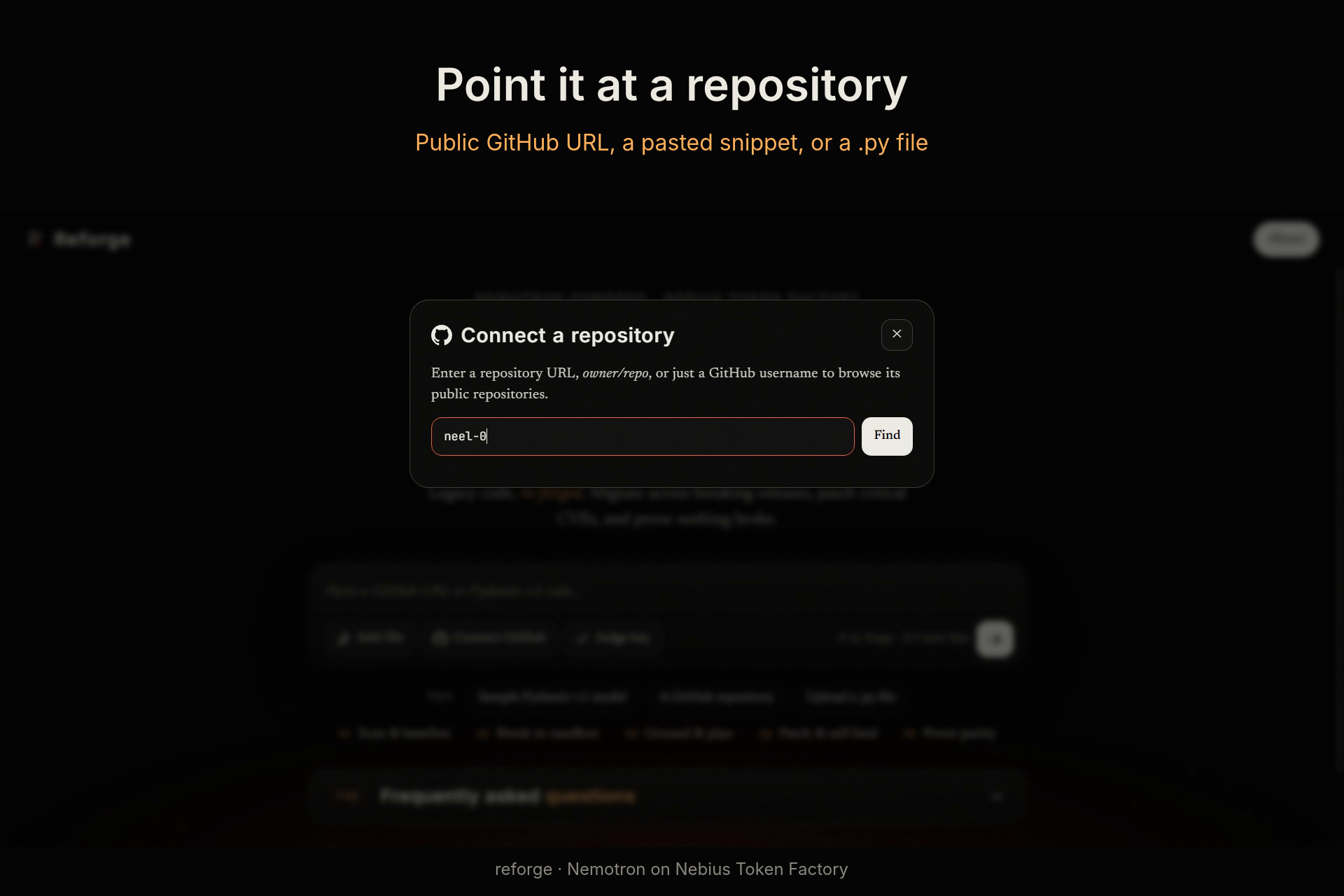
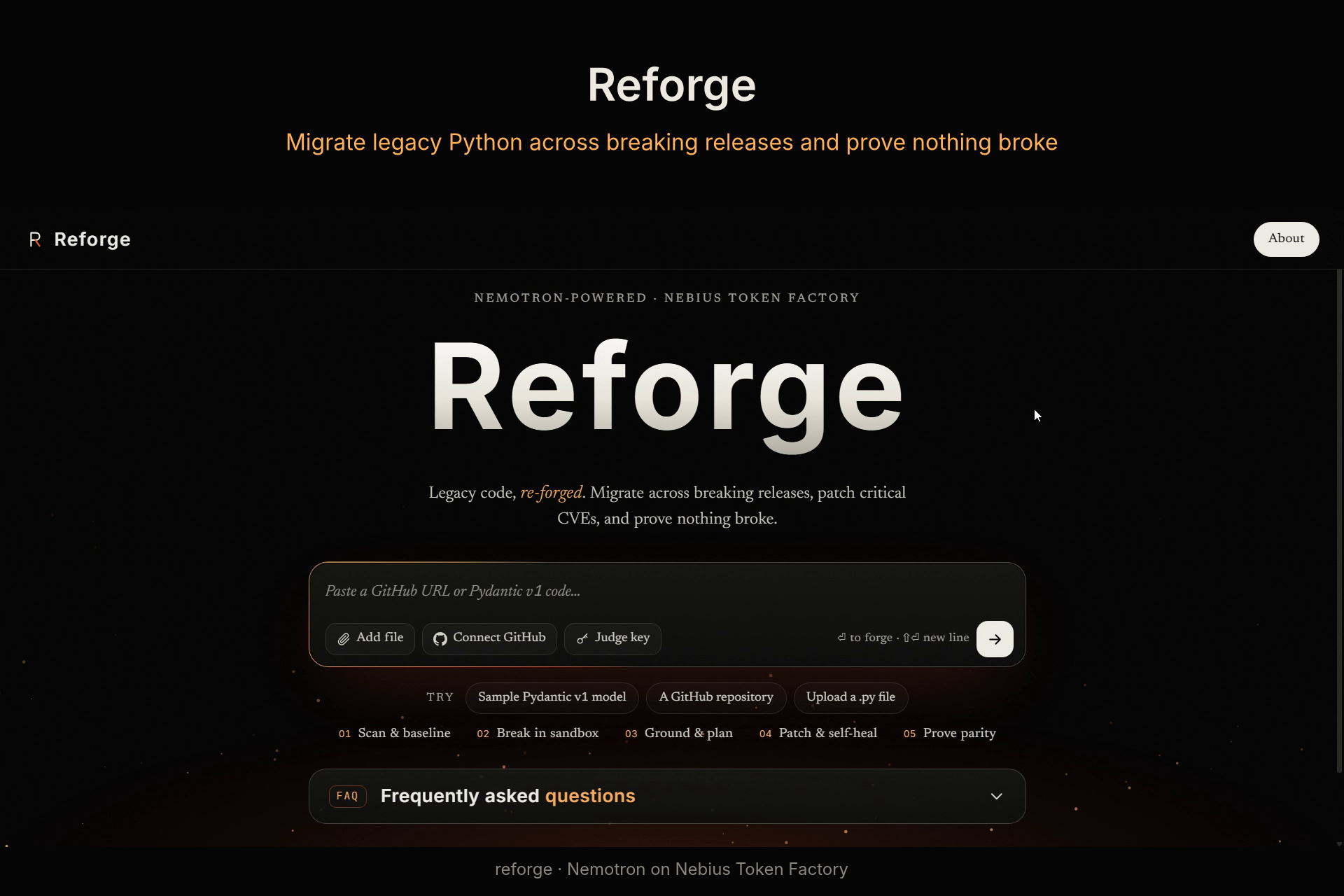
Landing Page
-
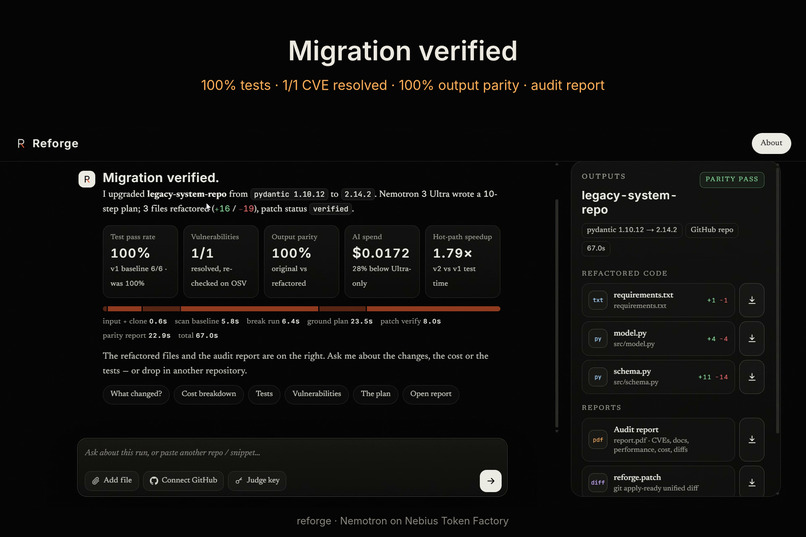
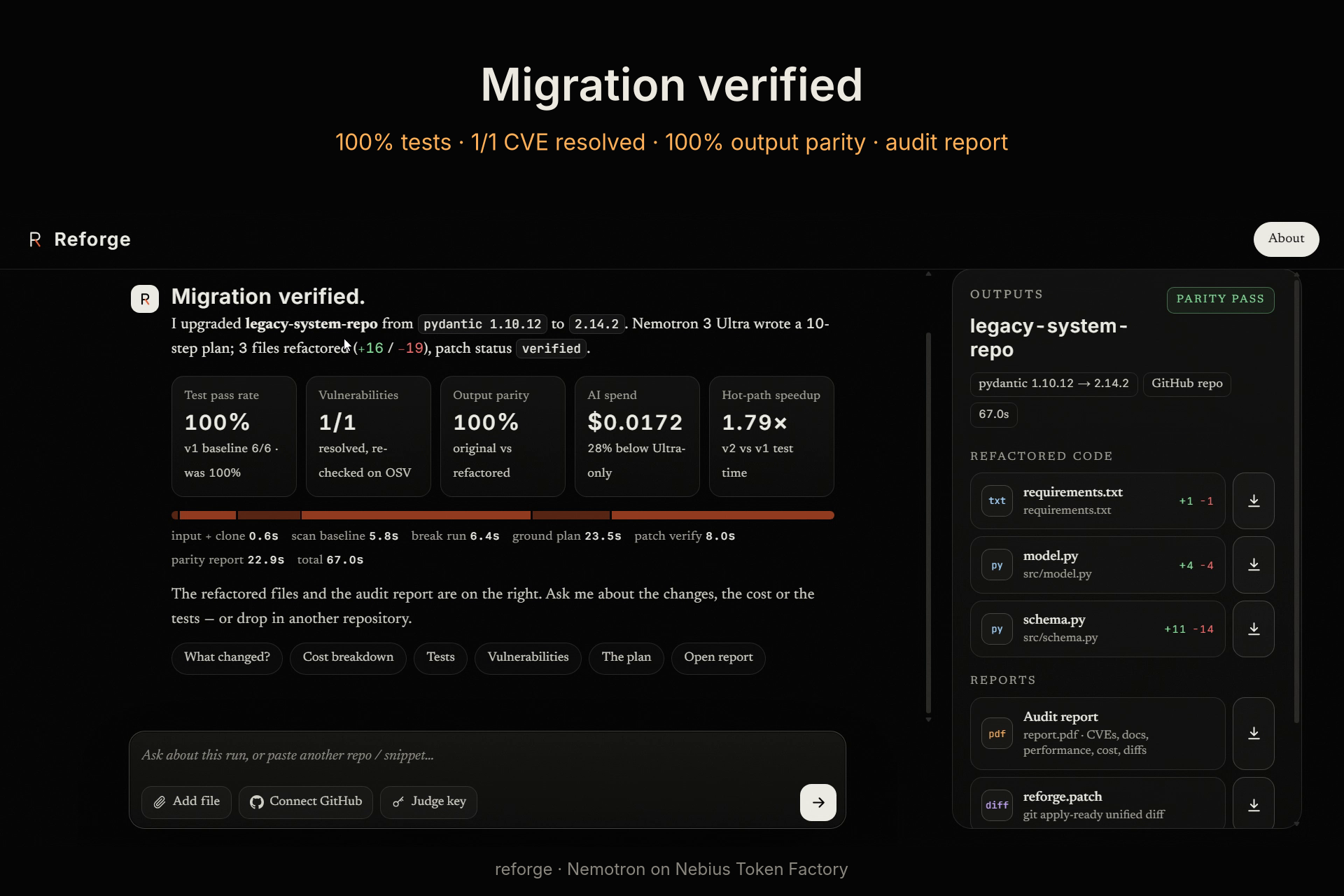
Results Page
Inspiration
Every Python team has an upgrade it keeps postponing. A major release like Pydantic v2 breaks validators, configs and serialization across a codebase, while the old version keeps collecting CVEs. The work is tedious, risky and easy to get subtly wrong, so it waits until a security audit forces it. I wanted an agent that doesn't just write the migration but proves it didn't break anything.
What it does
Reforge takes a GitHub repository or a code snippet and runs a five-stage agentic pipeline:
- Scan & baseline: detects the pinned dependency, checks known CVEs on OSV, and runs the existing tests under v1.
- Break & slice: installs v2 in an isolated sandbox, records exactly what breaks, and orders affected files with a static AST scan.
- Ground & plan: grounds every broken symbol in the official migration docs via Tavily; Nemotron 3 Ultra writes one validated refactor plan.
- Patch & self-heal: Nemotron 3.5 Lightning applies patches first; misses escalate to Super, then Ultra. Failing tests go through a heal ladder, and any fix that makes things worse is rolled back.
- Prove parity: compares the original and refactored code on test outcomes, return values, schemas and output, re-checks CVEs, and produces an audit PDF, a git-ready patch and side-by-side diffs.
How I built it
- Backend: Python + FastAPI, with NDJSON streaming so the UI shows every stage live.
- Models: three NVIDIA Nemotron tiers on Nebius Token Factory, behind one OpenAI-compatible endpoint.
- Router: cheap-first escalation with a cost ledger. Every call is priced and compared with sending the same tokens to Ultra:
$$\text{Cost} = \sum_{i} \left( \frac{T^{in}_{i}}{10^6} \, R^{in}_{tier(i)} + \frac{T^{out}_{i}}{10^6} \, R^{out}_{tier(i)} \right)$$
$$\text{Savings} = \text{Cost}_{\text{Ultra-only}} - \text{Cost}_{\text{actual}}$$
where:
- \(T^{in}_{i}\), \(T^{out}_{i}\): input and output tokens of model call \(i\)
- \(tier(i)\): the Nemotron tier that handled call \(i\) (Lightning, Super or Ultra)
- \(R^{in}_{tier}\), \(R^{out}_{tier}\): that tier's Token Factory price in USD per 1M input / output tokens (Lightning \$0.06 / \$0.24, Super \$0.30 / \$0.90, Ultra \$1.00 / \$3.00)
- \(\text{Cost}_{\text{actual}}\): what the run really cost with routing
\(\text{Cost}_{\text{Ultra-only}}\): the same tokens priced at Ultra rates, the "no routing" baseline
Safety: model output is validated, never trusted. Patches must match exactly once, pass an AST syntax gate, and are written atomically with rollback.
Frontend: zero-build HTML/CSS/JS with a live execution trace, model-router panel and results workspace.
Deployment: Docker on Google Cloud Run, with daily usage limits and a judge key so the credits last through judging.
Reference run: full migration for $0.12 vs $0.32 on Ultra alone (62% cheaper), with 1/1 CVE resolved, 100% output parity and a 5.28× hot-path speedup. The patch stage alone saved 88.5%.
Challenges
- Making the models reliable, not just smart. Lightning sometimes copied placeholder text from the prompt example; the patcher now rejects it. Thinking mode on the smaller tiers burned tokens without improving patches, so it's off for Lightning and Super.
- Proving correctness without trusting the model. Tests alone weren't enough, so I added a parity verifier that compares outputs and schemas between both versions and flags any attempt to edit the tests.
- Speed. The demo needed a full migration in about a minute, so patching runs per file in parallel, sandboxes are reused, and identical reruns hit a plan cache at $0.
- Budget. With limited credits, every design choice had a cost: routing, caching, per-run budgets, and daily caps on the hosted demo.
What I learned
- Cheap models do most of the work well when the task is narrow and the output is verified. The big model is best used once, for planning.
- Grounding in official docs beats relying on model memory for API migrations.
- In agentic systems, verification and rollback matter more than the generation itself.
What's next
The engine is library-agnostic: adding a migration means adding a migration pack (symbol rules, detection and docs), not new agent logic. Next up: SQLAlchemy 2.0 and NumPy 2, private repositories, and opening pull requests automatically.
Built With
- css
- docker
- fastapi
- github-api
- google-cloud
- google-cloud-run
- highlight.js
- html
- httpx
- javascript
- jszip
- nebius-token-factory
- nvidia-nemotron
- openai-sdk
- osv
- pydantic
- pytest
- python
- reportlab
- tavily
- uv
- uvicorn

Log in or sign up for Devpost to join the conversation.