-
-
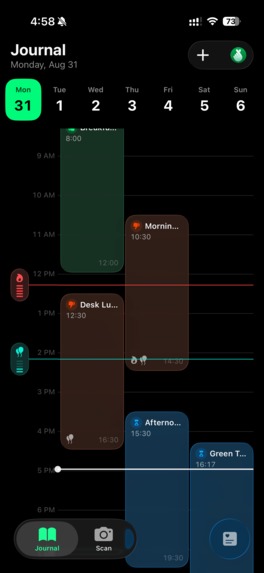
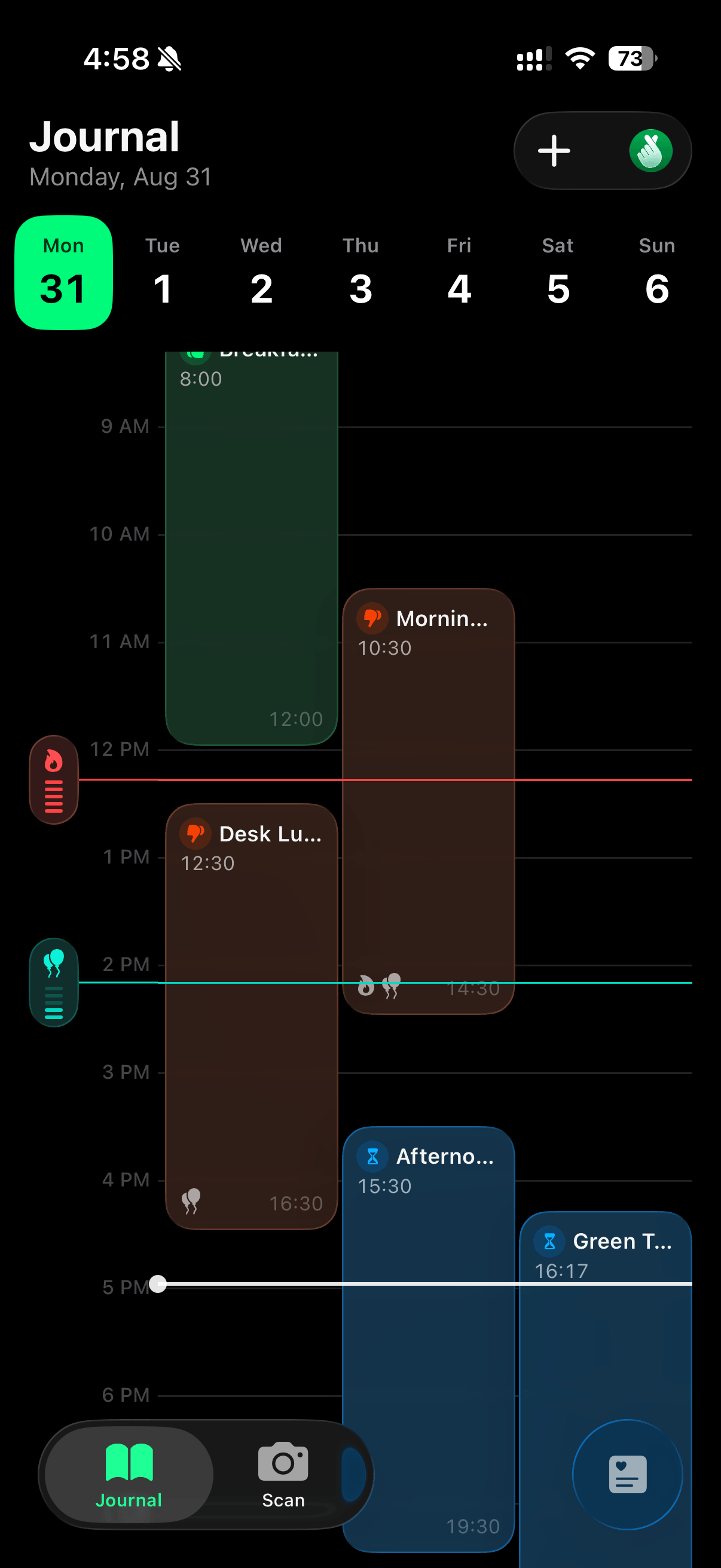
Timeline/Journal page
-
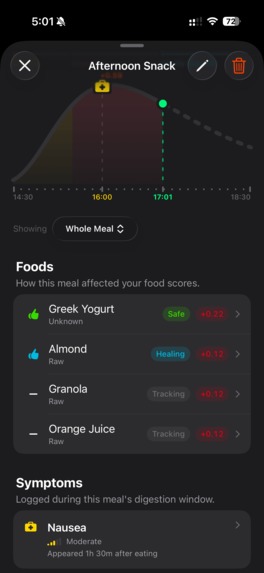
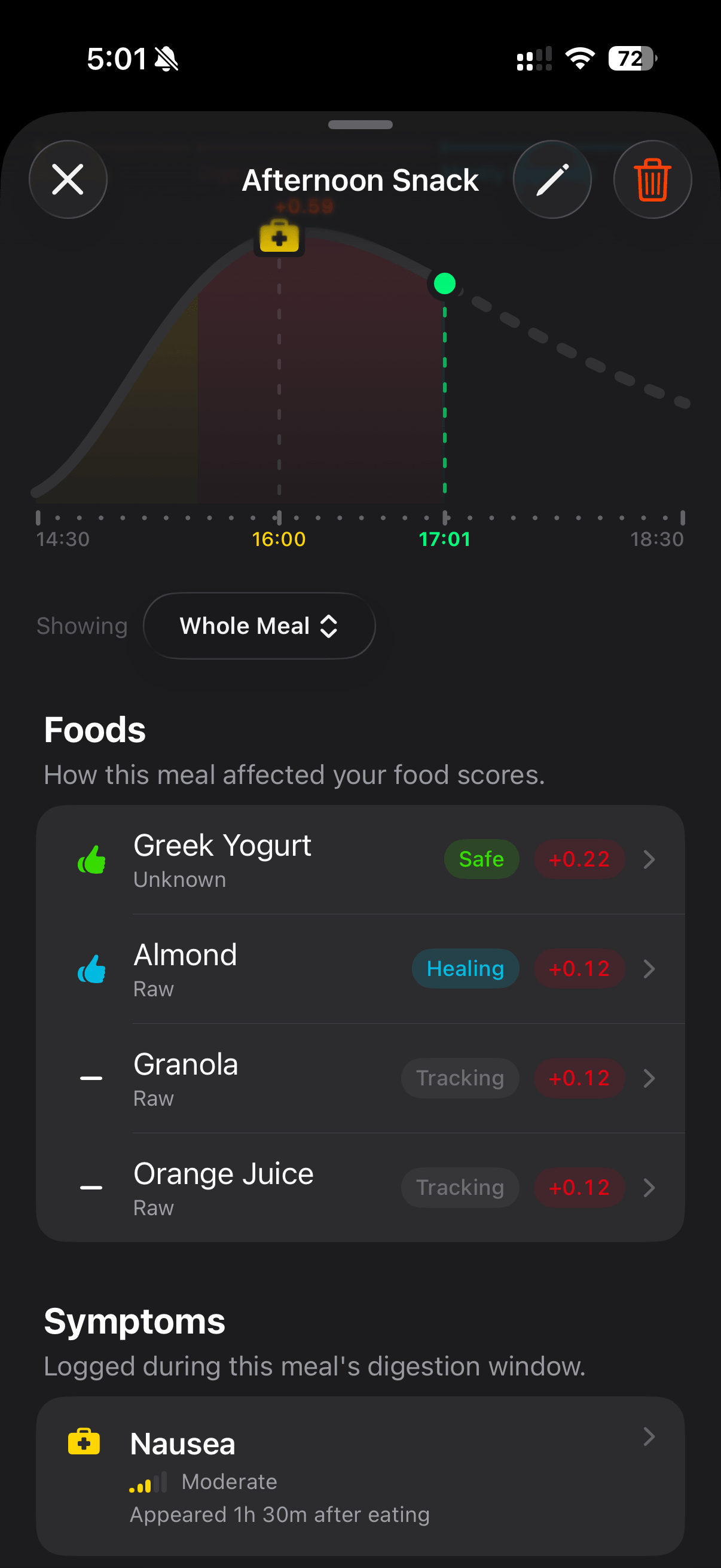
Meal detail sheet where you can see Digestion Curve.
-
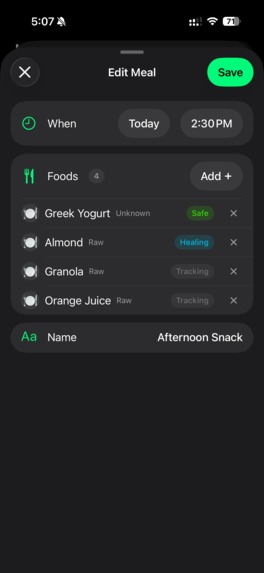
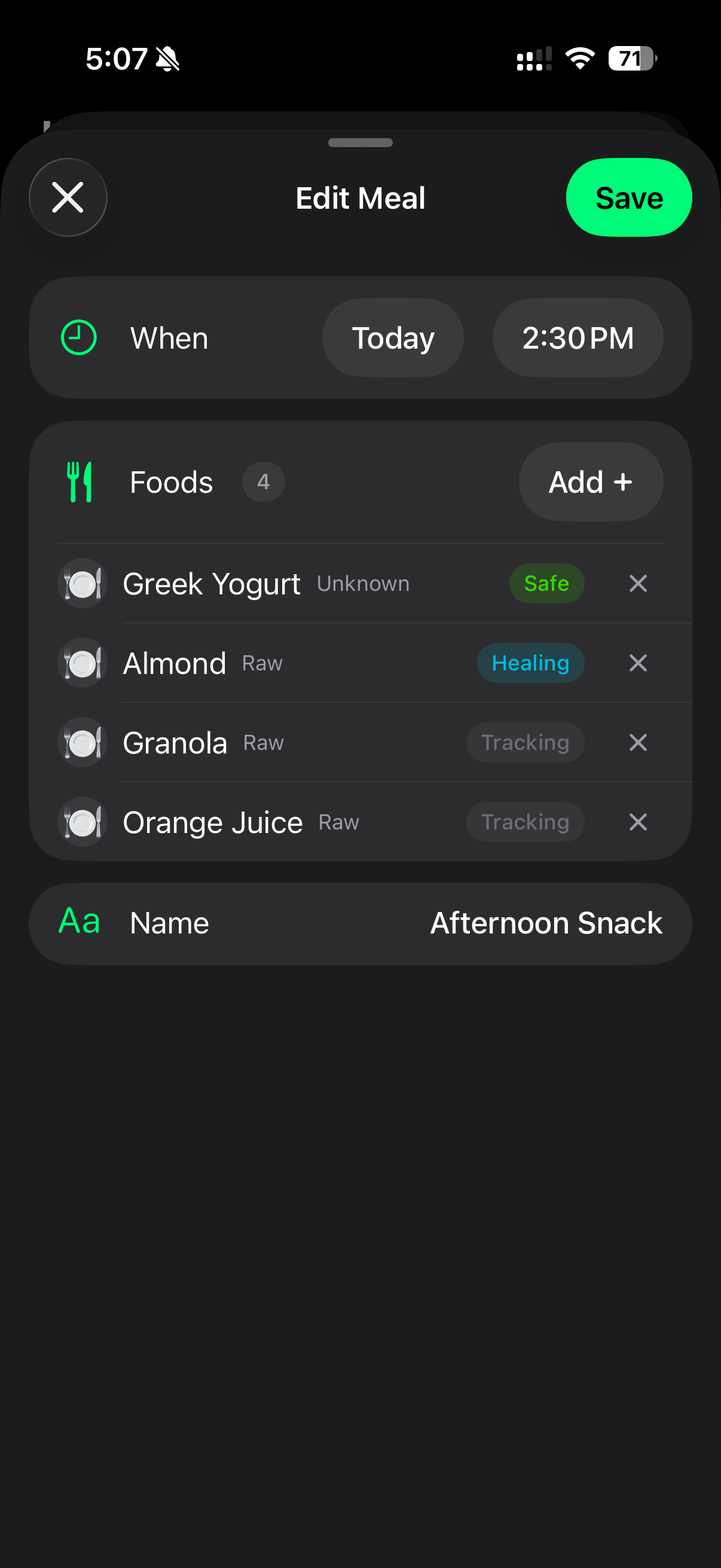
Meal logging sheet
-
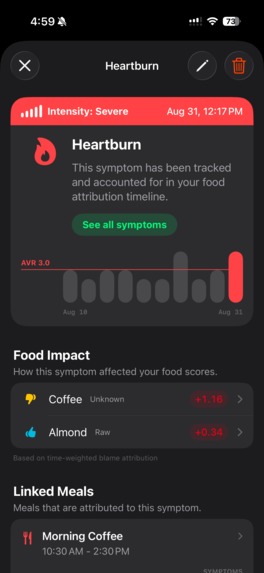
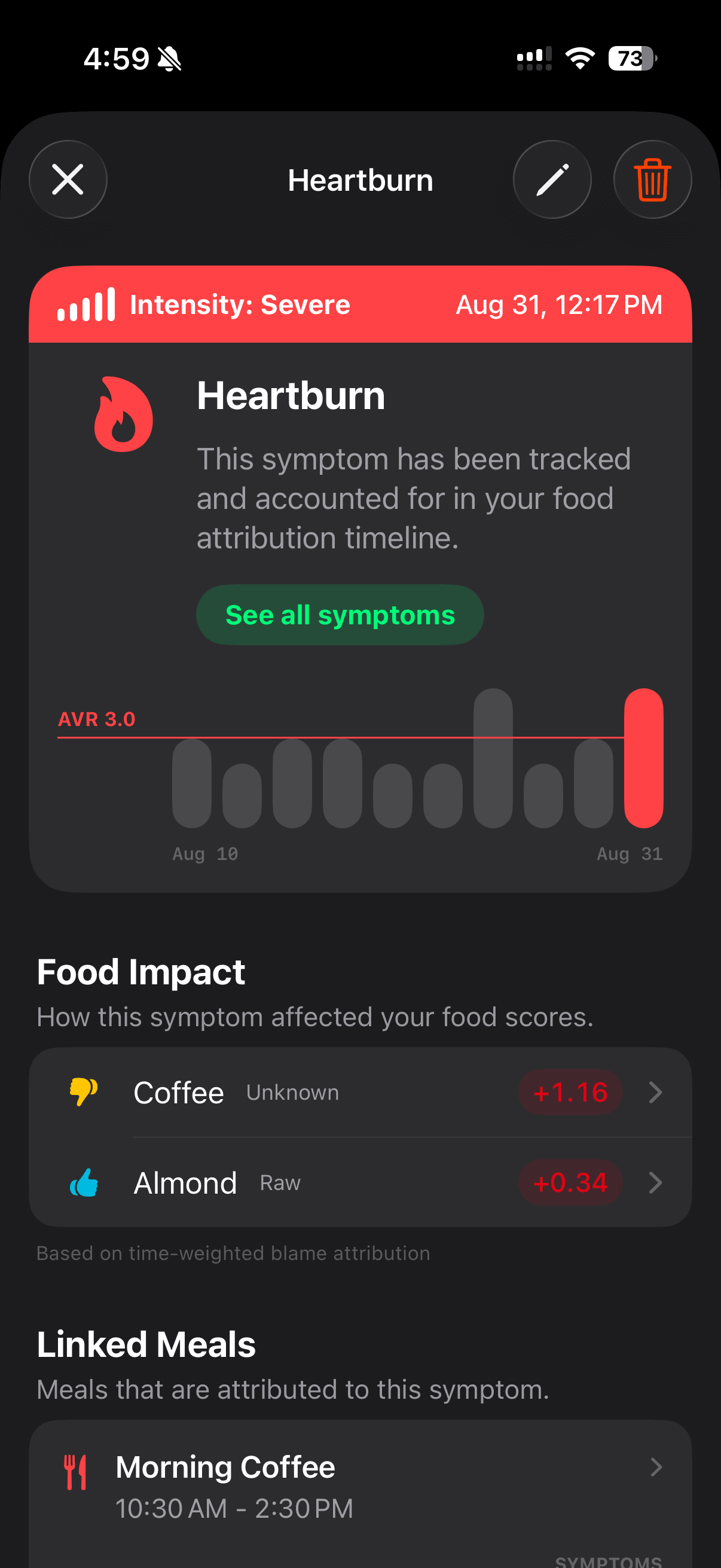
Symptom detail sheet where you see everything about your logged symptom.
-
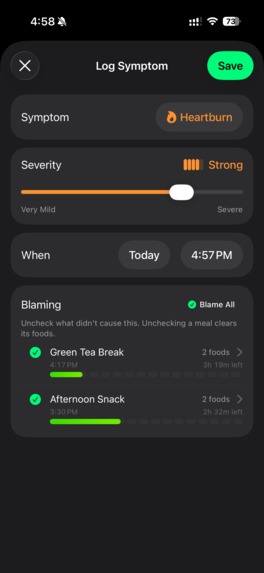
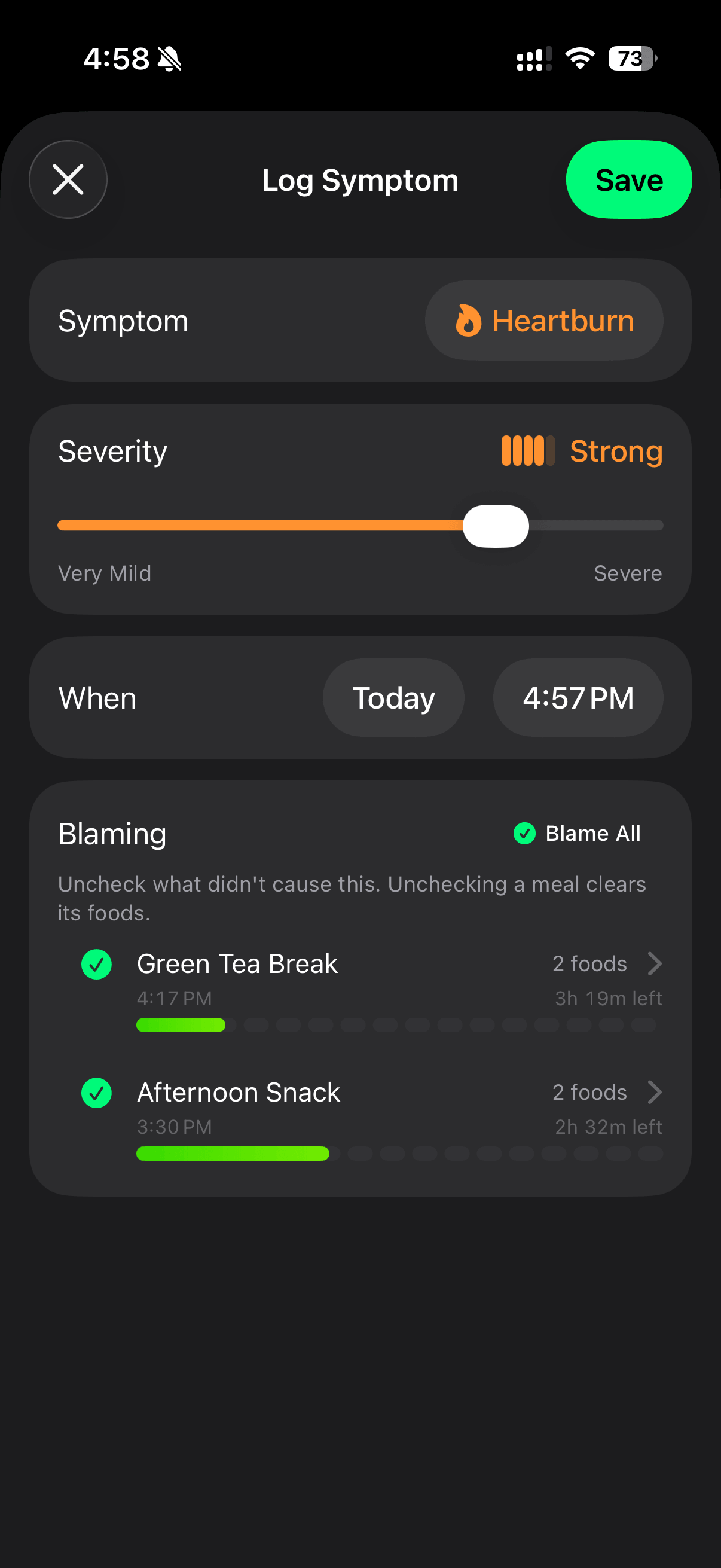
Symptom logging sheet. You can "blame" meals and foods based on your active digestion.
-
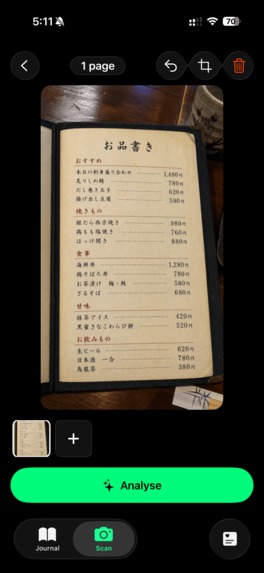
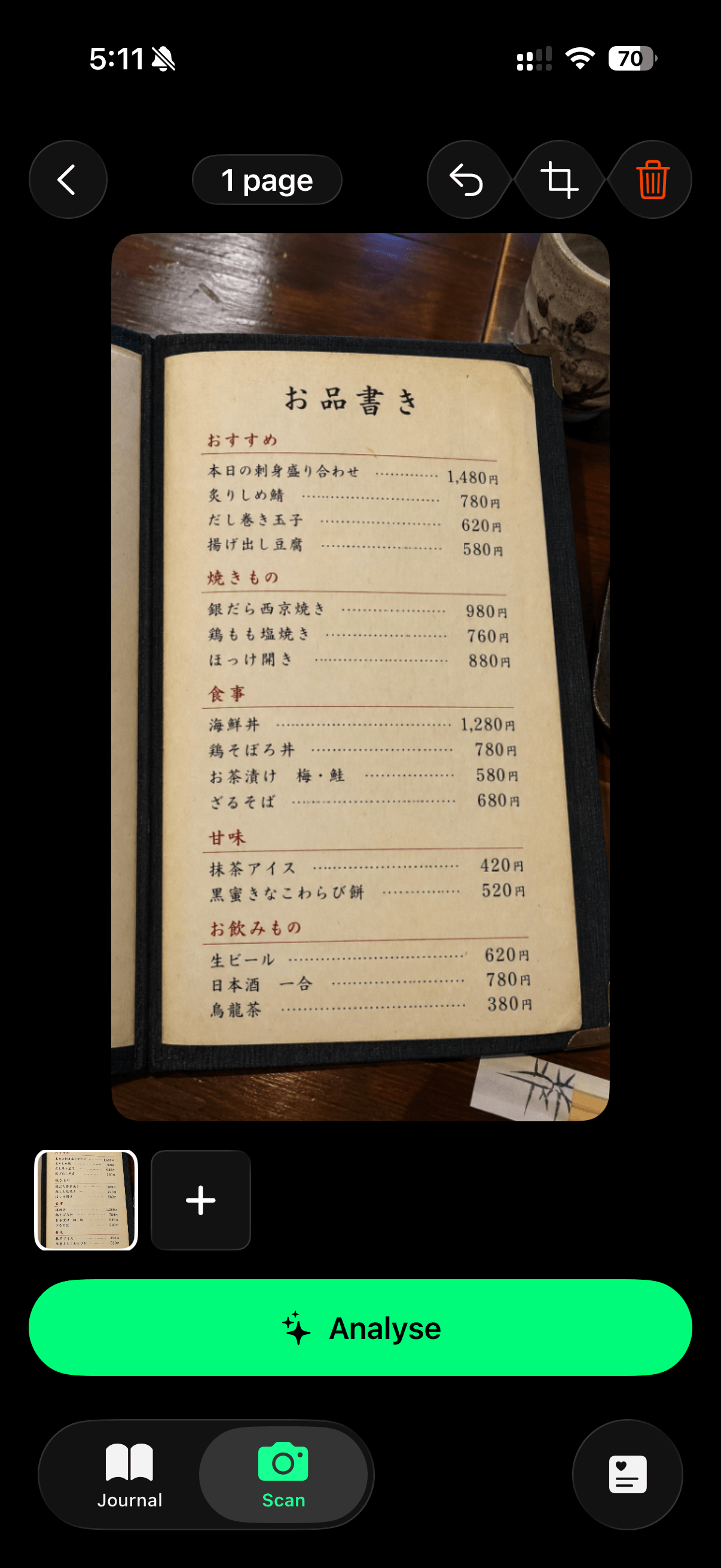
Scan/Camera screen. The app always opens to this screen to reduce friction.
-
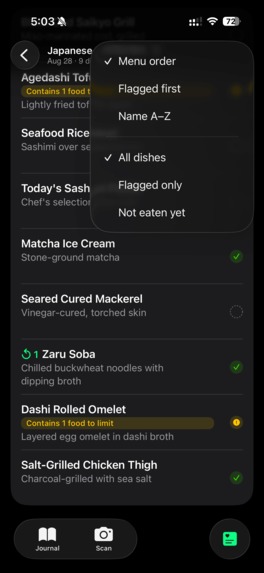
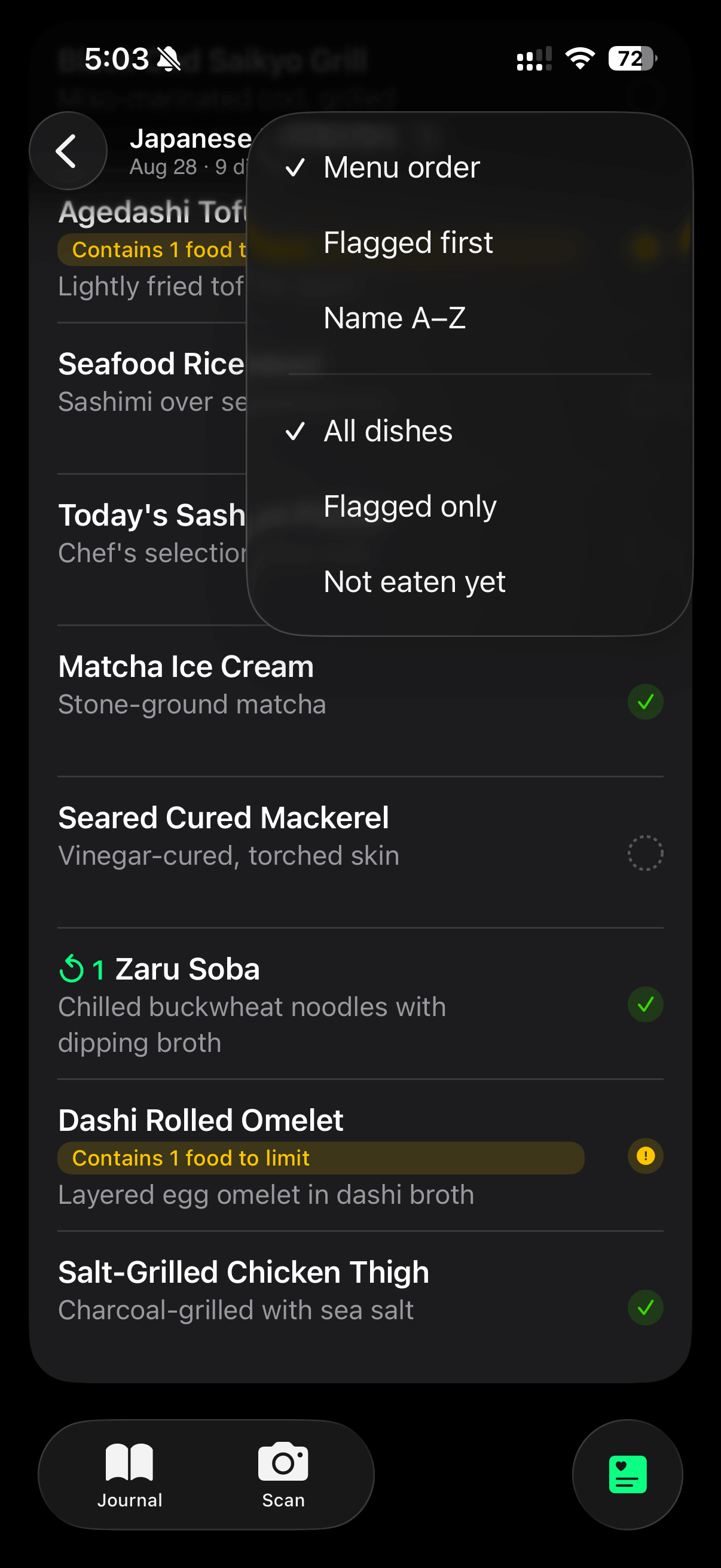
Scan results screen. You can see entire menu is organized and classified against your own food journal.
-
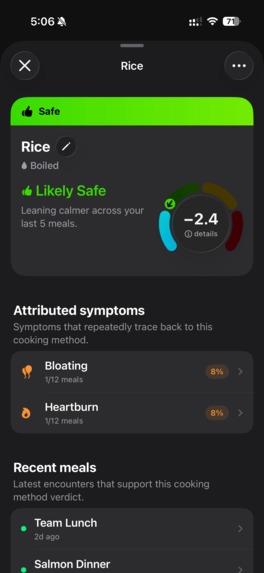
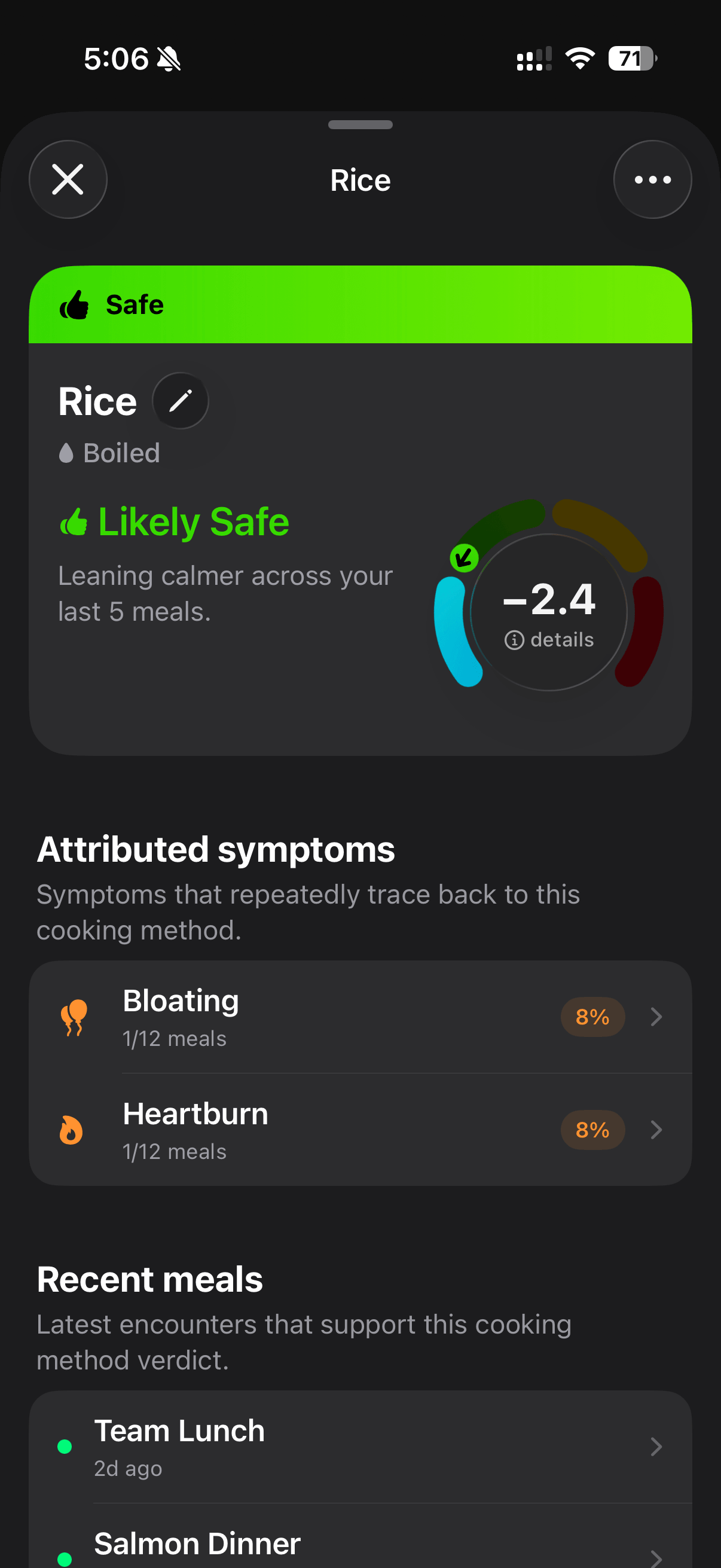
Food detail sheet. This is where you track each foods' score, history and trends.
-
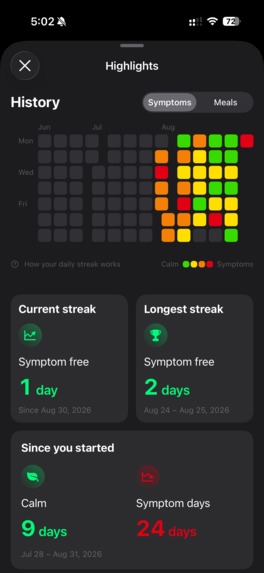
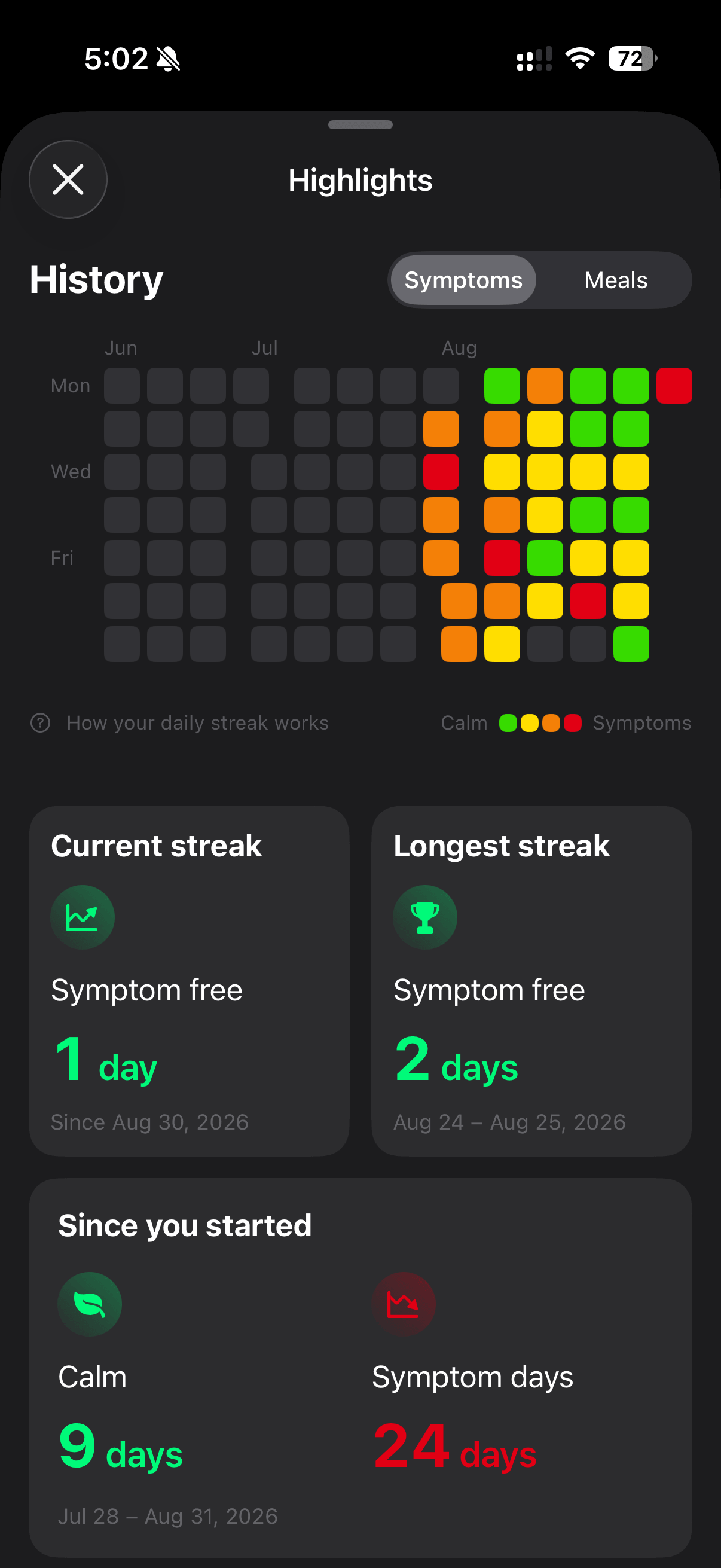
Highlights sheet. This is where you track the general trends and stats.
Inspiration
I was diagnosed with LA Grade B GERD in 2019. For those who don't know, that's a pretty serious grade.
Everyone gets reflux from shady food now and then. I had my share growing up. 2019 was the year mine stopped being "now and then."
Getting diagnosed took months, because COVID had just started and everyone was convinced my cough was COVID. It wasn't. Then came the long doctor sessions. Then more of them.
Six years later, here's the scoreboard: 20+ gastroenterologists. 5 endoscopies. 4 colonoscopies. Lab tests I lost count of. Every PPI drug under the sun. I still have reflux.
So I read. I went through every acid reflux book there is, from The Acid Watcher Diet to Dropping Acid: The Reflux Diet Cookbook & Cure. Then I ran out of books and started on the medical research papers.
I also eat upside down. Yeah, that's true. Once a day I eat a meal upside down to strengthen my esophagus. Why? Because there's one research paper that says it might work. One. That's the level we're operating at over here.
At this point I know more about acid reflux, and everything it quietly does to the rest of your body, than pretty much anyone without "MD" after their name. I know what I need to do. I know exactly how I should be journaling to keep this thing under control.
There's just one more problem. I've been diagnosed with ADHD since I was 7.
So all that paperwork? Impossible. Not "hard." Impossible. And I know exactly what I'm supposed to be doing the entire time I'm not doing it. Knowing the answer and being able to do the answer are two completely different sports.
So I decided to solve it. I asked myself:
What if I cut the logging time down to the absolute minimum, and cut the symptom tracking down to zero?
That's how Reflux Diary was born. I've been building it since last October. It's a passion project, and even if it fails financially, I have zero regret about a single hour I put into it. Because I built this for me and for my spouse. We both use it every day.
What it does
Reflux Diary is a zero effort food diary built for reflux, GERD and LPR patients. And we take "zero effort" part pretty seriously. It's not a marketing talk.
The biggest hurdle in a reflux patient's daily life is working out what hurts them and what doesn't. Some go full yolo. Some live on brutally strict diets. Some just lean on the drugs. But almost everyone has tried some kind of food journal at some point, whether it's a spreadsheet, their phone notes, or the back of a receipt.
Here's the thing though. Everyone is different. Your triggers are not my triggers. And the exact same food causes completely different problems in different people. Doctors love to promote oatmeal as the healing, gentle, safe choice for reflux patients. For me, oatmeal is literally my arch nemesis.
So people start these food journals, and the journals fail on two things:
- They're a pain to keep updated. The journal dies in week two, every time.
- They're useless exactly when you need them. Sitting in a restaurant. Standing in a grocery aisle. Cooking. Nobody pulls out their journal and cross-references their triggers against a menu while sitting with a group of friends. You go by memory and hope whatever you ordered doesn't have something bad hiding in it.
So there are two problems to solve:
- How do we let people journal with the absolute minimum effort?
- How do we give people the answer they need, in any situation, as fast as humanly possible?
One: the journal builds itself
Reflux Diary doesn't count on you to keep your foods tracked. It tracks them off your daily life instead.
You log a meal, either manually or by scanning it. The app detects every food in that meal and how it was cooked, because grilled and deep fried are not the same food as far as your esophagus is concerned. Then it builds an estimated digestion curve for that meal to estimate roughly how long that food is going to be with you.
You don't track anything. You log, and you're done.
Later in the day, if you feel heartburn, bloating, nausea, whatever it is, you log the symptom. That's it. From there the app blames the key foods sitting in your digestion curve, weighted by where in the curve you were and how bad the symptom was. Every food gets scored by the reflux algorithm, and over time each one drifts between Healing and Avoid.
Your food journal builds itself out of your ordinary life, without you doing the manual work.
Two: the answer in one photo
When you need information fast, you scan.
Is this sushi going to wreck me? Take a photo. You get the ingredients back, clearly marked against your own food journal.
I'm sitting in this restaurant, what's actually safe on this menu? Take a photo of the menu. The app ranks and classifies every dish on it, so within seconds you know what's safe and what you should walk away from.
Now imagine you're in a country whose language you don't speak. You can't read the menu, you can't read the product labels, you can't even talk to waiters. Take out the app, snap a photo, and let it scan, translate and classify everything against your own journal. No need to interrogate a waiter about all 100 trigger foods on your list.
The app handles dish scanning, menu scanning, barcode scanning and product label reading.
How we built it
I'm a web developer and a marketing engineer. Before last October I had never written a line of Swift.
The app is built in SwiftUI for iOS. I built it with the help of Claude Code and ChatGPT Codex, and used Replit for the initial pre-production proof of concept work. RevenueCat runs the subscription side, which spared me from turning payments into an entire second project.
The design is mine. All of it. I manually designed every interaction, every flow, the UI, the UX, the colors, all of it. My biggest inspiration was working out how to properly use Apple's new Liquid Glass design and how to actually respect the HIG principles instead of just skimming them.
Challenges we ran into
The algorithm
This was the big one.
The app runs on a genuinely complex algorithm for scoring and classifying food. That work alone took more than two months of development and fine-tuning (which is still far from perfect). I cleared countless bugs. I read countless research papers. The algorithm itself changed five times. What I started with looks nothing like what shipped.
The hard part wasn't building something complex. It was building the most complex version I could, and then trimming it down to only the parts that are actually useful, the simplest, most efficient thing that still tells you the truth. That process was enormous.
The design
The app has two hard rules, and everything gets optimized for those two rules and nothing else:
- Cut the initial logging time to the absolute minimum and make it completely frictionless.
- Give the user the information they want, whenever they want it, as fast as possible and just as frictionless.
Those two lines dictated every single interaction in the app. The UI changed more times than I can count. I experimented with an absurd number of UI and UX flows before landing here.
The result is a bit unusual. Unlike other food trackers, Reflux Diary is built on a timeline, and you might genuinely mistake it for a calendar app the first time you open it. Then you use it for a week and realize every one of those decisions exists to keep the thing clutter free.
Security
The biggest technical challenge.
The app has a backend, and users get daily AI credits to spend in it. The smallest mistake there doesn't produce a bug. It produces an invoice.
That made security a huge chunk of the work, mostly because I came from the web. I didn't know much about Swift or iOS development when I started, so I had to learn the Swift and iOS principles from scratch, and then learn how security actually works when you're not sitting safely inside a browser.
Keeping Revenuecat secure and away from client was a good choice on my end. I realised many ai assisted apps suffer from the same thing. RC sends and receives data directly from the client and it's very easy to forge those handshakes. So spent alot of time to ensure my backend and RC is safe and client can't fiddle with them.
Accomplishments that we're proud of
The design. I'm genuinely proud of it.
I created a lot of unique concepts and visualizations for this app. I invented the digestion curve system for tracking a meal as a process instead of a timestamp. I invented the food scoring and classification algorithm behind it. And I hand-designed every graph and every piece of UI that gives a reflux sufferer something meaningful.
I know they work, because I only put things in this app that I want to know.
Thanks to this app, I found out my body has a weird Thursday mode. It doesn't matter what I eat. On Thursdays I get a specific set of symptoms. Six years, twenty-plus specialists, five endoscopies, and nobody caught that. My own app did.
This app genuinely helps me understand my own body. That's the accomplishment I'm proudest of.
Another big one is BYOK option. All AI apps are all about monthly payments. I myself hate montly payments. I thought about what would make me happy both as a provider and as a client. Then I decided to offer BYOK option for people. One time lifetime purchase gives you all pro features. And you can use your own AI subscriptions for AI features.
What we learned
SwiftUI development. iOS development. Mobile security. Payments, subscriptions and the whole App Store system. Mobile design and UX. App Store SEO and marketing.
All of that from zero, in about ten months.
But the real lesson is a smaller one. I had the right answer for six years and still couldn't act on it. The gap between knowing and doing isn't a discipline problem. It's a design problem. I build Reflux Diary for people on their worst day, not on their most motivated one.
What's next for Reflux Diary
Business: 100 paying customers.
Tech: Bring Reflux Diary to the Apple Watch. I have so many ideas that only make sense on the wrist, and every one of them makes the app easier to use for our users, and honestly, for me.

Log in or sign up for Devpost to join the conversation.