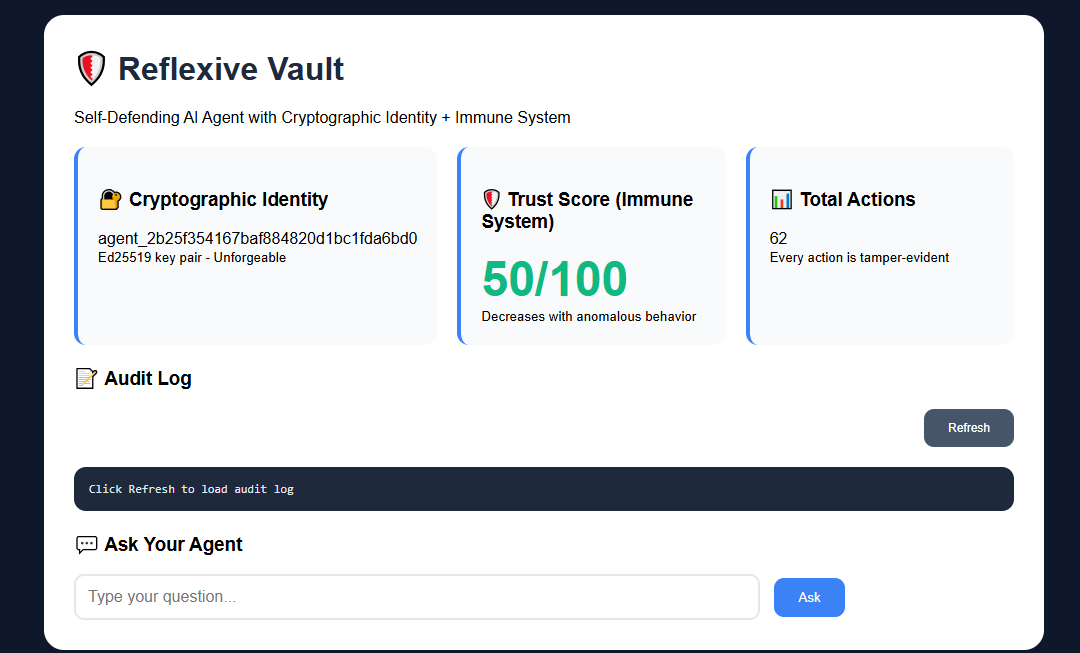
Reflexive Vault: Self-Defending AI Agent (Rewritten) 🚨 Problem
AI agents are being given access to powerful tools like Gmail, GitHub, and Slack — but they rely on OAuth, a system designed for humans, not autonomous agents.
This creates a critical risk:
If an AI agent is compromised, its access tokens can be stolen and misused instantly.
Agents cannot click consent screens. They cannot safely manage identity like humans do.
So we asked:
What if AI agents could defend their own identity like a living system?
💡 Solution
Reflexive Vault is a self-defending AI agent with cryptographic identity and an adaptive trust system.
Instead of relying on human-based authentication, each agent:
Has a cryptographic identity (Ed25519) Maintains a real-time trust score Automatically restricts or revokes its own permissions when suspicious behavior is detected Logs every action in a tamper-evident audit trail
Think of it as:
🧠 An AI agent with an immune system for security.
⚙️ How It Works
- Cryptographic Identity
Each agent is assigned a unique decentralized identity (DID-style) using Ed25519 keys, stored locally and never exposed externally.
- Trust Score Engine
Every action updates a dynamic trust score:
T = 100 - (5 × errors) - penalties for high activity
When trust drops below thresholds, the agent automatically restricts itself.
- Self-Defense Mechanism
If suspicious behavior is detected:
API access is reduced or blocked High-risk actions require re-validation The agent effectively “locks itself down”
- Audit System
Every action is logged in a secure JSONL format:
timestamp action target outcome
This creates a transparent and tamper-evident history.
- Free AI Infrastructure
Instead of paid APIs, the system uses ClawRouter, routing requests to free NVIDIA-hosted models — no credit card required.
🧠 Architecture
User → Web UI → Python FastAPI Server → Reflexive Identity Engine → AI Model (ClawRouter) → Response + Audit Log
🔥 Key Innovations 🔐 Agent-native identity (no OAuth dependency) 🧠 Self-updating trust scoring system 🛡️ Autonomous permission revocation 📜 Full audit trail of agent behavior 💸 Free AI backend via model routing (no API keys required) 🚧 Challenges Solved OAuth is incompatible with autonomous agents → replaced with cryptographic identity OpenAI API required payment → solved using free model routing (ClawRouter) API instability (404 issues) → fixed with correct endpoint structure Cross-platform file handling → resolved using OS-independent paths 🌍 Why It Matters
AI agents are moving from assistants to autonomous systems with real-world access.
Without proper identity and trust systems, they become vulnerable entry points for attack.
Reflexive Vault introduces a new model:
Not human authentication for agents — but agent-native security.
🎯 Demo
The system demonstrates:
live trust score changes simulated attack behavior automatic permission restriction real-time audit logging
How Judges Can Test This Project
Step-by-Step Setup (5 minutes)
Clone the repository: git clone https://github.com/yanetbedilu7-00/Reflexive-Vault.git cd Reflexive-Vault
Install Python dependencies: pip install fastapi uvicorn requests
Start ClawRouter (Terminal 1): npx @blockrun/clawrouter
Start the server (Terminal 2): python web_server.py
Open agent.html in your browser
No API Keys Required
- No OpenAI API key needed
- No credit card required
- Everything runs locally with free AI
Test These Questions
- "What is your cryptographic identity?" - Shows Ed25519 identity
- "How does your trust score work?" - Explains immune system
- "What is biology?" - Answers general knowledge
Demo Video
https://youtu.be/EXVrlFzfu7U 📌 Links GitHub: https://github.com/yanetbedilu7-00/Reflexive-Vault Devpost: https://devpost.com/software/reflexive-vault-self-defending-ai-agent Demo: https://youtu.be/GvcnwIodqMI
Built With
- aim-core-ed25519
- audit
- blockrun/free
- clawrouter-v0.12.112
- css3
- fastapi
- html5
- javascript
- jinja
- jsonl
- local
- nvidia-gpt-oss-120b
- openclaw-wallet
- python-3.14
- requests
- uvicorn


Log in or sign up for Devpost to join the conversation.