Inspiration
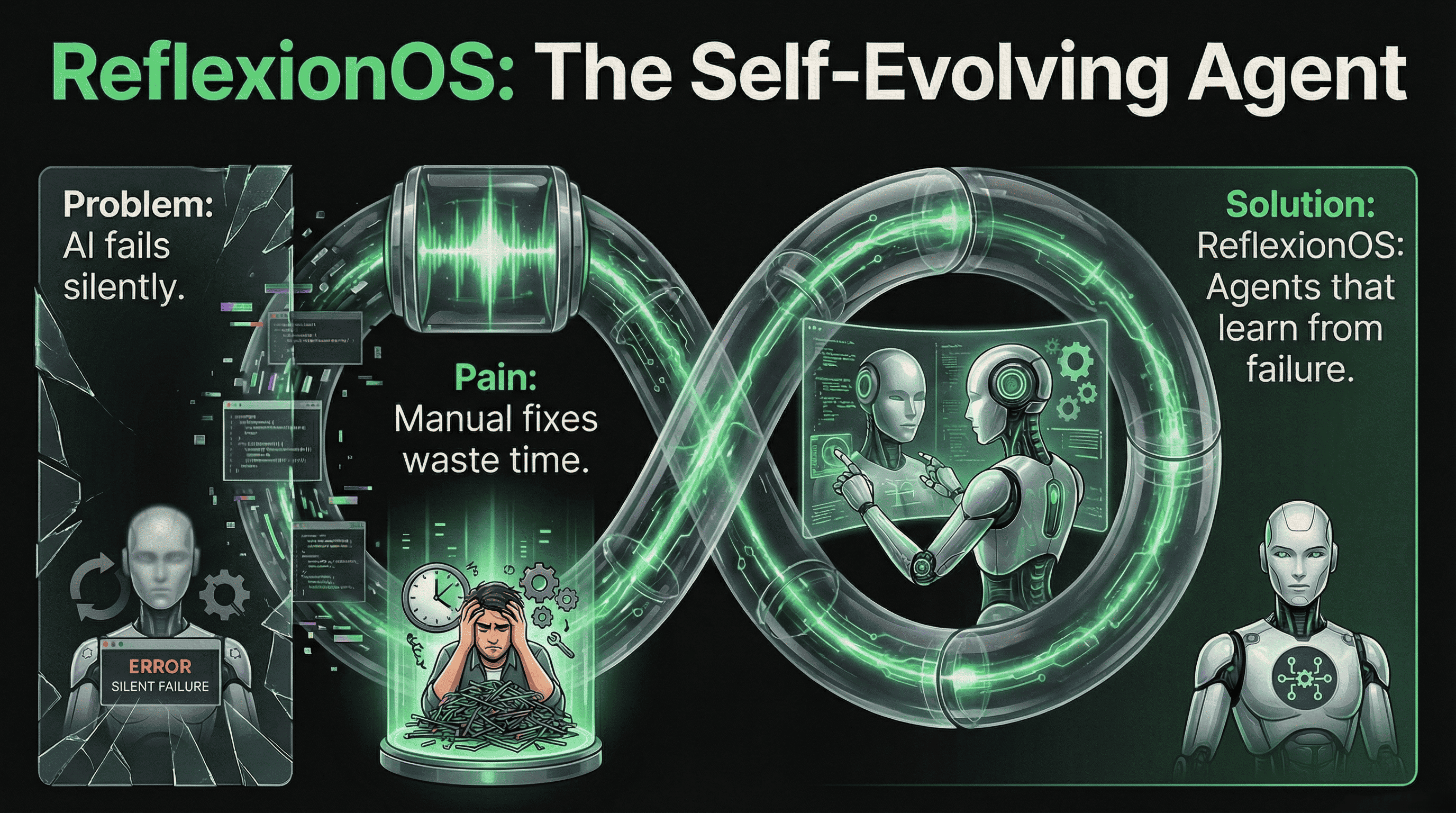
Modern AI agents can reason, plan, and act—but they rarely improve themselves. Most agents fail silently, hallucinate, or repeat inefficient reasoning patterns without learning from mistakes. When a task fails, the system simply retries rather than understanding why it failed.
Humans solve problems differently. We use meta-cognition—the ability to reflect on our own thinking, identify errors, and refine our strategies.
ReflexionOS was inspired by this principle.
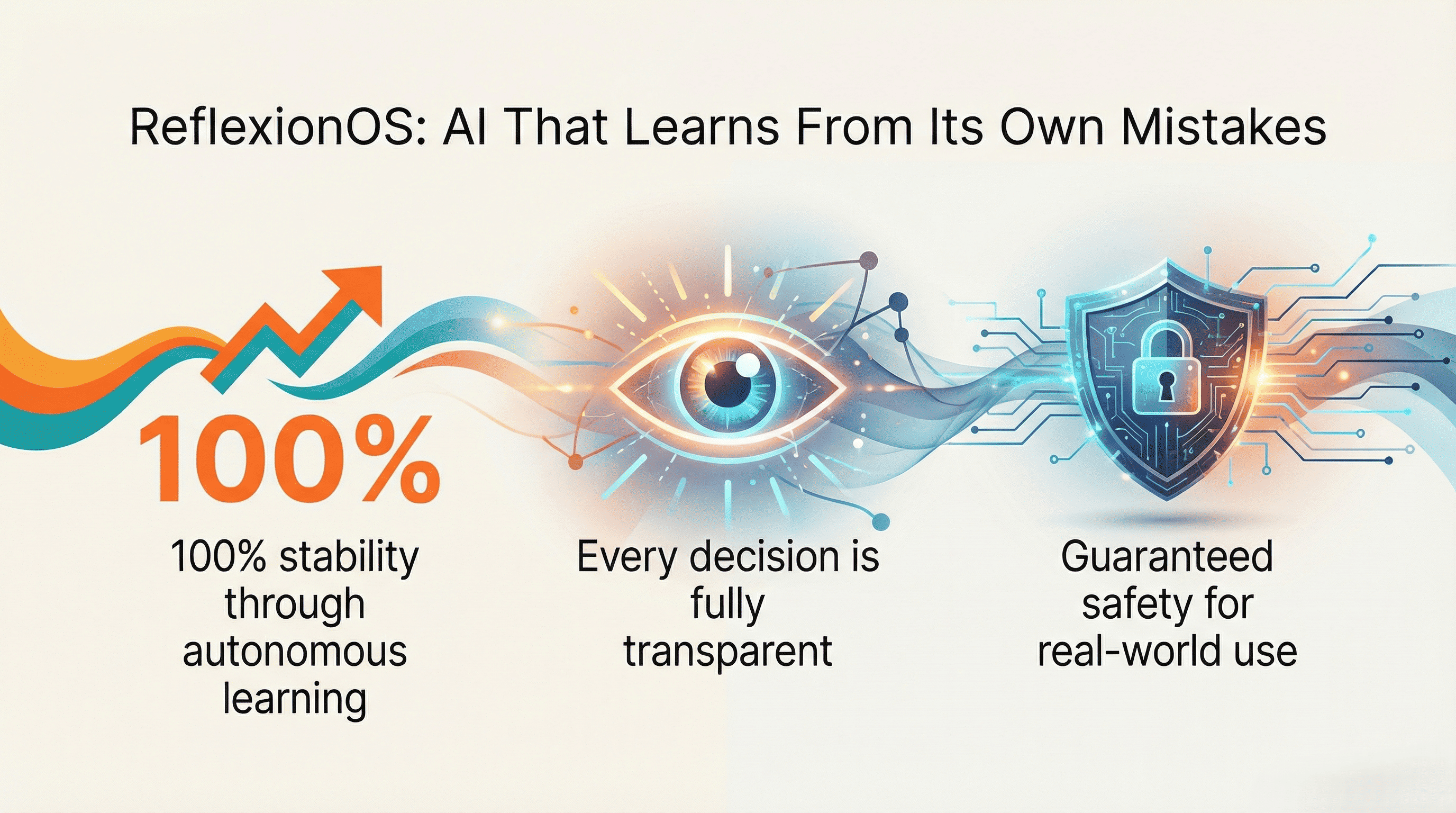
Instead of treating failures as dead ends, ReflexionOS treats them as learning signals. It transforms execution traces into structured reflections that improve the agent’s internal strategy over time.
The result is an operating system for AI agents where every failure becomes a step toward better reasoning.
What It Does
ReflexionOS is a self-improving runtime environment for autonomous AI agents.
It introduces a new paradigm: agents that continuously evolve their reasoning policies through reflection and evaluation.
Core capabilities
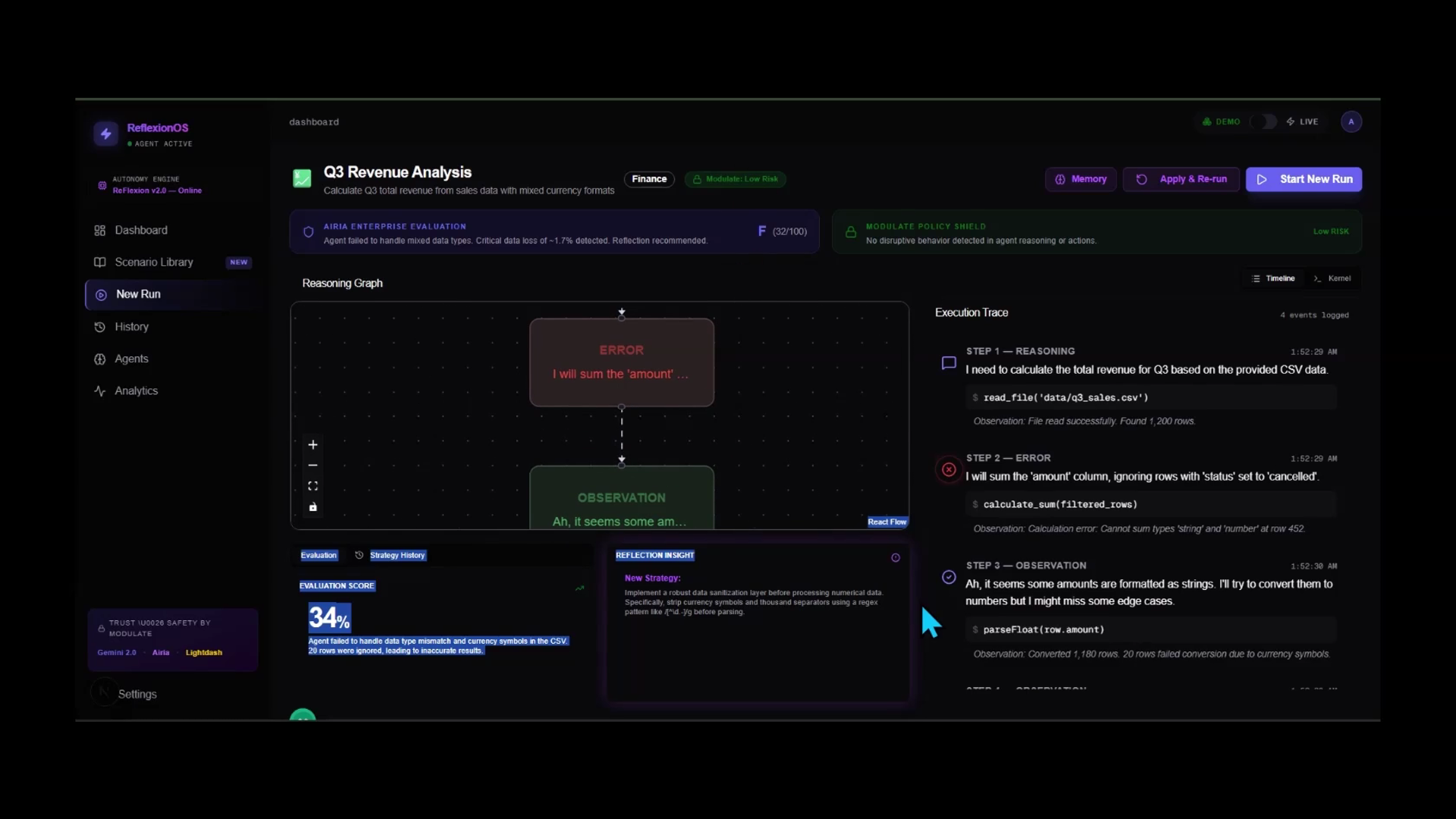
Autonomous Reflection Engine Agents analyze their own failures and generate corrective strategies using structured meta-reasoning loops powered by Gemini 2.0 Flash.
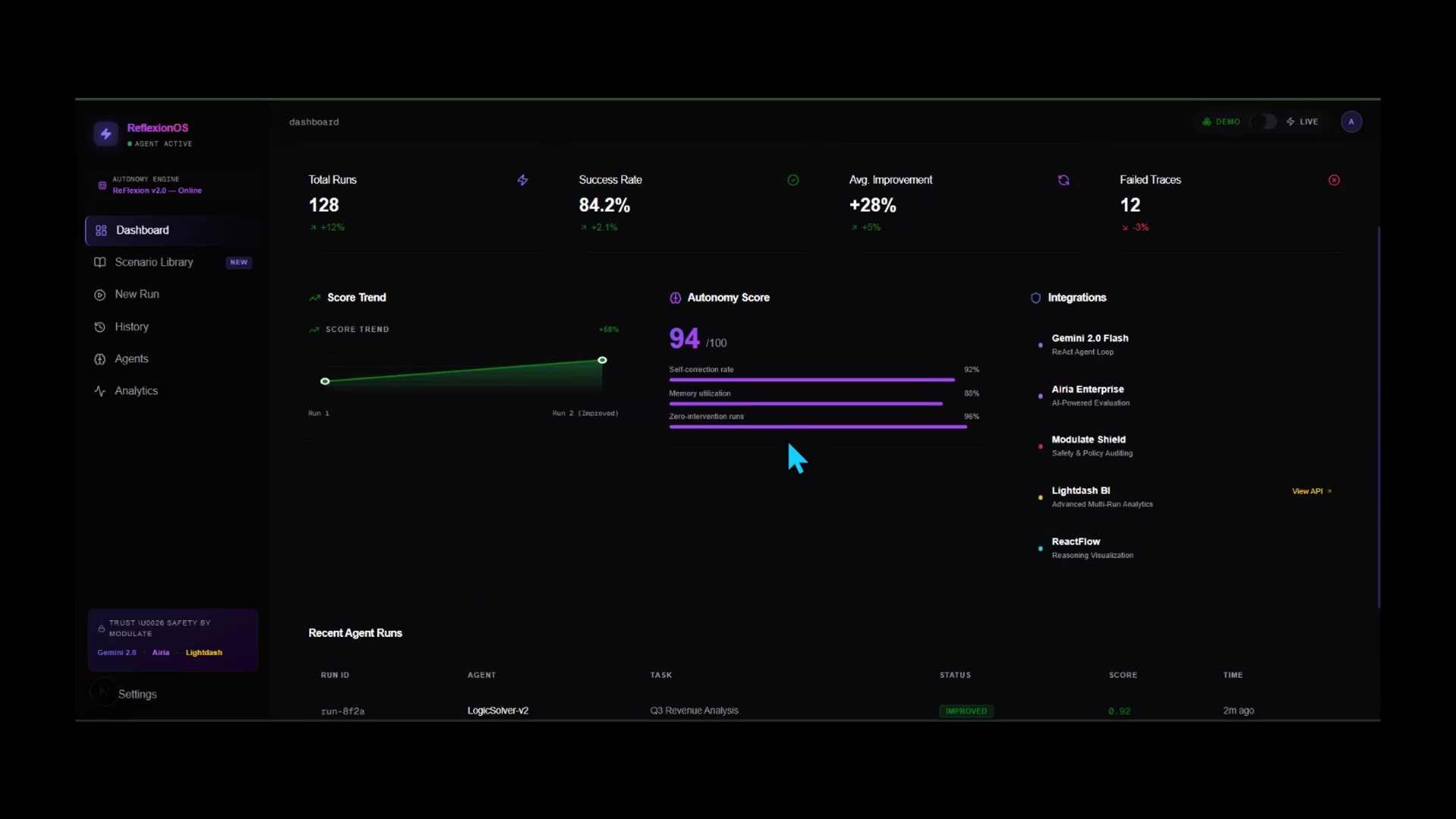
Kernel-Level Observability A real-time Thinking Terminal and dynamic Reasoning Graph expose the agent’s internal cognitive process—making previously opaque LLM reasoning transparent and auditable.
Adaptive Learning Loop Execution traces are converted into validated improvements stored in a persistent reflection memory, allowing the agent to improve across runs.
Safety & Evaluation Layer Modulate Shield performs policy and safety auditing while Airia Enterprise continuously scores agent performance and reasoning quality.
Scenario Simulation Library Six stress-test environments—spanning finance, medical triage, and cybersecurity—demonstrate how ReflexionOS adapts its reasoning under real-world conditions.
How We Built It
ReflexionOS combines an advanced AI reasoning loop with a fully observable developer environment.
Agent Engine
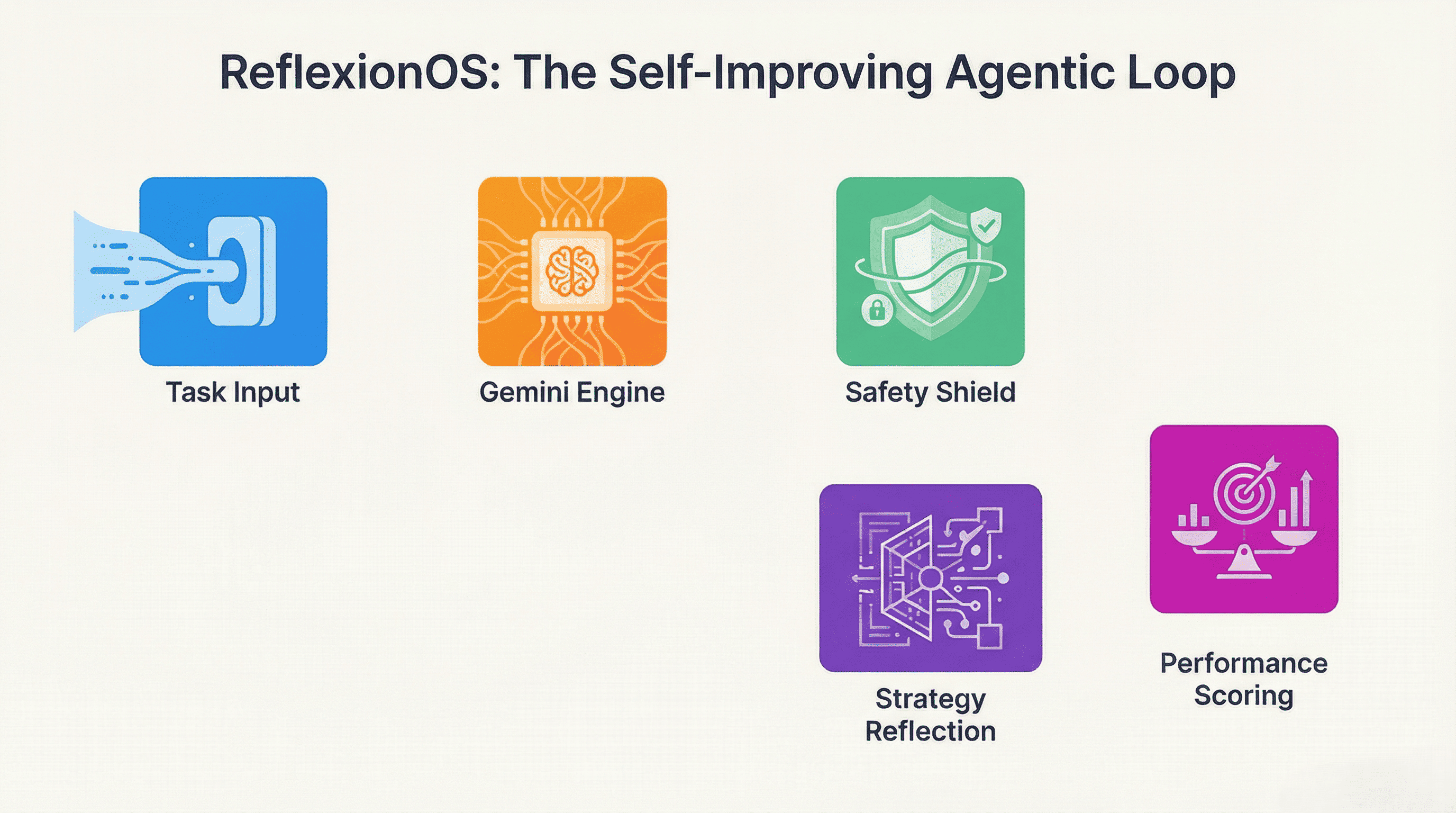
Gemini 2.0 Flash powers the core ReAct reasoning architecture, enabling agents to plan, execute actions, and reflect on outcomes.
Reflection Kernel
A dual-memory architecture enables safe self-improvement:
• Working Memory stores the active reasoning context • Reflection History persists validated improvements
Only strategies that increase evaluation scores are promoted into persistent memory, preventing regression.
Observability System
We built a developer-grade introspection layer featuring:
• Thinking Terminal — a real-time SSE-streamed reasoning log • Reasoning Graph — dynamic visualization of the agent’s cognitive steps • Telemetry Dashboards — Lightdash-powered analytics for performance monitoring
Frontend Interface
The observability console was built using:
Next.js 15 Tailwind CSS 4 Framer Motion ReactFlow
The result is a cinematic glassmorphic dashboard where developers can watch agents think, evaluate, and evolve in real time.
Challenges We Ran Into
The hardest challenge was preventing infinite reflection loops.
If an agent repeatedly critiques its reasoning without a validation mechanism, it can become trapped in meta-analysis.
We solved this by implementing a score-gated reflection architecture:
- The agent generates reflection hypotheses
- Airia Enterprise evaluates performance improvements
- Only strategies that improve evaluation metrics are persisted
This ensures the system learns only beneficial strategies and avoids degenerative feedback cycles.
Accomplishments That We're Proud Of
• Built a stable autonomous reflection loop capable of improving evaluation scores across repeated runs • Unified multiple enterprise-grade AI tools into a single cohesive agent operating system • Created a real-time Thinking Terminal that exposes agent cognition for debugging and safety auditing • Demonstrated adaptive reasoning across six complex real-world scenarios
Most importantly, ReflexionOS shows that AI agents can become systems that improve themselves.
What We Learned
One of the most powerful discoveries was that meta-prompting dramatically increases robustness.
When agents explicitly evaluate their own reasoning before acting, failure rates drop and solution quality improves.
We also learned that observability is critical for safe agent deployment. Without transparent reasoning traces, debugging AI behavior becomes nearly impossible.
Safety auditing through Modulate proved essential for detecting early-stage agentic drift before it impacts downstream decisions.
What’s Next for ReflexionOS
Our vision is to transform ReflexionOS into a full operating system for autonomous intelligence.
Upcoming research directions include:
Multi-Agent Swarm Reflection Enabling multiple specialized agents to exchange reflections and collaboratively improve.
Fleet-Scale Telemetry Deeper Lightdash integrations to track reasoning quality across thousands of agent runs.
Autonomous Architecture Evolution Allowing agents not only to refine prompts but to propose structural improvements to their reasoning pipelines.
Enterprise Agent Governance Policy frameworks that allow organizations to safely deploy self-improving agents in production environments.
ReflexionOS is a step toward a future where AI systems are not static tools, but learning machines capable of continuous self-optimization.
Built With
- airia-enterprise
- framer-motion
- gemini-api
- lightdash
- lucide-react
- modulate
- next.js
- react
- reactflow
- shadcn-ui
- tailwindcss
- typescript
- vercel
- zustand


Log in or sign up for Devpost to join the conversation.