-
-

Welcome to Reflections: A Visual Journal
-
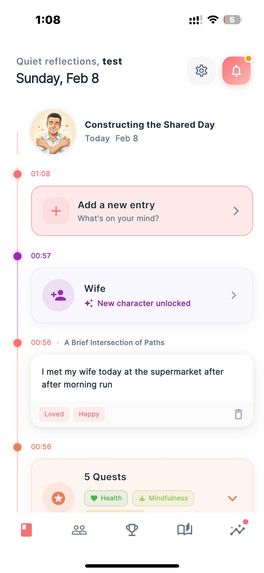
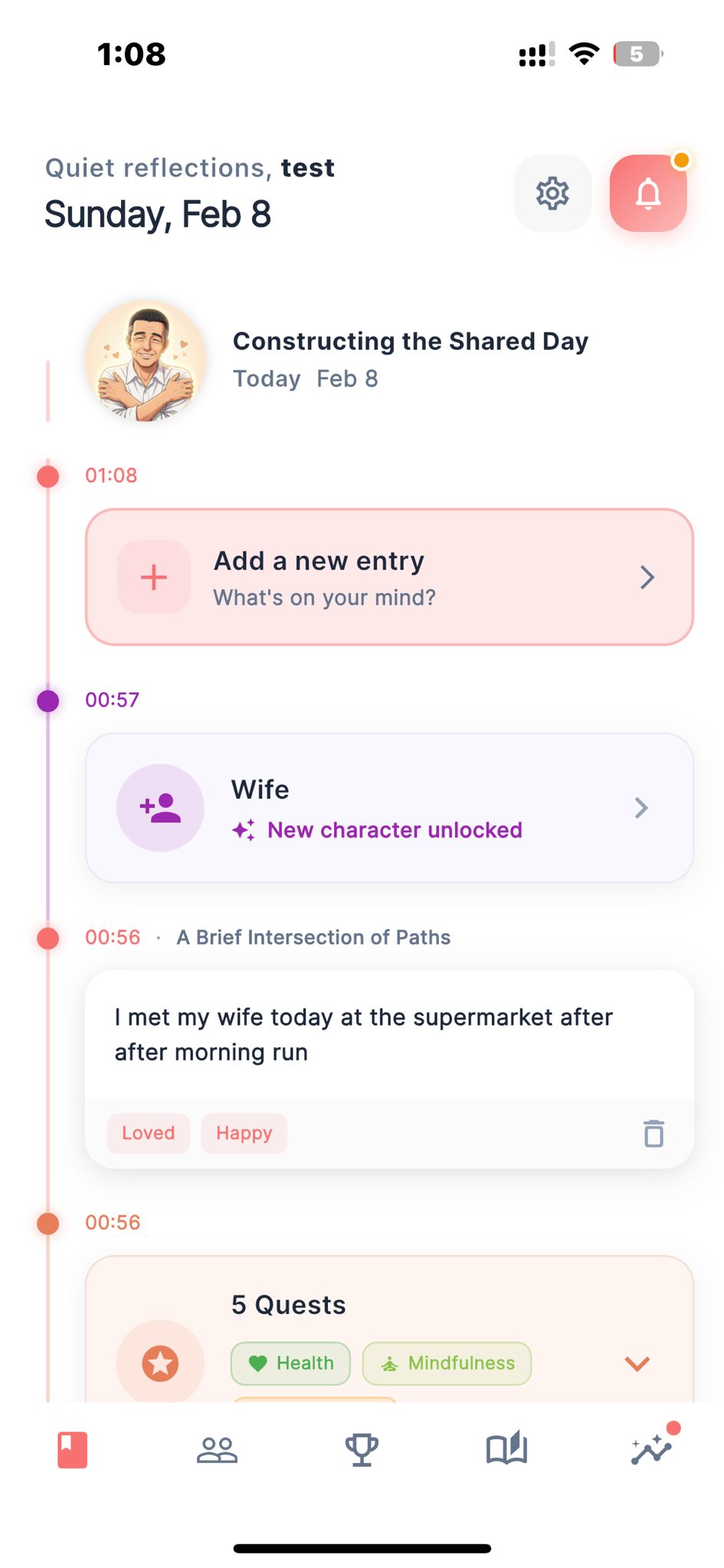
Every entry and moments are captured in a timeline
-
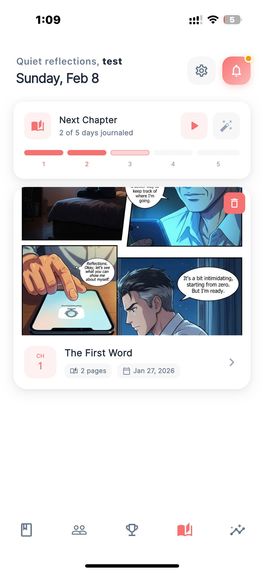
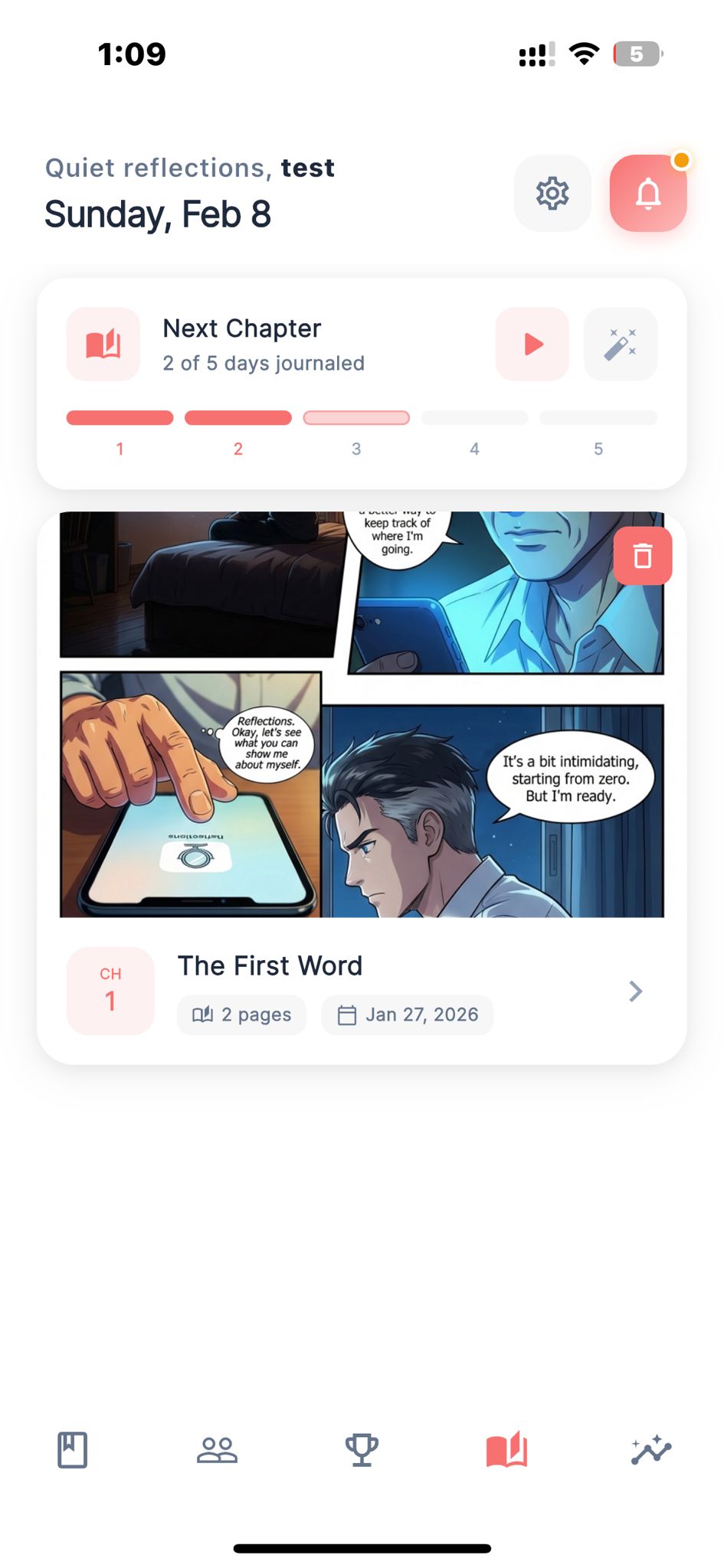
A visual biography is generated every 5 days
-

Comics are based on entries
-
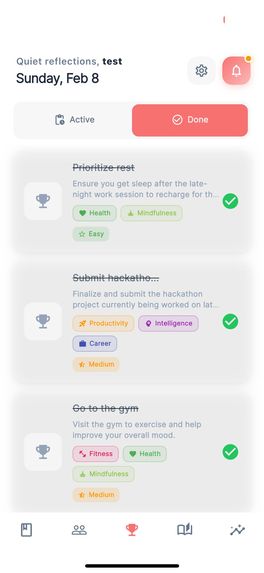
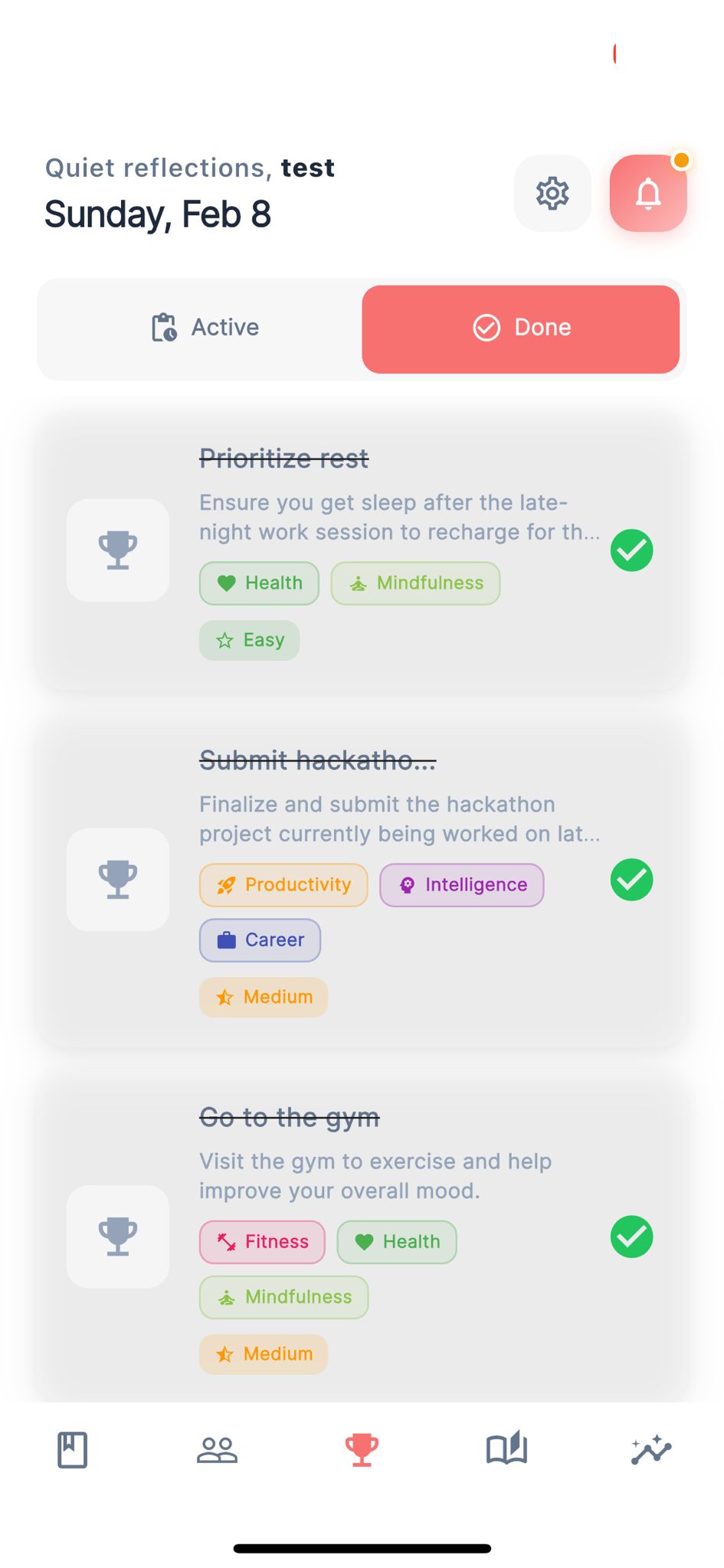
Quests
-
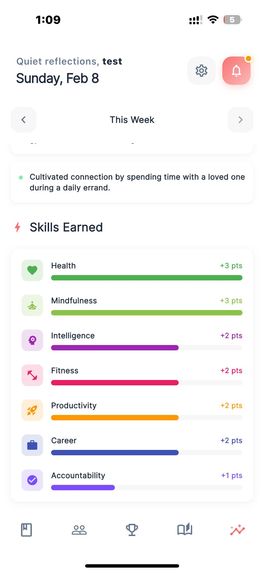
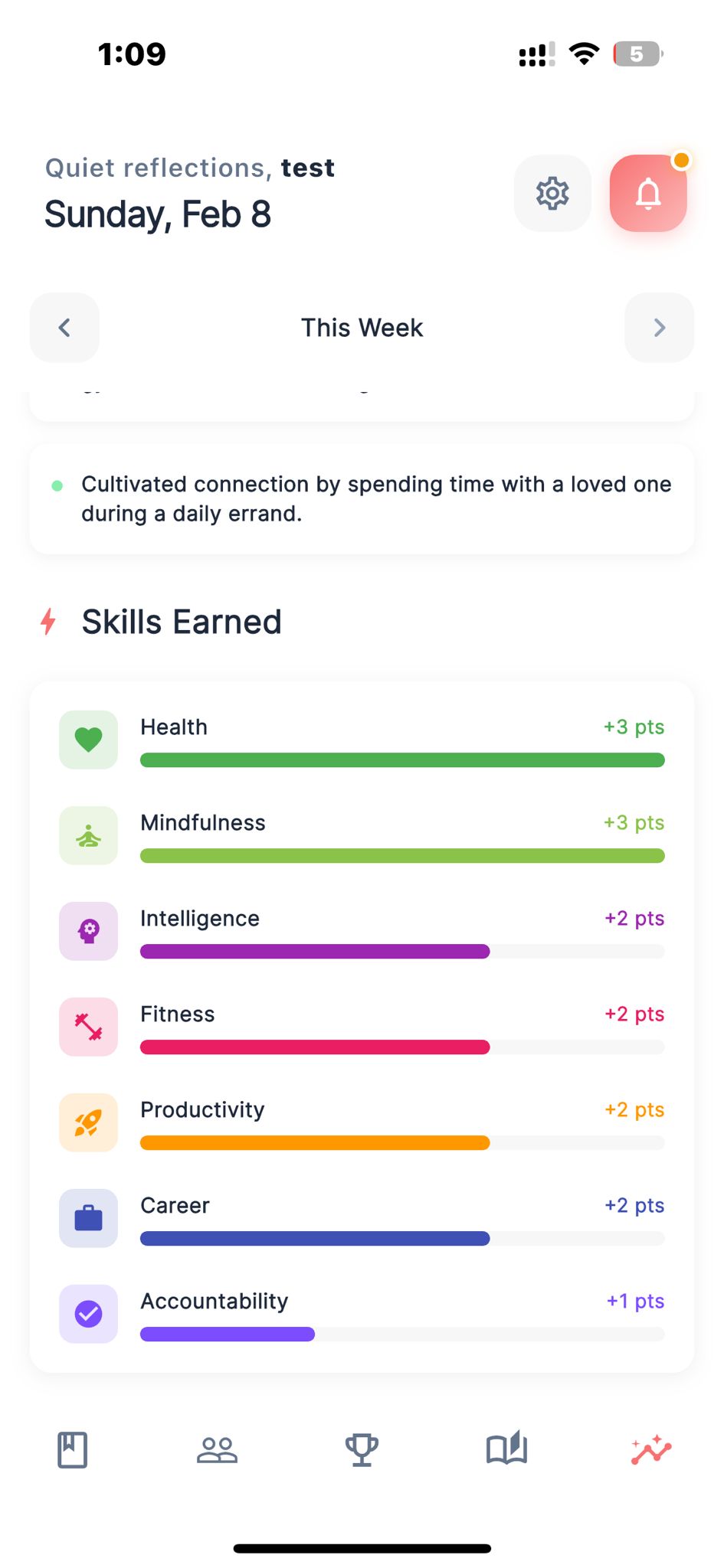
Skills earned by completing quests
-
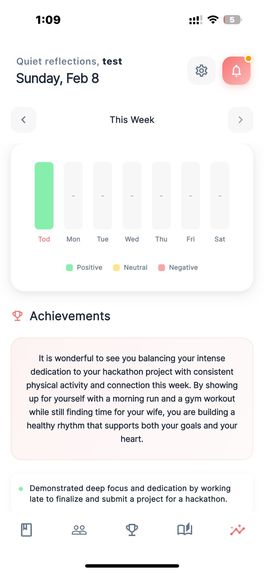
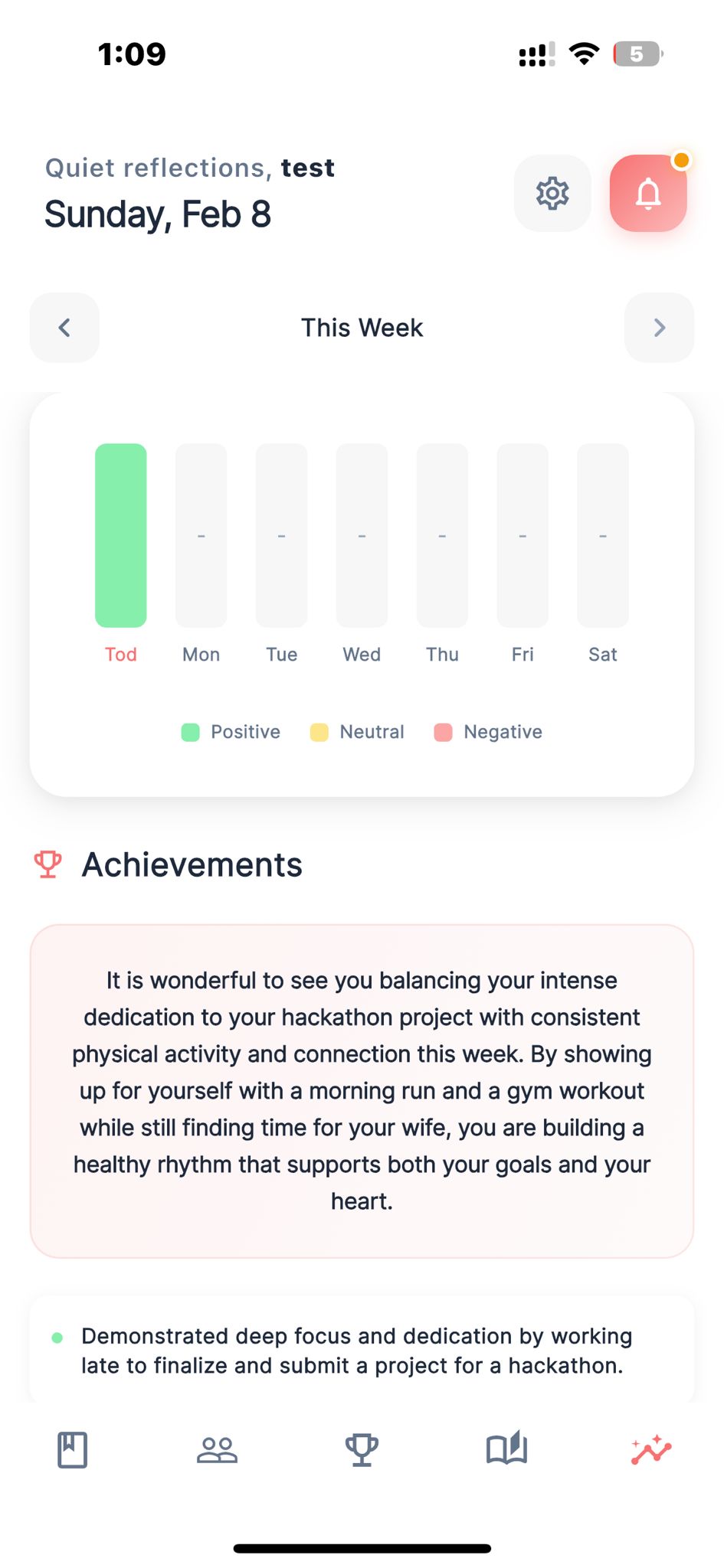
Achievements
-

Characters



Inspiration
Mental wellness starts with the self, in the everyday moments where people notice their thoughts, interpret their experiences, and assign meaning to what happens to them. Long before clinical care is involved, mental health is shaped by these internal processes, how stress is processed, how setbacks are framed, and whether effort or progress is acknowledged at all.
As rates of depression, anxiety, and chronic stress continue to rise, access to professional care remains limited, delayed, or inconsistent for many. This makes self-help and self-regulation tools essential, not optional. Practices like journaling are often the first, and sometimes only, form of support available to people as they try to make sense of their internal state.
While journaling may not appear preventative on the surface, it is one of the earliest forms of self-intervention. Many harmful patterns, such as persistent self-criticism, rumination, and distorted interpretations of events, often operate below awareness until they become entrenched. Journaling creates a pause that surfaces these patterns early, when they are easier to recognize and interrupt.
Despite strong evidence for journaling as a tool for emotional regulation, most journaling products have not evolved to fit modern life. Attention is fragmented, energy fluctuates, and emotional capacity is often lowest when support is needed most. Traditional text-based journaling assumes sustained focus and motivation, which causes many people to abandon the practice even when they know it helps.
Through my work in early intervention and preventive mental healthcare, including close exposure to high-stress populations like first responders, I repeatedly saw the same gap. People were making meaningful efforts just to function, but those efforts went unseen and unrewarded. Without feedback or perspective, progress felt invisible and negative experiences dominated memory.
Reflections was built to address this gap. Its impact lies in reshaping perspective and providing an accessible first layer of self-intervention. Instead of asking users to reflect harder, it helps them see differently. By turning journal entries into visual narratives that emphasize continuity, effort, and growth, Reflections surfaces evidence of progress that would otherwise be missed.
By externalizing experiences into stories, characters, and visuals, the system reduces emotional load and creates psychological distance. This allows users to revisit difficult moments with less overwhelm and more clarity, gradually shifting internal narratives away from rumination and harsh self-talk toward balance, self-compassion, and resilience.
Reflections does not force positivity or offer prescriptive advice. Its impact comes from making reflection engaging, sustainable, and perspective-shifting, supporting mental wellbeing early, consistently, and long before crisis becomes the only signal.
What it does
Turns journaling into a visual life story
Reflections converts journal entries into an evolving visual narrative with a clear narrator’s perspective. Instead of isolated thoughts, users see their experiences as connected chapters, making reflection easier to revisit, skim, and understand without emotional overload.Transforms everyday actions into visible progress
Journaling unlocks quests that reward consistency and intent across areas like mental wellbeing, focus, accountability, physical health, and relationships. Small actions that often go unnoticed are captured and reinforced as meaningful steps forward.Surfaces growth-oriented insights automatically
The system identifies recurring emotions, themes, and behavioral patterns and presents them in a way that emphasizes learning and momentum rather than rumination. Insights emerge without users needing to analyze or reread long entries.Maps relationships and their emotional impact over time
Characters represent people, roles, and recurring influences in the user’s life, evolving as interactions repeat. This helps users recognize which relationships contribute to stress or support, and how these dynamics shape emotional wellbeing over time.
How we built it
Reflections is built on top of Gemini 3 APIs, using both text and image generation extensively. To extract quests, characters, important moments, and emotional insights from journal entries, we relied heavily on Gemini’s text models. Instead of using a single large prompt, we followed a multi-step extraction pipeline where each prompt had a narrow, well-defined responsibility.
In the first step, structured information such as emotions, events, character signals, and narrative beats is extracted using focused prompts. These outputs are then passed into downstream generation steps to create summaries, insights, actions, chapter names, and visual story elements. This modular approach keeps the system predictable, easier to debug, and more controllable while still producing rich, creative outputs.
Generating the comic biography
The most complex part of Reflections was generating a coherent comic from raw journal entries. To make this reliable, we designed a multi-step pipeline that separates narrative reasoning, structure, and image generation.
Step 1: Script generation
We first generate a narrative script from the journal entries using Gemini text models. This script takes into account the user’s unlocked characters, their past history, their relationship with the user, and the theme specified for the chapter. The output is a structured story rather than free-form prose, optimized for visual translation.
Step 2: Page and panel planning
The script is then converted into a comic layout consisting of multiple pages, where each page has a clear theme. Each page is broken down into panels, and every panel includes a precise description of what is happening, the emotional context, and how it connects to the next panel. This creates a deterministic “map” of the comic before any images are generated. We also add dynamic styling so that all panels are not a boring square box. We extract important events and turn them into "Splash Panels", i.e, they will take up either the entire page or majority of the page.
Step 3: Page composition
Once all panels for a page are generated, the image generation model creates a comic page, preserving layout, flow, and narrative continuity.
Step 4: Self-correction and safety enforcement At every generation stage, outputs are automatically evaluated against strict safety, quality, and consistency constraints. This includes checks for nudity, violence, hate, racism, and other harmful or policy-violating content, as well as structural and visual inconsistencies.
If an output fails validation, the system re-enters a controlled regeneration loop. Feedback from the validation step is used to guide targeted corrections rather than restarting blindly, allowing the output to progressively converge toward the desired criteria. This self-correcting mechanism ensures that all generated panels, characters, and pages meet safety standards while preserving narrative intent and visual continuity.
Carefully constructed prompts
Task-specific extraction prompts We engineered dedicated prompts to extract emotions, events, character signals, goals, setbacks, and narrative tension from raw journal text. These prompts are deliberately constrained: they do not interpret beyond what is present, and they separate what happened from how the user experienced it. This reduces hallucination and ensures that downstream steps are grounded in the user’s actual entries.
Growth-aligned narrative prompts Narrative and visual prompts are explicitly designed to preserve the reality of events while gently emphasizing momentum, agency, and progression. Instead of reframing or “positivizing” difficult moments, prompts are structured to highlight continuation: what changed, what persisted, and what moved forward. This allows stories to feel honest without becoming static or defeatist.
Visual grounding prompts Image prompts are generated from structured scene descriptions rather than raw journal text. This ensures visual consistency across panels, stable character appearance, and coherent emotional expression. Styling, camera framing, and panel emphasis are all explicitly encoded to avoid ambiguity and visual drift.
Security and safety prompts Every generation stage is wrapped in a dedicated safety prompt layer. These prompts explicitly restrict adult themes, sexual content, graphic violence, hate, self-harm glorification, or exploitative imagery. When sensitive topics appear in journal entries, prompts guide the system to respond with abstraction, symbolism, or omission—preserving narrative continuity without visualizing harmful content.
Prompt feedback loops Validation outputs feed directly back into prompt regeneration, allowing the system to correct specific issues (e.g., tone mismatch, visual inconsistency, unsafe phrasing) rather than restarting generation. This creates a controlled convergence process instead of trial-and-error sampling.
Privacy and security
Privacy is foundational to journaling. Every journal entry is encrypted using Google KMS, ensuring entries can only be decrypted and accessed by the owner. Privacy is a key to any journaling application and hence we encrypt every single entry using Google KMS to ensure journal entries can only be unlocked by the owner.
Challenges we ran into
Character preservation
Ensuring characters remained visually consistent across the entire story was a major challenge. Characters needed to look exactly like how the user configured them, even when appearing in different scenes, emotions, and narrative contexts. This required careful use of reference images and panel-level generation instead of full-page generation.Typos in generated dialogue
Image generation models occasionally introduced spelling errors or awkward text in dialogue bubbles. Since this directly impacts readability and immersion, we added a validation step using text models to detect typos and trigger iterative refinements before a panel was approved.Cost vs creativity tradeoff
The multi-step pipeline significantly increases compute costs, especially for multi-page comics. We had to carefully balance creative richness with efficiency to ensure the product remains affordable while still delivering high-quality, meaningful visuals.
Accomplishments that we're proud of
Turning the idea into reality
Taking Reflections from a personal frustration to a fully working product was a major milestone. What started as a concept is now an end-to-end system that transforms journaling into something people actually look forward to.
Building a complete, engaging journaling experience
We developed a full pipeline that turns raw journal entries into timelines, insights, characters, and comic biographies, making reflection fun, visual, and habit-forming rather than repetitive.
Solving complex technical challenges
Along the way, we tackled difficult problems such as designing multi-step workflows, reducing hallucinations, and maintaining character and narrative consistency across multiple comic formats, pages, and panels.
Validating real-world adoption
Testing Reflections with early users and seeing it become part of their regular journaling routine reinforced that the experience resonates beyond novelty and supports sustained engagement.
Publishing on App store
We published the app on App Store, created a video for social media, and started seeing downloads from real users which felt awesome. We now want to become the best journaling app on the store.
What we learned
Multi-step generative AI workflows are inherently expensive, but rapid advances in model efficiency and tooling are steadily lowering these costs. This trajectory makes it increasingly feasible to build rich, multi-stage experiences that keep users engaged over time, even for tasks that are traditionally repetitive or effort-intensive, such as journaling.
At the same time, shrinking attention spans have fundamentally changed how people engage with products. Experiences that require sustained participation must now earn attention through immediacy, clarity, and feedback. Visual engagement, rapid reinforcement, and a sense of progression are no longer optional; they are baseline expectations for maintaining momentum.
We learned that these engagement hooks do not have to undermine meaningful or reflective tasks. When applied intentionally, they can be used to support behaviors that are inherently beneficial but difficult to sustain, such as journaling. By pairing visual feedback and short-term rewards with long-term growth signals, it becomes possible to keep users engaged while still guiding them toward deeper reflection, consistency, and personal development.
What's next for Reflections
Expanding beyond comics into short-form visual narratives
We plan to extend the storytelling format beyond static comics into short, lightweight videos that capture emotional arcs and progress over time. This allows reflection to remain visually engaging while adapting to different attention spans and usage contexts.
Deeper personalization through adaptive reflection and quests
Future iterations will enhance guided journaling by asking progressively deeper questions informed by a user’s history and patterns. Quests will adapt to individual growth areas, encouraging development in skills such as accountability, emotional regulation, or consistency, while respecting user capacity and avoiding pressure.
Positioning Reflections as a clinically supportive wellbeing tool
We aim to collaborate with mental health professionals to refine Reflections as a complementary support tool for mental wellbeing. This includes validating reflection patterns, aligning insights with therapeutic frameworks, and positioning journaling as an accessible, supportive practice alongside professional care.
Becoming the first line of support for mental wellbeing
We envision Reflections as the layer that exists before therapy, before crisis, and before someone even recognizes they need help. By embedding reflection into daily life, Reflections can surface early signals, reinforce healthy patterns, and bridge the gap between self-awareness and professional care. Our goal is to make meaningful self-support available to everyone — not as a replacement for clinical care, but as the foundation it currently lacks.


Log in or sign up for Devpost to join the conversation.