
Inspiration
Most interview preparation tools focus on what you answer, but not how you think.
While preparing for interviews, I noticed a pattern:
- Sometimes I knew the answer but couldn’t explain it clearly
- Sometimes I answered too quickly and made mistakes
- Sometimes I performed well in normal conditions but struggled under pressure
This led to a key realization:
The real problem isn’t just knowledge — it’s thinking patterns.
That inspired ReflectAI: a system that doesn’t just simulate interviews, but analyzes cognition, adapts dynamically, and helps users improve how they think.
What it does
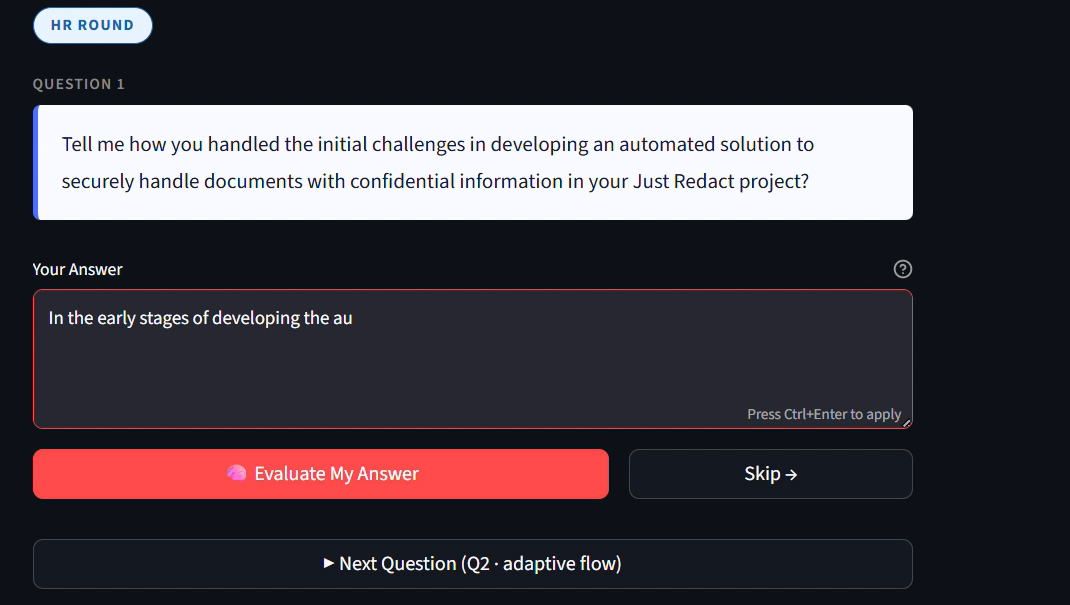
ReflectAI is an adaptive AI interview platform that goes beyond question-answering.
It can:
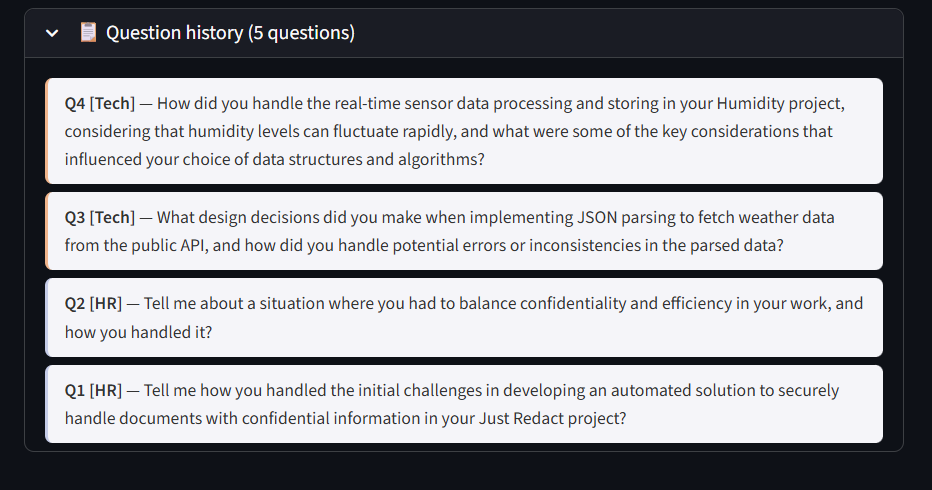
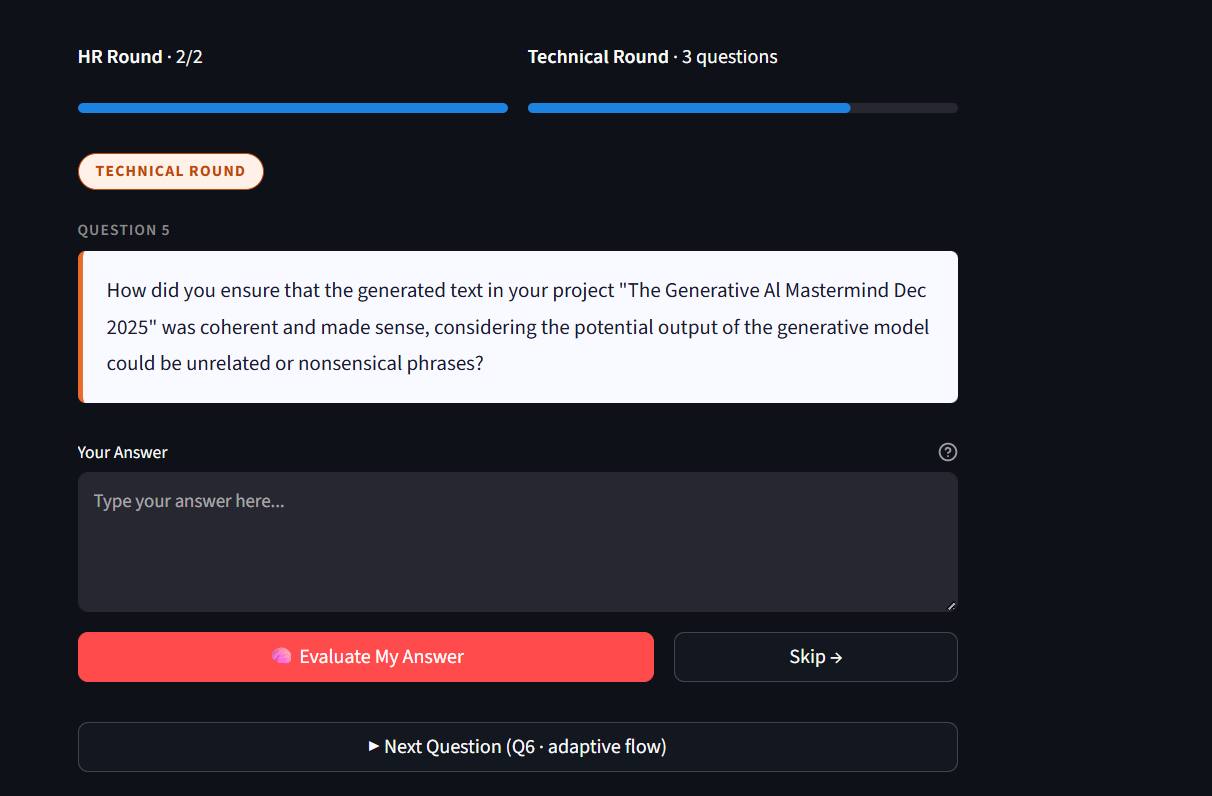
- Conduct multi-round interviews (HR, Technical, Stress)
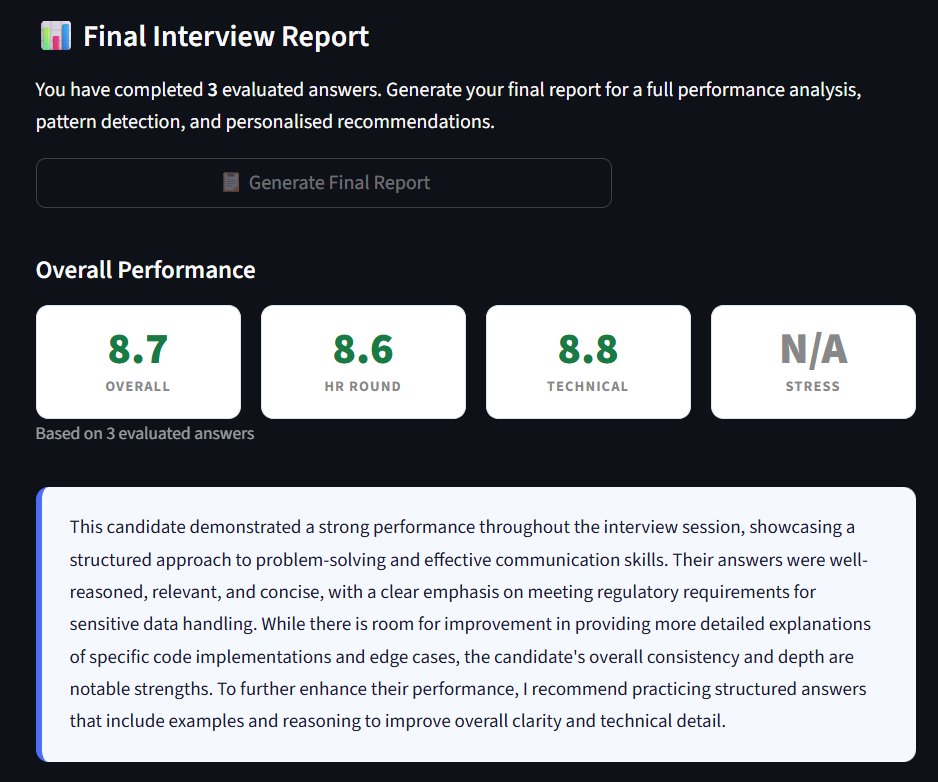
- Evaluate answers using multi-dimensional scoring
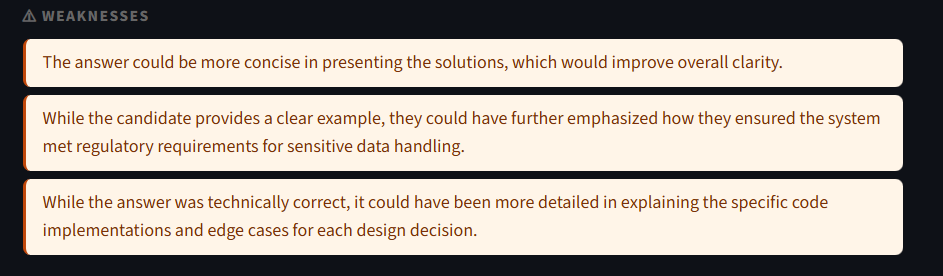
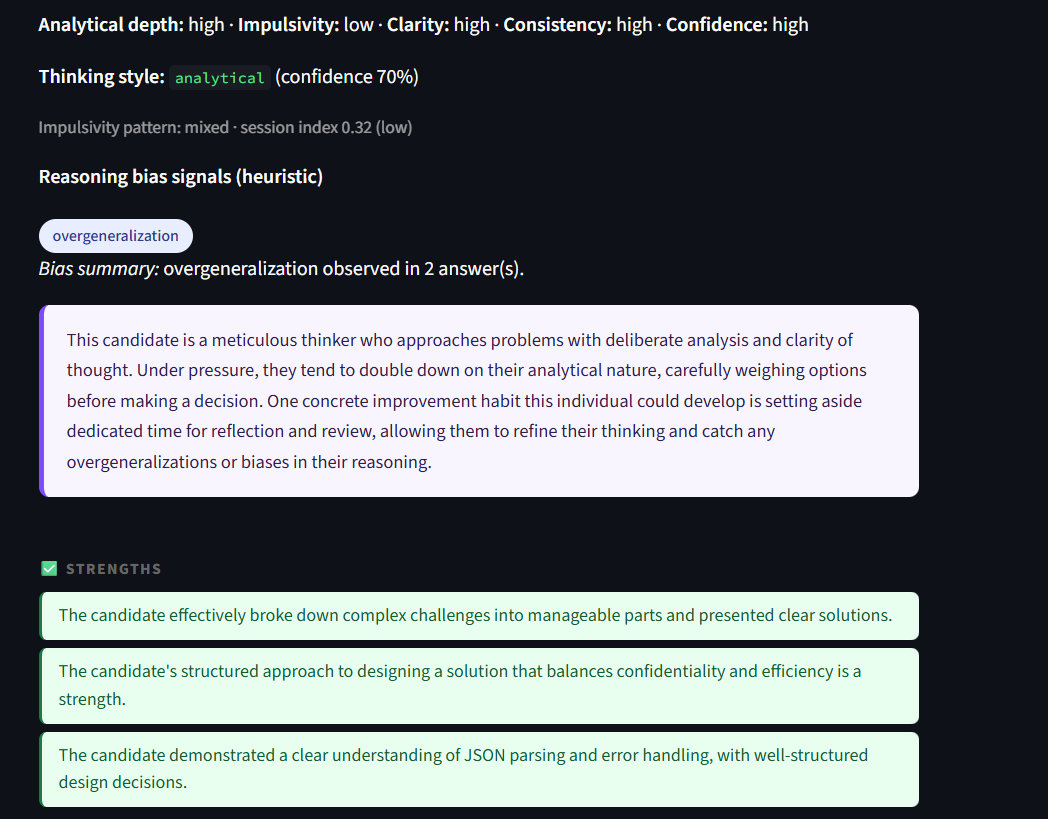
- Generate structured feedback (strengths, weaknesses, improvements)
- Adapt question difficulty based on performance
- Apply pressure through rapid-fire stress rounds
- Track performance across the entire session
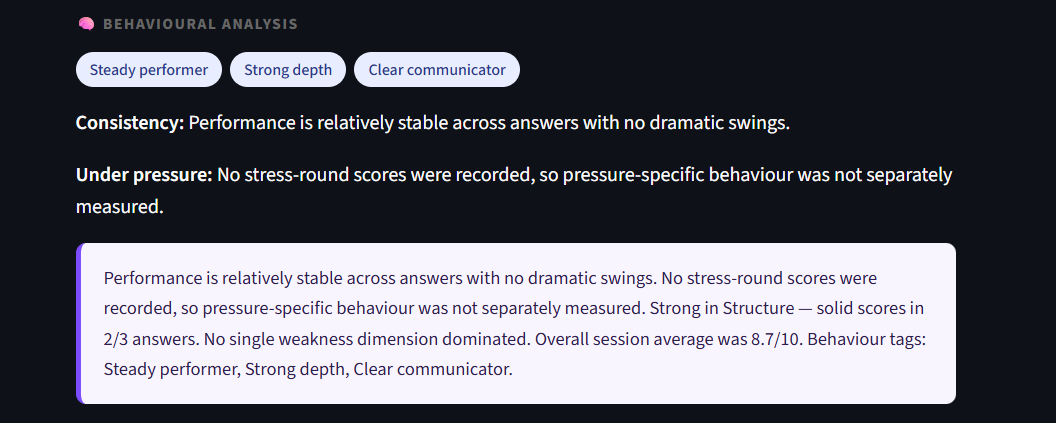
- Analyze thinking patterns (impulsivity, clarity, consistency)
- Generate detailed interview and cognitive reports
At its core, it acts as:
Interviewer + Evaluator + Coach + Cognitive Analyst
How we built it
We built ReflectAI as a modular, closed-loop system with multiple layers of intelligence:
Core Stack
- Backend: FastAPI
- Frontend: Streamlit
- LLM: Ollama (Llama3)
System Architecture
The system follows a continuous feedback loop:
User → Question → Answer → Evaluation → Cognitive Analysis → Decision → Next Question
Key Components
Agent Layer: HR, Technical, and Stress agents generate different types of questions.
Evaluation Engine: Scores answers across multiple dimensions like correctness, clarity, and depth.
Adaptive Engine: Adjusts difficulty dynamically based on performance trends.
Decision Engine: Controls flow using a state-based system (like a finite state machine).
Cognitive Layer: Models user thinking patterns using a latent state representation.
Formally, the system updates the user model as:
User Model {t+1} = Update(User_Model_t, observations)
Challenges we ran into
Designing meaningful evaluation
Scoring answers was easy — explaining why an answer is weak or strong was much harder.
Building adaptive behavior
Moving from a fixed pipeline to a dynamic system required designing:
- decision logic
- state tracking
- adaptive difficulty
Modeling cognition
Translating human thinking patterns into measurable signals like impulsivity and clarity was challenging.
System integration
Combining agents, evaluation, feedback, memory, and adaptation into a single coherent loop was the toughest part.
Accomplishments that we're proud of
- Built a closed-loop adaptive AI system
- Created a multi-agent interview platform
- Designed a cognitive modeling layer (thinking fingerprint)
- Enabled real-time difficulty adaptation
Developed a system that acts as:
- interviewer
- evaluator
- coach
- cognitive analyst
ReflectAI goes beyond answering — it understands the user.
What we learned
- AI systems are not just models — they are systems of interaction
- Real intelligence comes from: [ State + Feedback + Decision ]
- Adaptive systems feel more human than static ones
- The hardest part is not generating output, but controlling behavior and flow
What's next for ReflectAI: Inside Your Interview Brain
The next phase focuses on turning ReflectAI into a full product and research-grade system:
- Interactive dashboards for cognitive insights
- Visualization of thinking patterns and performance trends
- Voice-based interview support
- Real-time analytics and improvement tracking
- Deployment as a scalable web application
- Dataset collection for research and model improvement
Long-term vision:
Build an AI system that doesn’t just evaluate users — but helps them become better thinkers.
Built With
- docker
- fastapi
- llama3
- ollama
- pdfparsingtools
- postgresql
- python
- requests
- streamlit


Log in or sign up for Devpost to join the conversation.