Inspiration
Everyone deserves the opportunity to grow beyond their biases and blind spots. But here's the challenge: How can we address what we cannot see?
Reflective Practice is a proven framework for personal growth through structured self-examination. It guides individuals through three critical stages: understanding what happened, exploring what it means, and deciding what to do next. This cycle transforms experiences into developmental insights, helping us recognize our own beliefs and understand others more deeply.
Yet reflective practice has two fundamental limitations: many people lack the skills to self-reflect accurately, and even experienced reflectors carry bias into their own analysis. We see what we want to see, even when examining ourselves.
What it Does
This is where Reflect comes in.
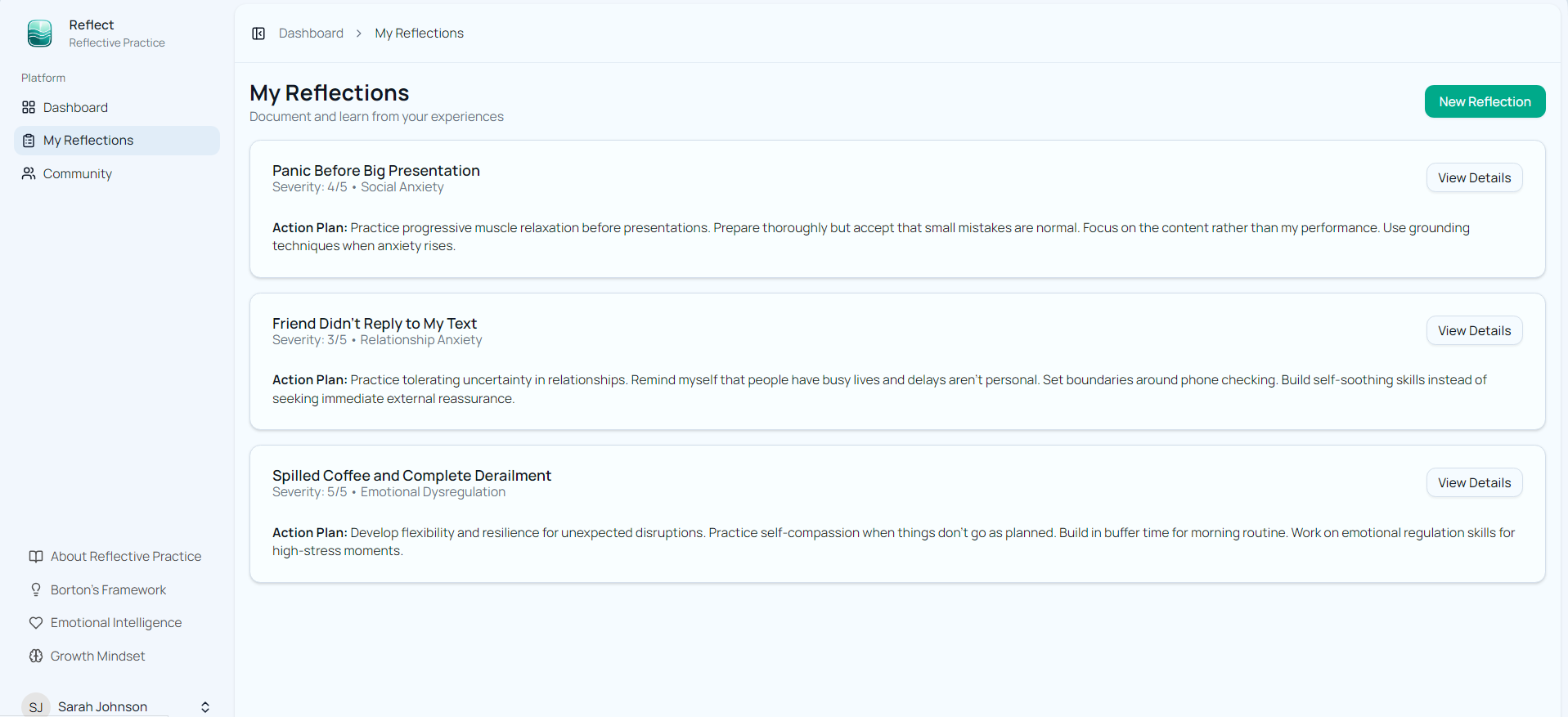
Reflect guides users through moments when their assumptions, judgments, or blind spots shape an outcome: a bad stock trading decision, a dismissed perspective, an awkward encounter. Through carefully designed questions, users explore what happened, identify the beliefs driving their actions, and uncover why these moments matter.
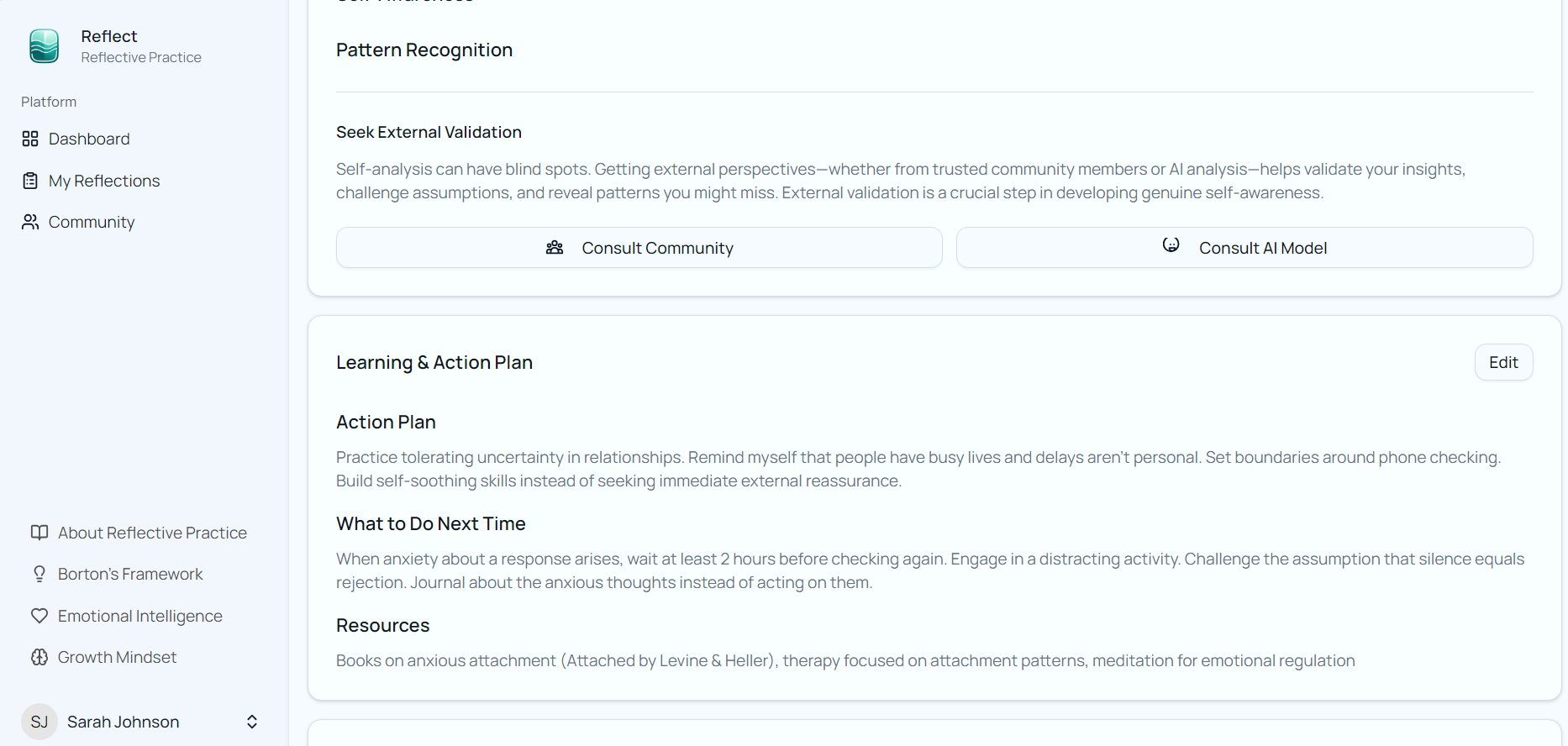
But self-analysis alone isn't enough. After completing their reflection, users unlock two powerful resources for external validation:
- Community Insight: Share your reflection with a supportive community of trained facilitators, coaches, and peers who can illuminate blind spots, challenge rationalizations, and offer perspectives drawn from lived experience and expertise in bias work.
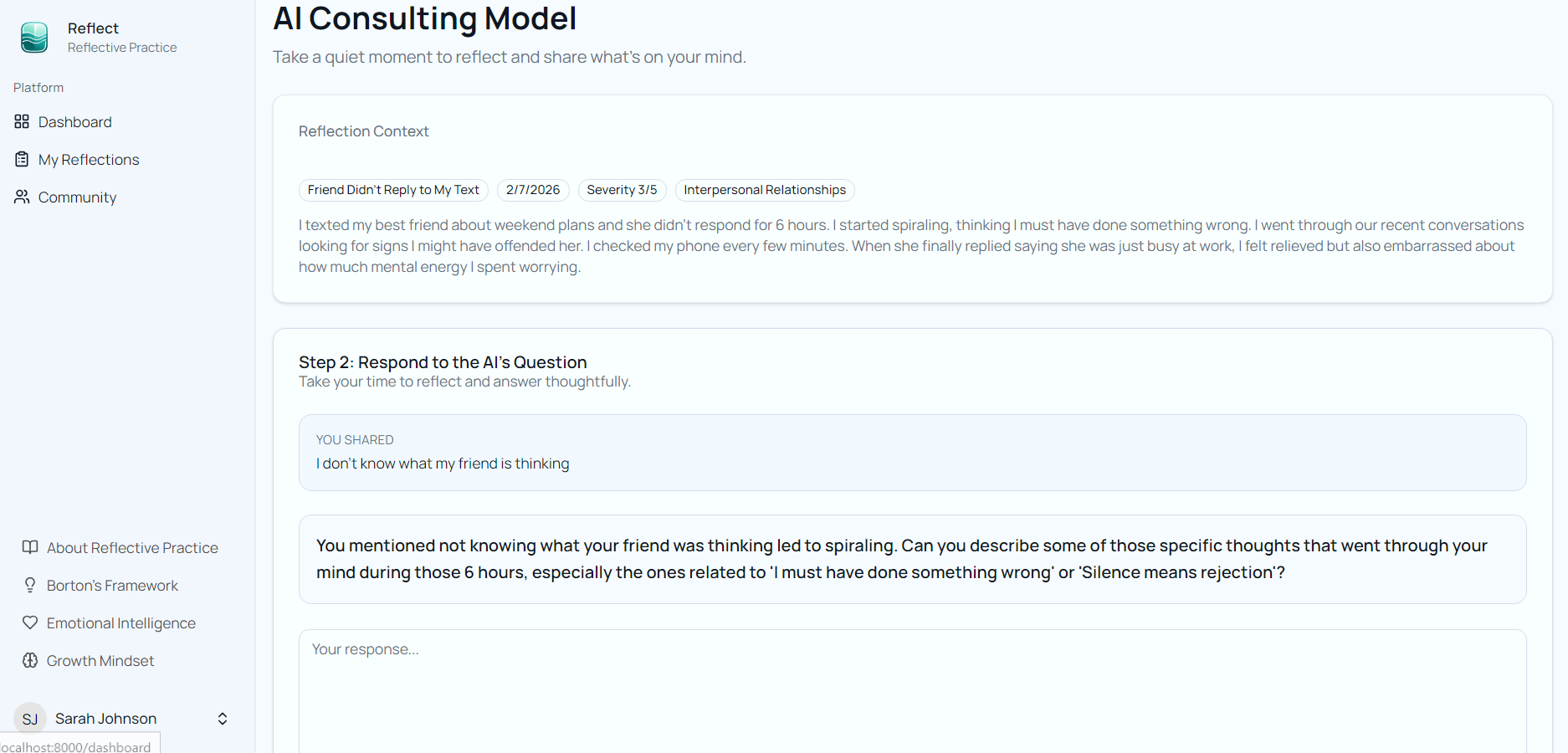
- AI-Powered Analysis: Our AI identifies patterns across your reflections, asks uncomfortable questions you might avoid, and reveals cognitive biases at play—all without judgment, offering questions rather than answers to deepen your introspection.
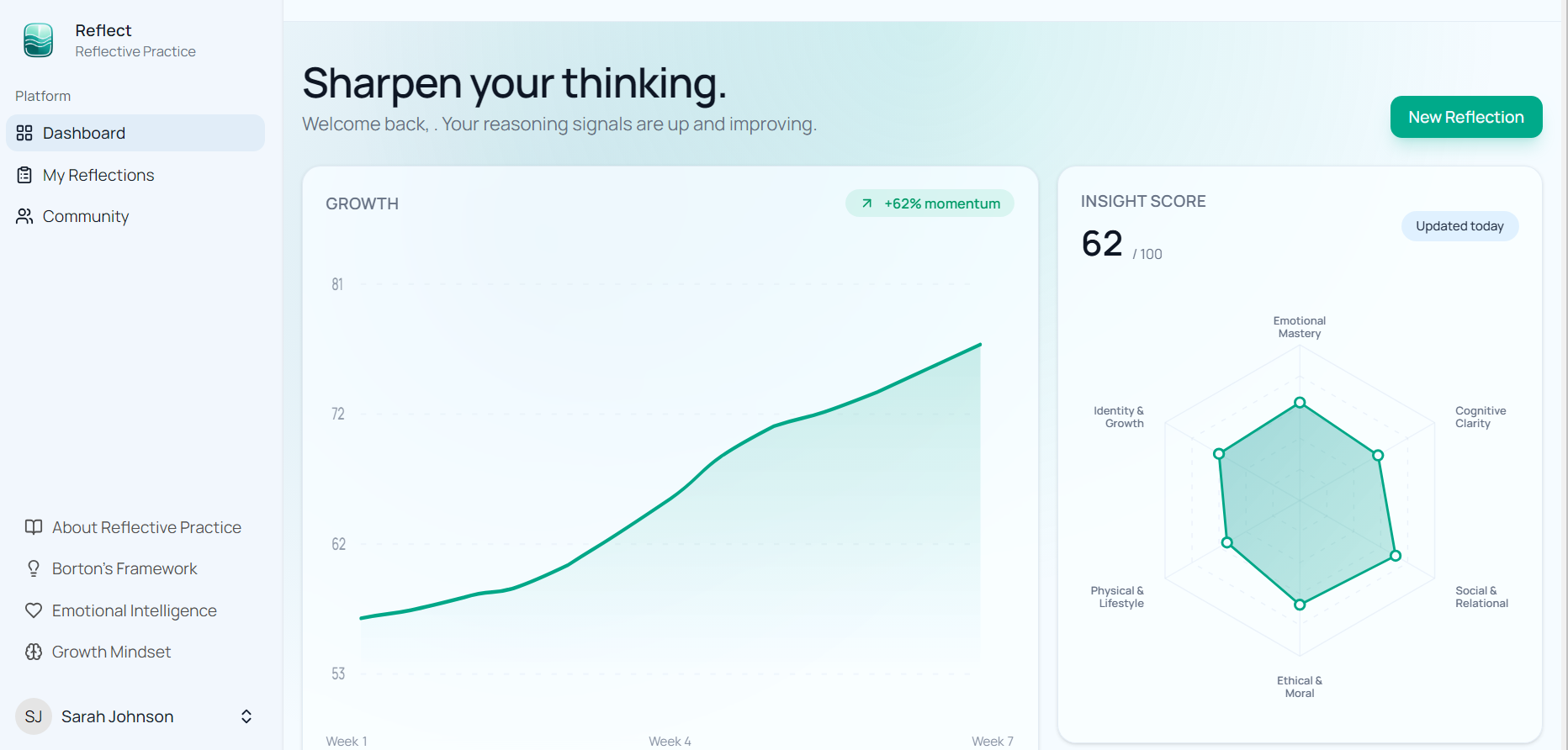
Over time, Reflect becomes your personal archive of growth—a living collection of reflections that reveals patterns, tracks progress, and compounds your efforts toward continuous improvement. Because the goal isn't to be better than others. It's about becoming a better version of yourself than you were yesterday.
A record of community post access will help other users (anonymously), because we care about privacy, understand their biases using shared experiences, much like how platforms like Reddit work but curated for the people wanting to self-improve and reflect.
How we built it
We built Reflect using a React frontend with TypeScript, TailwindCSS, and ShadCN. On the backend, we went with a dual-architecture approach: Laravel handles the core application logic while a FastAPI microservice powers everything AI-related in Python. When a user journals about a behaviour or experience they want to improve, their entry is sent to the FastAPI service where we use the Gemini API to generate targeted follow-up questions. The goal isn't to give answers — it's to guide users through a structured reflective process that pushes them to examine their own assumptions and think more critically about their actions. Research shows that this kind of self-reflection strengthens metacognitive skills and helps individuals evaluate their beliefs more deliberately rather than relying on instinct or bias. To make sense of each reflection, we built a classification system that organizes entries into 6 broad categories - such as Emotional Mastery, Cognitive Clarity, and Social & Relational awareness. There 6 labels are further broken down into 78 specific sublabels, each with a severity score. This lets us tailor the experience to what someone is actually working through without overwhelming them. We also implemented vector search using cosine similarity to match a user's reflection with similar anonymous community posts. This way, users can see that others have gone through something similar and, more importantly, what helped them move forward. Research on shared reflective spaces suggests that learners who see others confronting similar challenges report feeling less isolated and more motivated to grow. On the community side, psychology students looking to build clinical hours can respond to anonymous posts with informed, thoughtful feedback - creating a space where both sides benefit. All data is stored in SQLite, keeping the stack lightweight and easy to manage.
Challenges we ran into
Coming up with a thought provoking idea for a hackathon is challenging, especially when there are a multitude of AI tools available to “think” for you. While it would have been easy to build yet another productivity assistant or content generator, we deliberately chose a harder path: designing something we would personally use, grounded in our own values and lived experiences. Another challenge was finding a solid philosophy and beliefs system that would provide growth for users.
Technical challenges followed but we are used to them as computer scientists :)
Accomplishments that we're proud of
The classification system is something we put a lot of work into. Designing 6 categories and 78 sublabels, each with a severity score, took a ton of research and iteration, but it gives us a really solid way to understand what a user is going through and shape their experience around that. We're also proud of how we handled the AI. It would've been easy to just have Gemini give advice, but we deliberately constrained it to only ask questions. That choice is grounded in how reflective practice actually works: the growth comes from arriving at your own insight, not from being told what to do. Getting vector similarity matching to work was a big win too. Being able to surface relevant anonymous posts from people who went through something similar turns the app from a solo journaling tool into something that actually feels like a community. And honestly, the community model itself is something we're proud of. Connecting users who want to grow with psychology students who need clinical hours is a setup that could realistically scale and provide real value on both sides.
What we learned
We learned to start doing less features for a Hackathon, this was quite ambiguous. We overcommitted to too many ideas. It became very tricky to implement everything we wanted. In addition,
What's next for Reflect
The biggest next step is onboarding officially licensed therapists alongside the psychology students. Having verified professionals in the community would add another layer of trust and credibility for users seeking feedback on their reflections. We also want to add speech-to-text so users can talk through their reflections out loud instead of typing them. Reflective practice often works best in conversation, and being able to speak naturally would make the experience feel closer to an actual therapy session. It also makes the tool more accessible to people who struggle with writing or just process their thoughts better verbally.
Additionally, we want to introduce guided reflection templates for common life situations like academic failure, relationship conflicts, or career setbacks. A lot of people know something is bothering them but don't know how to start writing about it, so having structured starting points would lower the barrier to entry and help users get into the reflective process faster. Multilingual support is also something we're exploring. Limiting the app to English cuts off a huge number of people who could benefit from reflective practice. Supporting more languages would make Reflect genuinely accessible to a wider audience.

Log in or sign up for Devpost to join the conversation.