-
-
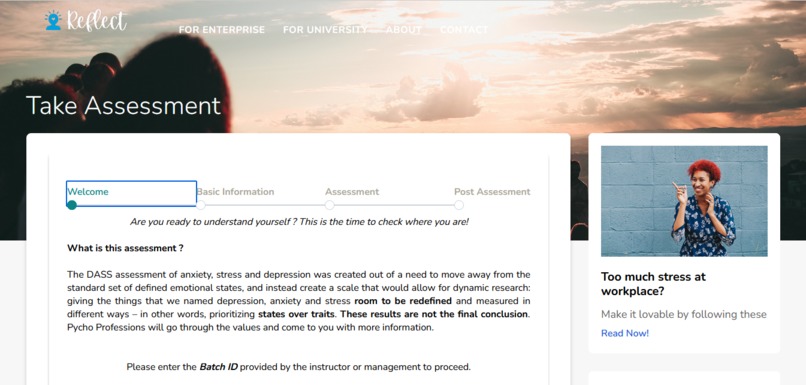
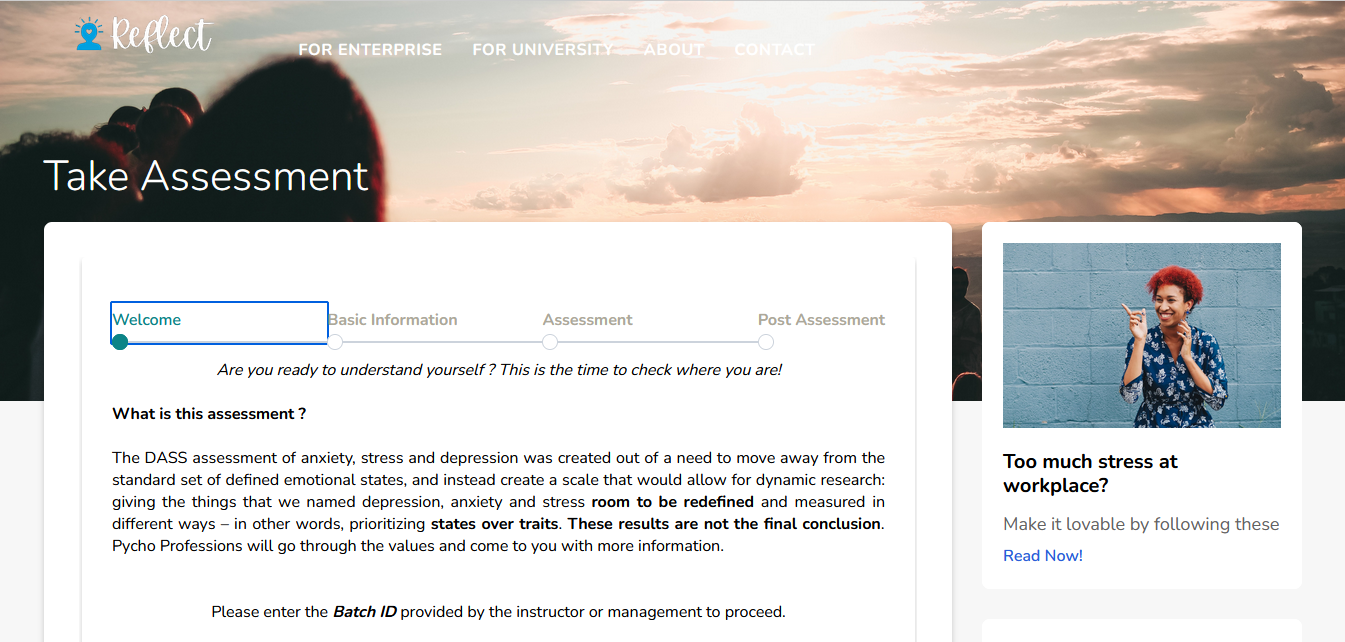
Assessment Screen
-
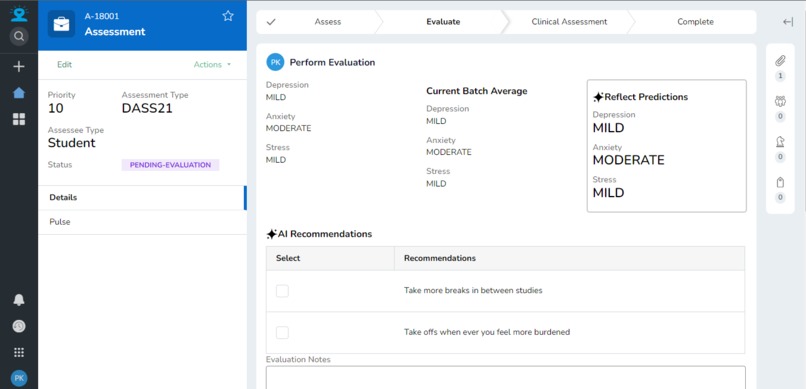
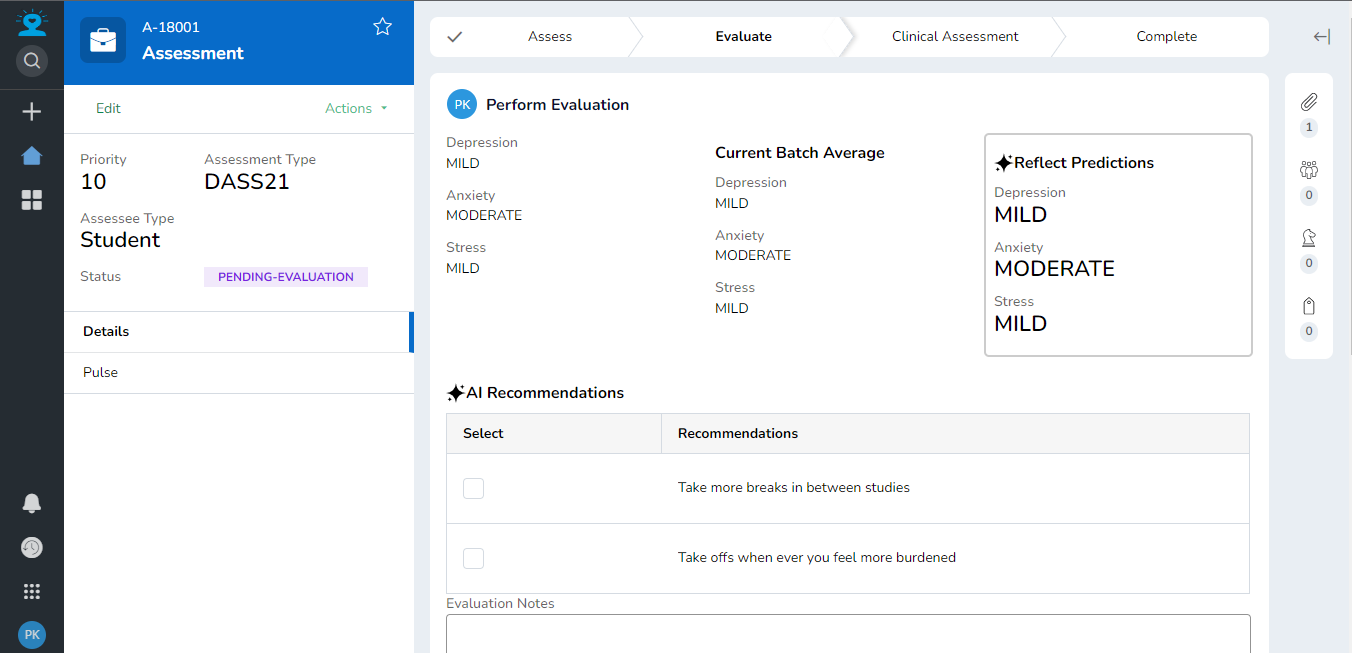
AI predictions for Psycho professionals
-
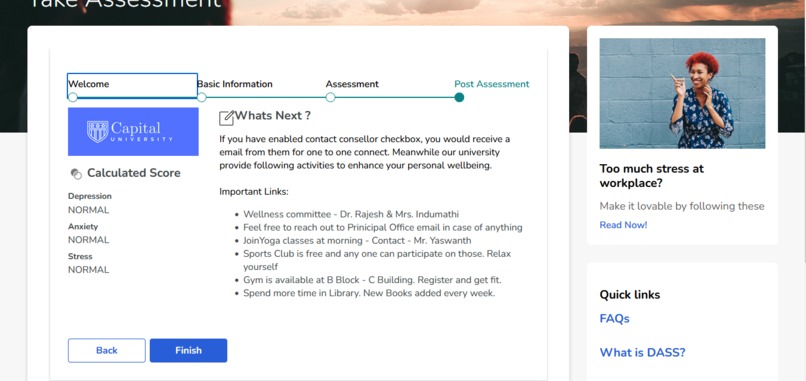
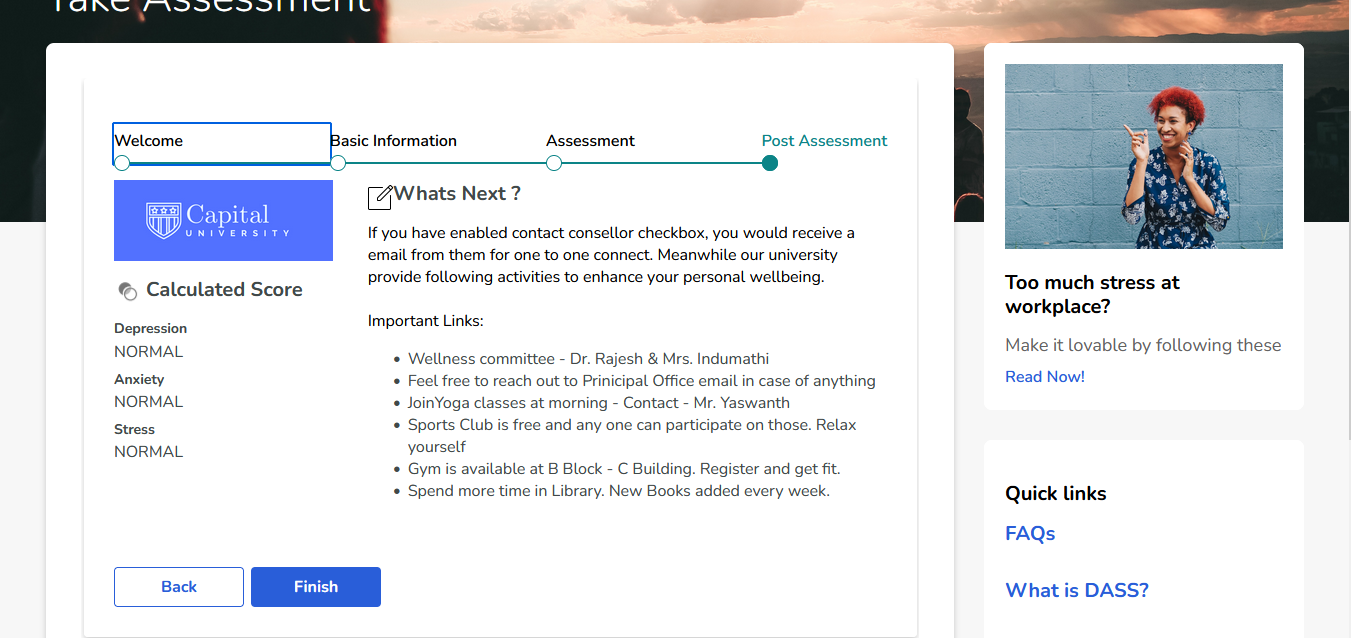
Post Assessment screen can be customized by clients based on Batch
-
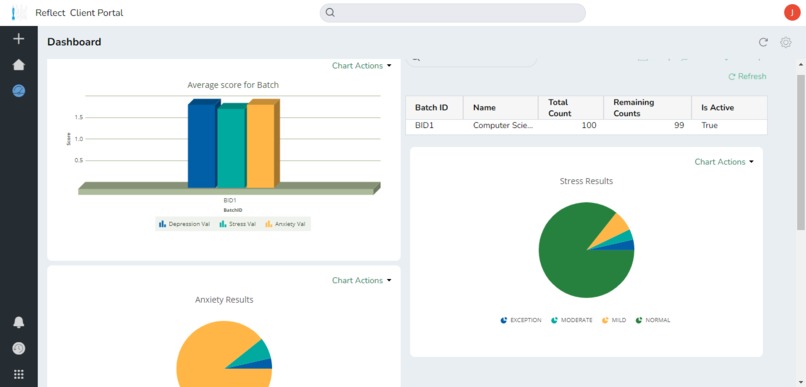
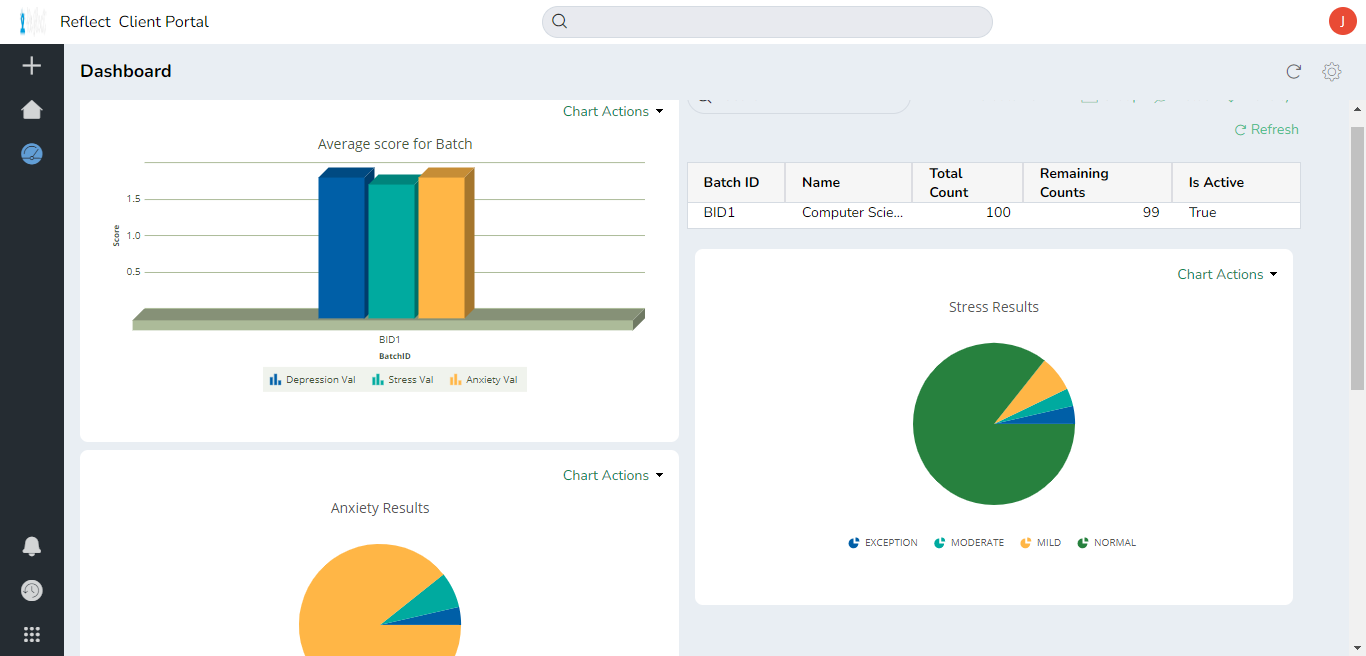
Powerful reporting capabilities
Inspiration
The COVID-19 pandemic has created a global crisis for mental health, fueling short- and long-term stresses and undermining the mental health of millions. Estimates put the rise in both anxiety and depressive disorders at more than 25% during the first year of the pandemic. At the same time, mental health services have been severely disrupted and the treatment gap for mental health conditions has widened.
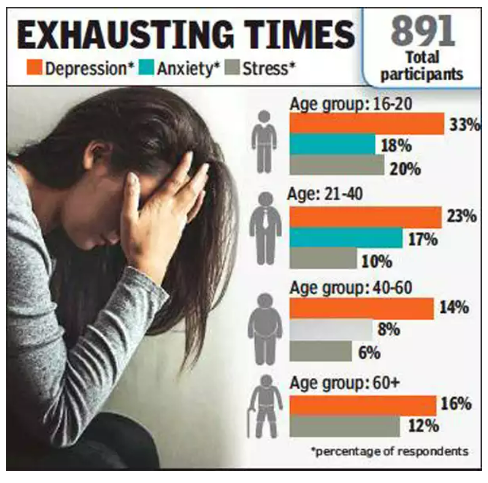
Many mental health conditions can be effectively treated at relatively low cost, yet the gap between people needing care and those with access to care remains substantial. Effective treatment coverage remains extremely low.
The major of affected segments are students and working professionals
Primary & Common mental issues are :
- Anxiety
- Depression
- Stress
What are the Consequences for Universities?
- Campuses feel the burden when students with mental health difficulties do poorly on coursework and drop out of school.
- Colleges and universities must be prepared to address the psychological impact of suicides on other students, as well as on teachers and staff.
- Poor student retention can mean losses in tuition, fees, and alumni donations.
- The community is negatively affected when students are unable to finish their degrees and contribute valuable skills in a competitive job market.
- One study found that five percent of students do not finish their education due to psychiatric disorders and estimated that 4.29 million people would have graduated from college had they not been experiencing such disorders.
What are the Consequences for Organization?
Wellness programs don't just increase productivity but also lead to increased engagement, improved employee morale and retention, and reduced health risks. There is a positive connection between employee wellness and the performance of a business.
Because of these Universities rank poor and companies' efficiencies lag as well.
What if there is a startup partnering with Psycho professionals to solve this problem of universities and company's well-being using Pega?
That is Reflect - Rediscover Yourself !
How can this problem be solved?
“Prevention is better than cure”, But mental illnesses are hard to be recognized before and are mostly normalized by society to have it.
Then, How mental issues can be identified? By proper counseling by trained professionals and by taking self-assessments.
Self Assessment Like DASS helps to identify the key attributes of mental illness without clinical setup or guidance.
What is a DASS assessment?
The Depression, Anxiety, and Stress Scale - 42 Items (DASS-42) is a set of three self-report scales designed to further the process of defining, understanding, and measuring the ubiquitous and clinically significant emotional states of depression, anxiety, and stress. DASS-21 is the shorter version of the test with the same three domains. It was designed by the Psychology Foundation of Australia. Each domain assesses the negative emotional symptoms on a four-point likert scale. A greater score indicates higher severity of these negative symptoms.
The DASS is based on a dimensional rather than a categorical conception of psychological disorder. The assumption on which the DASS development was based (and which was confirmed by the research data) is that the differences between the depression, the anxiety, and the stress experienced by normal subjects and the clinically disturbed, are essentially differences of degree.
DASS-21 is a highly reliable and clinically proven method to assess people of any age greater than 14. The results are not the conclusion they should be evaluated by psycho professionals
How does Reflect solve this problem?
Reflect bridges the gap between psycho professionals and organizations by taking self assessments, and giving counseling to needed candidates. Reflect helps organizations with suggestions to improve the well-being of the employees or students.
Reflect team would be a mix of psycho professionals and admin staff.
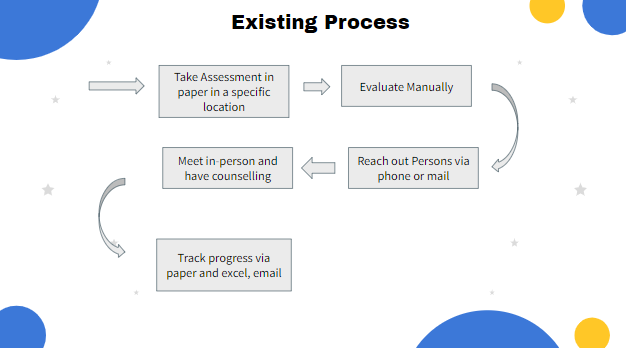
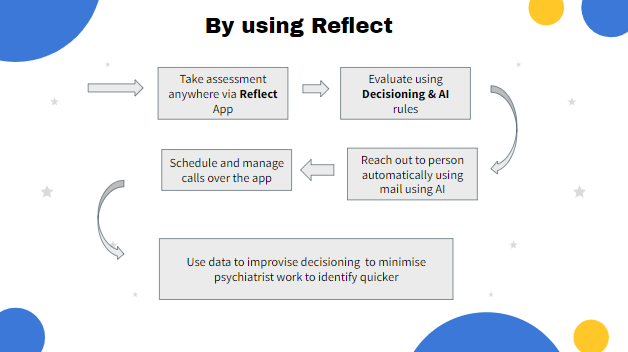
Key concepts of Reflect
Batch : Batches represent a specific group who are assessed. It can be a department, class, division, or a specific set of people. Reporting is done based on the batch level and client level. This helps the reporting to be more precise and helps an organization to take precise decisions. Batches can have max count so that beyond that count users can't take that it. The assessment Type is configured based on Batch level
*Client * : Clients are the entity whose users are assessed. Each client can have a number of batches. Clients get recommendations from the metrics for a batch and improvise their management.
Assessment : Assessment is a questionnaire where end users interact with the system. Basic information, Batch ID, and Assessment answers are evaluated here
Business model
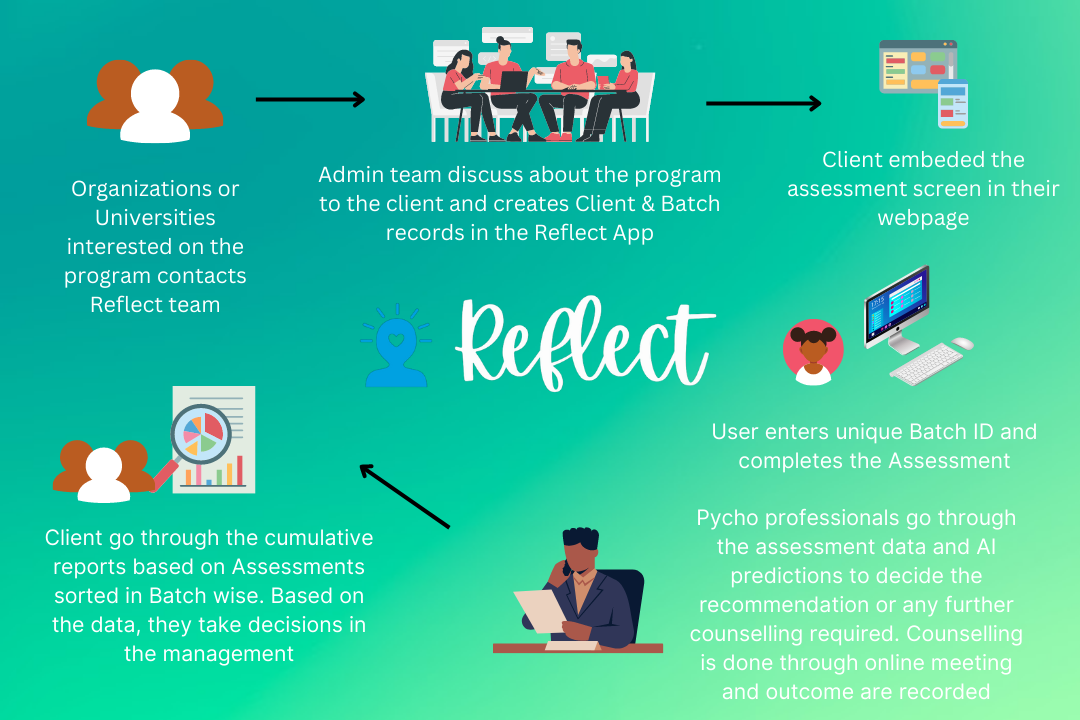
Clients like organizations reach Reflect team to improve their workforce well-being. Universities reach out to increase the resiliency of the students. They analyze the requirement and find out the appropriate self-assessment to get data from the users.
Clients are billed by the Reflect team based on the number of assessments taken per batch as it is stored in the system.
How we built it
Personas :
Users : The one who takes the assessment and counseling.
Staffs : The one who communicates with clients and creates/manages batches and clients
Professionals: Trained professionals who assess the assessment and give counseling to the users
Clients: The one who view reports of the user to take action in their management.
Case Types
Assessment: It is a questionnaire case type where we get inputs from the user. Questions can be configured based on the User Type and other parameters
Batch: To manage or create Batches and generate Batch ID which is used by users to complete the assessment
Client: To onboard new clients to the system
Web Self-service:
As Reflect is a user-centric application, we thought of building a separate channel to collect assessment and basic information alone. In the real world, Clients would love to embed these widgets into their web pages to make them easily available to users. We explore DX API V2 as well. As there was a time crunch to execute our vision end to end, we went with Pega’s Mashup channel. CaseType mashup is created and embedded into the dummy webs
Intelligent Routing :
We created a skill rule for each client ID and added it to the respective rules so the report the pulled based on the client logged in.
Reporting :
The assessment information is stored in the case table. We took key data to be stored in a separate table using Declare index rule and used it for reporting.
Organization chart: Org-div-unit configurations
RFLT-Internal-IT - For developers

RFLT-Internal-Management - For admin staff

RFLT-Internal-Professional - For Psycho professionals

RFLT-Client-University - For University client operators

RFLT-Client-Enterprise - For Enterprise client operators
Decisioning:
For assessment calculations, we used a Decision table and Data transform for additional manipulations
AI predictions :
We use attributes like Depression, Anxiety, Stress values, and Assessment answers to predict the outcome. The final outcome post-counseling is also recorded in the system. It is used to improvise the system.
UI :
We used mashup to showcase the embedding capabilities of Pega.
Intelligent workflow automation :
The assessment cases are autoclosed when the values are very less. We identify the cases which required psychiatrist attention. WorkQueue, Skills were use
Challenges we ran into :
New Domain :
Psychology was a completely new domain for our team. So we learned psychology from scratch and how it is assessed clinically and assessments. We contacted a few of our friends who are into this practice and implemented using real-world happenings and suggestions.
Implementing easily configurable assessments :
Citizen development was our ultimate goal for this application. It should be as easy for anyone to add questionnaires, and update scores and recommendations using a few clicks. We are happy that we achieved this using Pega survey rules.
Implementing Decisioning models :
As we built this application on the Pega community edition instance, we can't able to implement much on the decisions & AI part as those instances don't have ADM nodes on the cluster. In but meantime we came up with draft models for our predictions.
Accomplishments that we're proud of
Team Size :
We built this solution with a team with a total of experience summing 4 Years only. We scaled our solutioning and Pega technical skills using Pega Academy and implemented most parts by using the knowledge gained from the Pega Academy.
Impact to society :
We were so excited when we planned to pursue this idea into a reality because of the need for this solution to the market. We consider a lot of metrics and real-world examples to build the application.
Building SASS-type application in Pega :
Pega is the market leader in many segments. We thought to explore how we can leverage it to build configurable multi-client applications with very less admin effort.
User experience :
As this is a user-centric application that needs attention to each and every question, we built it in such a manner so the users don't get distracted and it is straightforward.
How we fitted Pega capabilities into this solution
Intelligent Workflow Automation :
For Workflow between users and psycho professionals, we used case management capabilities. Case types were created for Assessment, Batch, and Clients.
Pega Survey :
For creating reusable & configurable assessments, we used Pega survey rules. Simple question and Question Page rules were created for each assessment and configured in the ScreenFlow. In the future, we call the Question Page based on other parameters to support more assessments like DASS to the application within a few clicks
Low Code :
App studio was used to Configure workflow and Pega Express methodologies were used. We used App studio to configure & create data pages, configuring mashups and branding configurations.
Decisioning :
We used Pega decisioning capabilities such as Decision Table and When rules to evaluate the assessment systematically with no human interventions.
Predictions :
We explored Pega’s AI capabilities to predict the assessment outcome with past data of batch and similar candidates. Predictive & Adaptive models can be created on properties such as Assessment questions, scores, and outcomes to predict the outcome and recommendations to the system.
Omni Channel Integration :
Mashups were used to interact with the user and collect data for the Assessment case. In future, it can support chatbots as well.
Reporting :
Reporting is the primary feature of this application. By using Report Definition Rules and Declare Index rules, we can able to achieve this in a few clicks. We added reports to the user dashboard using OOTB report chart widgets.
What's next for Reflect?
Adding More assessment :
Reflect application is capable of adding new assessments to the system in a few steps. In the future, we can add more clinical assessments such as CTRS, CCRS, etc., and we can route to questionnaires based on the batch.
Localisation :
Supporting more languages for the questionnaire so that users will be convenient and understanding enough to fill out the assessment in their regional language.
Autorouting :
We can make our AI models mature enough so that we can automatically close & resolve the assessment evaluations which don't need psycho-professional attention by using previous data and outcomes. Email to users with AI recommendations automatically can be sent. This will significantly reduce the man-hours of psycho professionals and increase the efficiency
DX API :
As this application's business model involves exposing assessments as input from the client’s user. They would like to embed it on their official webpage or portals. We can use DX API features to bring them native-like experiences.
Decisioning models :
Adding more data points to predict the outcome and increase the efficiency of the system like demographic information.
Workflow for client onboarding :
We can enhance the workflow of client onboarding by adding billing, approval, and more features.
Advance reporting :
Apart from average and cumulative scores, many insights can be delivered from the recorded assessment and demographic data to the management to take better decisions.
Want to try the assessment? Go to https://goreflect.web.app [Please use PC firefox browser or enable 3rd party cookies in your chromium browser] Use batch code "BID1" or "BID2" to proceed further.
References
Stats :
https://www.verywellmind.com/depression-statistics-everyone-should-know-4159056
Relationship between mental health and academics in students https://www.intechopen.com/chapters/74883
About DASS Assessment:
http://www2.psy.unsw.edu.au/Groups/Dass/Download%20files/Dass21.pdf
http://www2.psy.unsw.edu.au/dass/over.htm
Validations of DASS assessment :
https://pubmed.ncbi.nlm.nih.gov/12782751/
https://www.frontiersin.org/articles/10.3389/fpsyt.2021.770532/full


Log in or sign up for Devpost to join the conversation.