Inspiration
Prediction markets on Polymarket have grown into a multi-billion-dollar venue, with top traders generating nine-figure PnL. Yet the platform still has no native copy-trade or follow feature. Every mirroring solution is either a fragmented third-party tool or a DIY bot that exposes users to key-management risk, slow execution, and zero portfolio-level risk control. We watched traders identify consistently profitable wallets and then fail to mirror them safely at scale. Reflect was built to close that gap: a non-custodial, institutional-grade mirroring layer that treats prediction-market exposure as a serious capital allocation problem, not a retail gimmick.
What it does
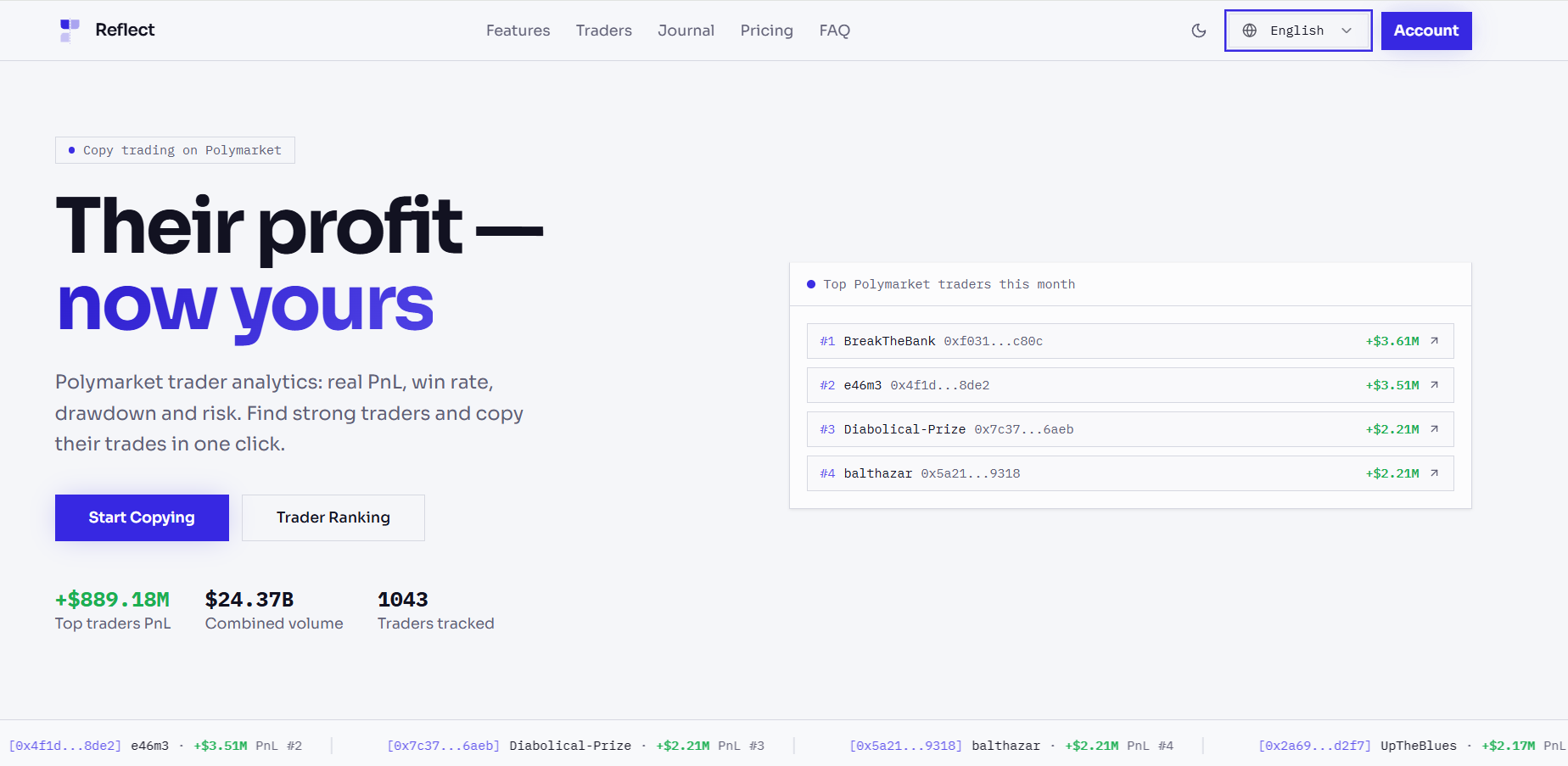
Reflect sits between a user’s Polymarket account and the wallets they choose to follow. It mirrors positions with 0.1-second latency via direct API access, so a copied entry lands before coefficient shifts erase the edge. Users filter leaders not by raw PnL alone but by drawdown, win rate, market category, and trading style. Capital governance is explicit: fixed sizing or balance percentage, per-trade and per-market limits, portfolio drawdown protection that auto-pauses copying, and a reserve-capital buffer with a live risk dashboard. The product is non-custodial, privacy-first (AES-256 at rest, TLS 1.3 in transit), and runs on multi-region infrastructure with automated failover. It is aimed at private traders scaling a concentrated book, trading teams pooling capital around multiple idea sources, and private investors/funds that need custom mandates with transparent risk attribution.
How we built it
The core is a low-latency execution engine that reads leader-wallet activity from Polymarket’s APIs and translates it into mirrored orders on the follower’s account through non-custodial signing. A separate risk layer enforces user-defined limits before any order is sent, and a reserve-capital module keeps a configurable share of USDC outside active mirrors. The frontend is a risk dashboard showing allocation across primary mirrors, satellites, and reserve, plus per-leader drawdown and style filters. The stack is deployed across three regions with backup API endpoints and 99.97% uptime; security is handled end-to-end with encryption at rest and in transit. The system does not hold user keys or funds at any point.
Challenges we ran into
The hardest problem was preserving edge while enforcing risk. Copy trading is only useful if execution is fast enough to beat coefficient shifts, but speed cannot come at the cost of the drawdown and exposure limits that make mirroring survivable. We had to build the risk gate as a pre-trade layer that adds minimal latency while still blocking orders that would breach per-market caps or portfolio drawdown thresholds. A second challenge was leader filtering without overfitting: raw PnL is noisy and regime-dependent, so we designed selection around drawdown, win rate, and market-category consistency rather than a single performance number. Finally, building a non-custodial mirroring flow that works reliably across regions required careful handling of API failover and order-state reconciliation.
Accomplishments that we're proud of
- A working, live copy-trading engine with 0.1-second mirror latency on Polymarket.
- A pre-trade risk layer that enforces per-trade, per-market, and portfolio-level limits without sacrificing execution speed.
- A non-custodial architecture where users retain key control and Reflect never holds funds.
What we learned
Speed and safety are not opposites in copy trading — they are both necessary, and the product only works when the risk layer is designed as part of the execution path rather than bolted on afterward. We also learned that leader selection is a risk-adjusted filtering problem, not a leaderboard problem: users need drawdown, style, and category controls more than they need another PnL ranking. Finally, institutional users do not want “set and forget” copying; they want explicit governance over how much capital is mirrored, where it is deployed, and when it pauses.
What's next for Reflect
Next steps include expanding leader-analytics (regime-aware filtering, category-specific track records), deepening the private-mandate offering with custom reporting and strategy construction, and continuing to harden multi-region failover and order reconciliation. We are also exploring integrations that let teams share a single risk framework across multiple idea sources without exposing individual wallets or strategies.
Built With
- aes-256
- low-latency-execution
- node.js
- non-custodial-signing
- polymarket-api
- risk-engine
- tls-1.3
- usdc
