-
-
Lost and Found by Refindi
Inspiration
Losing something while travelling, dining out, or attending an event is stressful - and the process of getting it back is usually fragmented. Guests do not know who to contact, venues receive incomplete descriptions, and neither side has a clear way to track progress.
We built Refindi Voice to make that journey feel simple and trustworthy. A guest can describe a lost item naturally by voice or text, while the venue receives a structured case it can actually act on. The goal was not only to collect a report, but to support the complete path from “I lost this” to “I have it back.”
What it does
Refindi Voice is a lost-item return workflow for venues and their guests.
Guests start from a venue-specific invitation link or QR code. They describe one item by voice or text, review the extracted details, add contact information and optional proof, then submit the report. They receive a private tracking link.
Venue employees receive a separate secure case link. They can review the report, record a possible match, and guide the return through shipment or pickup. For shipment, guests provide delivery details and venues record the courier and tracking information. For pickup, venues provide collection instructions. The guest can then follow the status and confirm the item has been returned.
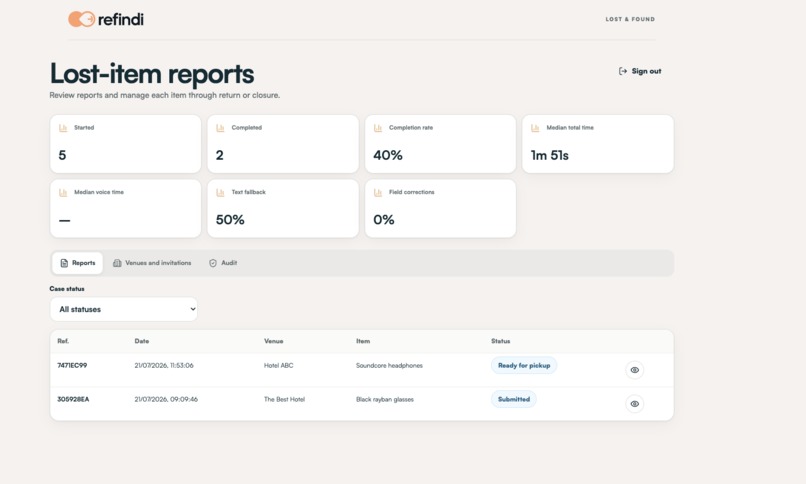
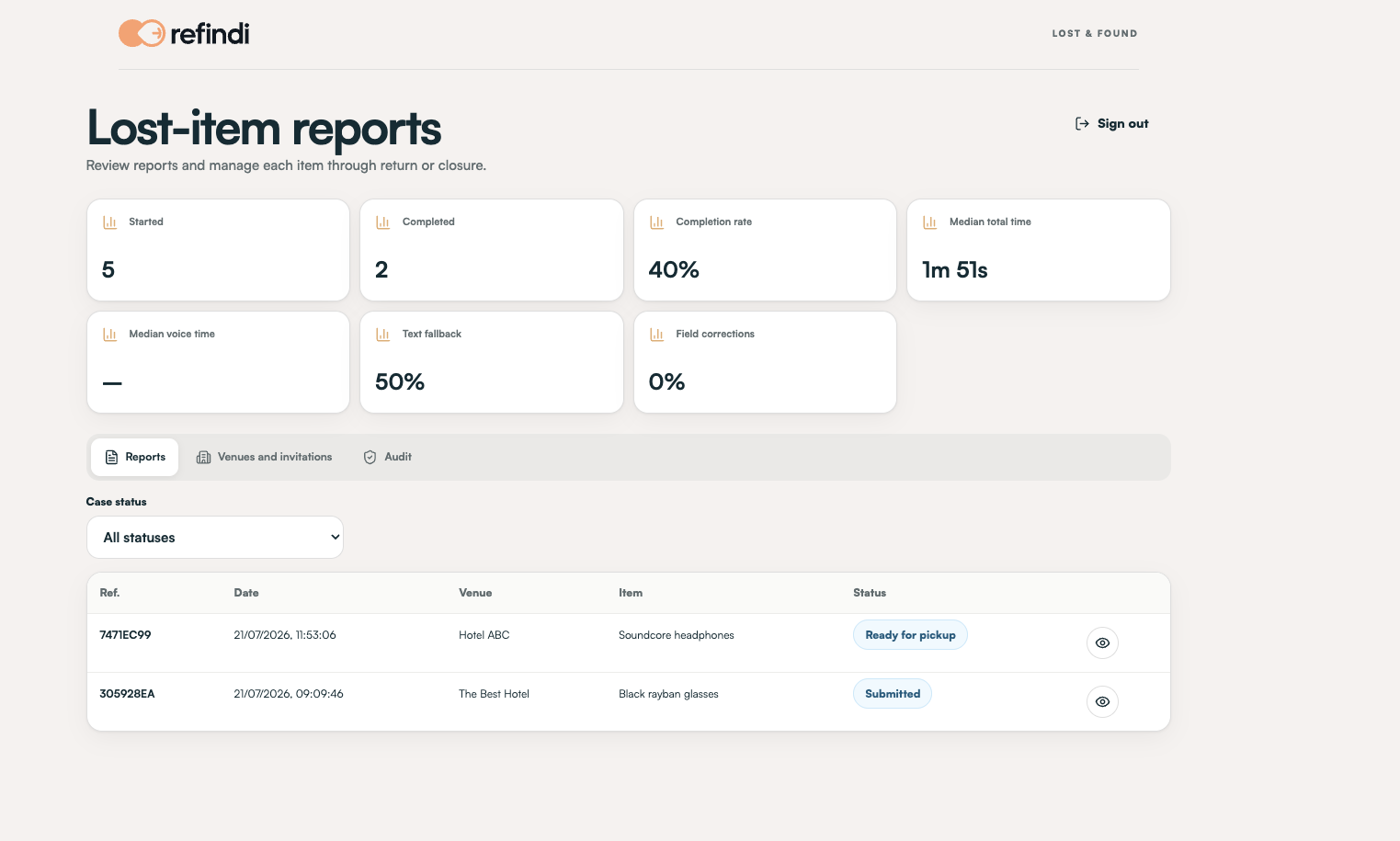
An administrator workspace provides oversight across venues, invitations, reports, notifications, access-link renewal, and audit history.
How we built it
We built Refindi Voice as a TypeScript monolith with a React and Vite frontend, a Fastify API, and Tailwind CSS. Voice intake uses OpenAI Realtime over WebRTC, with a text fallback and a structured extraction flow so guests can correct details before submission.
The application is designed for deployment on Google Cloud Run, with Firestore for case data, private Cloud Storage for photos, Secret Manager for credentials, and Resend for transactional email. We added unit, integration, browser end-to-end, accessibility, and live OpenAI evaluation coverage.
Codex and GPT-5.6 supported our process from refining the initial product concept through implementation, testing, documentation, and deployment preparation. The team retained responsibility for product decisions, privacy review, and release approval.
Challenges we ran into
The hardest part was making the product complete without making it complicated. A lost-item report alone is not enough: we needed to model venue review, possible matches, shipment, pickup, tracking, notification failures, and confirmed return.
Voice also required careful guardrails. We needed to turn a natural description into useful structured data, ask only targeted clarification questions, support corrections, and remove sensitive information before it could be stored.
Security and privacy were equally important. Guests and venue staff should not need accounts, but must only access their own case. We implemented role-specific, expiring private links that are exchanged for scoped secure sessions, while keeping administrator access separate. Audio is not retained, photos are stripped of metadata, and operational data has defined retention periods.
Accomplishments that we're proud of
We are proud that Refindi Voice covers the full human-operated return journey rather than stopping at a form submission.
We are also proud of the balance between convenience and safety: voice-first reporting, text fallback, private role-specific access, human venue matching, private photo storage, sensitive-data redaction, and an auditable case history.
Finally, we created a reproducible project: clear documentation, local setup, cloud deployment scripts, automated quality checks, browser workflow tests, and a live evaluation for the AI-assisted voice flow.
What we learned
We learned that AI is most useful when it improves an existing human workflow instead of pretending to replace human judgment. In Refindi Voice, the model helps turn an unstructured description into a clear report, but venue staff still decide whether an item is a real match and how it should be returned.
We also learned that privacy and operational edge cases need to be designed from the start. Secure access, data retention, failed notifications, concurrent updates, and recovery paths are not details to add at the end - they are what make a real workflow trustworthy.
What's next for Refindi Voice
Next, we want to validate the experience with real venue partners and improve the matching workflow using feedback from staff and guests. We plan to explore multilingual intake, more integrated carrier options, smarter - but still human-reviewed - matching assistance, and operational analytics for venues.
Our focus will remain the same: make returning a lost item feel less like a dead end and more like a clear, respectful path back to its owner.
Built With
- fastify
- google-cloud
- google-cloud-firestore
- google-cloud-run
- google-secret-manager
- node.js
- openai
- openai-realtime-api
- playwright
- qr
- react
- resend
- tailwind-css
- typescript
- vite
- vitest
- webrtc
- zod


Log in or sign up for Devpost to join the conversation.