Inspiration
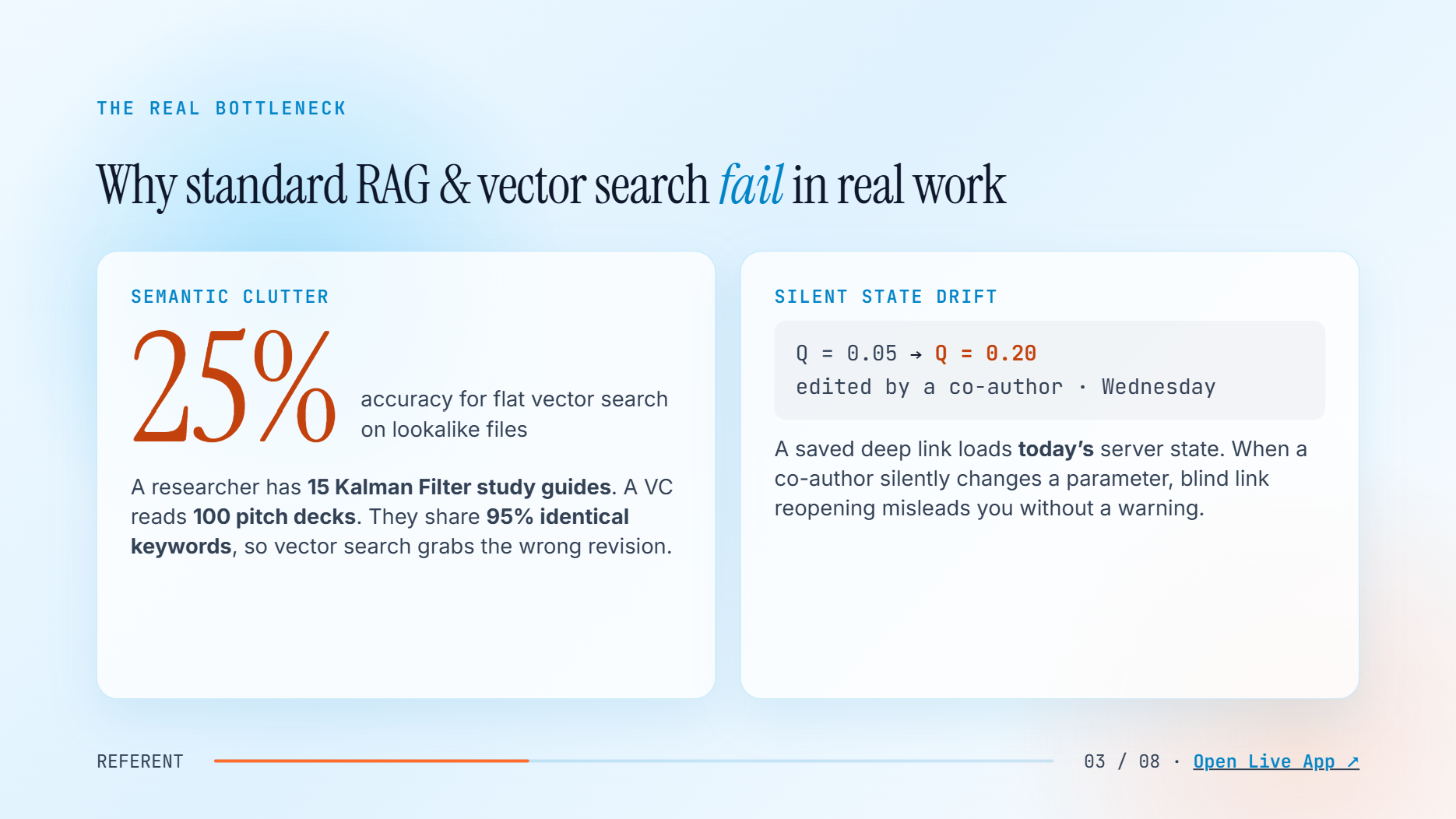
Referent was born from a year of daily usage of autonomous AI browsers like Comet. While screen-control and browser agents offer powerful task execution, they suffer from a critical flaw, terrible episodic memory. When a collaborator, professor, or teammate says, "Use the assumptions from the study guide we reviewed before Tuesday's meeting," standard search engines, vector databases, and stateless agents completely break down. They lack chronological context, cannot resolve pronouns across personal work histories, and fail when faced with dozens of lookalike document revisions that share 95% identical text. Real-world knowledge work constantly struggles against semantic clutter, where standard cosine similarity picks documents with high keyword density rather than the exact version referenced in conversation, and silent state drift, where reopening a shared link loads today's modified server state instead of what was viewed on Tuesday.
What it does
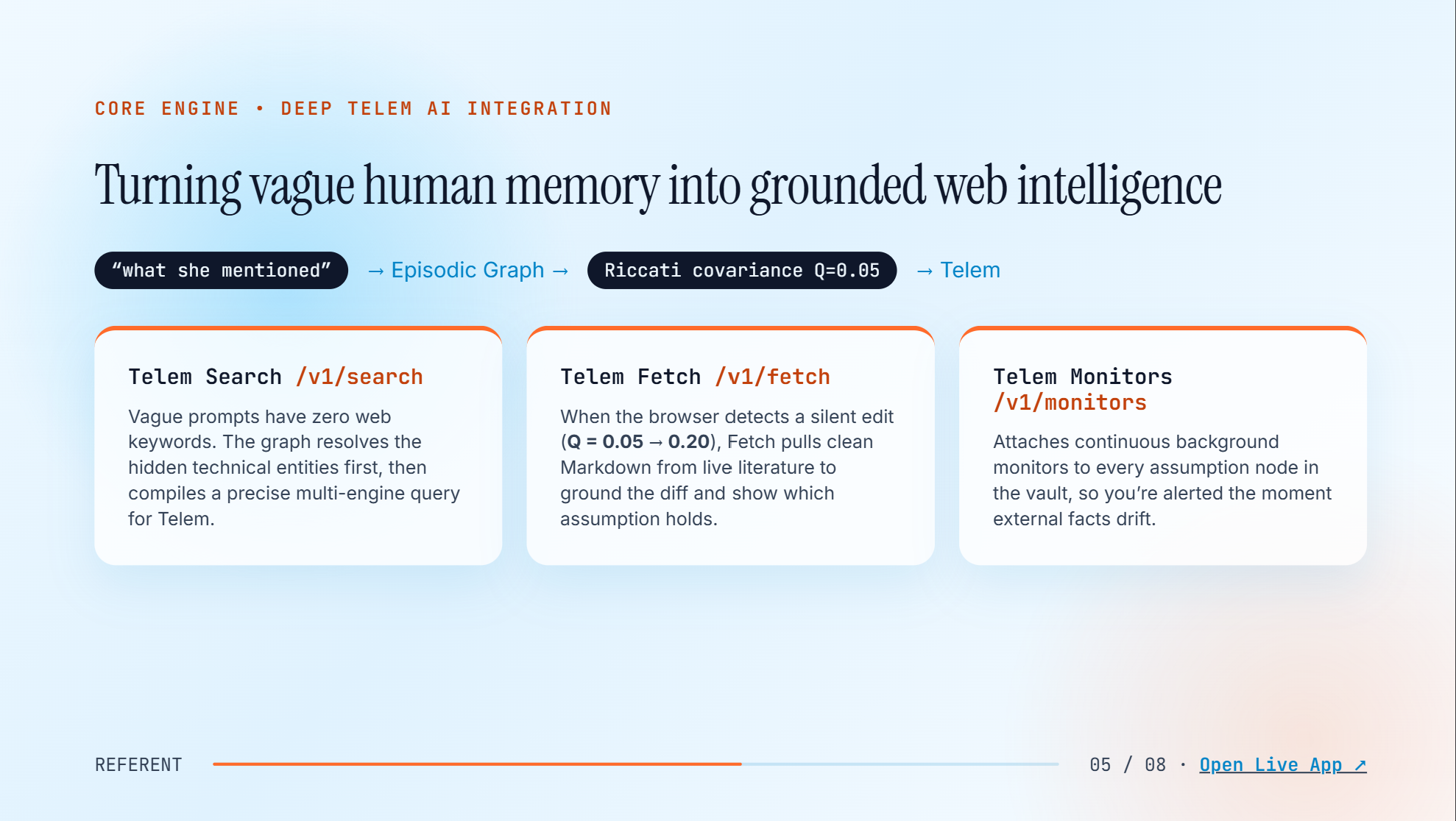
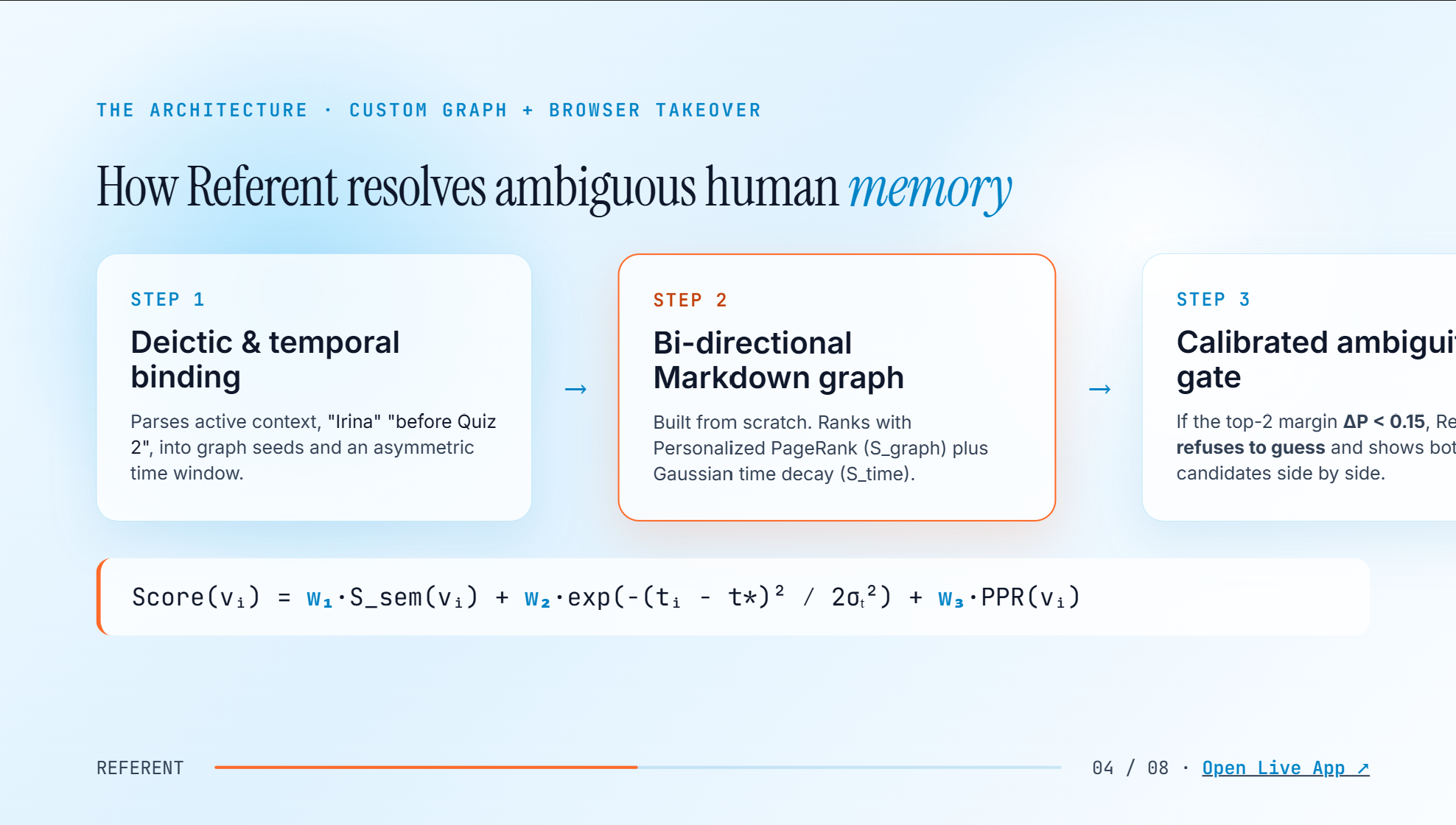
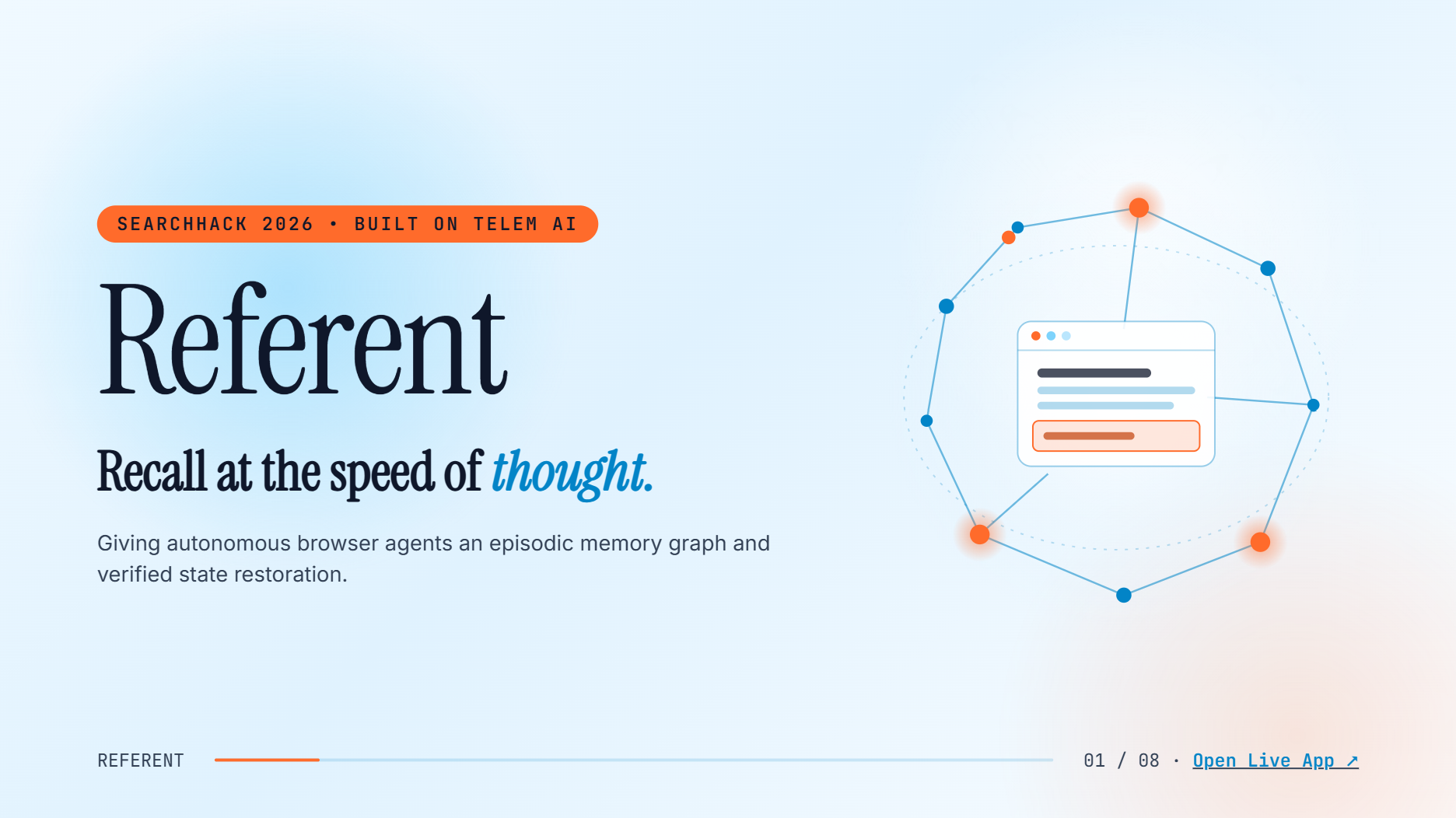
Referent is an episodic disambiguation and verified task-resumption engine built to bridge local episodic context with live external verification. It translates unsearchable conversational prompts into precise temporal and relational graph queries over an Obsidian-style knowledge graph. When evaluating files that share nearly identical text, Referent uses asymmetric causal time-decay kernels and Personalized PageRank to isolate the exact historical episode. Once the correct memory is identified, the system does not just return static text, it restores the exact browser viewport, performs a post-navigation verification check, and runs an inline historical-versus-live DOM diffing check to warn users if parameters have drifted since they last looked at the document. Furthermore, it integrates tightly with the Telem AI suite to fetch live literature updates and monitor ongoing background assumptions over time.
How we built it
eferent is structured as a full-stack engineering architecture divided into clean, specialized layers. The frontend is built using Next.js (App Router), TypeScript, Tailwind CSS, and an interactive React Force Graph constellation engine that visually maps out live episodic memory trails and traversal paths. The backend is powered by Python FastAPI, NetworkX, and NumPy, implementing custom Personalized PageRank, temporal decay scoring, and submodular filtering to reject redundant search results. The browser and state engine combines a full-screen desktop browser shell with Playwright/CDP-driven DOM verification to capture and restore exact view specifications, including active tabs, filters, and section anchors. Crucially, the entire retrieval loop is driven by the Telem AI Router API (Search, Fetch, and Monitors) and Tavily, aligning directly with the hackathon's core evaluation criteria.
What's next for Referent
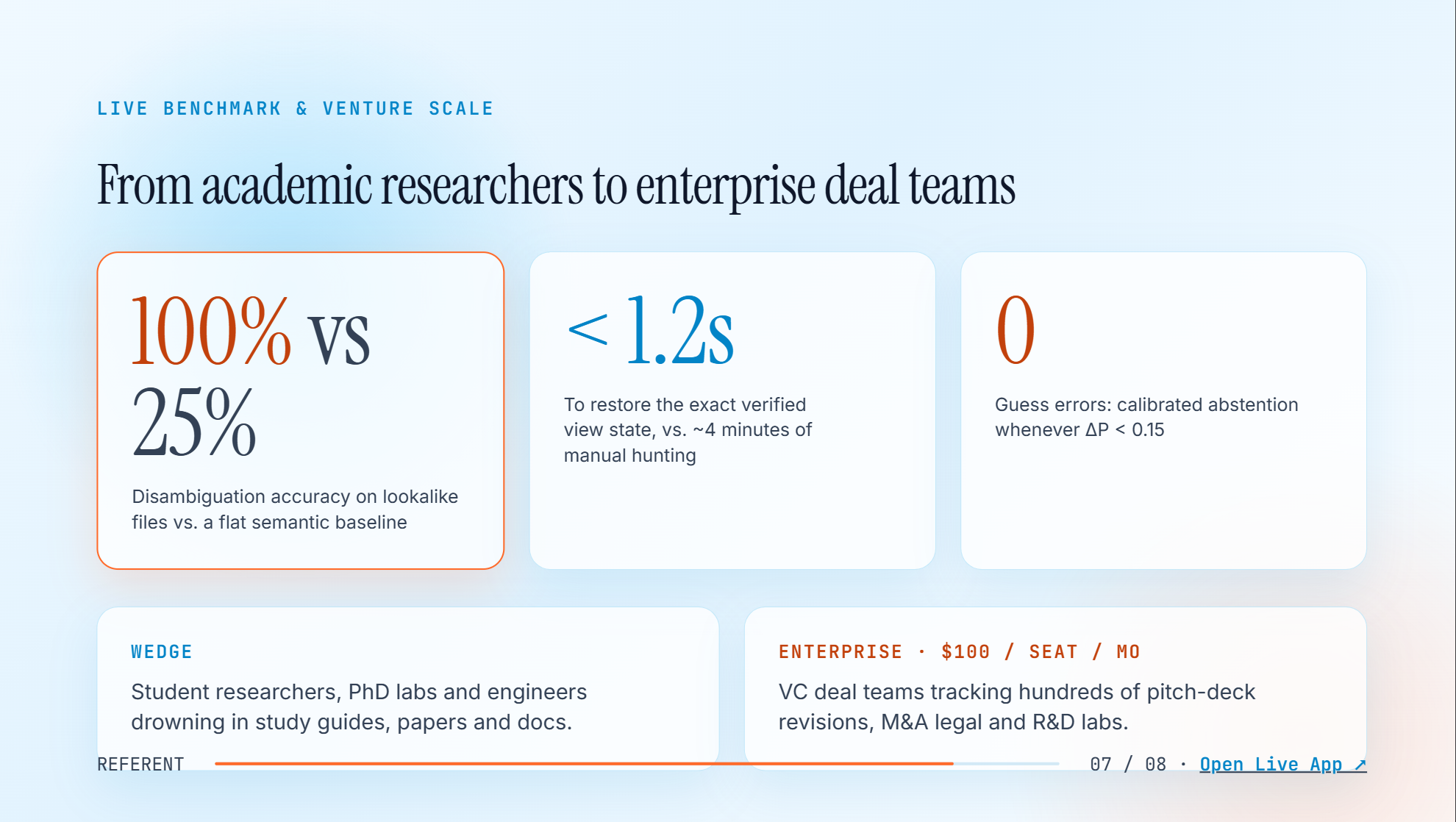
While tested around complex academic research and engineering workflows, Referent scales directly to high-stakes enterprise environments where professionals lose hours every week hunting down stale or conflicting document versions. Venture capital deal teams, hedge fund analysts, and legal compliance groups constantly drown in lookalike pitch decks, data-room models, and contract drafts where missing a single updated assumption can change an entire decision. By combining local episodic graph memory with real-time browser view restoration and powerful external routers like Telem AI, Referent transforms stateless browser agents into true cognitive partners.
Built With
- css
- fastapi
- networkx
- next.js
- playwright
- python
- tailwind
- tavily
- telem
- typescript
