-
-
ReEntry - One Recovery Loop
-
Student Workflow - Evidence, Insights & Control
-
Student Workflow - Low friction capture
-
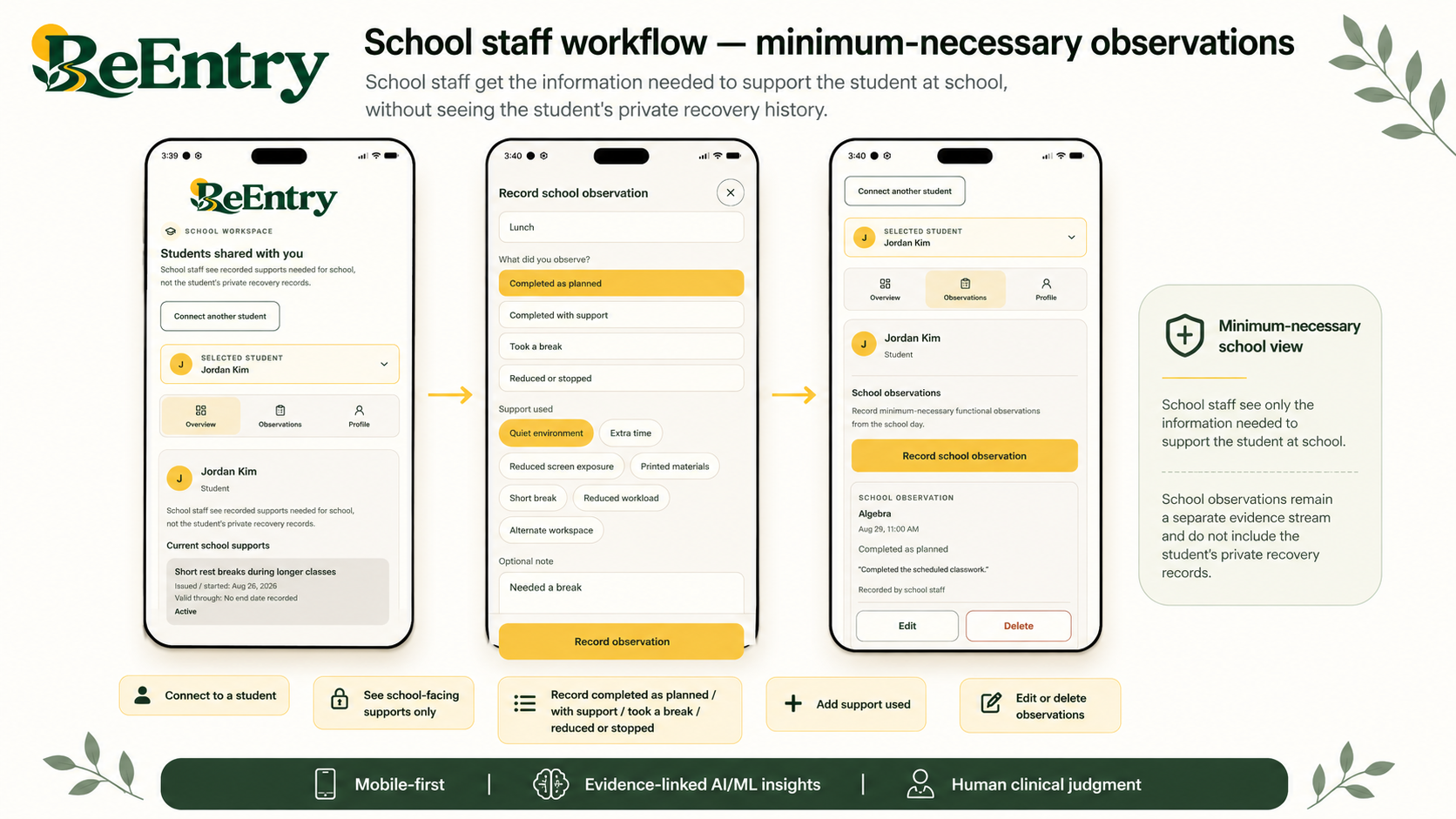
School Staff - Minimum Necessary Observations
-
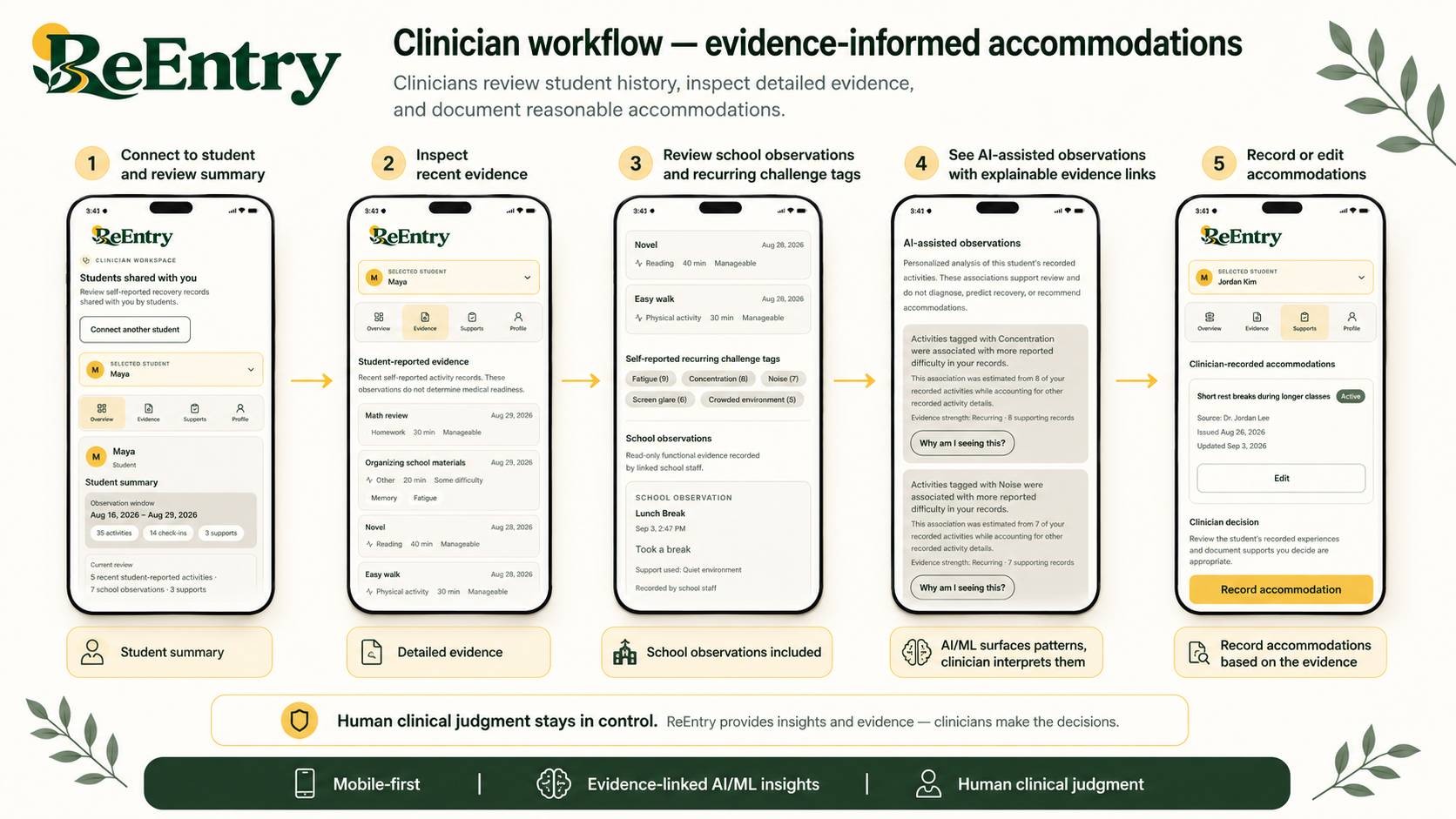
Clinicians - Evidence Observed Accommodations
Inspiration
A concussion doesn't end when a student leaves the clinic.
For a teenager, recovery happens in chemistry class, under bright lights, while reading an assignment, using a laptop, concentrating in a noisy classroom, or simply trying to spend time with friends again.
But most of those experiences happen between appointments.
By the next clinician visit, it can be difficult to reconstruct what actually happened. Which activities were manageable? What became difficult? Did screens, noise, concentration, or duration appear alongside harder experiences? What support helped?
Schools face a different problem: they need enough information to support the student, but they shouldn't automatically need access to that student's entire private recovery history.
That gap inspired ReEntry.
ReEntry helps adolescents capture what returning to school and everyday life is actually like, turns those experiences into evidence they and their clinician can inspect, and communicates relevant supports to school — without asking AI to make medical decisions.
Return to school. Return to friends. Return to life.
What it does
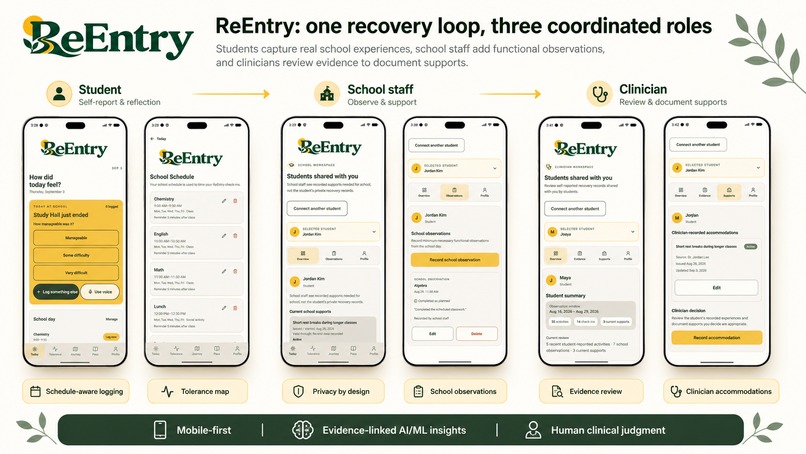
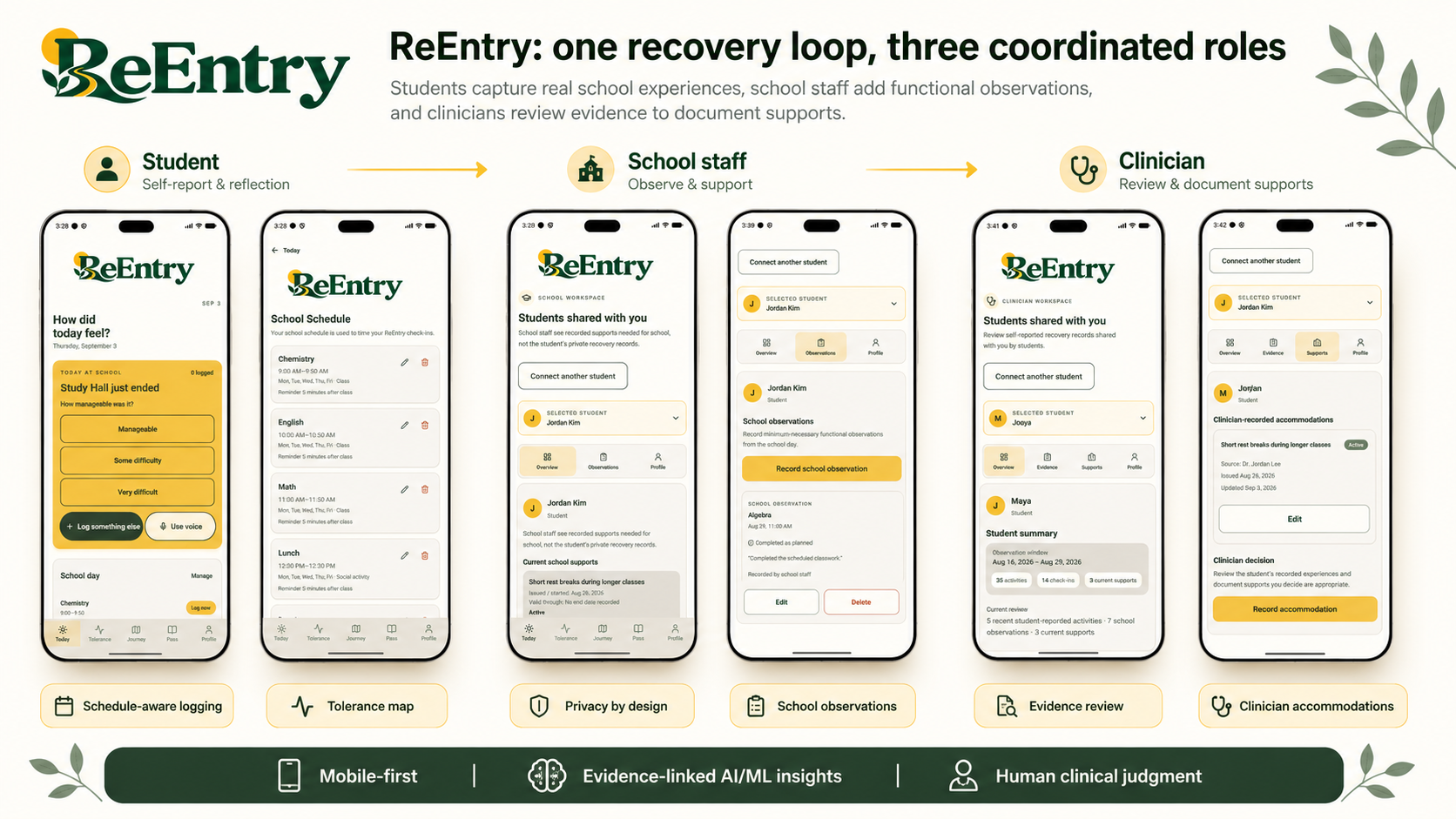
ReEntry creates a loop between the student experiencing recovery, the clinician interpreting evidence, and the school providing support.
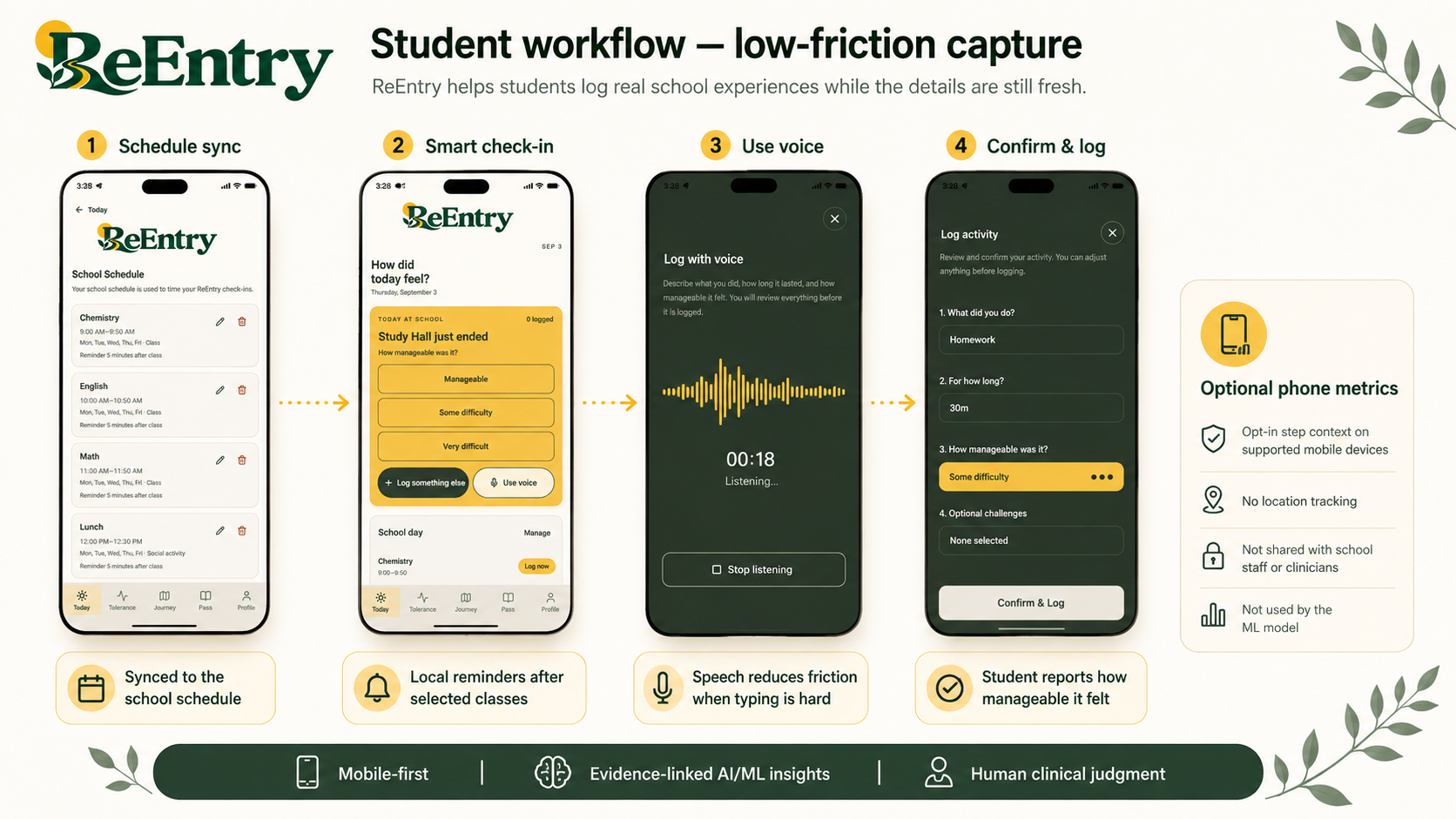
Low-friction student capture
Students record real-world activities such as class, reading, screens, concentration-heavy work, physical activity, and social activity using three descriptive states:
- Manageable
- Some difficulty
- Very difficult
They can also record duration, challenge/context tags, and an optional note.
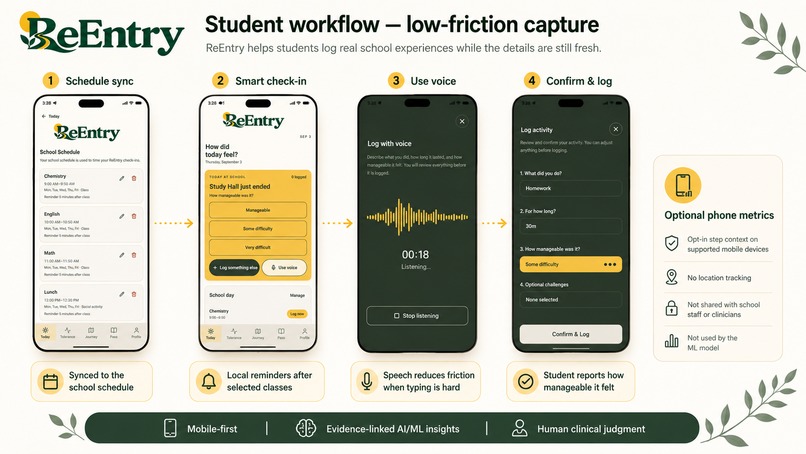
To reduce typing, ReEntry includes AI-assisted voice capture:
Student speaks → speech recognition → structured draft → student reviews → Confirm & Log
Nothing is silently added to the student's record.
Students can also add their recurring school schedule. Smart Capture provides timely logging opportunities after classes so experiences can be recorded while they're still fresh.
Our principle is simple:
We automate the collection opportunity, not the medical interpretation.
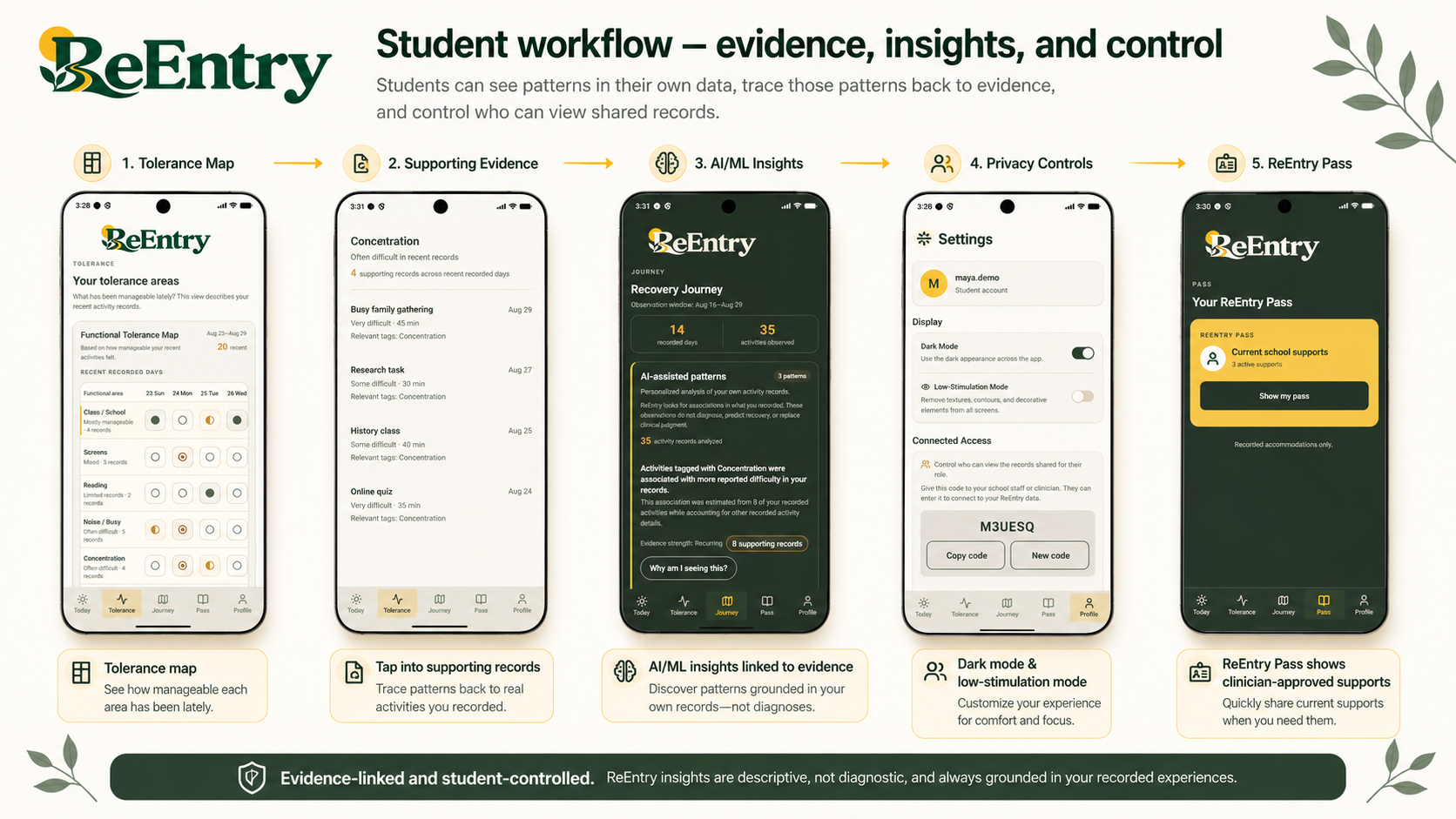
Tolerance Map
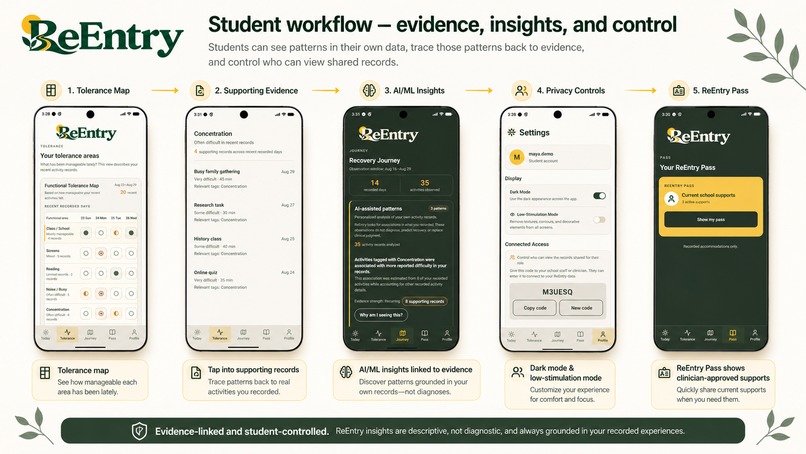
Confirmed experiences build a visual Tolerance Map across areas such as:
- Class / School
- Screens
- Reading
- Noise / Busy
- Concentration
- Physical Activity
- Social Activity
Students can open the evidence underneath the visualization.
The map is descriptive — not a recovery percentage, severity score, readiness score, or medical clearance system.
Journey + personalized ML
Journey turns individual records into a longitudinal view of the student's observation window.
ReEntry then runs a personalized ridge-regression model on the student's own confirmed functional records.
Rather than predicting recovery, the model asks:
Are there sufficiently supported patterns in this student's own records that may be useful to review?
The model uses activity category, challenge tags, duration, position within the observation window, and prior recorded manageability.
It uses chronological validation plus minimum-data, variability, coefficient-strength, and evidence-support gates. If there isn't enough usable evidence, ReEntry shows no pattern rather than forcing an AI insight.
Every surfaced observation links back to supporting records through "Why am I seeing this?"
This makes the ML inspectable:
Evidence → Pattern → Evidence
School Observations
Student self-report isn't the only useful perspective.
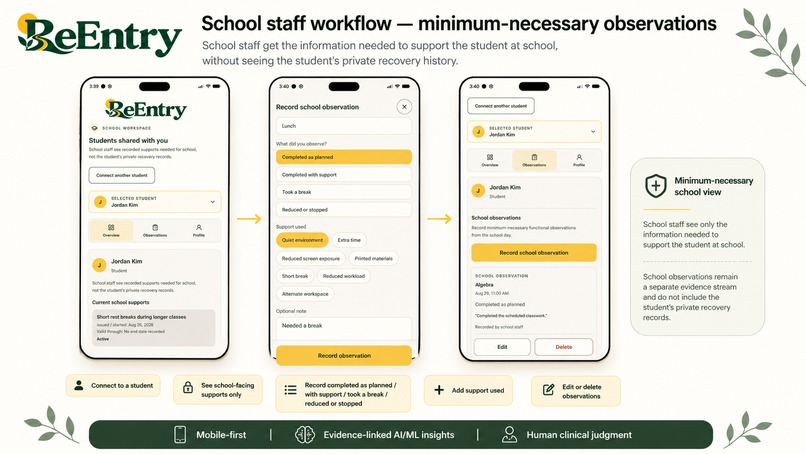
Linked School Staff can separately record whether a student:
- completed an activity as planned;
- completed it with support;
- took a break; or
- reduced or stopped the activity.
School Observations remain a separate evidence stream. They are not silently merged into student self-report and are not used to train the personalized ML model.
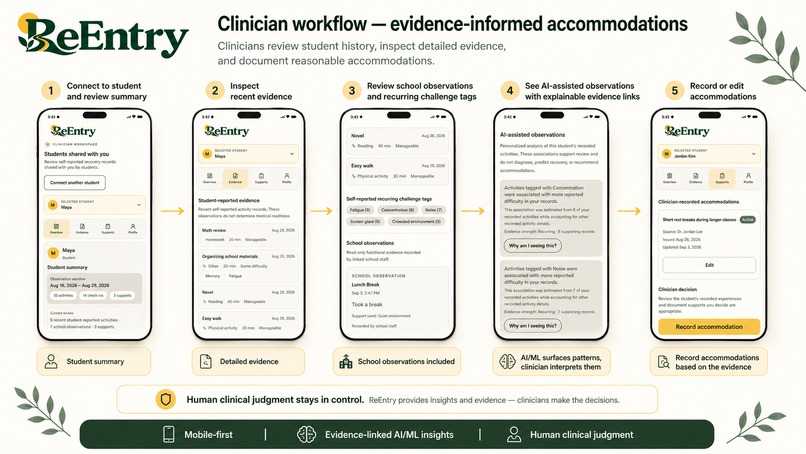
Clinician workflow
Clinicians can review student-reported functional evidence, Journey, evidence-linked ML observations, supporting records, and School Observations.
But we deliberately drew a boundary:
AI surfaces observational evidence. The clinician interprets it. The clinician — not AI — records accommodations.
When a clinician records an accommodation, School Staff can receive the support information they need without automatically receiving the student's private activity history or Journey.
The student can also carry those recorded supports through their ReEntry Pass.
Optional device context
On supported native devices, ReEntry can display opt-in pedometer context.
We intentionally kept this limited: no location tracking, no hidden continuous surveillance, no step-based medical interpretation, no ML use of steps, and no sharing of step context with School Staff or Clinicians.
Device activity is context, not a medical conclusion.
How we built it
ReEntry is built with:
- Expo
- React Native / React Native Web
- Expo Router
- TypeScript
- Supabase
- PostgreSQL
- Supabase Auth
- PostgreSQL Row Level Security
- expo-speech-recognition
- expo-notifications
- expo-sensors / Pedometer
The personalized ML pattern engine is implemented locally in TypeScript using ridge regression.
One of our most important architectural decisions was treating privacy as more than a frontend concern.
ReEntry has distinct Student, Clinician, and School Staff experiences. Supabase Row Level Security combines user roles with active student-access relationships so access boundaries are enforced at the database layer.
We also intentionally separated evidence streams:
Student-confirmed records → personalized ML
School Observations → separate clinician evidence
Device activity → optional local context
Clinician accommodations → human-authored decisions
We didn't make every available data point an AI input simply because we could.
Responsible AI
Building AI for concussion recovery required us to define what AI shouldn't do before deciding what it should do.
ReEntry does not use AI to:
- diagnose concussion;
- classify severity;
- calculate a recovery percentage;
- predict a recovery date;
- establish medical causation;
- recommend medication or treatment;
- determine medical readiness;
- provide return-to-play clearance; or
- prescribe school accommodations.
Instead, AI and ML have deliberately bounded roles.
Voice reduces capture friction.
The student reviews the structured result before it becomes evidence.
Personalized ML organizes evidence.
Patterns appear only when predefined evidence and quality gates are satisfied.
Explainability exposes the evidence.
Users can inspect the actual records supporting a surfaced observation.
Humans make decisions.
The clinician — not the model — determines whether to record an accommodation.
Privacy limits information flow.
School Staff receive minimum-necessary support information rather than a student's complete private recovery history.
For ReEntry, Responsible AI isn't a disclaimer at the bottom of the screen. It's part of the architecture.
Sometimes the most responsible model output is no output at all.
Challenges we faced
Making ML useful without turning it into a clinician
It would have been easy to build an impressive-looking recovery score or prediction.
We deliberately chose not to.
The harder challenge was making ML useful while keeping it personalized, observational, evidence-linked, and appropriately limited. That led us to chronological validation, evidence gates, supporting-record provenance, and suppression when evidence isn't sufficient.
Reducing logging burden
A concussion recovery app can easily become another assignment.
Quick structured logging, voice capture, recurring schedules, Smart Capture, and local reminders were all designed around reducing how much effort it takes to record useful context.
Designing privacy across three roles
A single shared dashboard would have been simpler.
Instead, we built separate Student, Clinician, and School Staff experiences and enforced those boundaries with database-level Row Level Security.
Building across mobile and web
Native speech recognition, notifications, and pedometer access behave differently across platforms. Supporting Android, iOS, and a web preview required handling permissions, unsupported states, native configuration, and platform-specific behavior.
What we learned
The biggest lesson was that Responsible AI is an architectural decision, not a disclaimer.
It affects what data you collect, what enters the model, when the model stays silent, what evidence users can inspect, what information each role receives, and which decisions remain human.
We also learned that adolescent-focused design changes what "good data collection" means.
The most comprehensive form isn't necessarily the most useful one. A low-friction interaction a student will actually complete can be more valuable than a detailed diary they avoid.
And explainability became much more meaningful when we stopped thinking of it as a confidence number and instead asked:
Can the user see the evidence behind this?
Accomplishments we're proud of
We're proud that ReEntry became more than an activity tracker or an AI feature added to a health app.
We built a complete functional loop:
Real-world student experience
→ low-friction confirmed capture
→ schedule-aware Smart Capture
→ Tolerance Map
→ personalized evidence-linked ML
→ School Observations
→ clinician interpretation
→ clinician-authored accommodation
→ minimum-necessary School communication
→ ReEntry Pass
We're especially proud that the ML has a defined purpose, defined inputs, validation requirements, evidence gates, suppression behavior, and supporting-record provenance — without asking it to make medical decisions.
What's next
ReEntry is a prototype, not a clinically validated medical system.
The next step would be working directly with adolescents, caregivers, educators, concussion clinicians, and accessibility experts to evaluate the workflow in real return-to-school environments.
We would want to study logging burden, accessibility, model behavior on larger longitudinal datasets, whether surfaced observations are useful to clinicians, and how students understand evidence-linked ML.
Clinical evaluation, privacy and security review, accessibility testing, and regulatory analysis would be necessary before real-world clinical deployment.
A student's experiences between appointments shouldn't disappear.
ReEntry is an attempt to make those experiences easier to capture, easier to understand, and easier to communicate — while keeping medical decisions where they belong: with people.
Return to school. Return to friends. Return to life.
Try ReEntry
📱 ReEntry is a mobile-first app for iOS and Android.
🌐 Web preview: https://re-entry-alpha.vercel.app
Demo accounts
- Student — Maya:
maya.demo/Pass123 - Clinician:
clinician.demo/Pass123 - School Staff:
school.demo/Pass123
All demo users and records are synthetic. The web preview demonstrates ReEntry's core workflows; native speech recognition, notifications, and device activity require a compatible mobile build.
Built With
- ai
- android
- auth
- expo-notifications
- expo-sensors
- expo-speech-recognition
- expo.io
- ios
- learning
- level
- machine
- native
- pedometer
- postgresql
- react
- recognition
- regression
- ridge
- router
- row
- security
- speech
- supabase
- typescript
- web


Log in or sign up for Devpost to join the conversation.