-
-
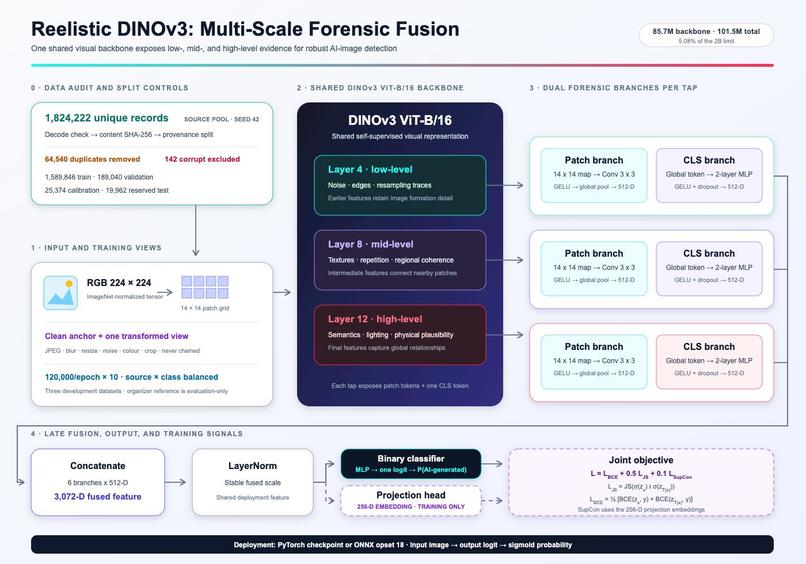
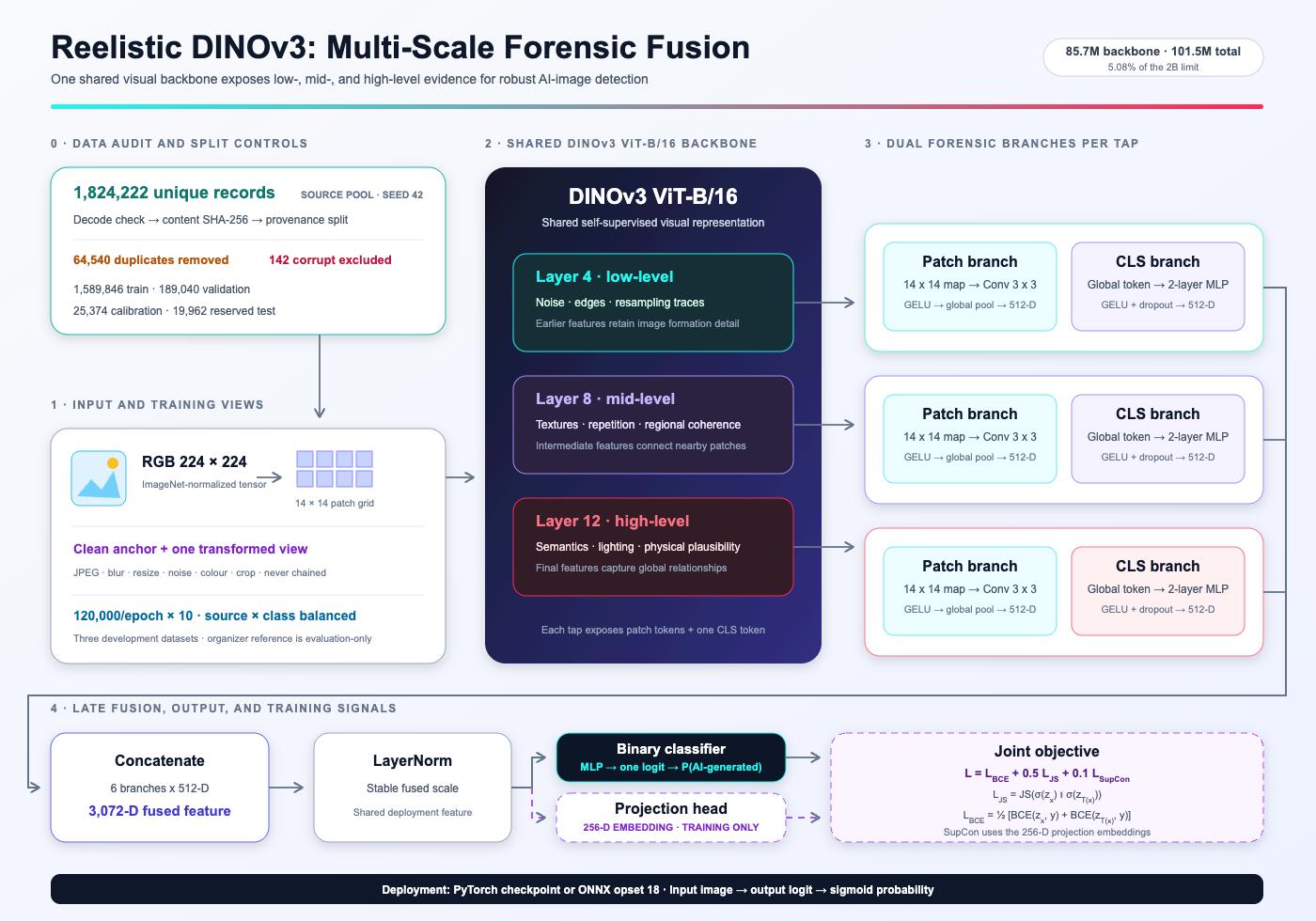
Detection Model Architecture
-
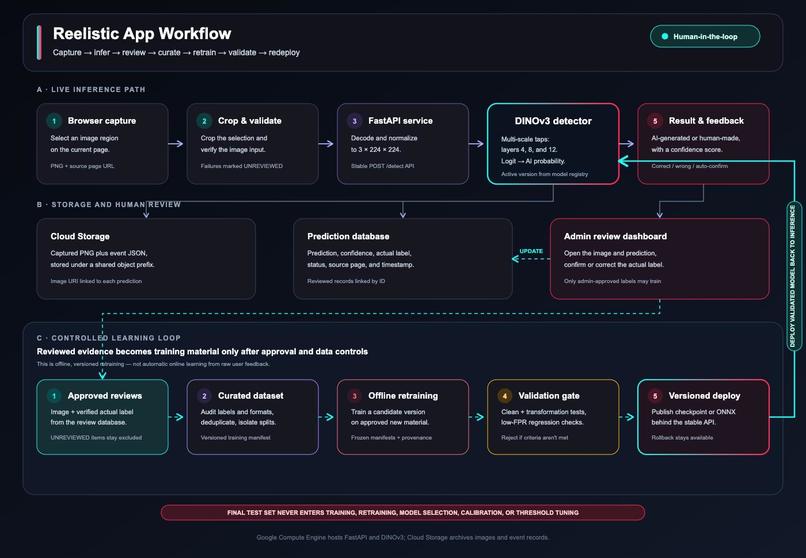
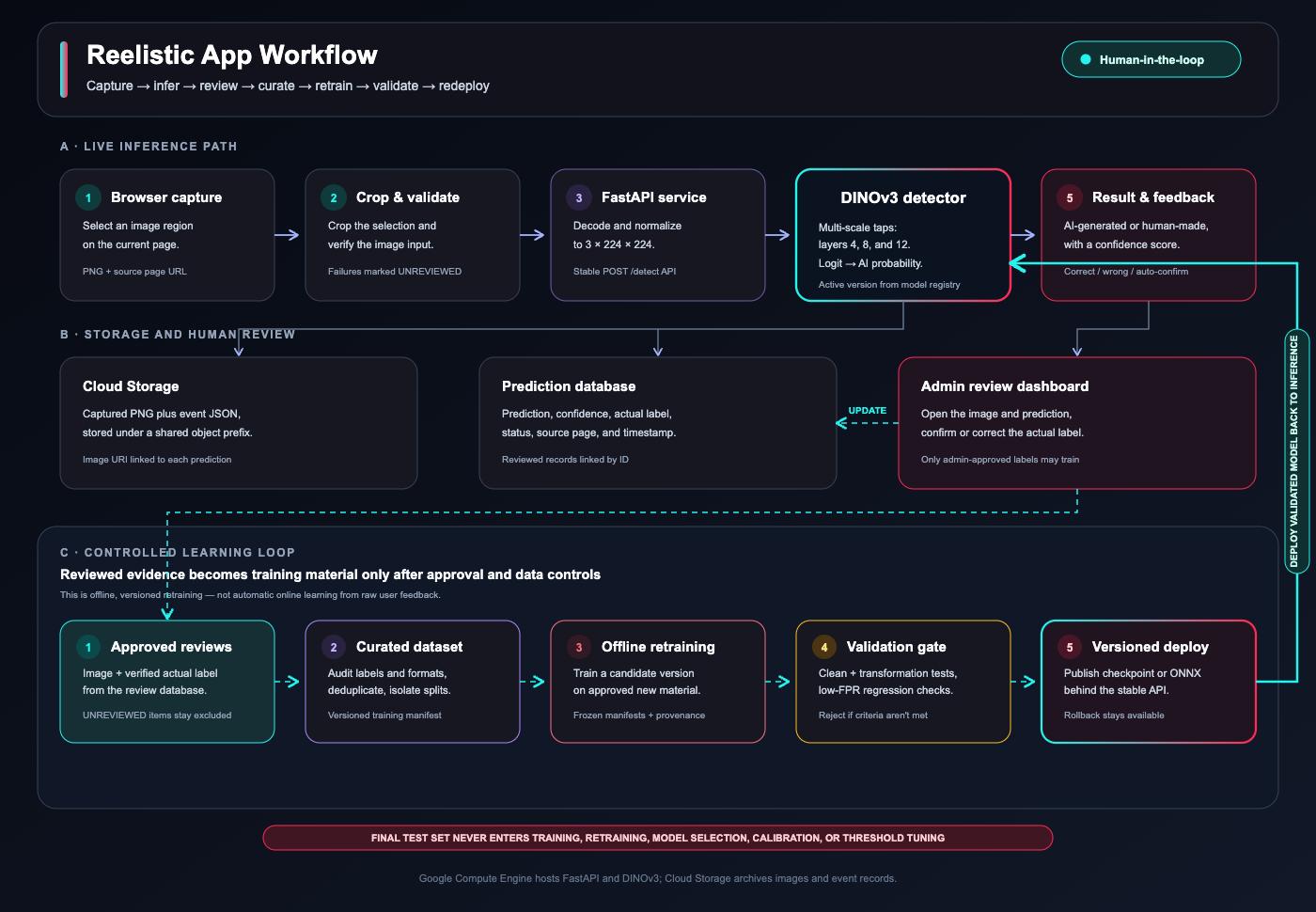
Application Architecture
-
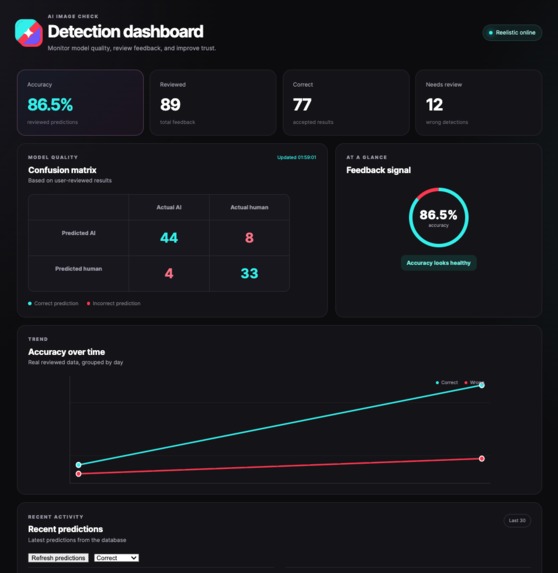
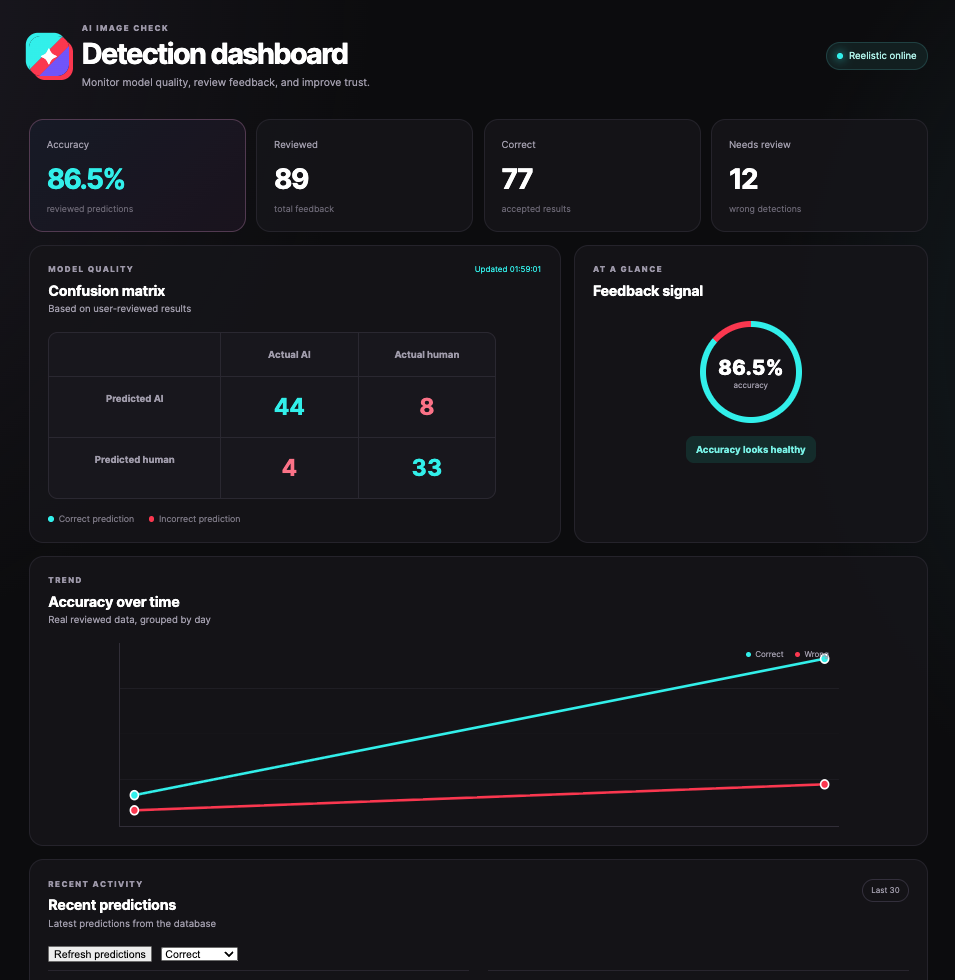
Monitoring Dashboard
-
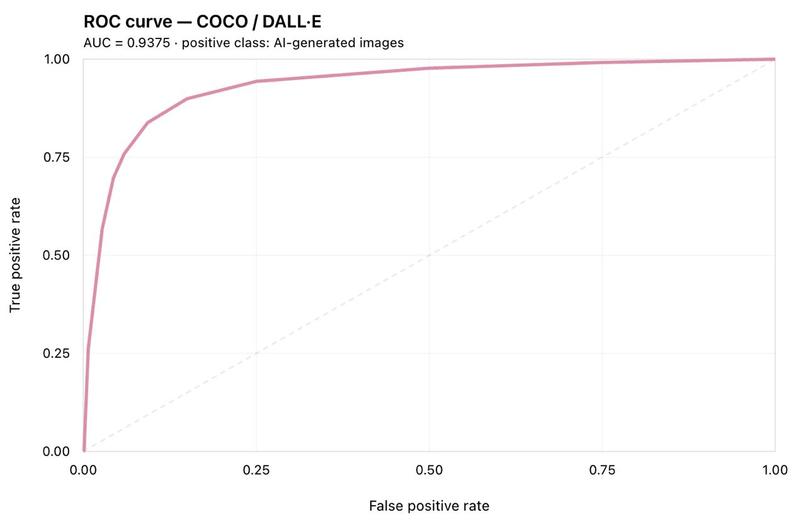
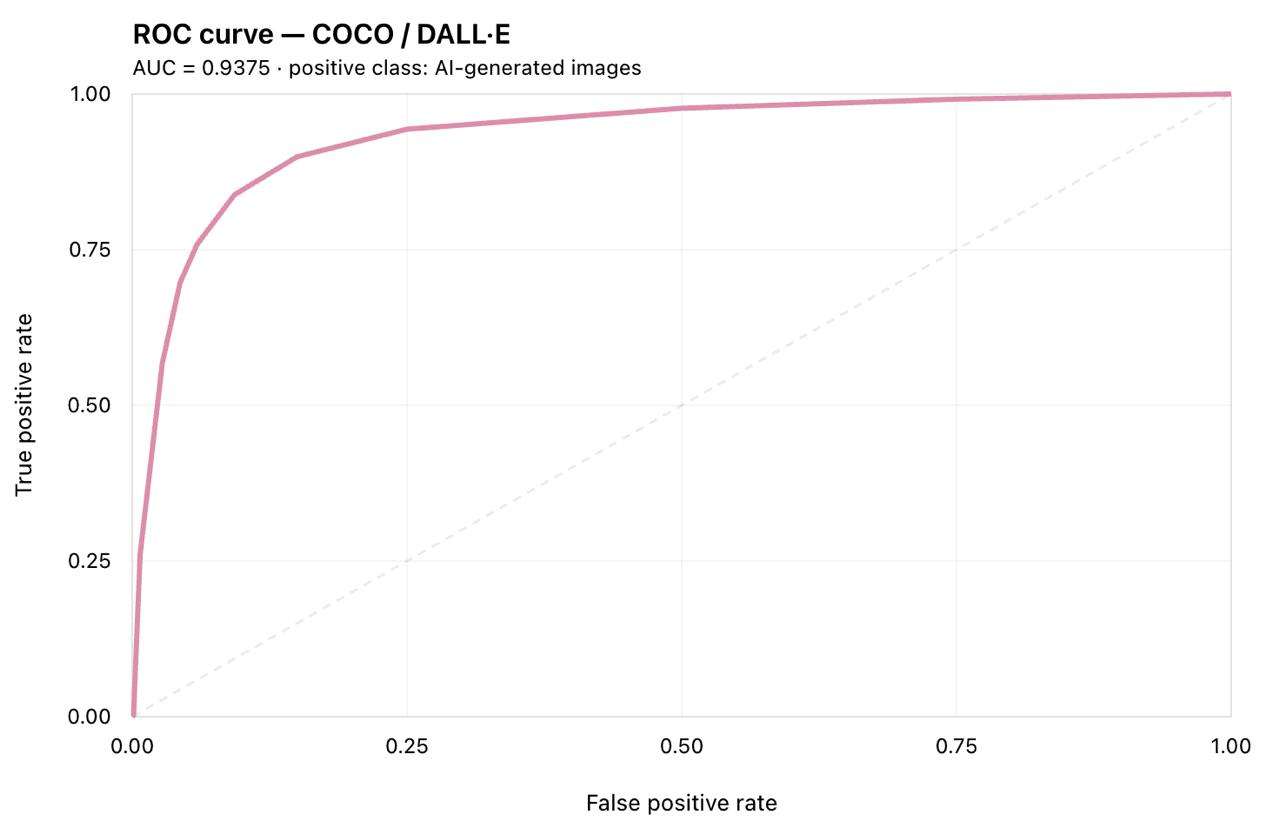
ROC curve - COCO / DALL - E
Reelistic — Web-Native AI Image Authenticity & Detection
Why We Built Reelistic 🔍
AI-generated images are increasingly mixed into normal online content, but people often have no quick way to assess whether an image is authentic before trusting or sharing it. We wanted to bring an image-authenticity signal directly into the browsing experience instead of requiring users to upload files to a separate website.
What It Does 🧩
Reelistic is a browser-based AI-image detection system.
- Browser-Integrated Capture: Users select an image region directly from any webpage.
- Cloud API Processing: The extension sends the capture to a fast, cloud-hosted FastAPI backend.
- Forensic Predictions: The model returns an AI-generated or authentic result along with a calibrated confidence score.
- Admin & Review Dashboard: Predictions and user feedback are stored in a centralized dashboard for auditing and manual review.
The dashboard records prediction history, user feedback, review status, image references, accuracy trends, and confusion-matrix statistics. This makes it possible to investigate mistakes rather than treating every model output as absolute ground truth.
How We Built It ⚙️
The product combines a browser extension, FastAPI backend, cloud storage, database layer, review dashboard, and a DINOv3-based image-forensics model.
Architecture & Model Design
The detector fine-tunes a DINOv3 ViT-B/16 backbone and extracts multi-scale representations by combining low-, mid-, and high-level features from layers 4, 8, and 12. These multi-depth feature maps help capture distinct forensic signatures:
- Layer 4 (Low-level): Pixel-level artifacts, high-frequency noise, and sensor-level textures.
- Layer 8 (Mid-level): Local pattern consistency, edge structure, and boundary continuity.
- Layer 12 (High-level): Global lighting, semantic composition, and object consistency
Each layer contributes:
- local patch features
- global CLS features
All six vectors are concatenated into a 3,072-D representation before classification.
Inspiration
- Park et al., Rethinking the Use of Vision Transformers for AI-Generated Image Detection (MoLD, 2025). It directly supports the AI-image-detection claim that earlier and different ViT layers provide distinct, complementary signals.
- Ciernik et al., Beyond the Final Layer: Attentive Multilayer Fusion for Vision Transformers (ICML 2026). It supports the broader claim that task-relevant information is distributed across the ViT hierarchy.
Transformation curriculum
Used curriculum learning where augmentations increase in complexity over every few epochs. Only one augmentation is applied per image, randomly chosen from the list of augmentations.
Why one augmentation per image?
To simulate one dominant platform transformation at a time, isolate its forensic impact, and avoid unrealistic compounded corruption.
Easy → medium → hard transformations
Stage 1 (epochs 0–2): JPEG Q90, Gaussian blur (σ = 0.5 or 1.0), 0.5× resize, Gaussian noise (σ = 0.02 or 0.05), 0.8 centre crop, and colour jitter (0.1).
Stage 2 (epochs 3–6): JPEG Q70–50, Gaussian blur (σ = 1.0 or 2.0), 0.25× or 0.5× resize, Gaussian noise (σ = 0.05 or 0.10), 0.8 centre crop, and colour jitter (0.2).
Stage 3 (epochs 7–9): JPEG Q50–30, Gaussian blur (σ = 1.0 or 2.0), 0.25× resize, Gaussian noise (σ = 0.05 or 0.10), 0.8 centre crop, and colour jitter (0.2).
Training Objective
The model is trained using a composite loss function combining binary cross-entropy, feature consistency, and supervised contrastive loss:
$$L = L_{\text{BCE}} + 0.5 \cdot L_{\text{consistency}} + 0.1 \cdot L_{\text{supcon}}$$
- Binary cross-entropy: makes the clean-image prediction match the ground-truth label.
- JS consistency: keeps the prediction stable when the same image undergoes one realistic web transformation.
- Supervised contrastive loss: groups representations of images with the same authenticity label while separating real and AI-generated examples.
Data Pipeline & Hygiene
We developed the model using SID, CIFAKE, and approved WildFake generator families. To maintain rigorous data hygiene:
- SHA-256 hash auditing was performed to eliminate duplicate content.
- Strict split-isolation was enforced between training, validation, calibration, and test data to prevent data leakage.
- Images that could not be decoded, preprocessed, or successfully passed through the model were excluded and logged before dataset splitting and evaluation.
Main Challenges 🌊
The primary engineering challenge was robustness under real-world web distribution. A detector that performs well on pristine synthetic images often experiences severe performance drift when images undergo real-world platform transformations like JPEG compression, blurring, downscaling, noise, or cropping, or when exposed to unseen generator architectures.
To solve this, we moved beyond basic accuracy metrics and evaluated:
- ROC-AUC & Calibration Error: Ensuring predicted probabilities reflect true empirical likelihoods.
- False-Positive Operating Points: Maintaining low false-positive rates to avoid flagging genuine content.
- Robustness Stress-Testing: Systematically evaluating performance under platform-specific image degradation.
- Deduplication Auditing: Implementing SHA-256 deduplication and duplicate-aware reporting to prevent source imbalance from skewing evaluation metrics.
What We Are Proud Of 🏆
- End-to-End System: Built a complete browser-to-cloud detection workflow instead of merely a standalone model script.
- Human-in-the-Loop Review: Created an administrative review dashboard that supports granular error analysis and continuous offline retraining workflows.
- Compact, Powerful Backbone: Developed a multi-scale DINOv3 detector with approximately 101.5M parameters — well within the 2B parameter competition threshold.
- State-of-the-Art Benchmark Results: Achieved an impressive ROC-AUC of 0.9375 on the duplicate-aware 8,717-image COCO / DALL·E evaluation dataset.
- Rigorous Engineering Safeguards: Designed strict split-isolation and data-audit safeguards across the entire pipeline.
Benchmark Evaluation Results (COCO & DALL·E Dataset)
**results reported are after de-deuplication
| Condition | Count | ROC-AUC | Accuracy | Precision | Recall | F1 Score | TPR @ 5% FPR | Threshold @ 5% FPR |
|---|---|---|---|---|---|---|---|---|
| Clean | 8,717 | 0.9375 | 0.8066 | 0.6995 | 0.9583 | 0.8087 | 0.7139 | 0.9648 |
| JPEG (Q=90) | 8,717 | 0.9433 | 0.8270 | 0.7261 | 0.9546 | 0.8248 | 0.7623 | 0.9595 |
| JPEG (Q=70) | 8,717 | 0.9376 | 0.8237 | 0.7235 | 0.9497 | 0.8213 | 0.7139 | 0.9624 |
| JPEG (Q=50) | 8,717 | 0.9054 | 0.7871 | 0.6843 | 0.9301 | 0.7885 | 0.5690 | 0.9673 |
| JPEG (Q=30) | 8,717 | 0.8301 | 0.7077 | 0.6051 | 0.9062 | 0.7257 | 0.1936 | 0.9736 |
| Blur (σ = 0.5) | 8,717 | 0.9389 | 0.8185 | 0.7146 | 0.9567 | 0.8181 | 0.7303 | 0.9634 |
| Blur (σ = 1.0) | 8,717 | 0.9345 | 0.8128 | 0.7078 | 0.9556 | 0.8133 | 0.6878 | 0.9658 |
| Blur (σ = 2.0) | 8,717 | 0.8981 | 0.7465 | 0.6340 | 0.9597 | 0.7636 | 0.4343 | 0.9722 |
| Resize (0.50x) | 8,717 | 0.8881 | 0.7397 | 0.6283 | 0.9548 | 0.7579 | 0.4052 | 0.9727 |
| Resize (0.25x) | 8,717 | 0.7689 | 0.6196 | 0.5303 | 0.9489 | 0.6804 | 0.0495 | 0.9766 |
| Noise (σ = 0.02) | 8,717 | 0.9503 | 0.8577 | 0.7707 | 0.9489 | 0.8506 | 0.7849 | 0.9551 |
| Noise (σ = 0.05) | 8,717 | 0.9634 | 0.8869 | 0.8170 | 0.9470 | 0.8772 | 0.8543 | 0.9277 |
| Noise (σ = 0.1) | 8,717 | 0.9156 | 0.8210 | 0.7289 | 0.9244 | 0.8151 | 0.6314 | 0.9609 |
| Color Jitter (0.20) | 8,717 | 0.9305 | 0.8023 | 0.6957 | 0.9540 | 0.8046 | 0.6771 | 0.9658 |
| Center Crop (0.80) | 8,717 | 0.9144 | 0.8108 | 0.7127 | 0.9325 | 0.8079 | 0.5787 | 0.9668 |
What We Learned 📚
This project reinforced that reliable real-world AI image detection requires far more than training a baseline classifier. Long-term accuracy and trustworthiness depend heavily on:
- Dataset Design & Curation: Removing duplicates and balancing source distributions.
- Proper Probability Calibration: Aligning model confidence scores with real error rates.
- Realistic Stress-Testing: Measuring performance degradation across realistic web image transformations.
- Transparent & Auditable Metrics: Evaluating metrics beyond standard accuracy (e.g., TPR at fixed low FPR).
- Human-in-the-Loop Feedback: Incorporating admin review mechanisms to catch edge cases and prevent model blind spots.
Next Steps 🚀
- Real-World Data Collection: Gather verified real-world browsing samples to continuously measure and mitigate domain drift.
- Low-Quality Robustness: Further optimize model performance for low-resolution and heavily compressed web imagery.
- Uncertainty Estimation: Introduce explicit "uncertain/borderline" prediction states for ambiguous confidence regions.
- Automated Retraining Pipeline: Build a versioned, automated retraining workflow powered by admin-approved user feedback.
- Multi-Modal Authenticity: Expand Reelistic beyond visual artifacts to incorporate metadata, provenance, and multi-modal authenticity signals.


Log in or sign up for Devpost to join the conversation.