Inspiration
Creators are constantly told to create more content.
But we noticed a different problem: creators often already have more content than they realize.
A single podcast, interview, webinar, video, or article can contain dozens of valuable ideas. The difficult part is finding those ideas, deciding which ones are worth publishing, adapting them for different platforms, and turning them into a consistent content plan.
Most AI content tools start with:
"Give me an idea."
        ↓
"Generate content."
We wanted to build something different.
ReelForge starts with:
"What valuable ideas are already hiding
inside the content I've created?"
That question inspired ReelForge — an AI Content Decision Engine.
Our goal is simple:
Don't Create More. Extract More.
What it does
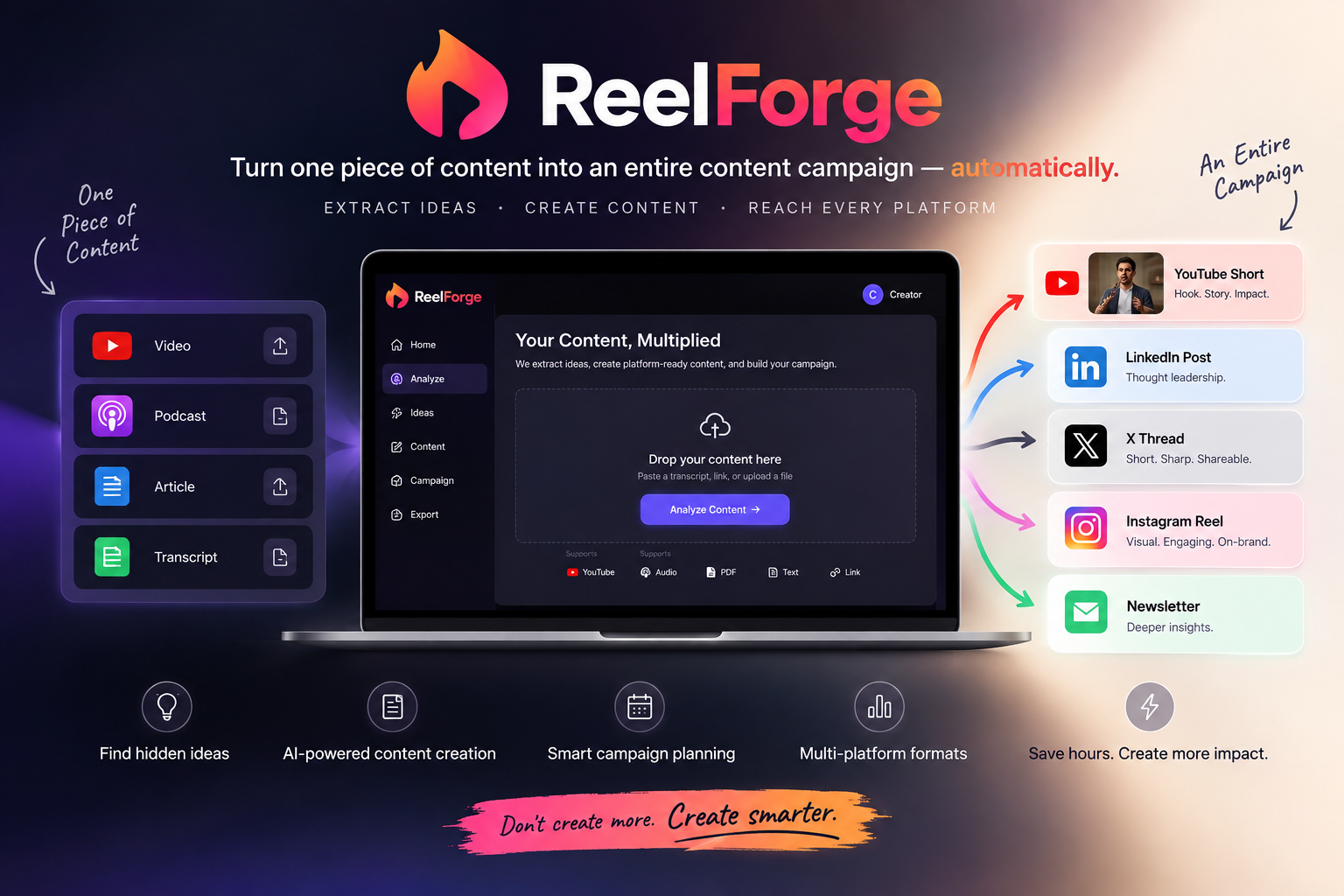
ReelForge takes one piece of long-form content and turns it into a structured content campaign.
A creator can paste a transcript, article, podcast notes, interview, webinar, or other long-form content.
ReelForge then:
- Analyzes the source
- Breaks it into Content Atoms
- Identifies high-value opportunities
- Classifies ideas as hooks, stories, insights, lessons, frameworks, opinions, and more
- Scores each opportunity
- Explains why an idea is valuable
- Recommends the best platform
- Transforms the idea for different platforms
- Builds a 7-day content campaign
The core workflow is:
Long-form Content
       ↓
Content Understanding
       ↓
Content Genome
       ↓
Opportunity Detection
       ↓
Opportunity Scoring
       ↓
Platform Recommendation
       ↓
Content Transformation
       ↓
7-Day Campaign
Content Genome
Instead of treating an entire transcript as one large block of text, ReelForge identifies smaller, reusable pieces of information called Content Atoms.
For example:
"The hardest problem wasn't AI.
It was distribution."
ReelForge can recognize this as a Contrarian Insight and determine that it could work particularly well as a short-form video, LinkedIn post, or X post.
Opportunity Score
Each content opportunity receives an internal score based on factors such as:
- Hook strength
- Audience relevance
- Novelty
- Emotional impact
- Shareability
- Platform fit
Conceptually:
$$ Opportunity = 0.25H + 0.20R + 0.20N + 0.15E + 0.10S + 0.10P $$
This score is used as a ranking mechanism, not as a claim that the content will go viral.
Platform Transformation
ReelForge doesn't simply copy the same text across platforms.
The same underlying idea can become:
YouTube Short → Hook + Script

LinkedIn → Thought Leadership Post

X → Concise Post / Thread

Newsletter → Expanded Insight
The idea remains consistent while the format, tone, structure, and purpose change.
Campaign Engine
Finally, ReelForge organizes the strongest opportunities into a simple publishing sequence.
MONDAY    → YouTube Short
TUESDAY   → LinkedIn
WEDNESDAY → X
THURSDAY  → YouTube Short
FRIDAY    → Newsletter
SATURDAY  → LinkedIn
SUNDAY    → Repurpose / Review
The result is a workflow that goes beyond content generation:
Discover → Decide → Transform → Publish
How we built it
We built ReelForge as a lightweight full-stack AI application focused on making the complete workflow work end-to-end.
Technology
Frontend
├── React
├── Next.js
├── TypeScript
└── Tailwind CSS

AI Layer
└── Large Language Model

Backend
└── Server-side API

Deployment
└── Web-based deployment
The AI pipeline takes source content and produces structured information that the application can turn into interactive UI components.
Source Content
      ↓
AI Analysis
      ↓
Structured JSON
      ↓
Content Atoms
      ↓
Opportunity Scores
      ↓
Platform-Specific Content
      ↓
Campaign
We designed the AI prompts to focus on decision-making before generation.
Instead of immediately asking the model to write a post, we first ask it to understand the source, identify meaningful ideas, rank them, and explain why they matter.
This allows the generated content to be connected back to the original source idea.
We also added validation and fallback behavior so that the core experience remains usable when an AI request fails or returns an unexpected response.
Challenges we ran into
1. Building something more than another AI generator
The biggest challenge was differentiation.
A simple application can easily be built around:
Prompt → AI → Content
But we wanted ReelForge to provide value before generation.
Our approach became:
Content
   ↓
Understand
   ↓
Discover
   ↓
Rank
   ↓
Explain
   ↓
Transform
   ↓
Campaign
This changed the product from a writing tool into a content decision workflow.
2. Turning unstructured content into structured opportunities
Long-form content contains many different types of information.
A transcript can contain a story, an opinion, a lesson, a statistic, and a strong hook within the same few minutes.
We needed to turn that unstructured material into structured Content Atoms that the application could rank and display.
3. Making AI output reliable
AI-generated responses aren't always perfectly structured.
We had to think about:
- Structured JSON
- Validation
- Error handling
- Fallback responses
- Consistent scoring
- Keeping generated content connected to the source
This taught us that building an AI product isn't just about writing prompts. It is also about designing a reliable system around the model.
4. Working under a tight hackathon deadline
Time forced us to prioritize.
Instead of attempting to build every possible creator feature, we focused on one complete workflow:
Input
 ↓
Analyze
 ↓
Find Opportunities
 ↓
Rank
 ↓
Transform
 ↓
Campaign
 ↓
Export
We chose a working end-to-end experience over a large collection of unfinished features.
Accomplishments that we're proud of
We built a complete creator workflow
ReelForge doesn't stop at generating a caption.
It takes content from source → analysis → decision → transformation → campaign.
We created the Content Genome concept
The idea of decomposing long-form content into reusable Content Atoms became the foundation of the product.
It gives creators a different way to look at their existing work.
We added explainability
One of the features we're particularly proud of is the "Why This Idea?" layer.
Instead of simply presenting an AI recommendation, ReelForge explains why the opportunity was selected and where it could be used.
We made platform adaptation part of the workflow
The same idea can be transformed into different formats rather than simply duplicated across platforms.
We focused on a real creator problem
The goal wasn't to generate more AI content for the sake of generating more content.
The goal was to help creators extract more value from content they have already created.
What we learned
The biggest lesson we learned was:
AI becomes much more useful when it helps make decisions, not just generate text.
We initially thought about the problem as content generation.
But as we explored the workflow, we realized that the harder problem comes earlier:
Which idea is worth turning into content?
That led us to design the Content Genome and Opportunity Engine.
We also learned how important structured AI outputs are when building an actual application.
A model can generate an excellent paragraph, but a product needs more than paragraphs. It needs:
Data
↓
Structure
↓
Logic
↓
UI
↓
User Action
We learned to treat the AI model as one component of a larger system rather than the entire product.
Finally, the hackathon taught us the importance of scope control.
With limited time, the best engineering decision isn't always adding another feature. Sometimes it is removing features so that the core experience can become reliable and polished.
What's next for ReelForge
The current version focuses on turning existing content into opportunities and campaigns.
The next version could evolve into a complete Content Intelligence Platform.
Automatic content ingestion
Connect ReelForge directly to:
- YouTube
- Podcasts
- Blogs
- Webinars
- Interviews
- Video libraries
Instead of manually pasting transcripts, creators could connect their existing content sources.
Creator Style Memory
ReelForge could learn a creator's preferred:
- Tone
- Vocabulary
- Writing style
- Content structure
- Audience
- Calls to action
This would allow generated content to feel more like the creator.
Performance Feedback
Future versions could connect actual engagement data back to the Opportunity Engine.
The system could learn:
Content Opportunity
       ↓
Published Content
       ↓
Real Performance
       ↓
Feedback
       ↓
Better Recommendations
This would transform the current ranking system into a continuously improving content strategy engine.
Content Recycling
Older content could be automatically analyzed to find evergreen ideas that are still relevant.
Instead of letting valuable content disappear after publication:
Old Content
    ↓
Evergreen Ideas
    ↓
New Angles
    ↓
New Formats
    ↓
New Campaign
Automated Publishing
Eventually, ReelForge could integrate with supported publishing platforms so that creators can move from:
Idea → Content → Campaign
to:
Idea → Content → Campaign → Publish → Learn
Our long-term vision is for ReelForge to become the intelligence layer between what creators create and what they publish.
One source. Multiple opportunities. One intelligent campaign.
REELFORGE
Don't Create More. Extract More.
Built With
- artificialintelligence
- automation
- content-creation
- content-marketing
- creator-tools
- css
- genai
- llm
- natural-language-processing
- next.js
- openai
- react
- tailwind
- typescript


Log in or sign up for Devpost to join the conversation.