-
-
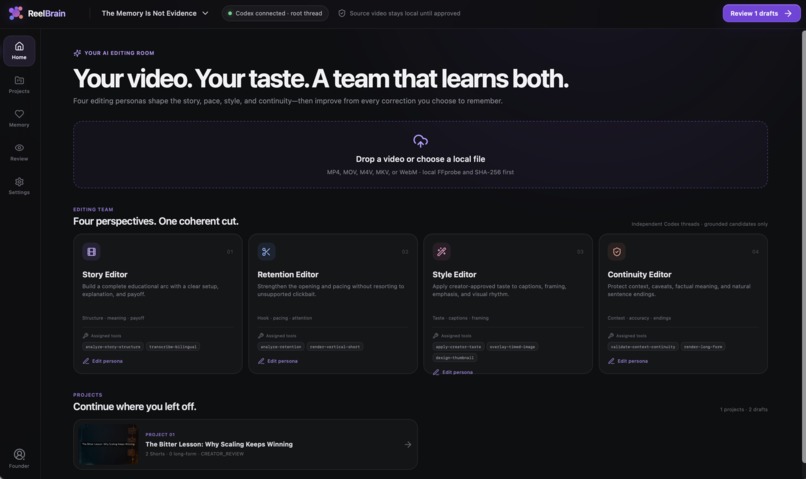
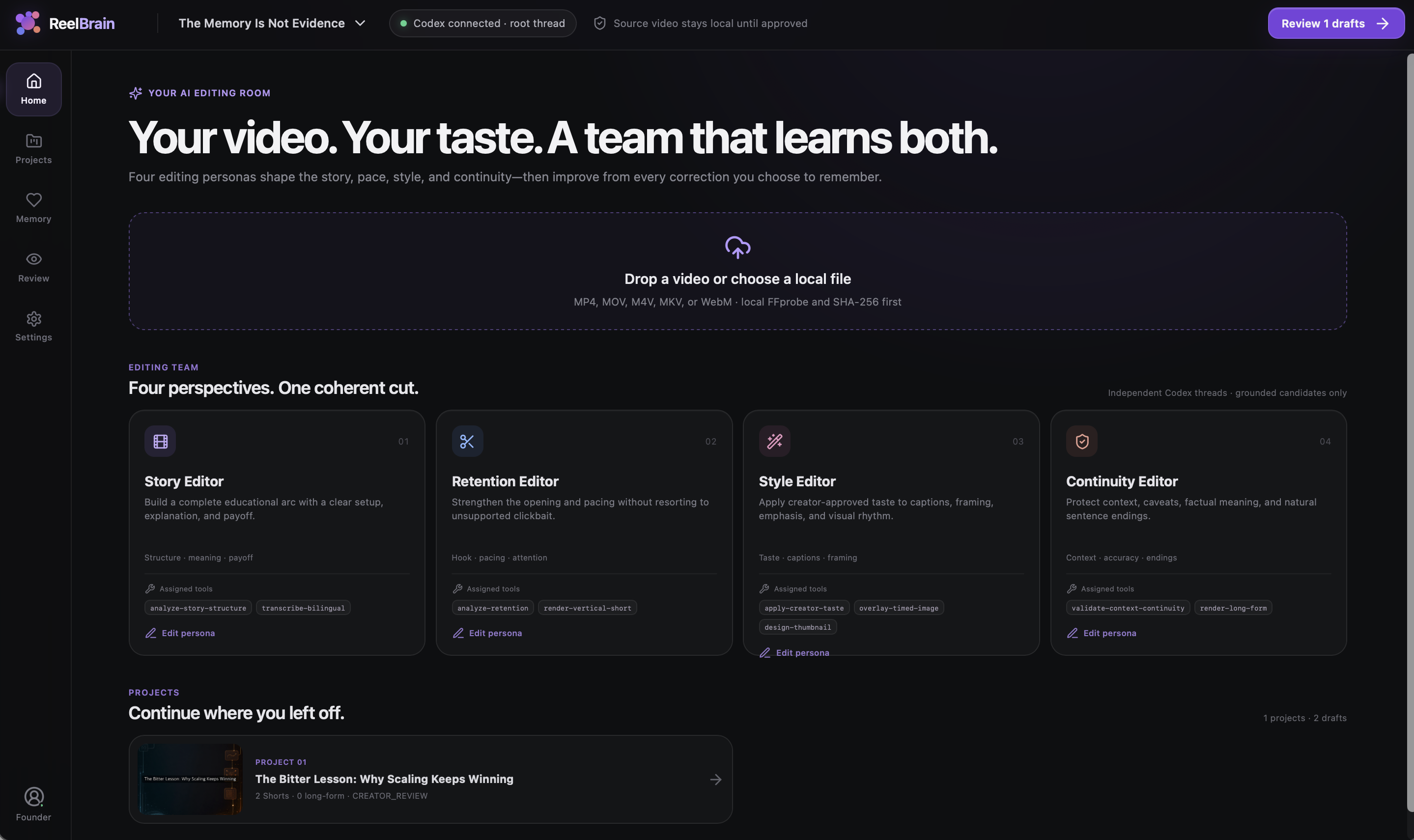
Home: Drop in a local video and let four specialized editors improve story, retention, style, and continuity.
-
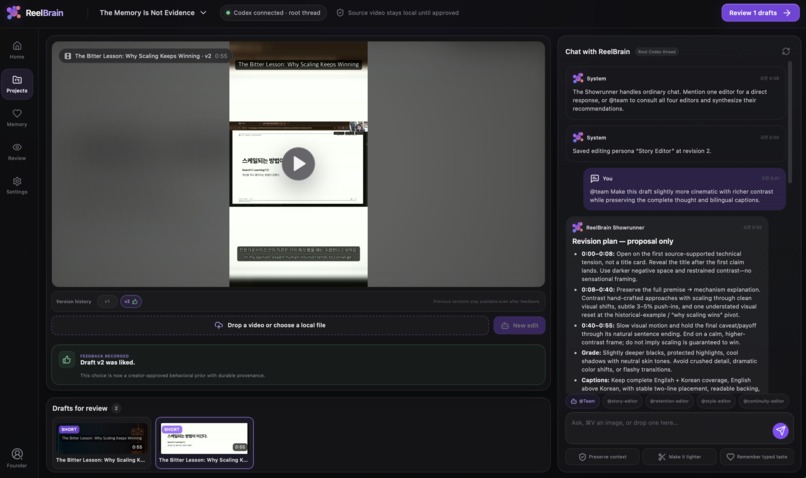
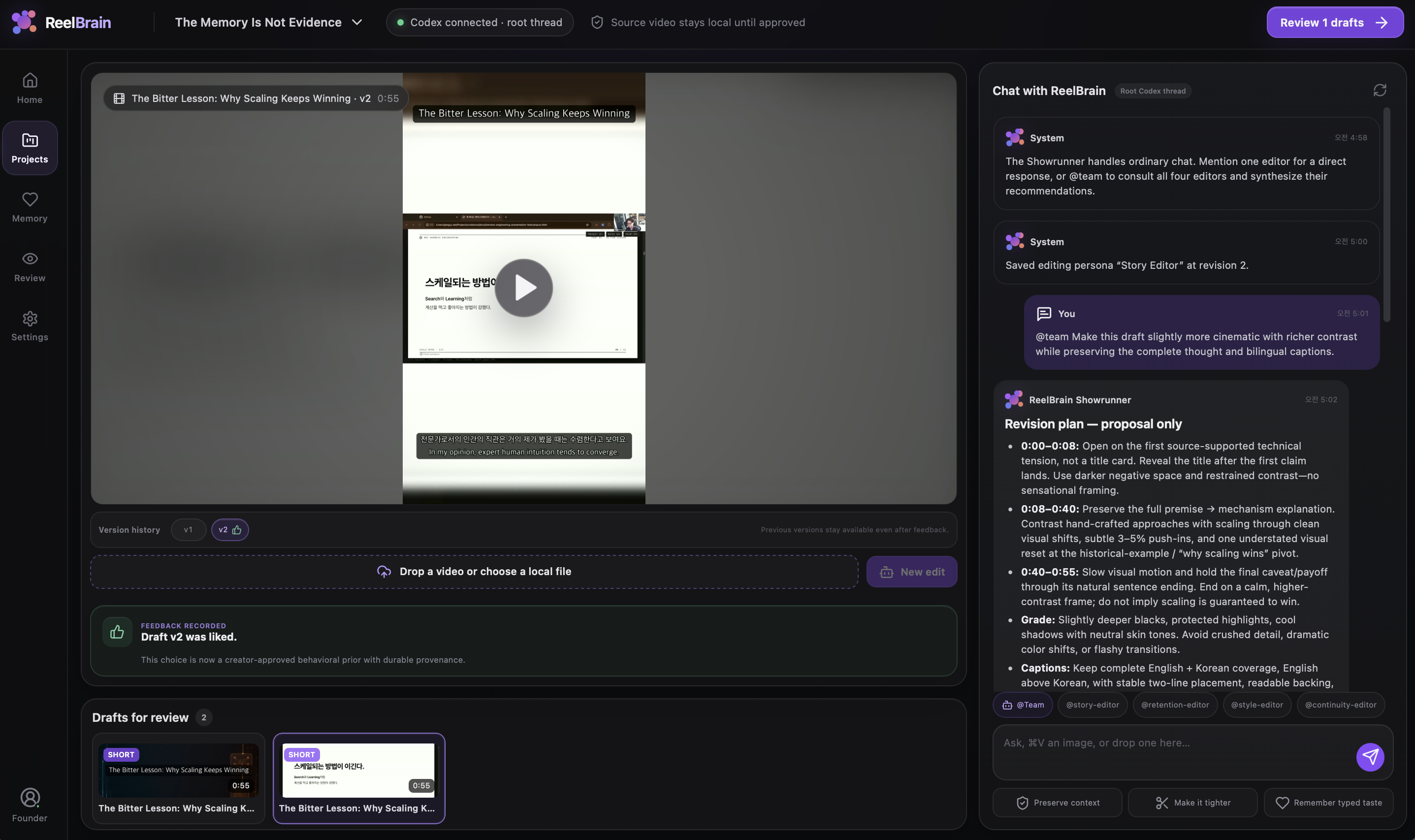
Project workspace: Chat with ReelBrain or ask all four editors to create a grounded revision plan together.
-
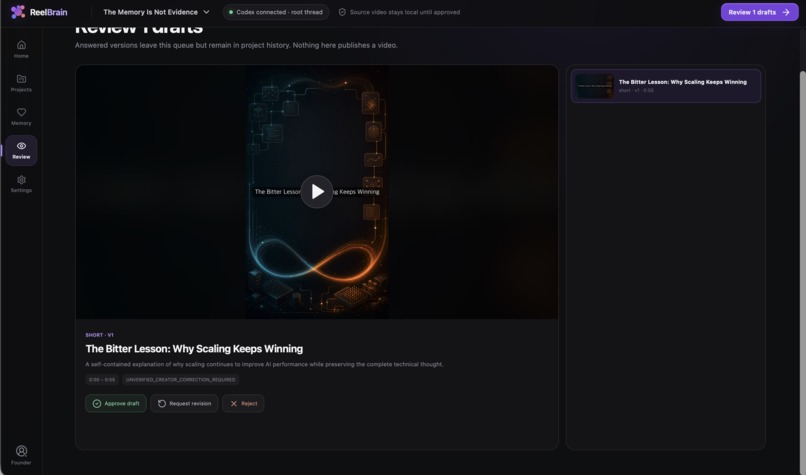
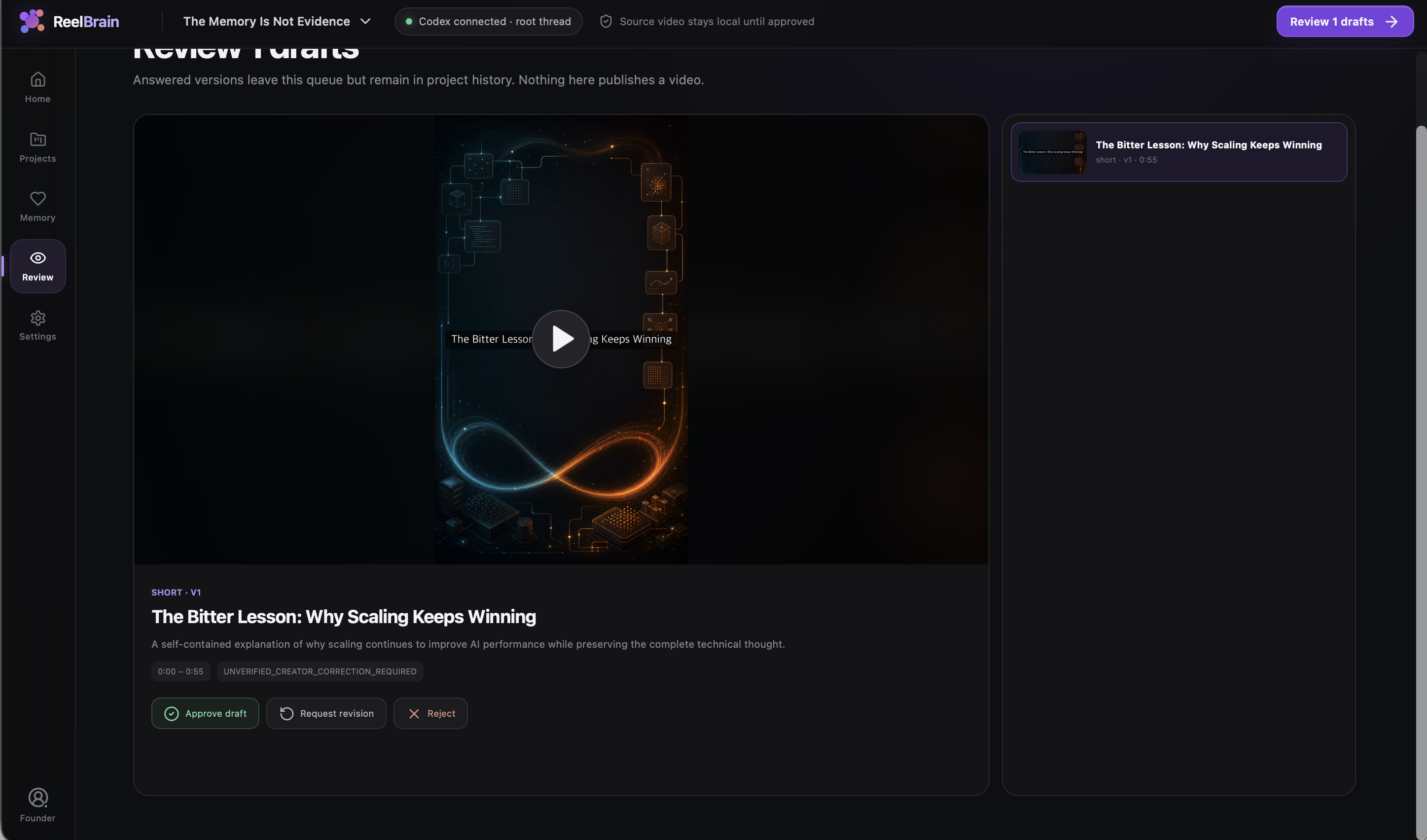
Review: Review every generated draft and approve, revise, or reject it before anything is published.
-
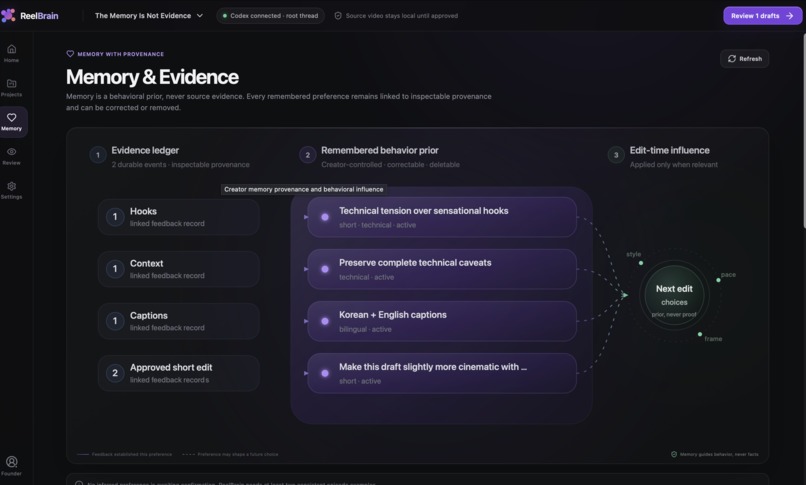
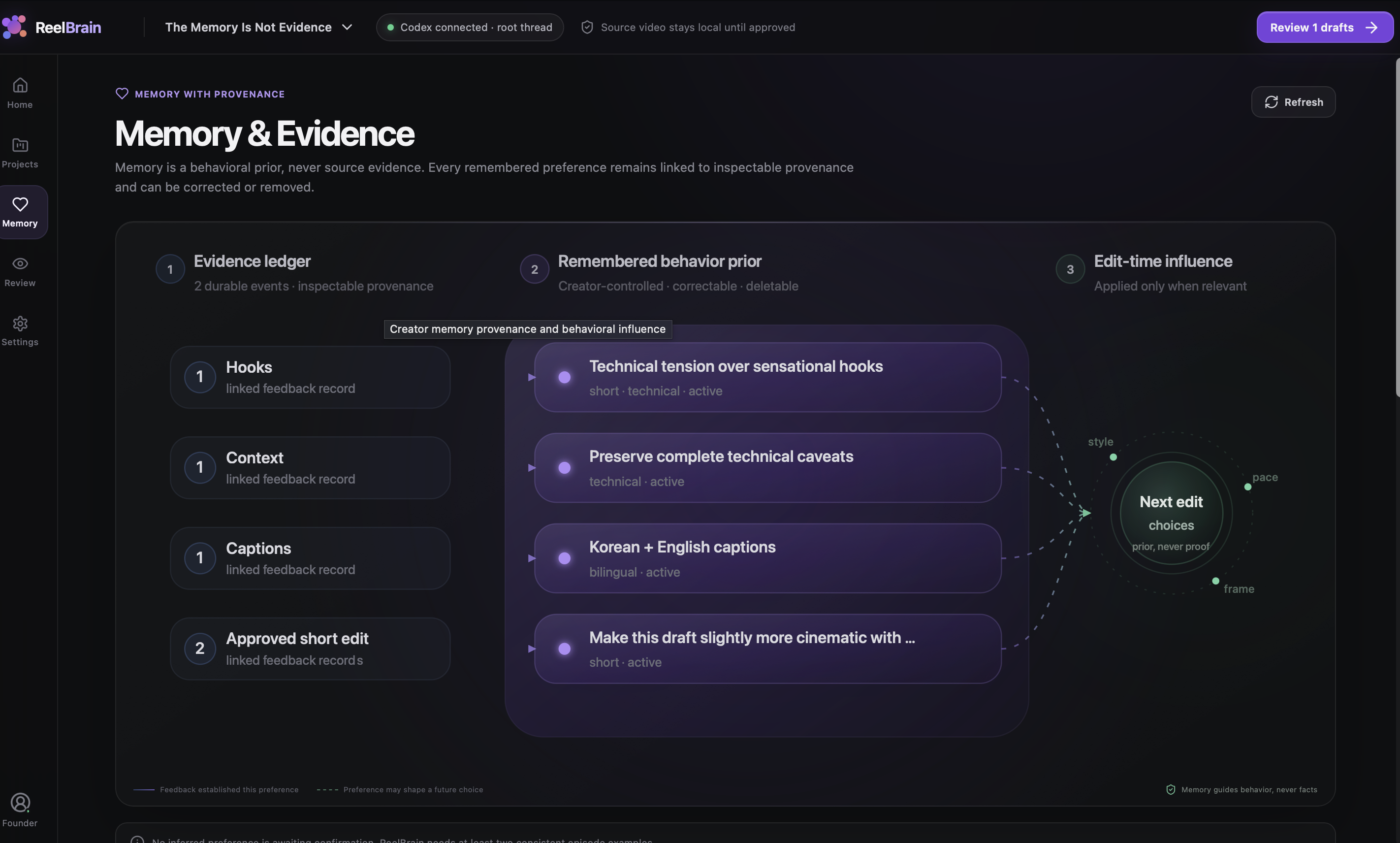
Memory & Evidence: Approved feedback becomes creator-controlled taste memory that guides future edits, never replacing evidence.
-
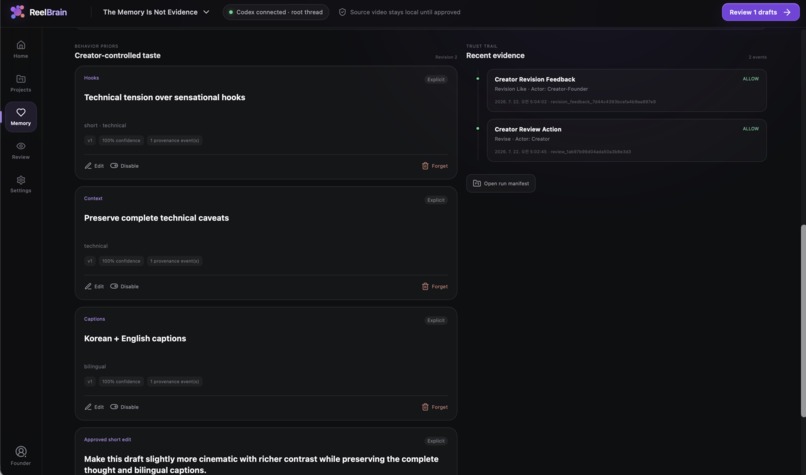
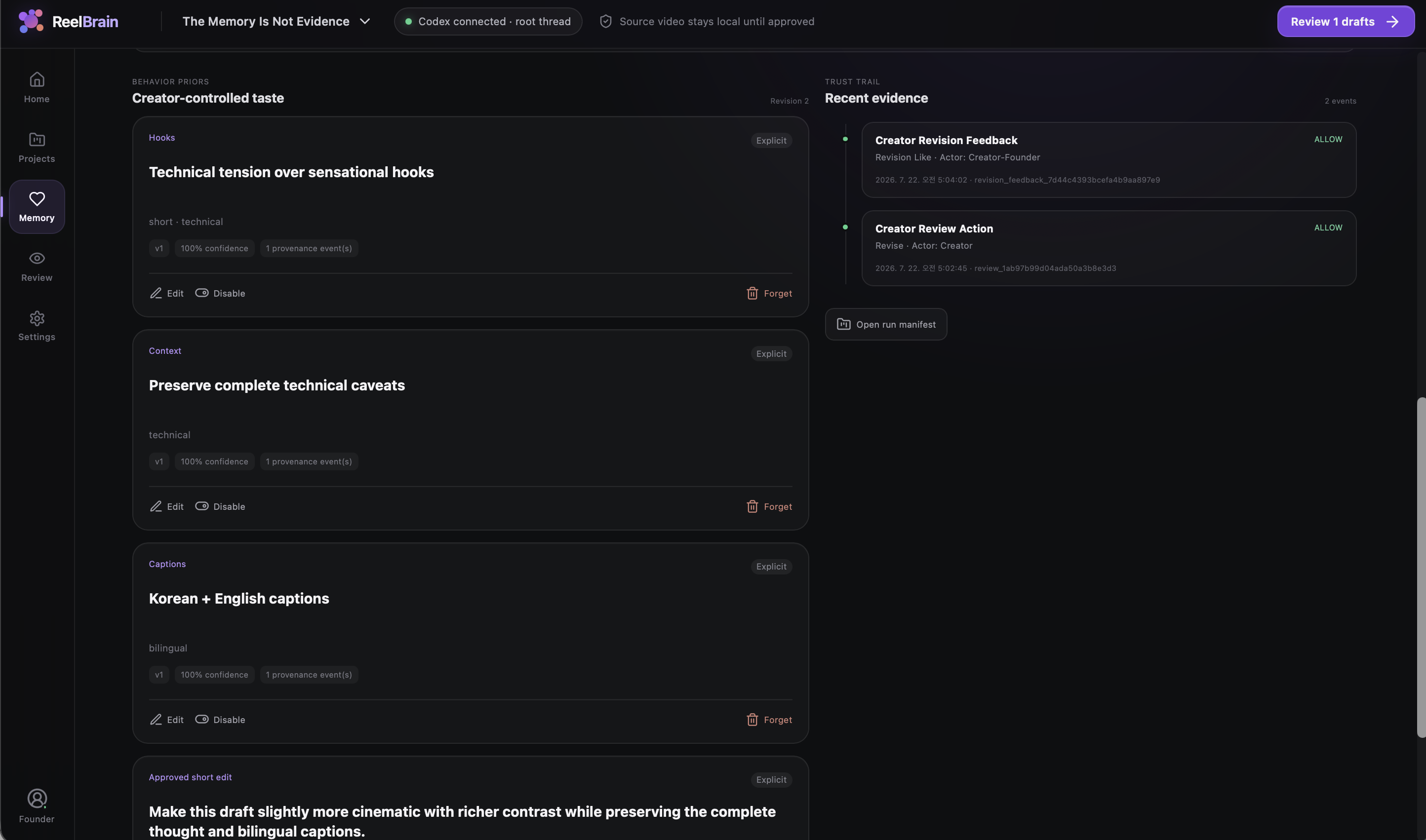
Memory Details: Inspect, edit, disable, or forget saved taste preferences and the evidence behind them.
-
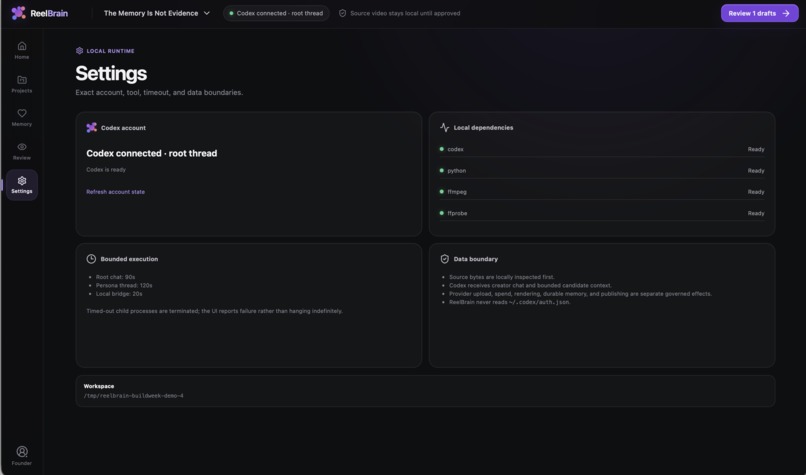
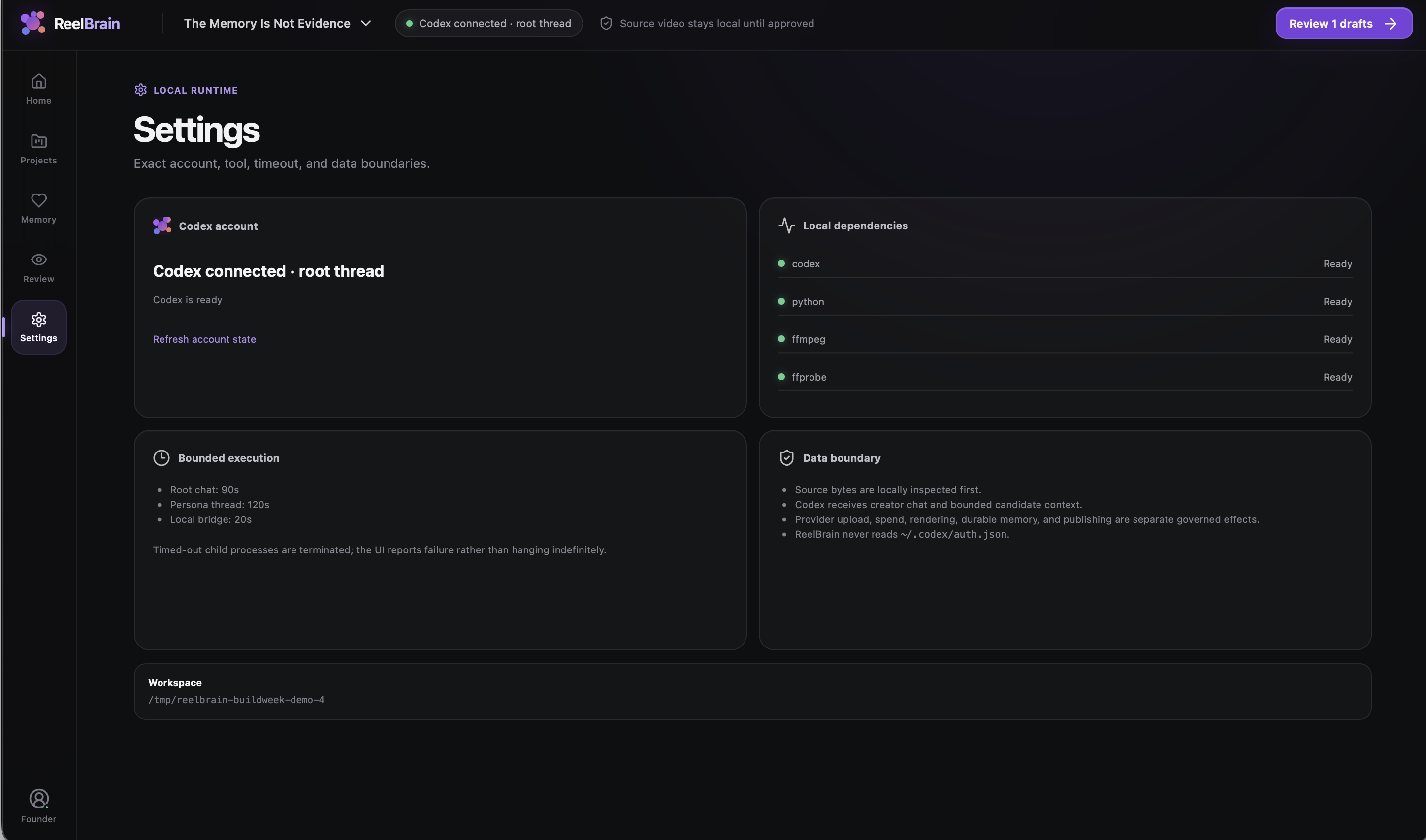
Settings: ReelBrain connects to Codex locally, with clear tool, timeout, and data boundaries.
Inspiration
Video editing tools remember files and timelines, but they rarely remember the creator.
Educational creators often repeat the same instructions for every new video: preserve the full caveat, avoid sensational hooks, keep the terminology precise, maintain natural pacing, and use a consistent caption style. Existing AI editors can generate clips quickly, but their decisions are often opaque. Creators cannot easily see why a moment was selected, whether important context was removed, or how their previous feedback influenced the result.
The problem becomes even harder when multiple AI agents are involved. More agents can produce more ideas, but they also introduce new questions:
- What did each agent see?
- What was each agent allowed to do?
- Did the edit come from the actual video?
- What happens when an agent exceeds its authority?
- How can the system learn a creator’s taste without silently accumulating unreliable memories?
We built ReelBrain around one principle:
Memory is a behavioral prior, not evidence.
ReelBrain can remember how a creator prefers to communicate, but every edit must still be supported by the source video. The creator remains in control of what is remembered, what is forgotten, and what reaches the final review.
What it does
ReelBrain is a desktop AI video-editing team that turns raw creator videos into grounded, personalized drafts.
The creator connects Codex, drops a local video into ReelBrain, and describes the desired direction through conversation. ReelBrain then prepares a timestamped catalog of real moments from the source and sends it to four specialized editorial agents:
- Meaning Scout finds self-contained explanations and valuable ideas.
- Hook Scout identifies compelling openings with a genuine payoff.
- Creator Advocate applies the creator’s approved style and preferences.
- Context Guardian rejects cuts that remove essential context or caveats.
Instead of inventing timestamps, the agents evaluate source-grounded candidate IDs prepared by ReelBrain. Their recommendations are combined and validated before any draft is rendered.
From one raw video, ReelBrain can produce:
- short-form video candidates;
- a coherent long-form draft;
- Korean and English captions;
- generated thumbnails and title treatments;
- explanations for why each moment was selected;
- a local package prepared for creator review.
Creators can steer the process through natural conversation. They can ask ReelBrain to preserve context, tighten an edit, explain a decision, or remember a preference.
The Your Taste workspace shows exactly what ReelBrain has learned. Preferences can be inspected, edited, disabled, or deleted. One-time feedback remains specific to the current project unless the creator explicitly asks ReelBrain to remember it.
ReelBrain does not automatically publish its results. Every output stops at creator review.
How we built it
We divided ReelBrain into two complementary layers.
Codex manages the creative collaboration. It runs the specialized editorial agents, coordinates their independent perspectives, and supports the conversational experience through which the creator directs the edit.
ReelBrain manages trust and durable state. It owns the source-grounded candidate catalog, permissions, creator-approved memory, validation rules, evidence records, and rendering process.
The desktop application is built with Tauri and React. It connects to Codex for agent orchestration and to a local Python runtime for media analysis, governance, memory, and rendering.
Our video pipeline uses FFmpeg, FFprobe, and Pillow. Videos are processed locally, and creator files remain on the creator’s Mac. ReelBrain produces deterministic video outputs, subtitle files, caption overlays, thumbnails, and review manifests.
Each editorial agent receives a limited permission envelope defining:
- which task it may perform;
- which source candidates it may inspect;
- which creator preferences it may use;
- which tools and file paths it may access;
- how long its permission remains valid;
- which version of the workflow it belongs to.
ReelBrain verifies these permissions whenever an agent requests a controlled action. If an agent attempts something outside its authority, the action is blocked before it can have an effect, and a denial receipt is added to the evidence trail.
We also version the creator’s instructions and taste snapshot. When the creator changes direction, results generated under the previous direction become stale and are rejected.
Rendering is permitted only after ReelBrain validates an accepted editorial plan. This connects every final draft to its source material, agent recommendations, creator preferences, and permission history.
Challenges we ran into
Making multi-agent editing trustworthy
Running several agents was the easy part. The harder problem was ensuring that their recommendations remained grounded, observable, and controllable.
We prevented agents from inventing edit boundaries by having ReelBrain create the timestamped source catalog first. Agents rank and explain real candidate IDs rather than generating arbitrary timestamps.
Separating creativity from authority
We wanted agents to explore different editorial perspectives without giving every agent unrestricted control over the system.
We introduced limited permission envelopes for each agent. This lets an agent reason creatively while ReelBrain remains responsible for validating and authorizing real effects.
Preventing stale work
Creators frequently change direction during editing. A suggestion may be technically valid but no longer relevant after the creator provides new guidance.
We created workflow versions and snapshot digests that connect each result to the exact source, instructions, and creator preferences used to produce it. Results from an older version are rejected instead of silently overwriting the creator’s latest direction.
Learning taste without memory poisoning
Automatically treating every interaction as a permanent preference would make personalization unpredictable.
ReelBrain separates temporary project feedback from durable memory. Explicit “remember this” requests can become lasting preferences, while inferred patterns require repeated evidence and creator confirmation.
Preserving context in short-form edits
A compelling sentence is not necessarily a safe or accurate clip. Educational content often depends on qualifications, definitions, and surrounding explanation.
We created Context Guardian specifically to identify cuts that are attractive in isolation but incomplete or misleading without their surrounding context.
Rendering multilingual captions consistently
FFmpeg environments do not always provide identical text-rendering capabilities. We used Pillow to generate exact Korean and English text overlays and composited them through FFmpeg, while preserving separate subtitle files for portability.
Accomplishments that we're proud of
- We built a working four-agent editorial workflow rather than simulating multiple personas inside a single prompt.
- Every proposed edit is connected to a real source segment and timestamp.
- Creators can see the different editorial perspectives working on their video in real time.
- Unauthorized agent actions are blocked before execution and recorded as visible evidence.
- ReelBrain rejects work created before the creator’s latest change of direction.
- Creator taste is explicit, scoped, editable, disableable, and deletable.
- Preferences influence editorial behavior without being treated as factual evidence about the source.
- Rendering happens locally, keeping creator files on their machine.
- We connected the full process—from source ingestion to final review package—through an inspectable evidence trail.
- We translated a complex agent architecture into a simple experience: connect Codex, drop a video, and talk to your editing team.
Most importantly, we built ReelBrain so creators do not have to choose between personalization and control.
What we learned
The number of agents is not the moat.
What matters is whether those agents are grounded in real source material, whether their permissions are enforceable, whether their actions can be inspected, and whether the creator remains in control of what the system learns.
We also learned that memory should be designed as a visible product experience rather than a hidden model feature. When creators can inspect and correct what the system believes about their taste, personalization becomes trustworthy instead of mysterious.
Another important lesson was that orchestration and governance should not be owned by the same layer. Codex is well suited to running collaborative agent workflows. ReelBrain is responsible for preserving ground truth, enforcing permissions, managing creator-approved memory, and validating real effects.
Finally, we learned that good AI editing is not simply about finding the most exciting sentence. For educational creators, preserving meaning, uncertainty, and context is part of the creative work.
What's next for ReelBrain
Our next step is to move ReelBrain from a powerful review workspace into a complete, creator-centered editing environment.
We plan to add:
- interactive timeline refinement and manual boundary adjustment;
- stronger support for interviews, podcasts, tutorials, and screen recordings;
- cross-project search across approved source evidence;
- reusable taste profiles for different channels and audiences;
- collaborative review for editors, producers, and subject-matter experts;
- deeper explanations of why candidates were selected or rejected;
- comparison tools that show how a new direction changes the edit;
- optional integrations with existing professional editing workflows;
- privacy-preserving export and import of creator taste;
- more specialized agents for pacing, visual storytelling, captions, and accessibility.
We also want to explore how ReelBrain’s governance model can extend beyond video editing. Any creative AI system that acts through multiple agents will need grounded inputs, limited authority, reversible memory, stale-work protection, and inspectable evidence.
Our long-term vision is not an editor that replaces the creator.
It is an AI editing team that understands the creator better over time—while remaining transparent, correctable, and firmly under their control.
Built With
- codex
- python
- react
- rust
- tauri
- typescript


Log in or sign up for Devpost to join the conversation.