Inspiration
The contemporary domestic culinary landscape has experienced a profound paradigm shift, effectively appointing the short-form social video feed as the modern kitchen's digital sous-chef. Millions of creators publish high-engagement culinary content across TikTok, Instagram Reels, and YouTube Shorts daily, inadvertently serving as the primary source of meal discovery for modern households. However, a structural friction point exists between content consumption and execution: translating a volatile, fast-paced 30-second entertainment clip into an actionable kitchen routine remains fundamentally broken.
Users systematically encounter high cognitive load and process fragmentation. Valuable recipe details are lost inside saturated, unindexed saved folders; tracking aggregate macro- and micro-nutrients across disconnected video sources is practically impossible without tedious manual logging; and during physical preparation, cooks are forced into a disruptive loop—repeatedly cleansing their hands of raw ingredients to manually pause, rewind, and re-watch brief video frames on their mobile screens.
We engineered "reel to meal" to eliminate this friction. By introducing a unified interface layer between bite-sized micro-entertainment and physical culinary choreography, our application seamlessly normalizes unstructured video content into highly systematic, predictable, and data-driven meal orchestration pipelines.
What it does
"reel to meal" functions as a premium, highly reactive single-page client application engineered to programmatically isolate, clean, and map unstructured social video parameters into high-fidelity nutritional telemetry and progressive workspace checklist guides.
The user journey is structured across three core viewport domains:
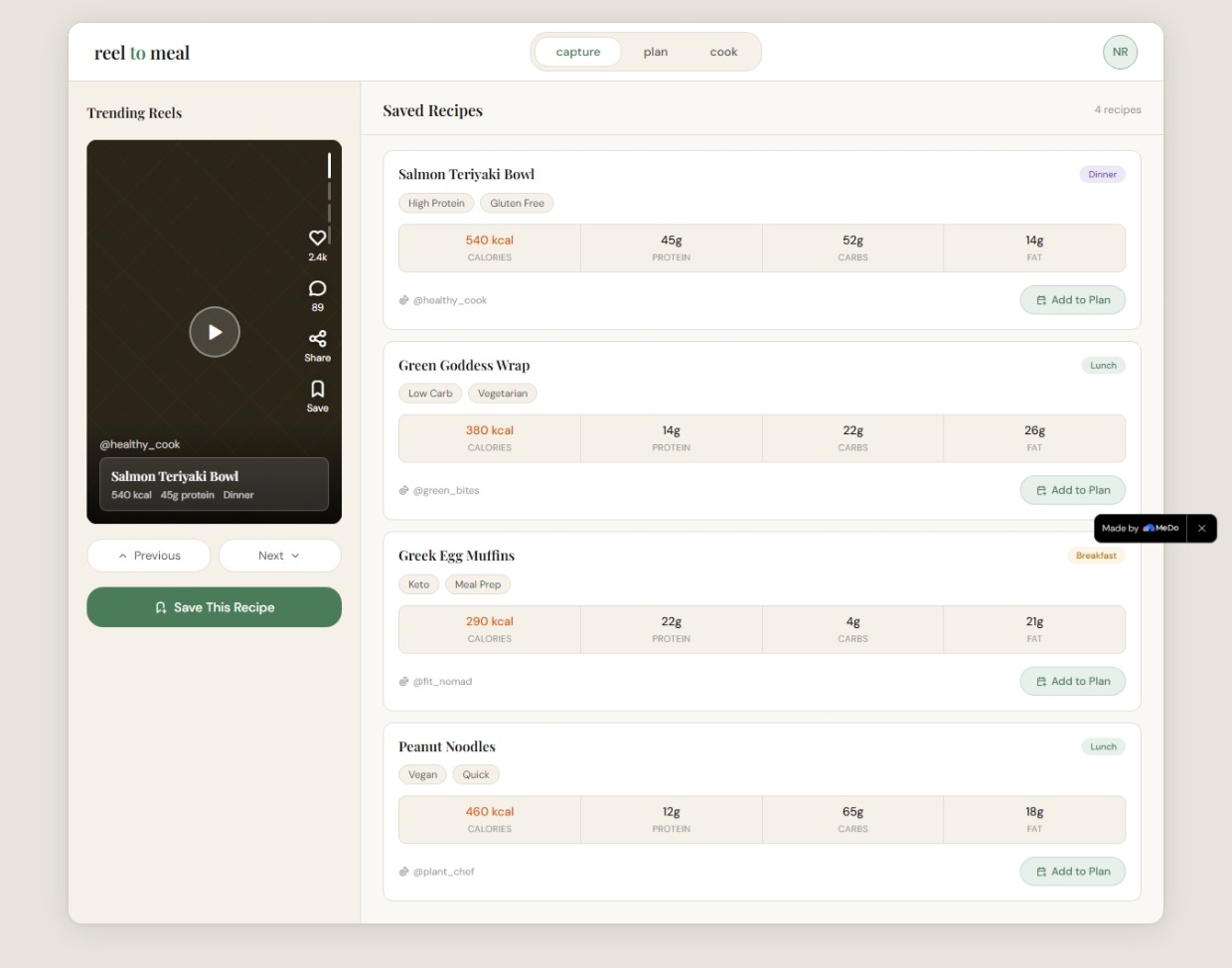
- Capture & Extraction Interface: A layout containing an optimized media feed panel adjacent to a dynamic parsing sandbox. When a social URL is injected, the application processes the content metadata, isolates precise macro-nutrient metrics (Calories, Protein, Carbohydrates, Lipids), structuralizes the underlying ingredient string arrays, and appends the product to a localized, immutable client asset library.
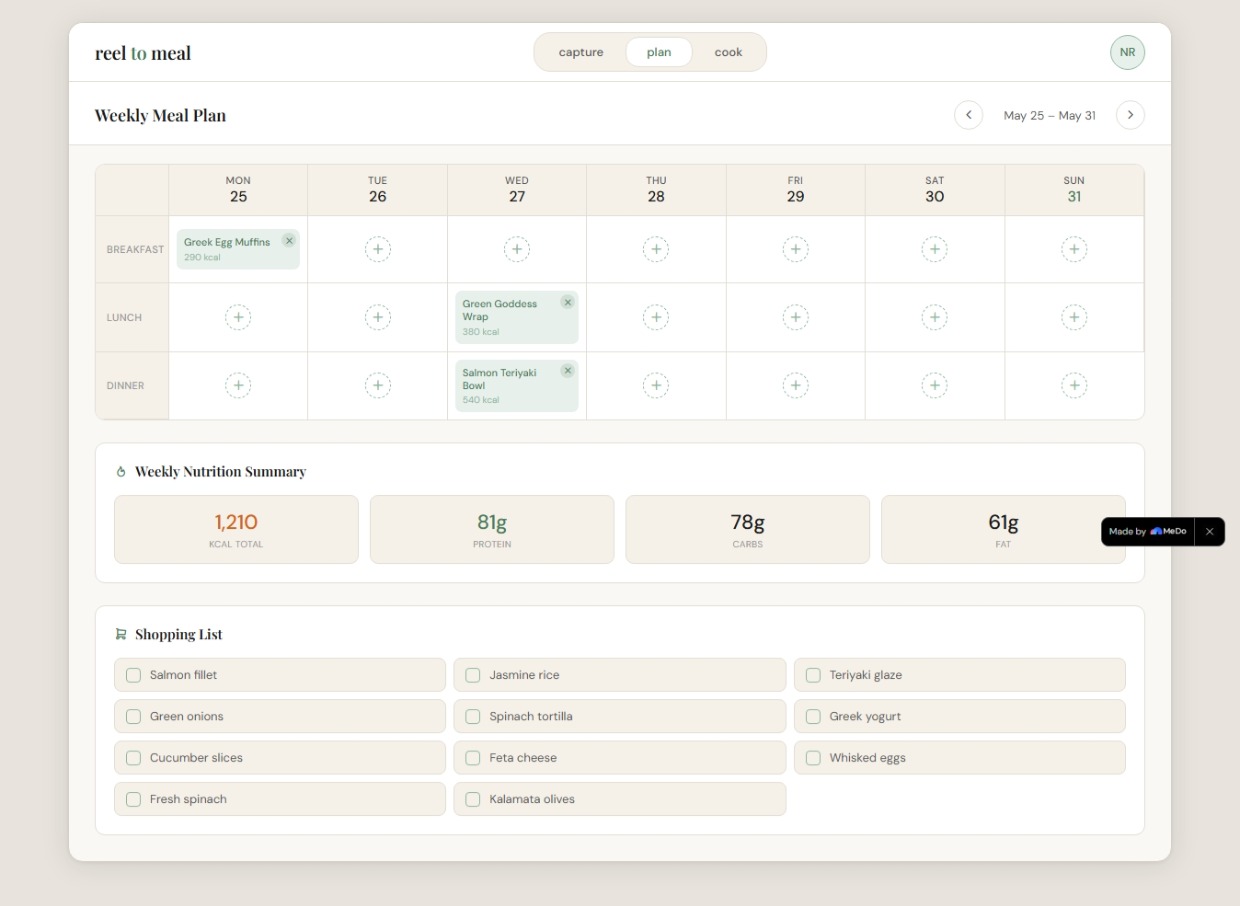
- Weekly Dashboard & Scheduling Engine: A highly dense temporal grid structured strictly via custom CSS Grid properties layout specs to align Breakfast, Lunch, and Dinner rows against a 7-day cyclical horizon. The engine automatically computes moving nutritional sums on the fly as slots are bound, highlights the current calendar column (Wednesday) with a targeted Terracotta aesthetic marker, and programmatically computes a deduplicated, multi-recipe master ingredient shopping matrix.
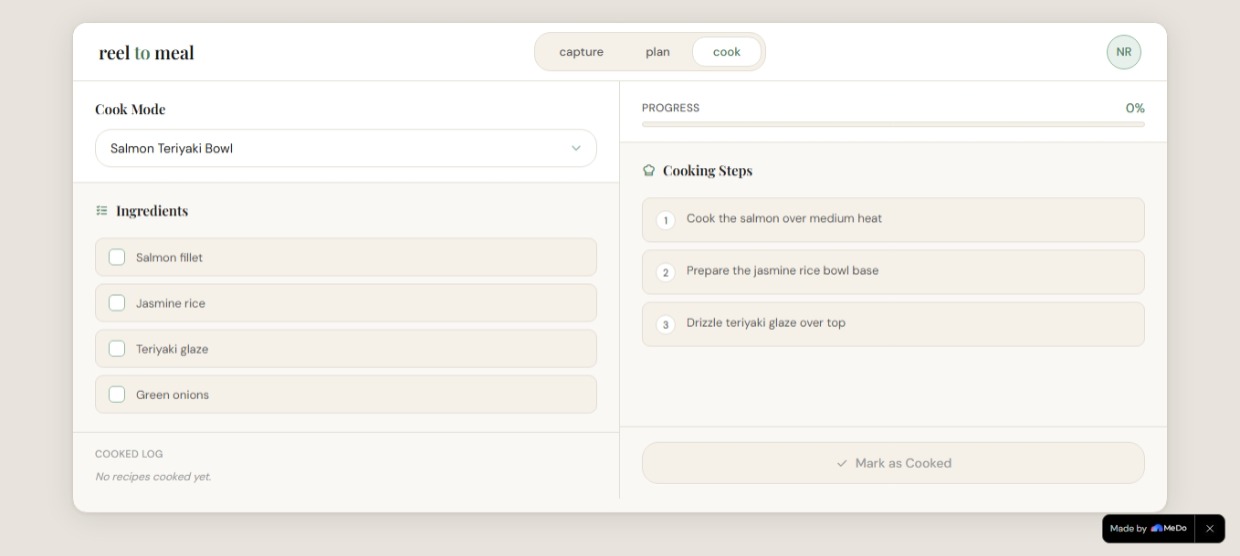
- Interactive Active Cook Studio: A specialized operational viewport that transforms the application into an immersive, hands-free "Kitchen Mode." The space deploys an asymmetric split-pane workspace layout: the left terminal locks a persistent video loop context, while the right terminal serves an indexed step-by-step technical checklist. Mutating the checked states drives a real-time kitchen progress bar using custom fractions, dynamically logs operational time stamps, and updates the parent calendar framework with persistent completion states.
How we built it
To achieve maximum rendering velocity, minimize main-thread execution latencies, and bypass the overhead associated with heavy framework hydration loops, "reel to meal" was built entirely upon a self-contained, lightweight vanilla architecture with zero external dependency compilation:
- Semantic Layout Frame.
- Scoped Design System.
- Reactive Client State Machine.
- Iconography Pipeline: All graphic markers, actions, and operational triggers are integrated uniformly using the Tabler Icons webfont configuration layout.
Challenges we ran into
- State Continuity and Tab Persistence: A significant architectural hurdle involved maintaining structural state fidelity across aggressive view changes. For instance, if a cook checked multiple operational steps inside the Cook terminal, or began staging an item allocation inside the calendar, switching tabs would historically risk tearing down the unmounted DOM trees and purging temporary data modifications. We resolved this by abstracting all temporary state variables entirely out of the UI presentation layer, binding them instead to decoupled, deep-nested tracking indices inside our global JavaScript object cache prior to executing view re-render pipelines.
- Multi-Source Array Parsing and Ingredient Normalization: Auto-generating a clean shopping list introduced data integrity complexities. Different recipe objects frequently capture identical raw ingredients with distinct volumetric formats, string prefixes, or alternate wording conventions. To mitigate messy duplicate entries within the grocery matrix, we implemented a sanitization routine that systematically traverses the selected weekly plan coordinates, extracts active ingredient entries, flattens the multidimensional records into a unified JavaScript Set primitive for automated string deduplication, and binds local checkbox booleans to independent keys without mutating the underlying immutable recipe definitions.
Accomplishments that we're proud of
- Zero-Latency Tab Transition Mechanics: Designing a client-side layout router that achieves instantaneous view snapping with zero asset flickering, DOM layout shifts, or rendering pipeline bottlenecks.
- Precision Tabular CSS Matrix Alignment: Engineering a watertight mathematical calendar grid (
grid-template-columns: 65px repeat(7, 1fr)) that preserves rigid textual boundary truncation and content centering even during high density data variations across the three temporal meal rows. - Dynamic Fluid Layout Optimization: Establishing a breakout CSS media-query architecture that detects screen dimensions scaling down below the 640px viewport threshold, instantly collapsing the complex dual-pane layout into a stacked vertical interface that locks the streaming media pane at the apex while prioritizing the checklist array directly below for mobile ergonomics.
What we learned
- The Optimizations of Dependency-Free Development: Authoring custom modal dialog structures, state machines, and aggregate mathematical summary dashboards using pure native DOM interfaces highlighted the performance benefits of bypassing massive modern framework dependency layers. It proved that minimal vanilla code paths can yield unmatched UI snappiness and lightweight payload metrics.
- High-Fidelity UX via Minimalist Styling Paradigms: Eliminating visual flourishes like multi-layered drop shadows, micro-gradients, and background filters forced a heavy reliance on clean typography scaling, precise grid column geometry, and strict whitespace rules to successfully establish an elite, authoritative, and accessible lifestyle product brand identity.
What's next for Reel To Meal
- Machine-Vision Recipe Ingestion: Moving past static pre-populated extraction objects by implementing native LLM-driven multimodal processing layers capable of analyzing raw social video streams, evaluating visual overlay text frames, and synthesising procedural cooking step arrays dynamically.
- Automated API-Driven Merchant Logistics: Developing automated merchant export protocols that allow users to dispatch their auto-deduplicated weekly shopping arrays directly into external localized on-demand grocery fulfillment APIs (e.g., Instacart, Amazon Fresh) with single-click precision.
- Hands-Free Acoustic Telemetry Controls: Integrating native browser Web Speech and audio re
Built With
- medo
- tailwind-css
- vite

Log in or sign up for Devpost to join the conversation.