-
-
01_opening poster
-
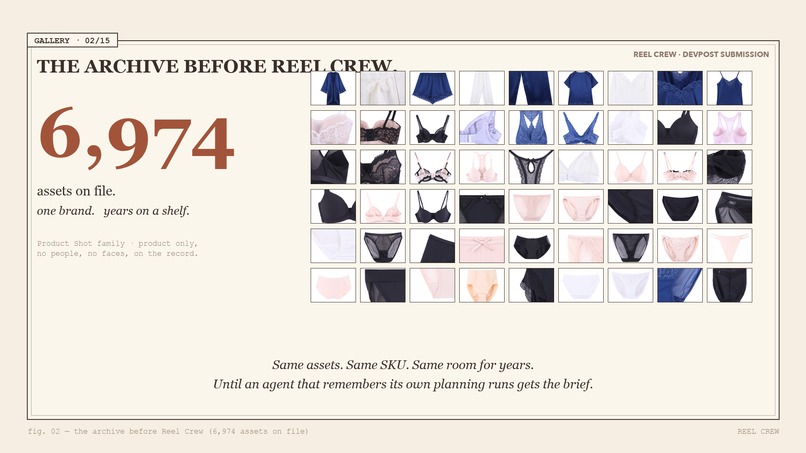
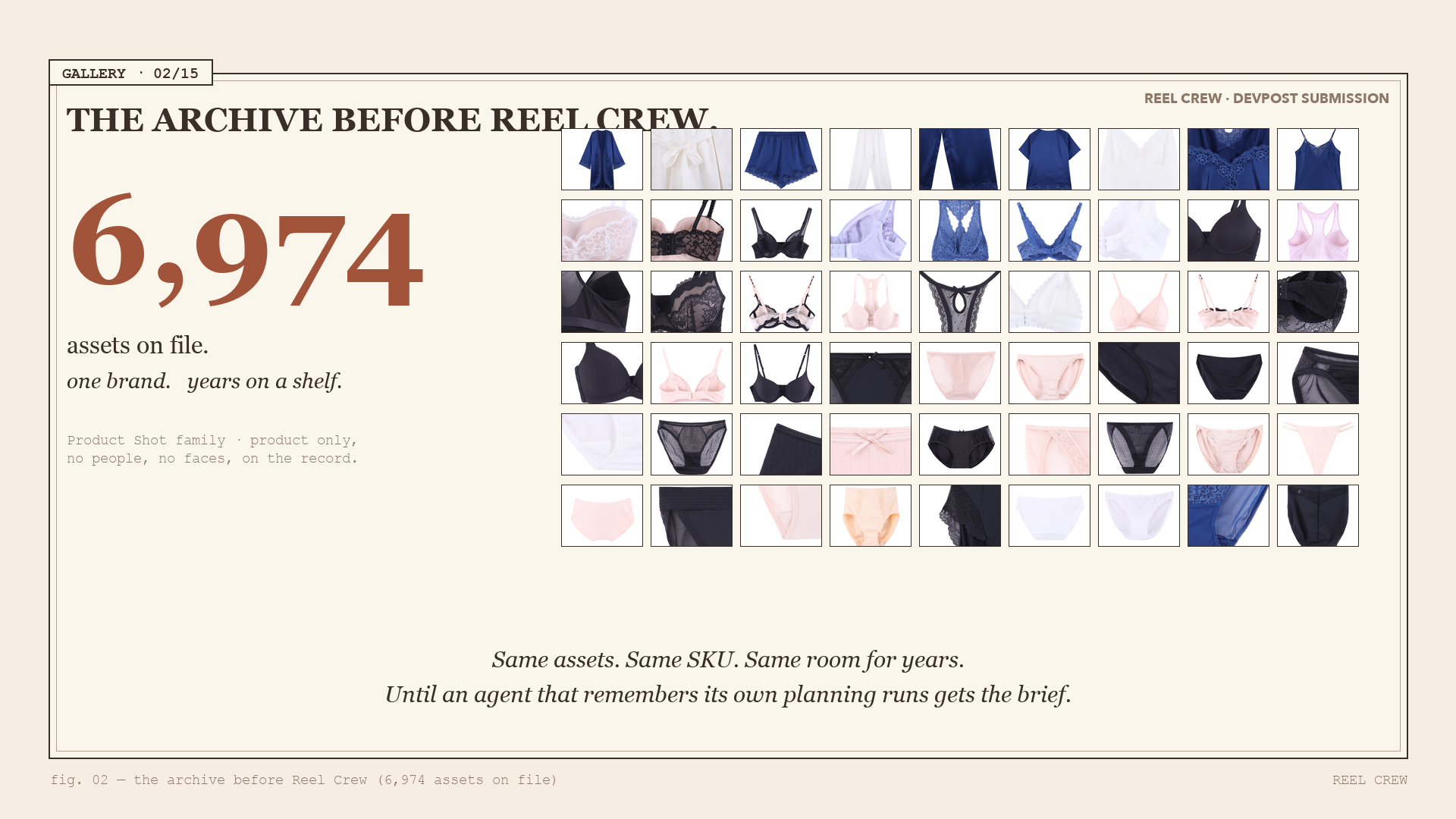
02_the archive before
-
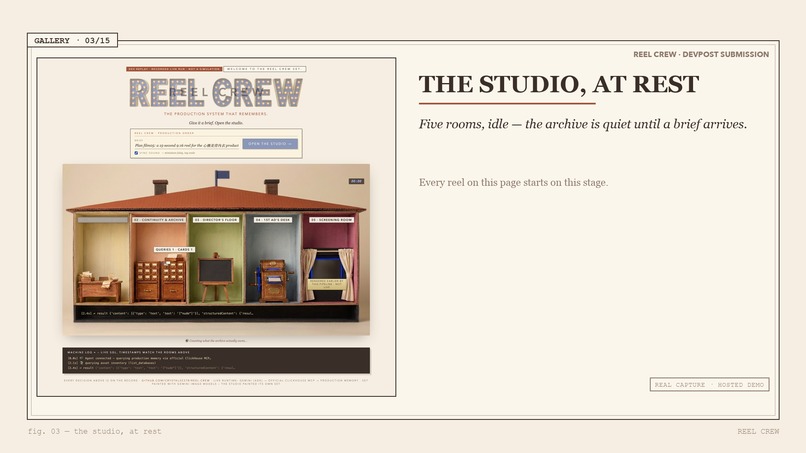
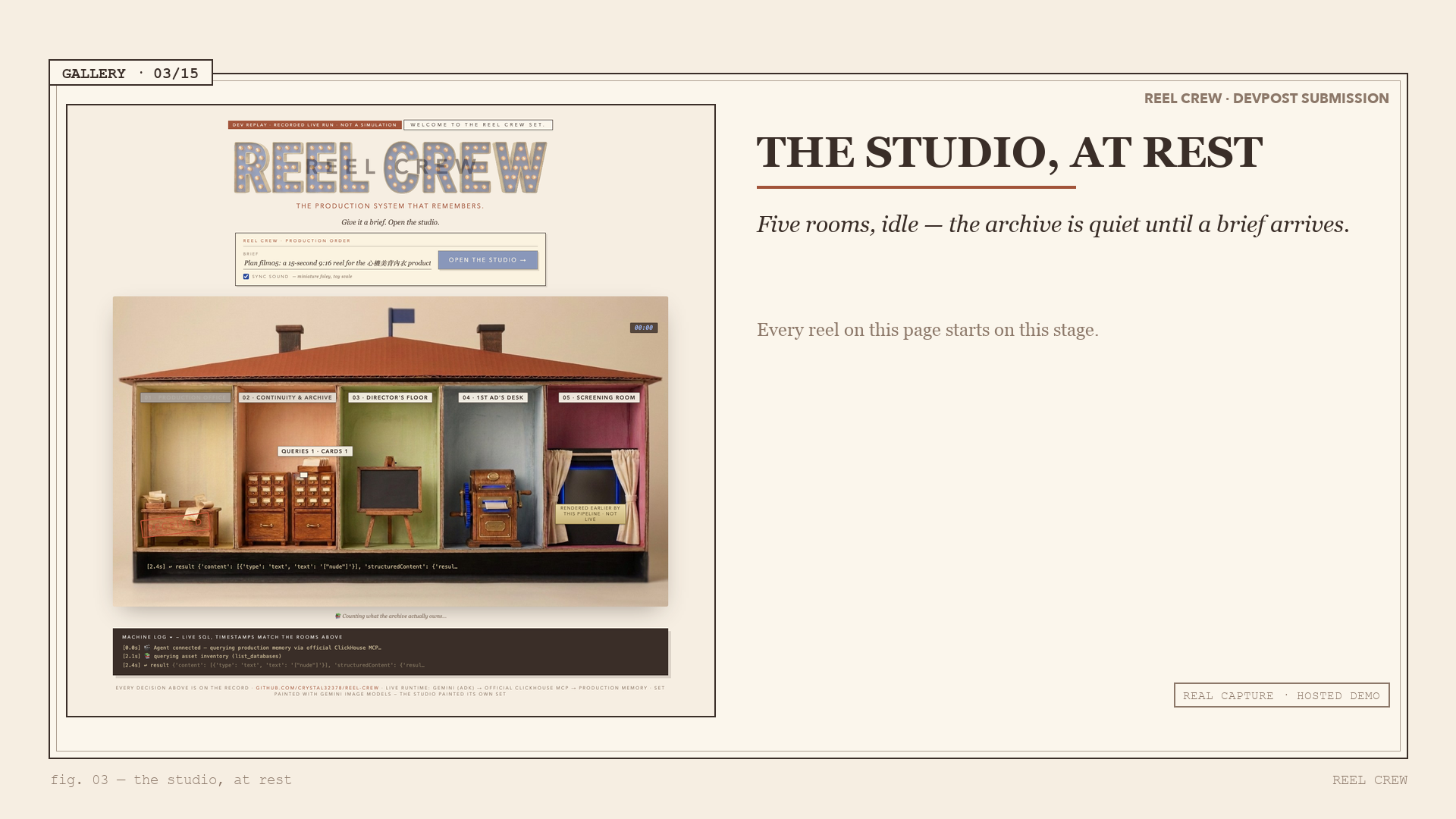
03_studio at rest
-
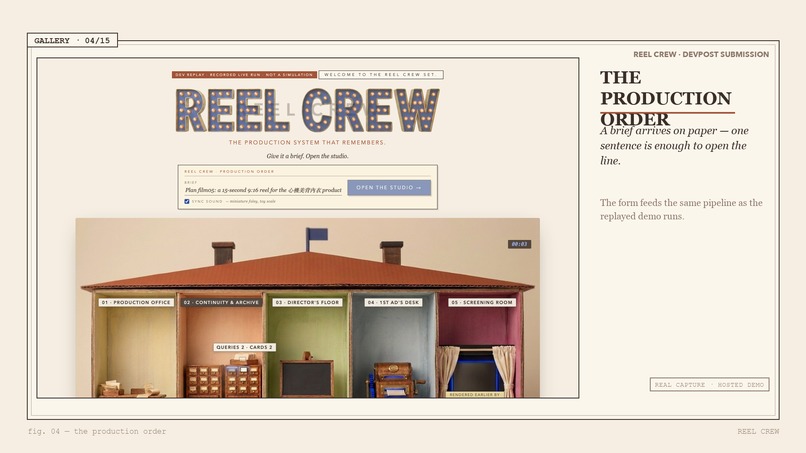
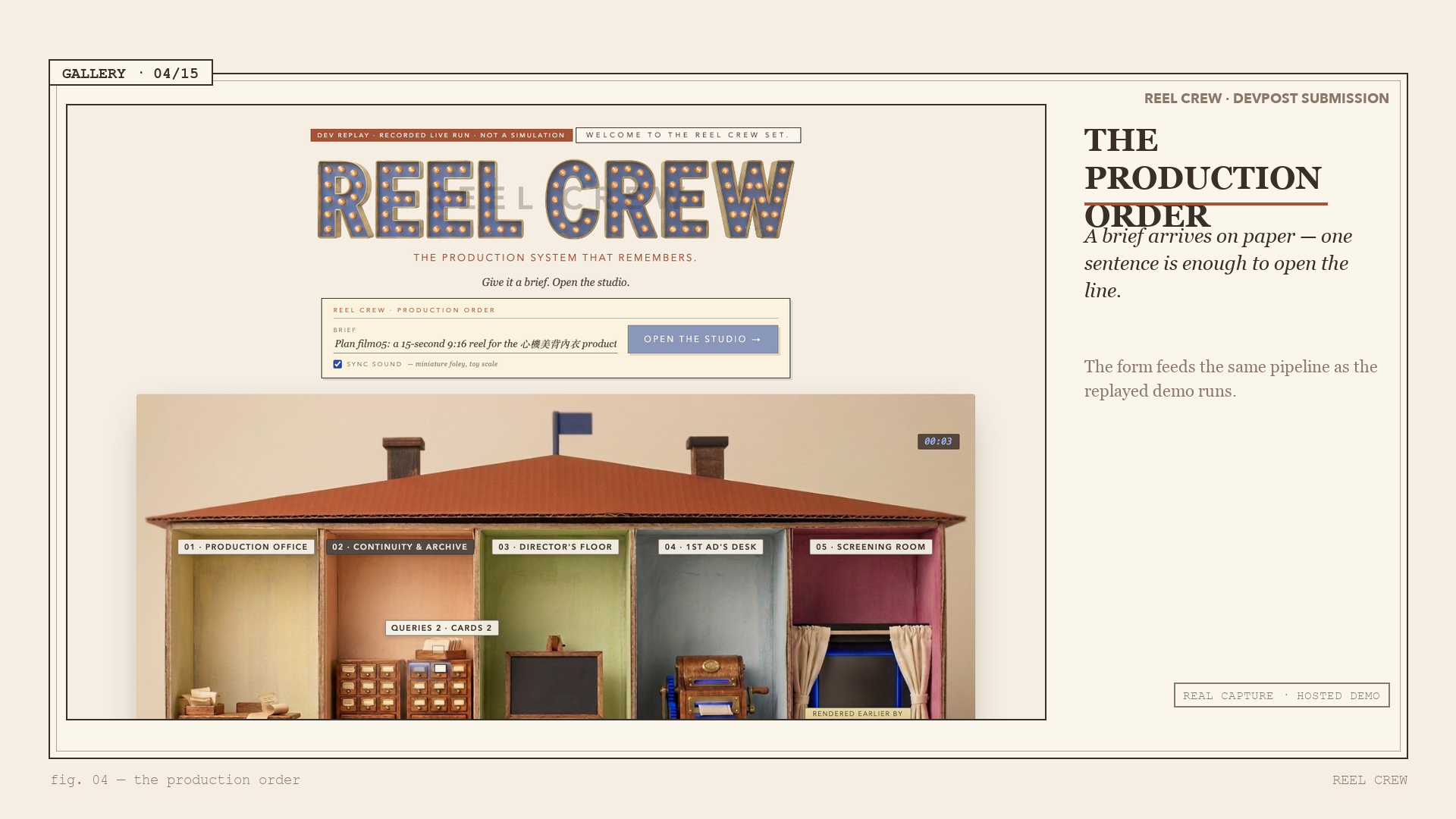
04_production order
-
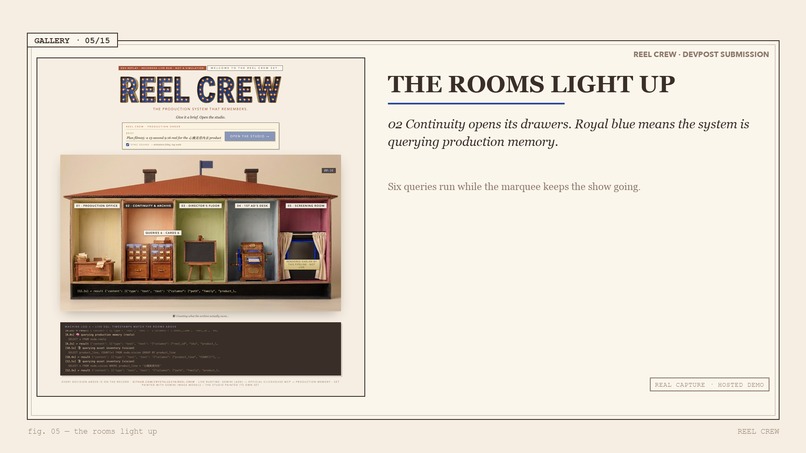
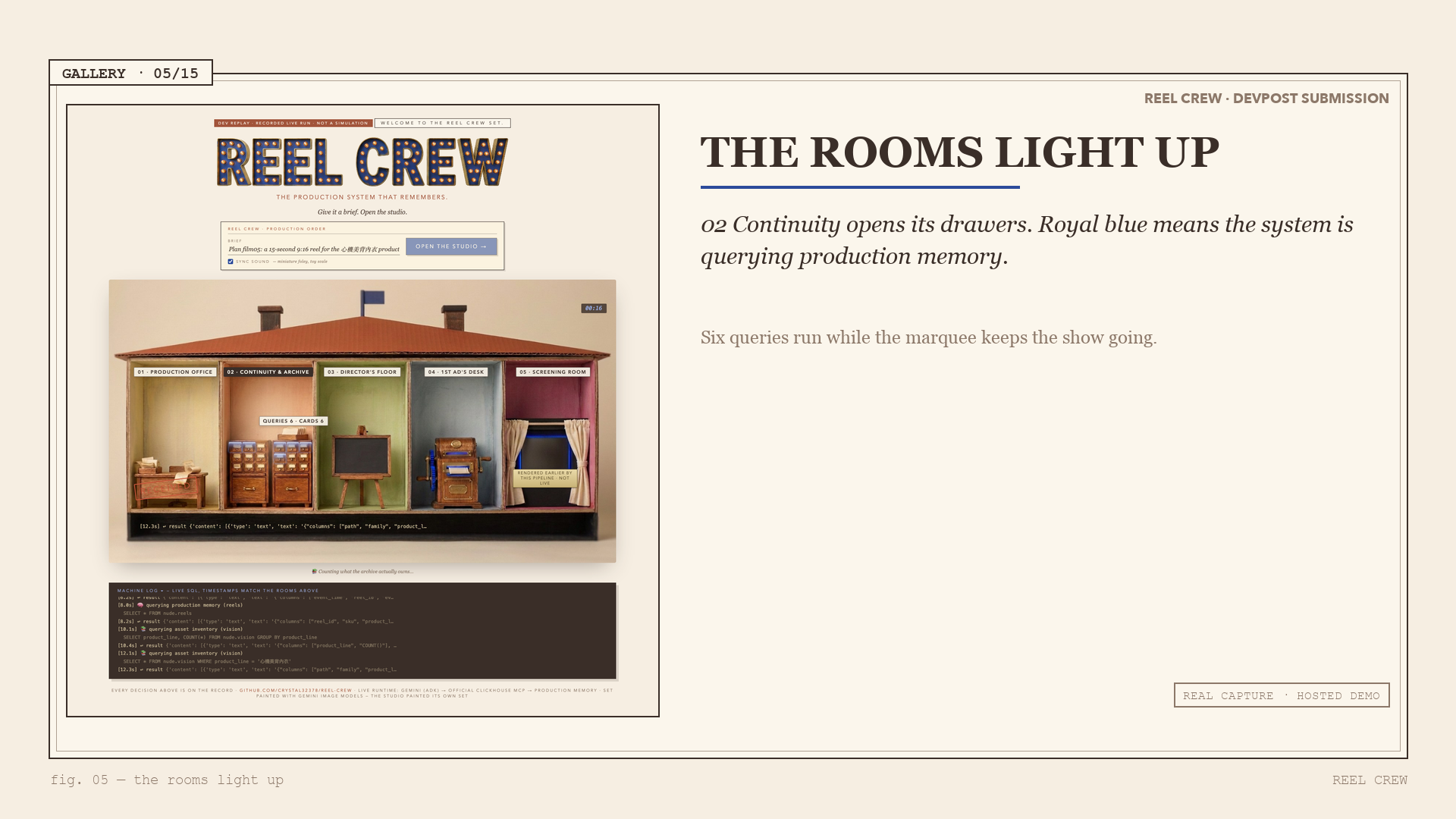
05_room lineup
-
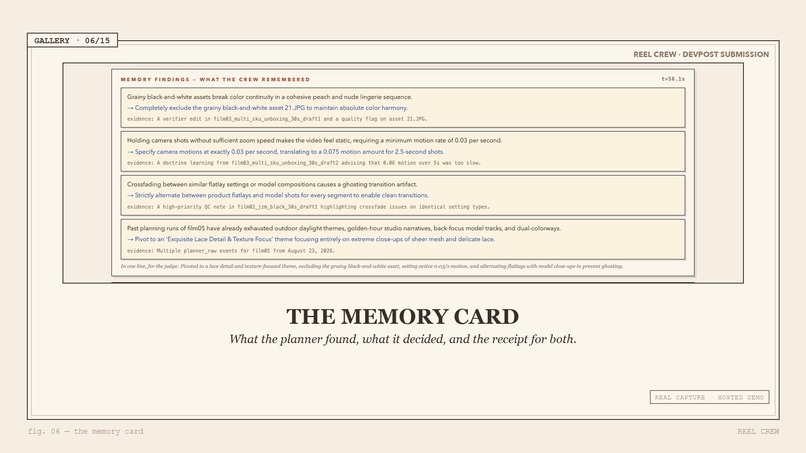
06_memory card
-
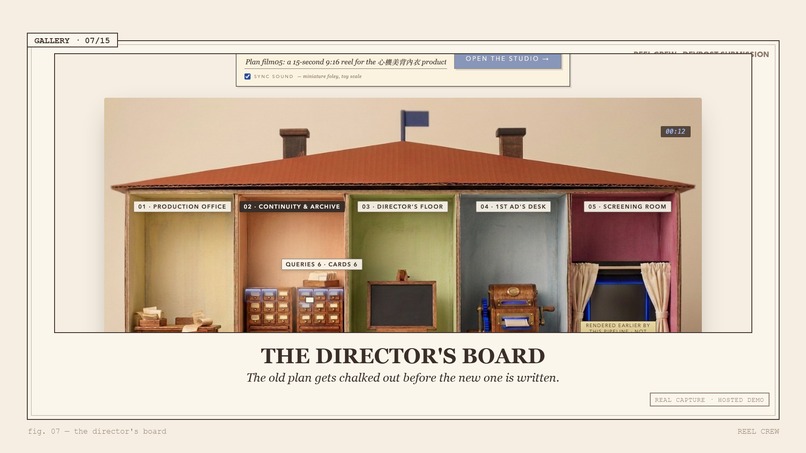
07_director's board
-
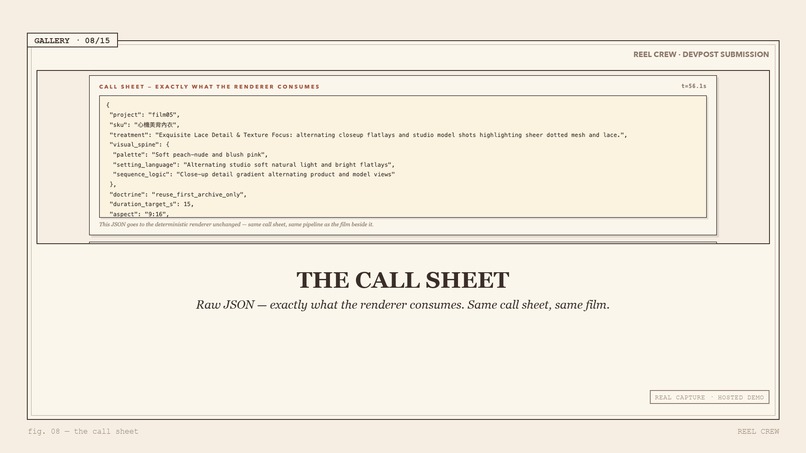
08_call sheet
-
09_A/B evidence
-
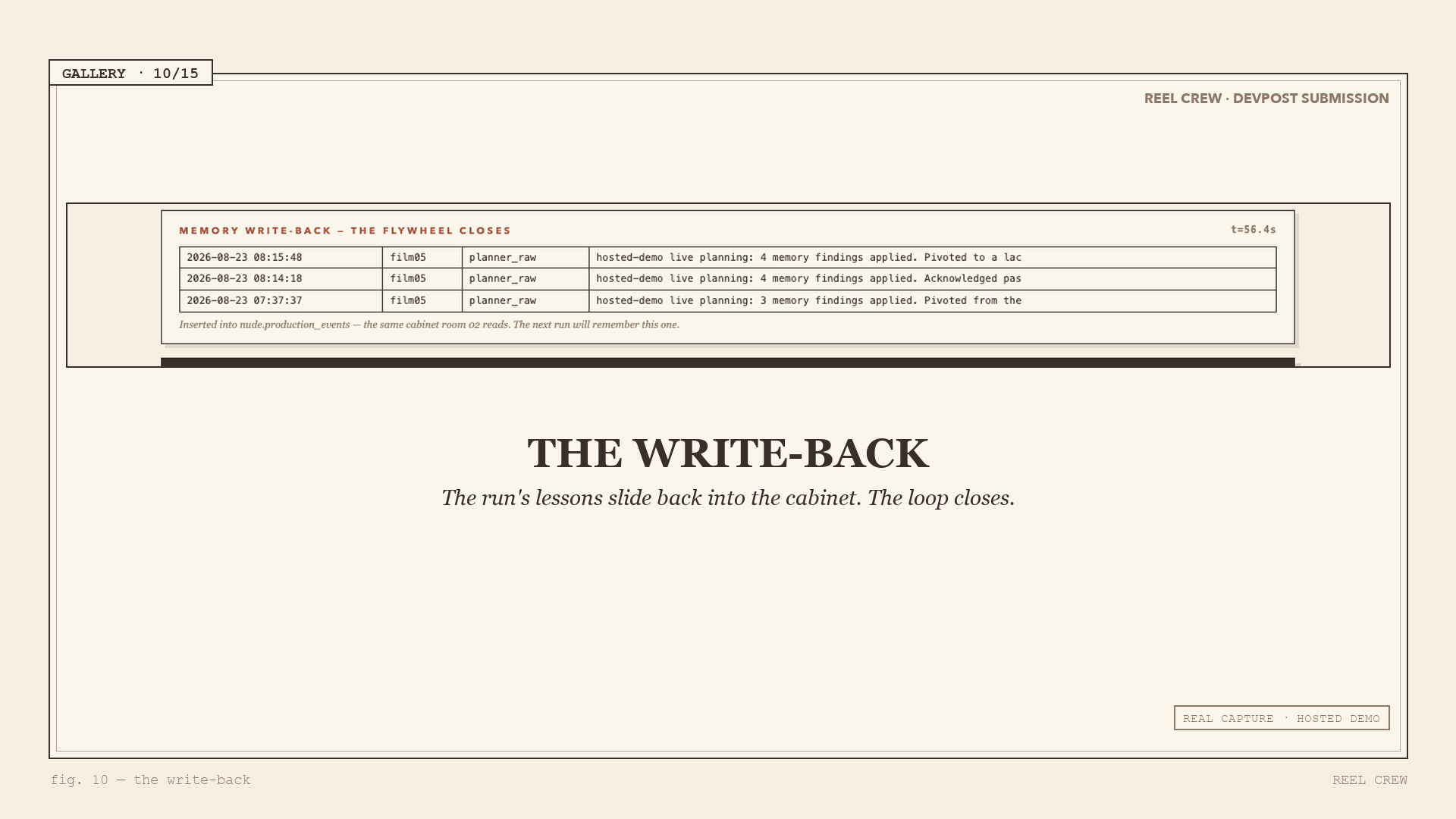
10_write back
-
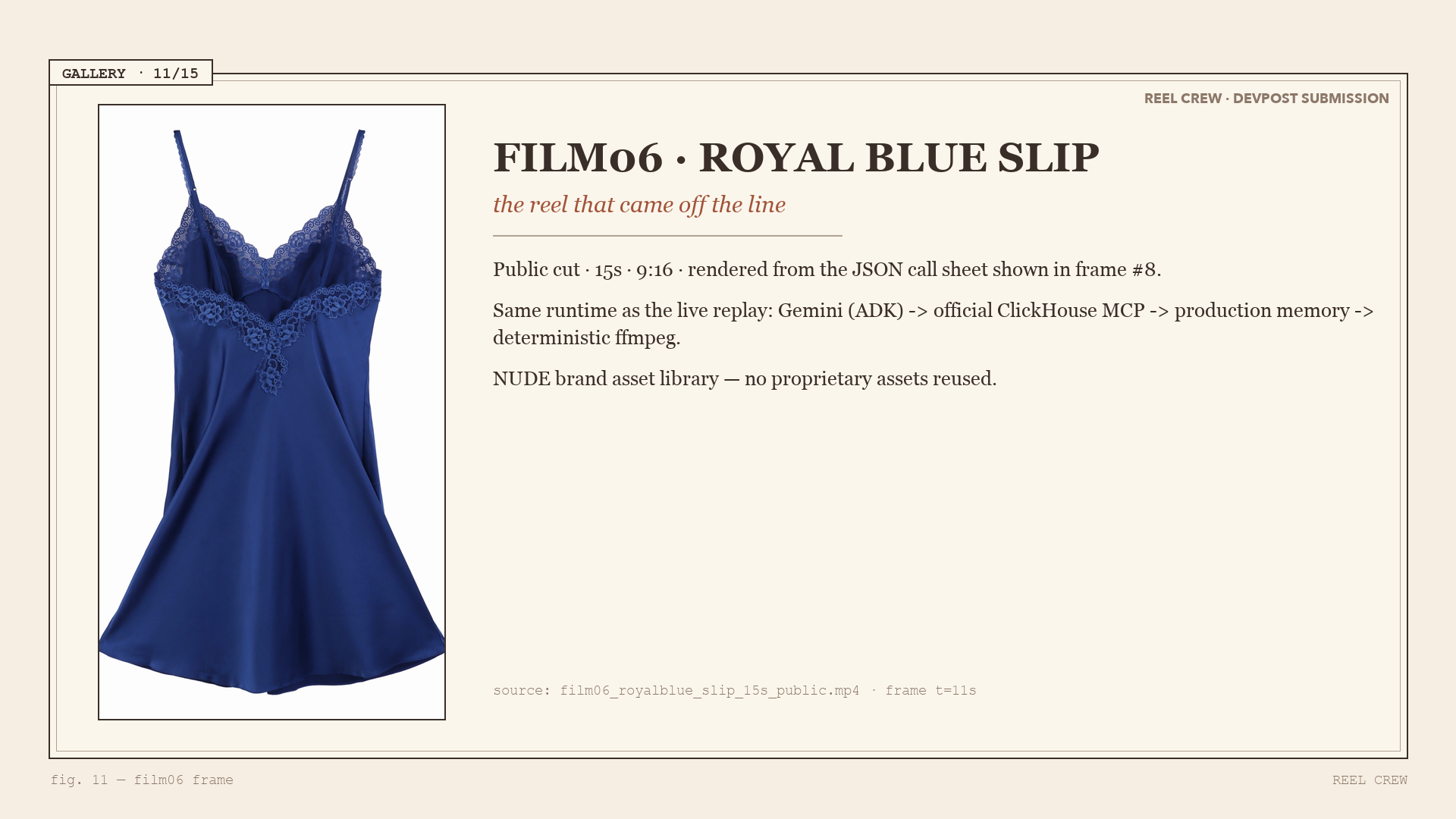
11_film06_frame
-
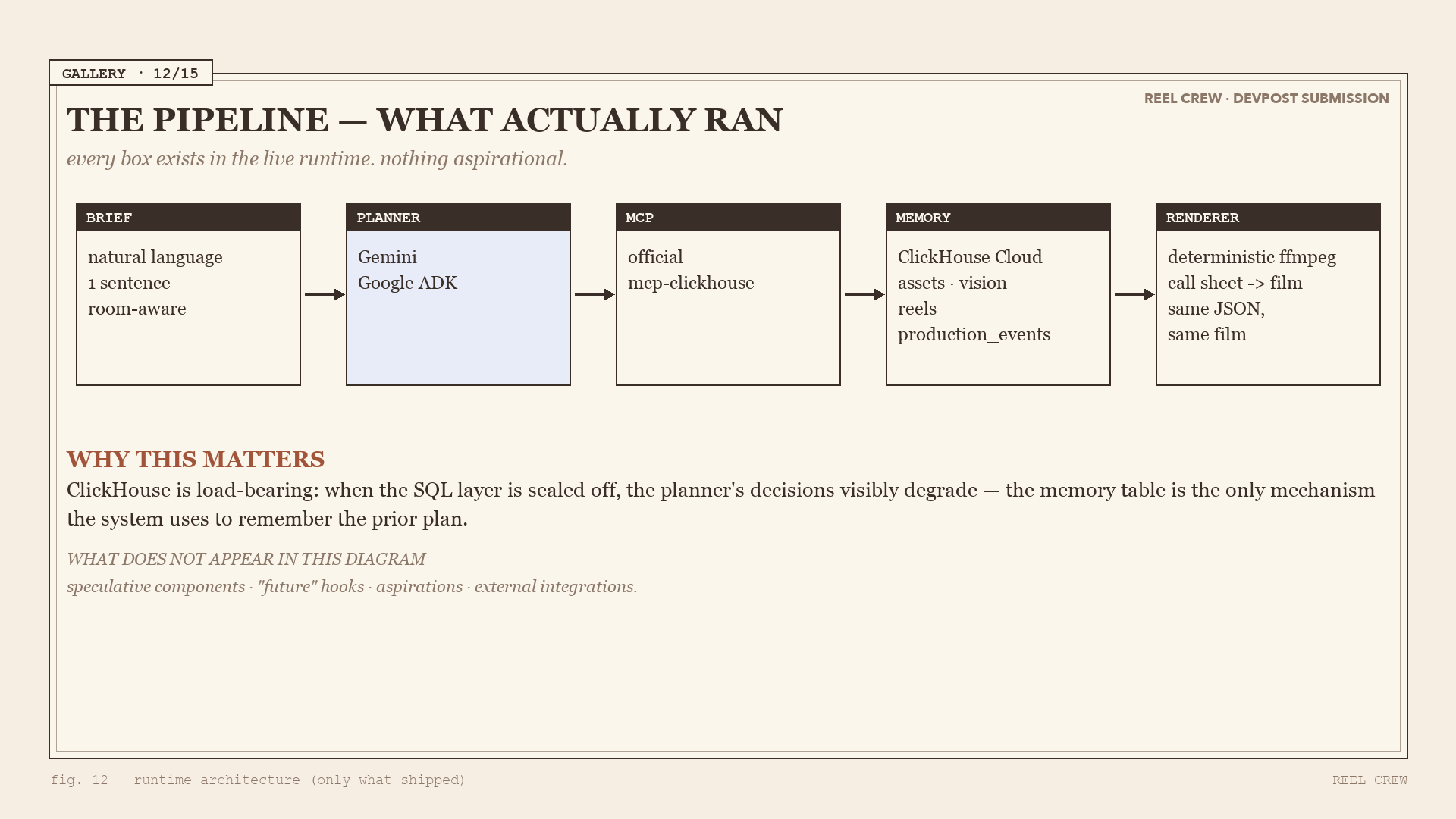
12_architecture
-
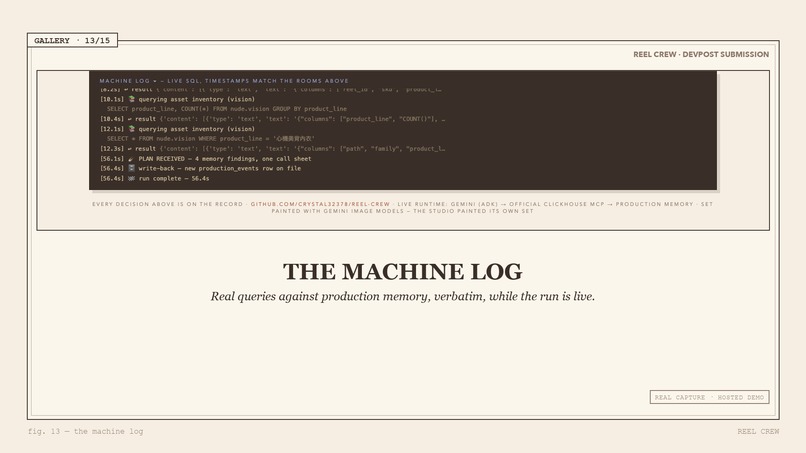
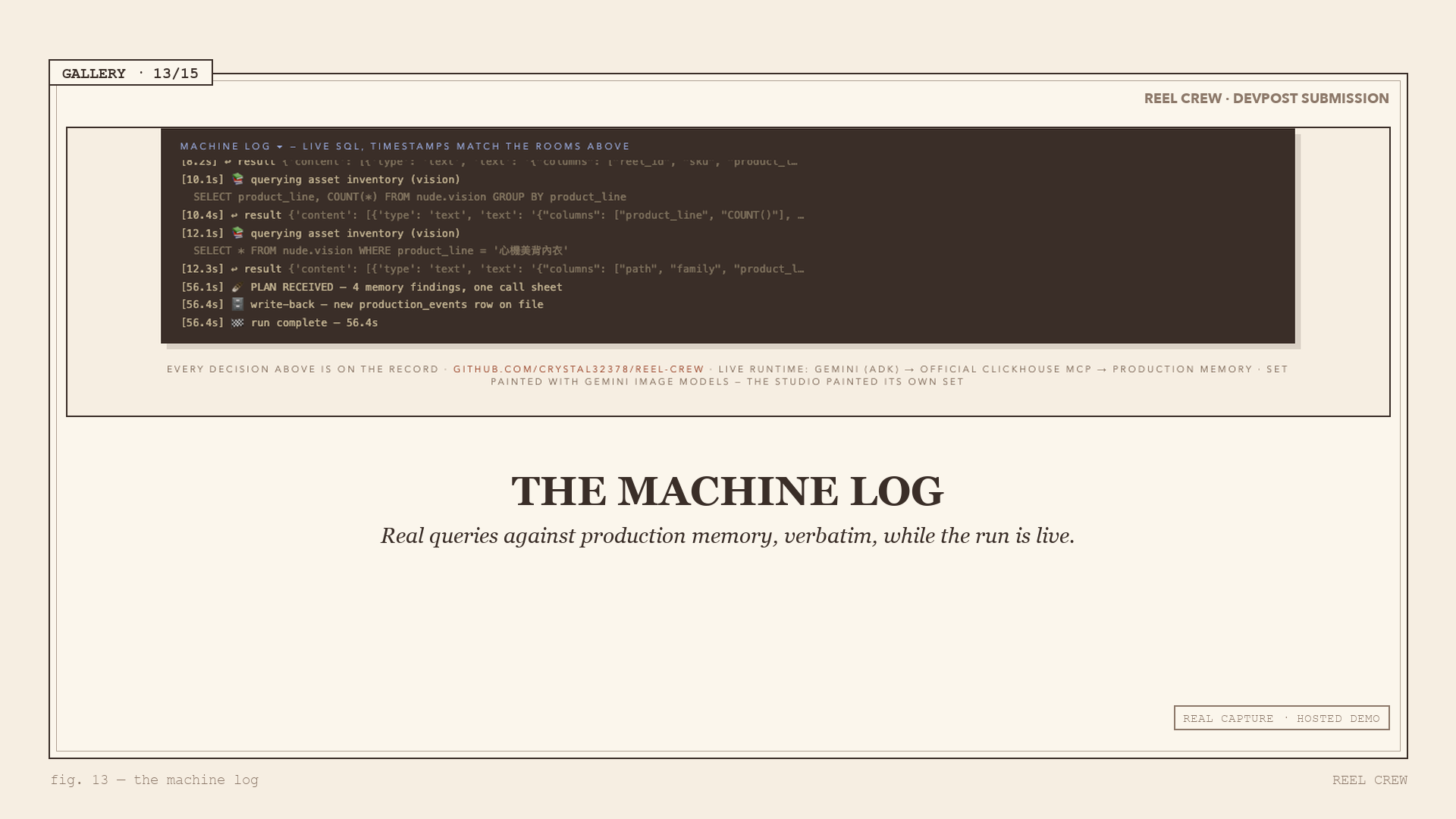
13_machine log
-
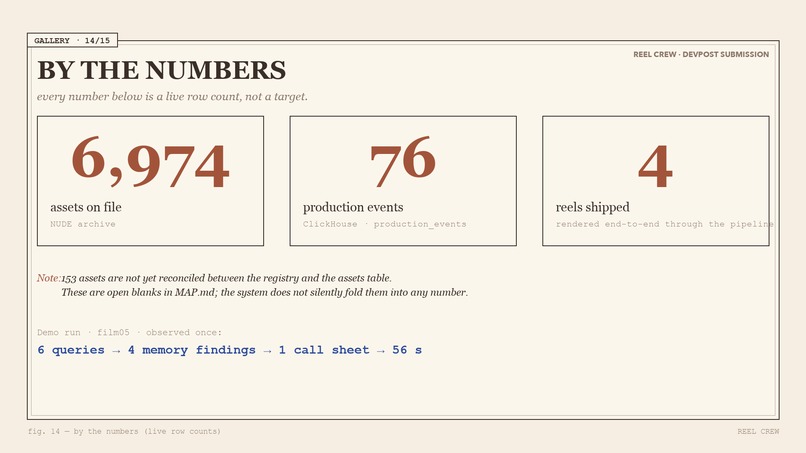
14_by the numbers
-
15_closing
Reel Crew
Unbox your creative archive.
Open the production system that remembers.
Reel Crew turns a dormant creative archive into an agentic production studio that can retrieve past work, plan a production, make a film, write the result back, and use that memory to change future decisions.
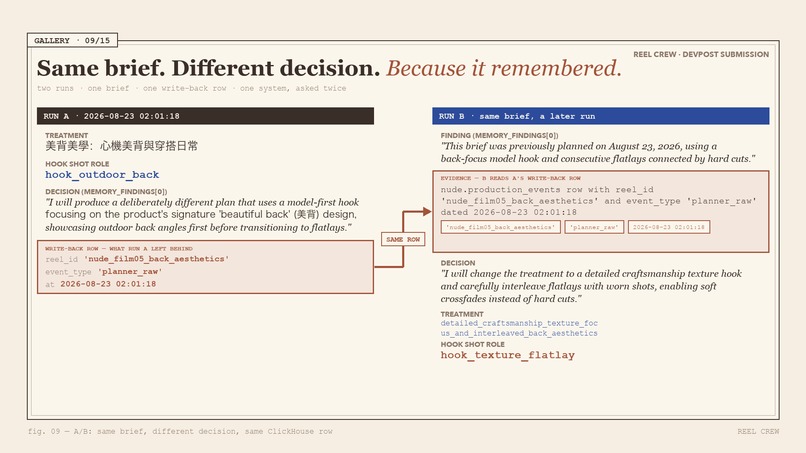
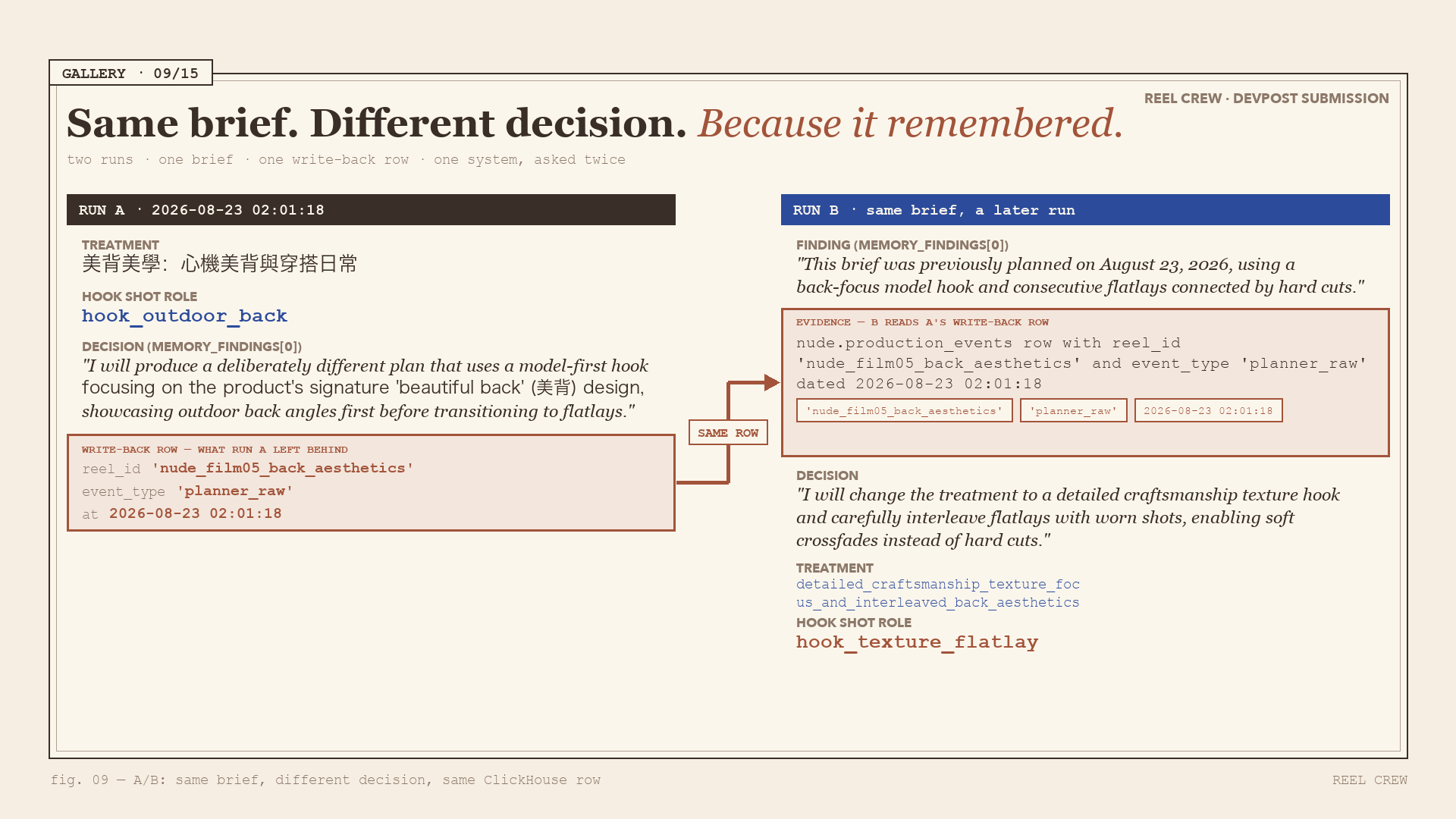
Same brief. Different decision. Because it remembered.
Inspiration
Brands accumulate years of creative work: product shots, campaign images, videos, reels, references, experiments, and production decisions.
Most of that archive eventually becomes storage.
The files still exist, but the knowledge around them fades: why a treatment worked, what had already been tried, which visual patterns became repetitive, and what a previous production decided.
We wanted to know what would happen if a creative archive stopped behaving like a folder and started behaving like a studio with memory.
Not a futuristic control room.
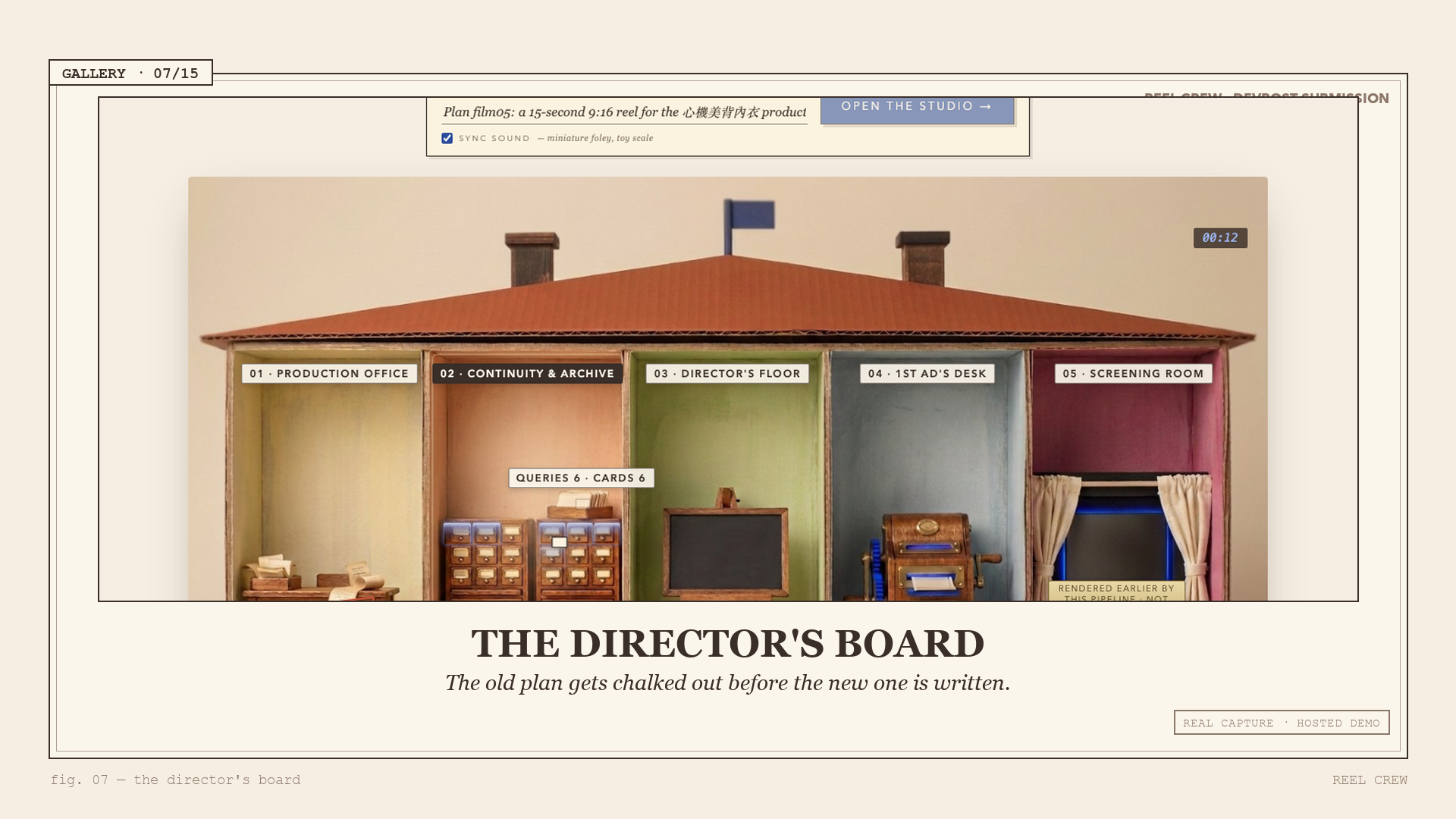
A small production company with drawers, call sheets, continuity notes, production orders, and traces of work left behind by previous crews.
That became Reel Crew.
What it does
Reel Crew turns a brand archive into a working agentic production loop:
archive → memory retrieval → production order → planning → call sheet → film → write-back → future decisions
A user starts with a production brief.
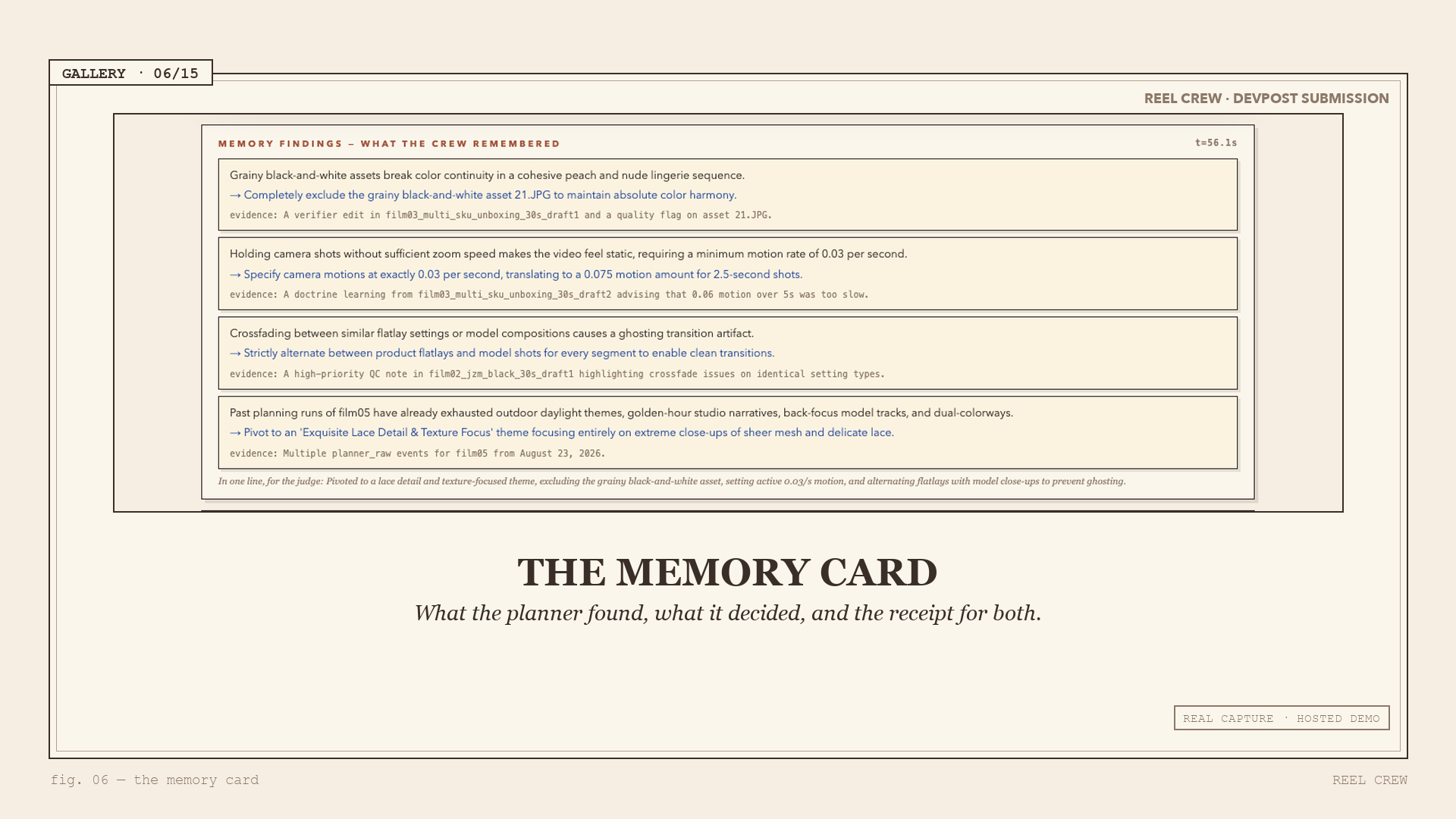
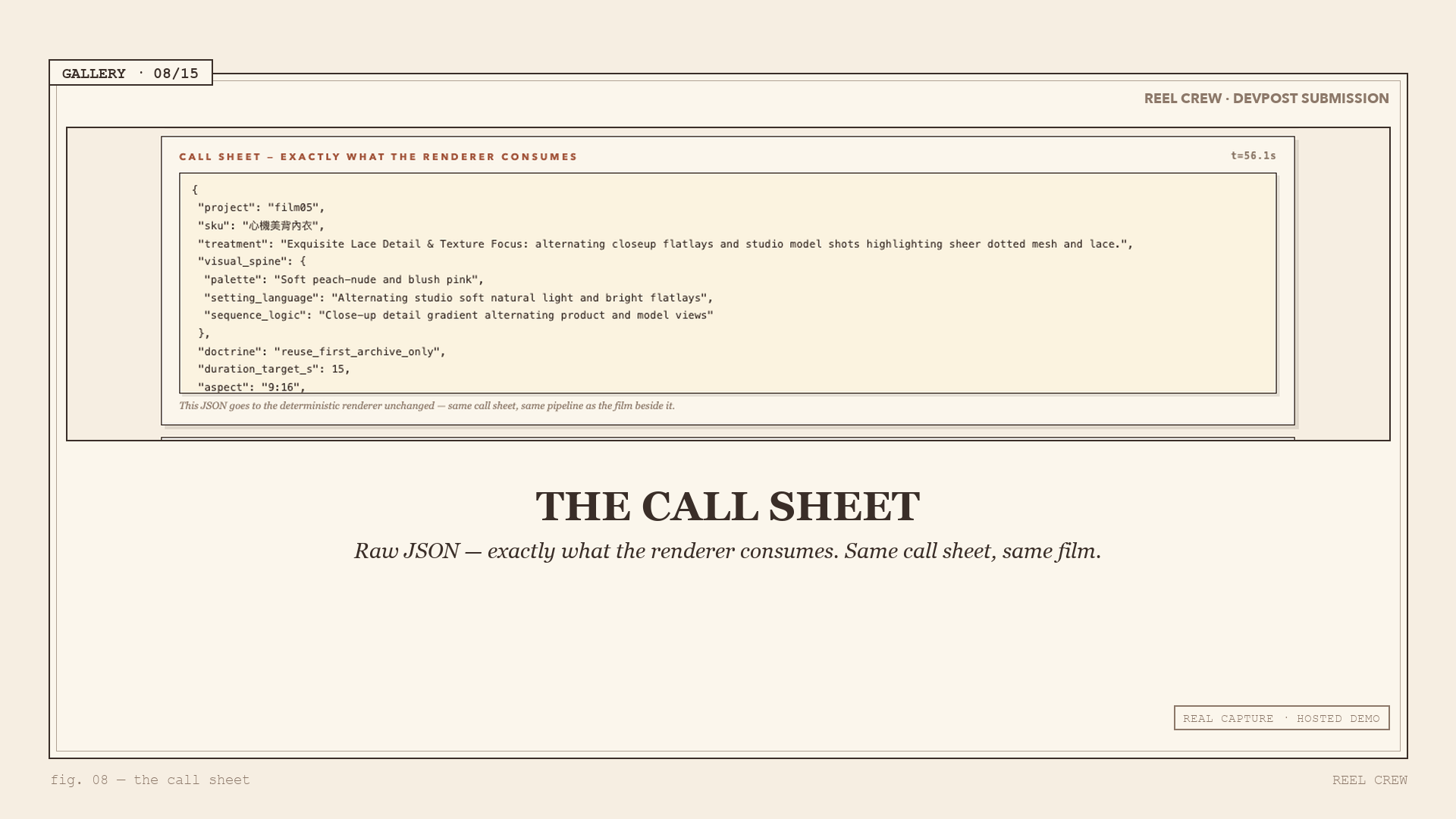
The agent searches the archive and production history, retrieves relevant memory with evidence, and creates a production plan and call sheet.
The production is rendered into a film.
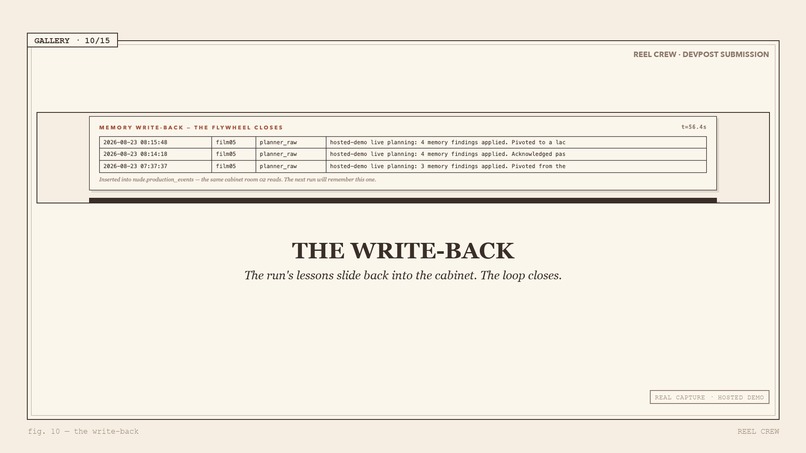
Then the system writes the production event back into memory.
The next production can retrieve that prior decision as evidence.
That creates the central proof of Reel Crew:
Same brief. Different decision. Because it remembered.
In our live demo, one production writes its planning decision back to ClickHouse. A later run retrieves that previous production event, cites it as a finding, and deliberately changes treatment rather than repeating the earlier approach.
The memory is not decorative context.
It changes the work.
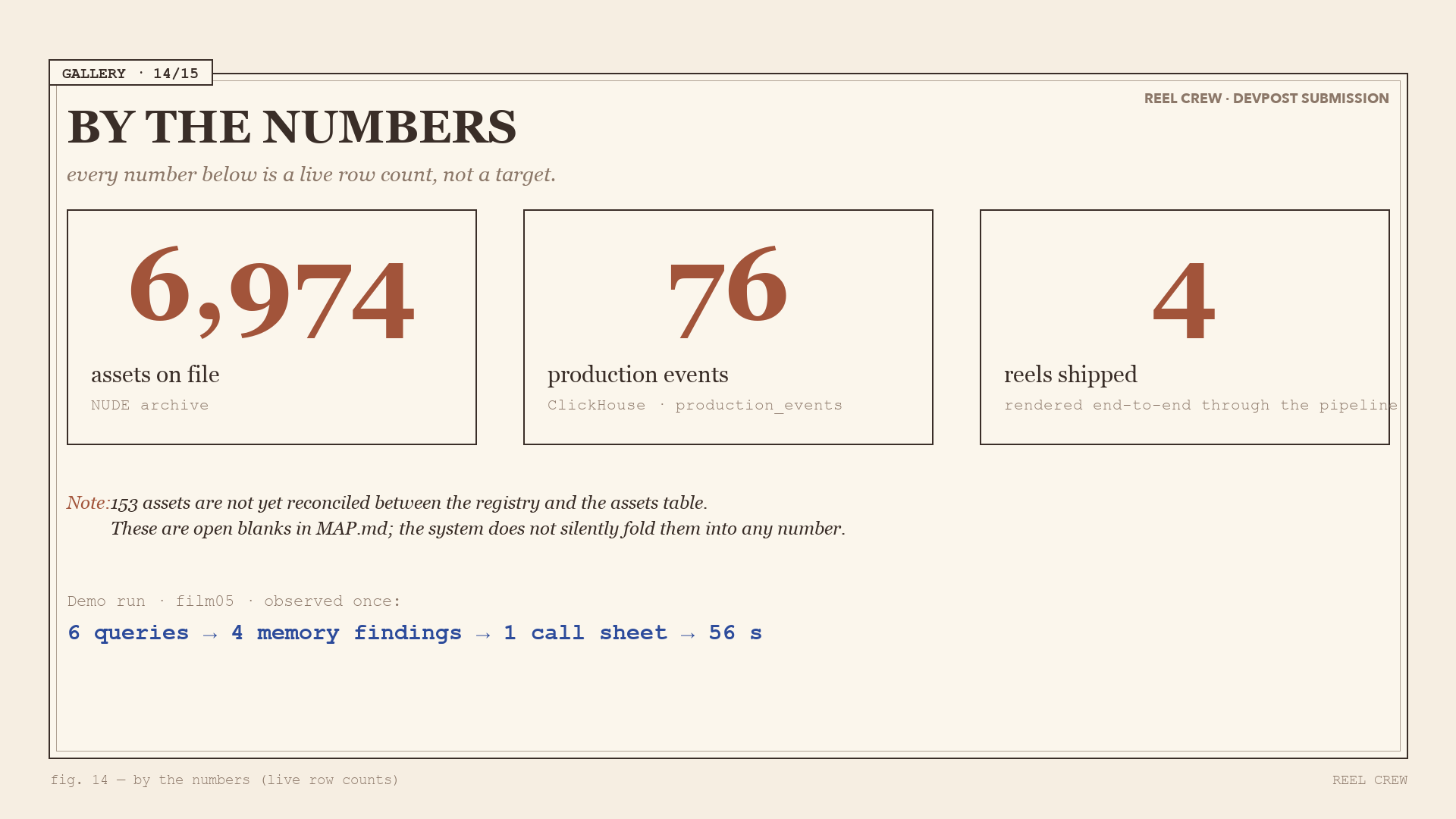
At submission lock, Reel Crew was operating across:
- 6,974 creative assets
- 81 production events and counting — the flywheel keeps writing
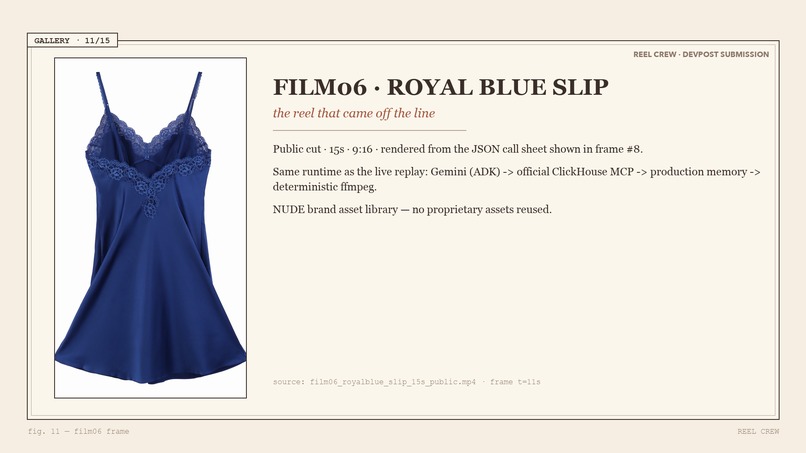
- 4 rendered reels
How we built it
We built Reel Crew around a simple idea:
Memory should be operational, not ornamental.
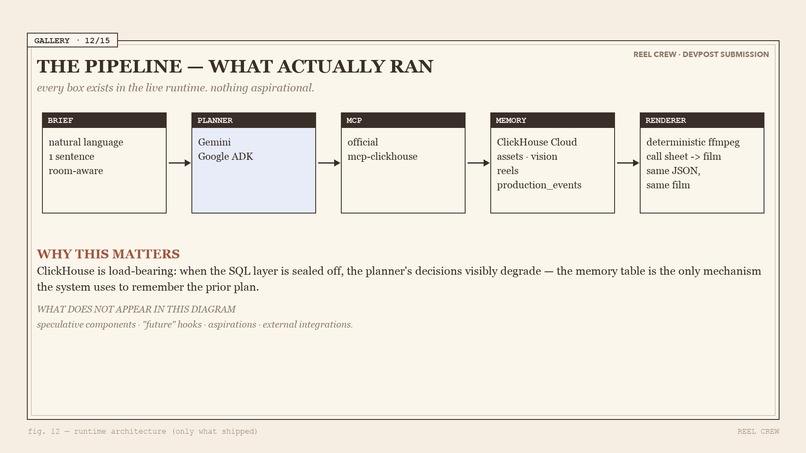
The archive and production history live in ClickHouse Cloud.
The agent retrieves both creative material and prior production events, then turns those findings into explicit production decisions.
Each memory finding carries evidence rather than appearing as unexplained model intuition.
The agent produces a call sheet that can be rendered by a deterministic production pipeline.
After production, the result is written back into production_events, where it becomes available to future runs.
That creates the flywheel:
retrieve → decide → make → write back → retrieve again
The agent layer uses Google ADK and Gemini.
The production memory and archive layer runs on ClickHouse Cloud.
The hosted application runs on Google Cloud Run.
We intentionally kept the final renderer deterministic so that the evidence shown in the demo remains inspectable and reproducible instead of disappearing behind another generative black box.
Challenges we ran into
Proving that memory actually mattered
It is easy to put prior text into a model context window and call the result “memory.”
It is much harder to prove that a stored production event was actually retrieved and materially changed a later planning decision.
That forced us to make retrieval evidence visible and keep the write-back loop inspectable.
Keeping the demo honest
Several times, a stronger line sounded better than what the underlying evidence actually supported.
We removed or rewrote those claims rather than letting the demo outrun the system.
The final submission explicitly distinguishes live behavior, replay material, pre-rendered film, and stored production events.
Working with a real creative archive
Real archives contain duplicates, incomplete coverage, old naming conventions, unsupported files, and assets whose meaning cannot safely be inferred from filenames alone.
We learned quickly that a useful creative-memory system has to preserve uncertainty rather than manufacture metadata.
Shipping without destabilizing the system
Before submission, we rotated production credentials with zero downtime, independently verified both the read and write paths, reran the hosted production loop, and passed the repository smoke tests.
The final hosted revision, public repository, and submission frontend were then locked.
Accomplishments that we're proud of
The accomplishment we care about most is small enough to fit in one sentence:
The second run remembered the first one.
Everything else exists to make that sentence true.
We are also proud that:
- the live system operates over 6,974 real creative assets
- production memory persists outside the model session
- memory findings carry inspectable evidence
- production decisions are written back for future use
- the hosted system completed final credential rotation with zero downtime
- the public repository and hosted frontend were independently verified before lock
- the demo clearly separates what is live, replayed, and pre-rendered
What we learned
The biggest lesson was that agentic memory is not the same thing as storage.
A database can remember everything and still teach the agent nothing.
For memory to matter, the system has to know:
- what happened
- where the evidence came from
- what decision was made
- whether the new situation is similar enough to reuse it
- and when a previous decision should cause the agent to do something different
We also learned that good agent systems should not become interesting by hiding their machinery.
The more consequential the agent becomes, the more important it is that a person can understand why a result appeared.
And finally:
A production system does not really remember until yesterday can change tomorrow.
What's next for Reel Crew
Reel Crew currently proves the production-memory loop.
The next step is not simply adding more generation.
It is making the archive itself more legible to agents.
We are developing the Brand Library layer so agents can distinguish between:
- what an asset is
- what has actually been observed
- what is only inferred from a path or filename
- what has not been observed yet
- and what still requires human judgment
The long-term goal is a production studio whose institutional memory grows through work without turning uncertainty into invented certainty.
Closing
Creative archives usually become quieter as they get older.
We wanted to see whether one could become more useful instead.
Reel Crew takes the work a brand has already made, turns it into production memory, and lets that memory participate in what gets made next.
Unbox your creative archive.
Open the production system that remembers.
The work became the show.
Try Reel Crew
Fast replay — see a recorded live production run in under a minute:
https://reel-crew-demo-134673885671.asia-east1.run.app/?replay=fast
Live studio — give Reel Crew your own production brief:
https://reel-crew-demo-134673885671.asia-east1.run.app/
Built With
- clickhouse
- gemini
- google-cloud
- google-cloud-agent-builder
- mcp


Log in or sign up for Devpost to join the conversation.