-
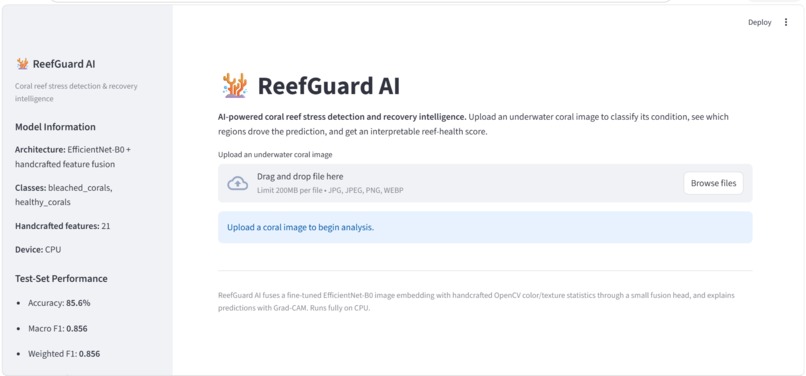
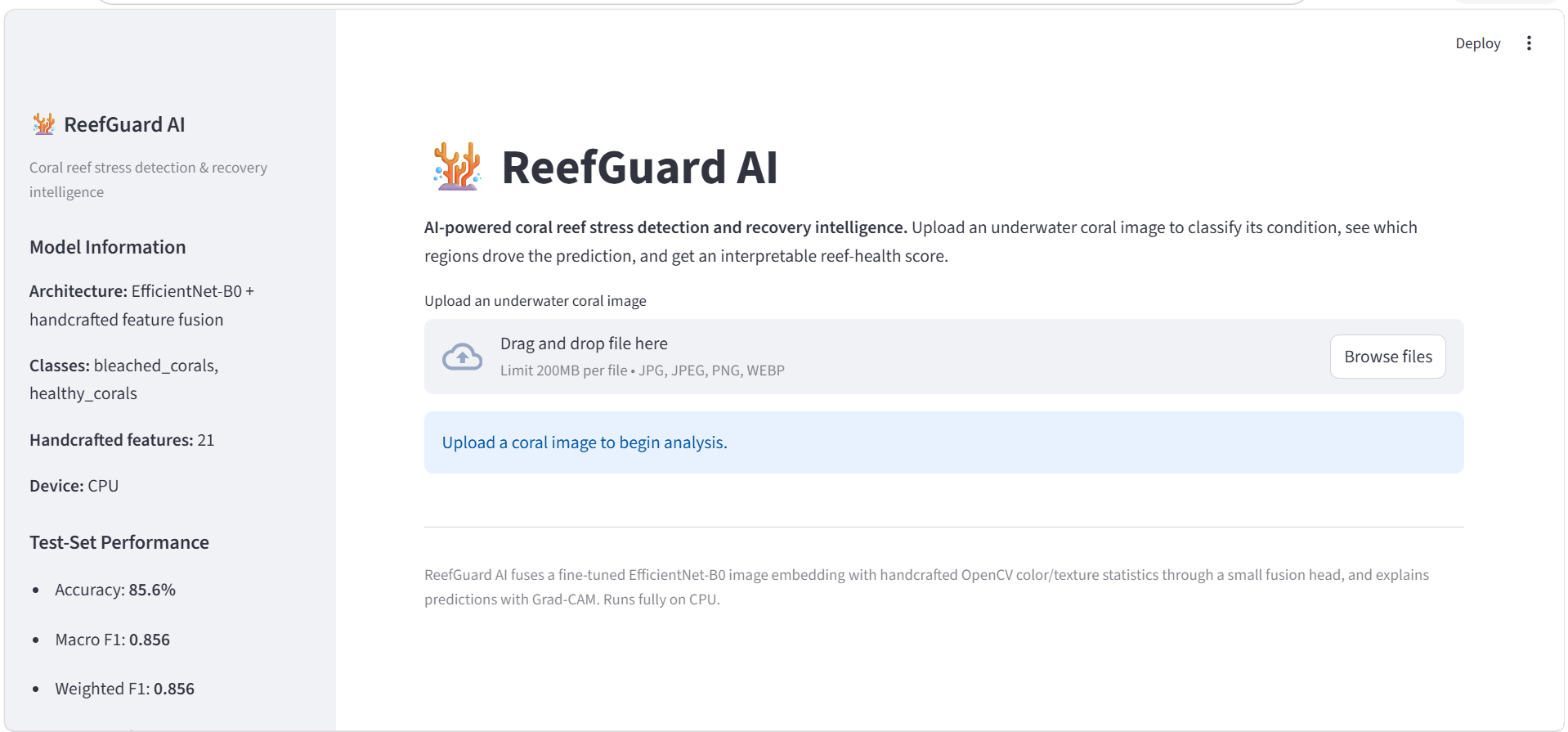
ReefGuard AI Dashboard
-
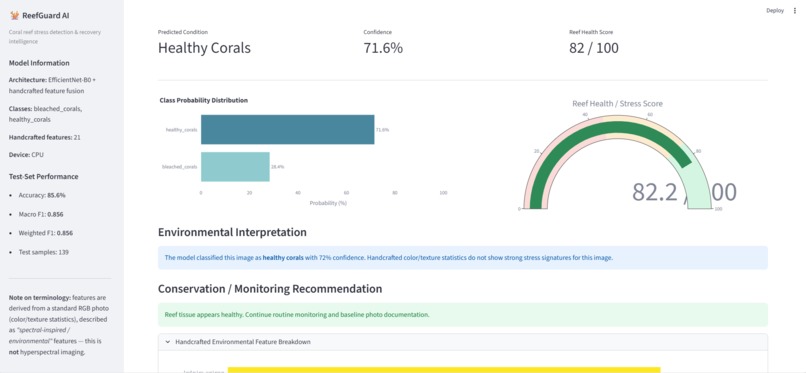
Coral Health Assessment
-
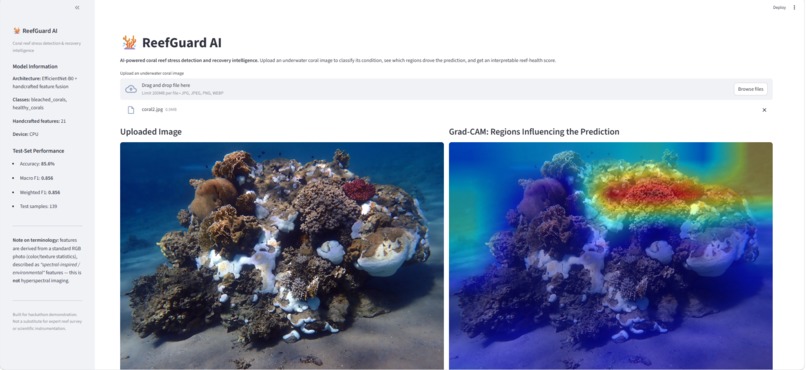
Grad-CAM Explainability
Inspiration
Coral reefs are increasingly threatened by environmental stress and coral bleaching, while access to tools for preliminary reef assessment can be limited.
We wanted to explore how computer vision could make coral health assessment more accessible to students, citizen scientists, and environmental technology users. This led to ReefGuard AI, a lightweight AI-powered system that analyzes coral images while also providing visual explanations and environmental image features rather than returning only a classification label.
What it does
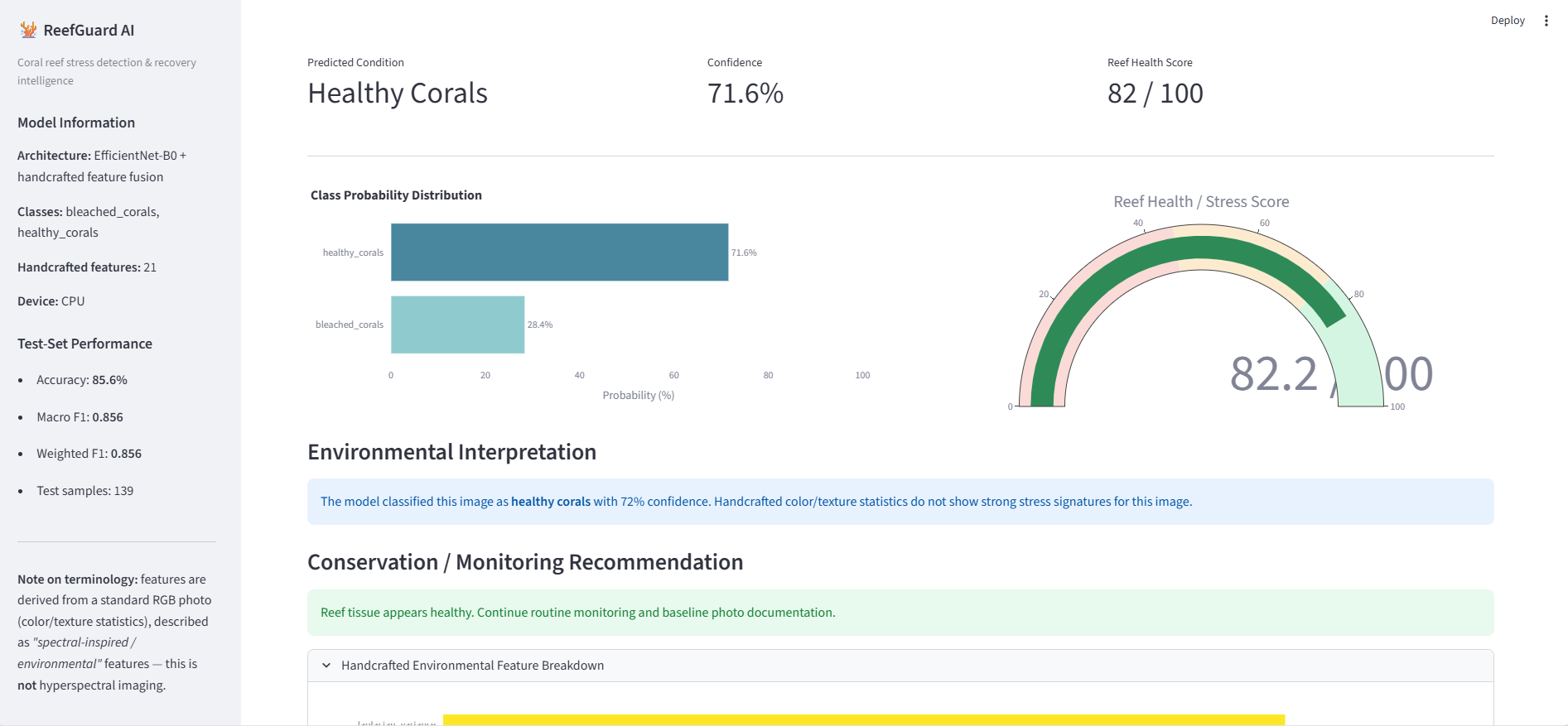
ReefGuard AI analyzes an uploaded coral image and classifies it as either healthy coral or bleached coral.
The platform provides:
- Coral condition prediction
- Class probabilities and confidence
- Reef health/stress score
- Environmental image feature analysis
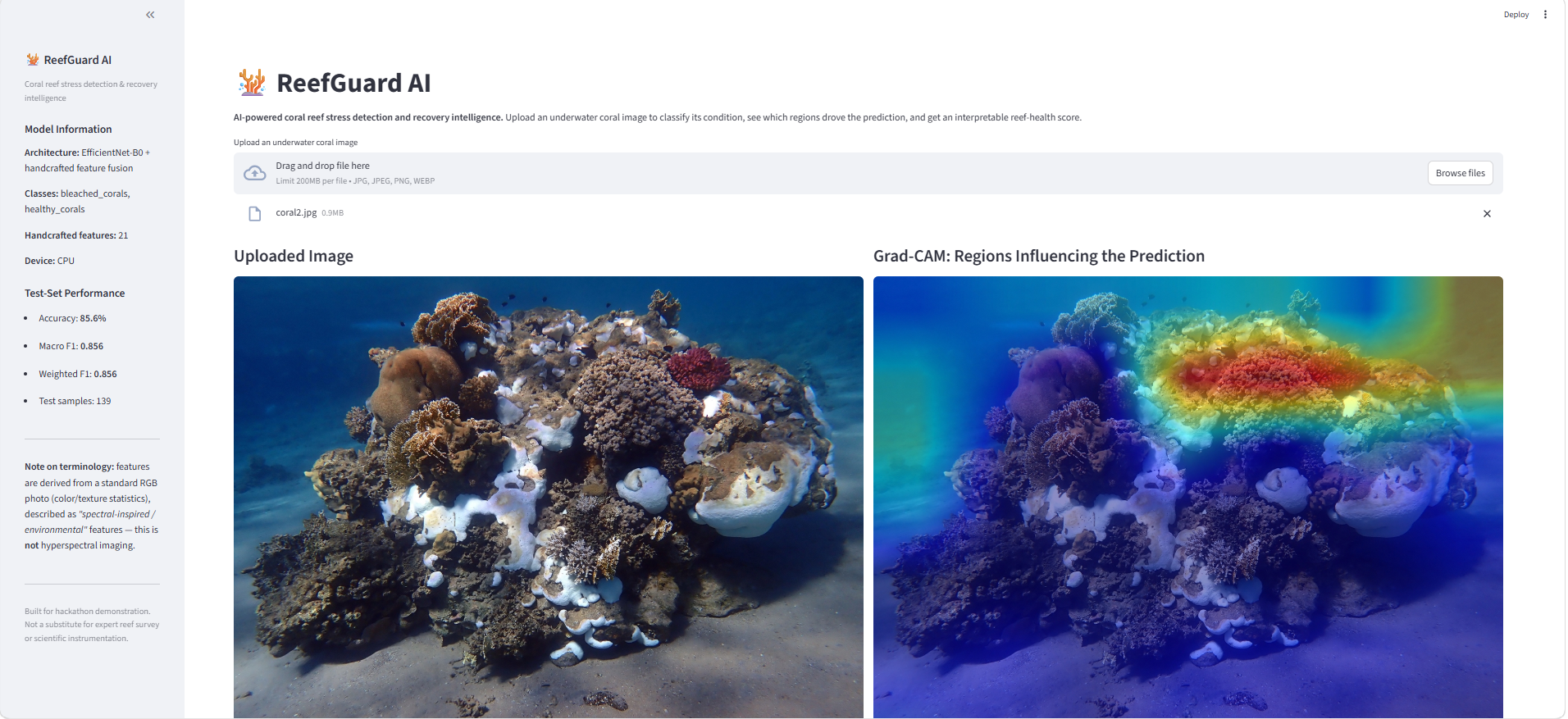
- Grad-CAM visual explanations
- Interactive visualizations
- Environmental interpretation and recommendations
The goal is to provide an accessible preliminary assessment tool while helping users understand how the AI arrives at its prediction.
How we built it
ReefGuard AI uses a lightweight computer vision pipeline designed to remain practical for CPU-based development and inference.
The main visual branch uses EfficientNet-B0 to extract learned image representations. A second branch extracts handcrafted environmental image features using OpenCV and NumPy, including color, brightness, saturation, contrast, texture, and edge characteristics.
These representations are combined through a feature-fusion architecture before the final classification layer.
For explainability, we use Grad-CAM to highlight image regions that contributed to the model's prediction.
The interactive dashboard was built with Streamlit and Plotly, providing users with the prediction, confidence, feature analysis, health score, and visual explanation in one interface.
The dataset contains 923 coral images, with 438 healthy coral images and 485 bleached coral images.
Challenges we ran into
One of the main challenges was working with a relatively small environmental image dataset while building a model that could still generalize to unseen images.
We also wanted the system to remain practical on CPU rather than depending on specialized GPU infrastructure. This influenced our choice of EfficientNet-B0 and a lightweight feature-fusion approach.
Another challenge was making the predictions more interpretable. Instead of stopping at a classification label, we incorporated Grad-CAM and environmental feature visualizations to give users more insight into the model's output.
Accomplishments that we're proud of
- Built a complete end-to-end coral health assessment system
- Trained a computer vision model using 923 coral images
- Combined learned visual representations with handcrafted environmental features
- Achieved 85.61% test accuracy and 85.59% macro F1 on a held-out test set of 139 images
- Achieved an F1-score of 0.86 for bleached coral and 0.85 for healthy coral
- Added Grad-CAM-based visual explanations
- Built an interactive Streamlit dashboard
- Created a CPU-friendly pipeline that can run locally without specialized hardware
What we learned
Through ReefGuard AI, we explored the complete machine learning workflow from dataset analysis and preprocessing to model training, evaluation, explainability, and deployment.
We also learned that environmental AI needs to communicate uncertainty and limitations clearly. An image-based prediction can support preliminary assessment, but it should not be presented as a definitive ecological measurement.
What's next for ReefGuard AI
Future improvements include:
- Expanding to more coral health categories
- Training with larger and geographically diverse datasets
- Supporting more coral species
- Adding temporal reef monitoring
- Integrating additional environmental datasets
- Improving model calibration and explainability
- Supporting field deployment for citizen scientists
- Expanding the system toward broader marine ecosystem monitoring
ReefGuard AI is currently a research and hackathon prototype exploring how accessible computer vision can contribute to environmental monitoring and coral conservation.

Log in or sign up for Devpost to join the conversation.