-
-
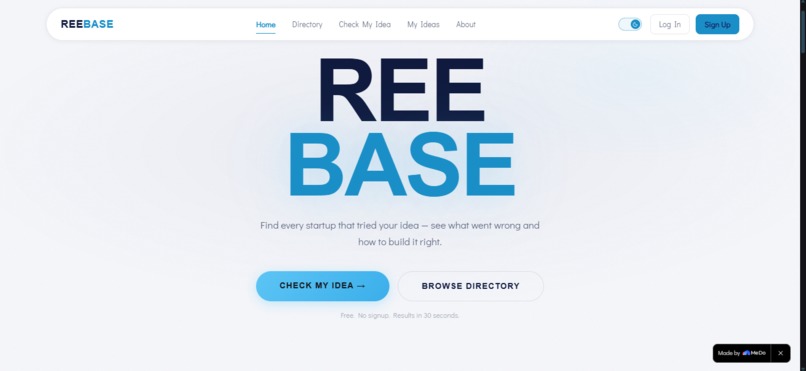
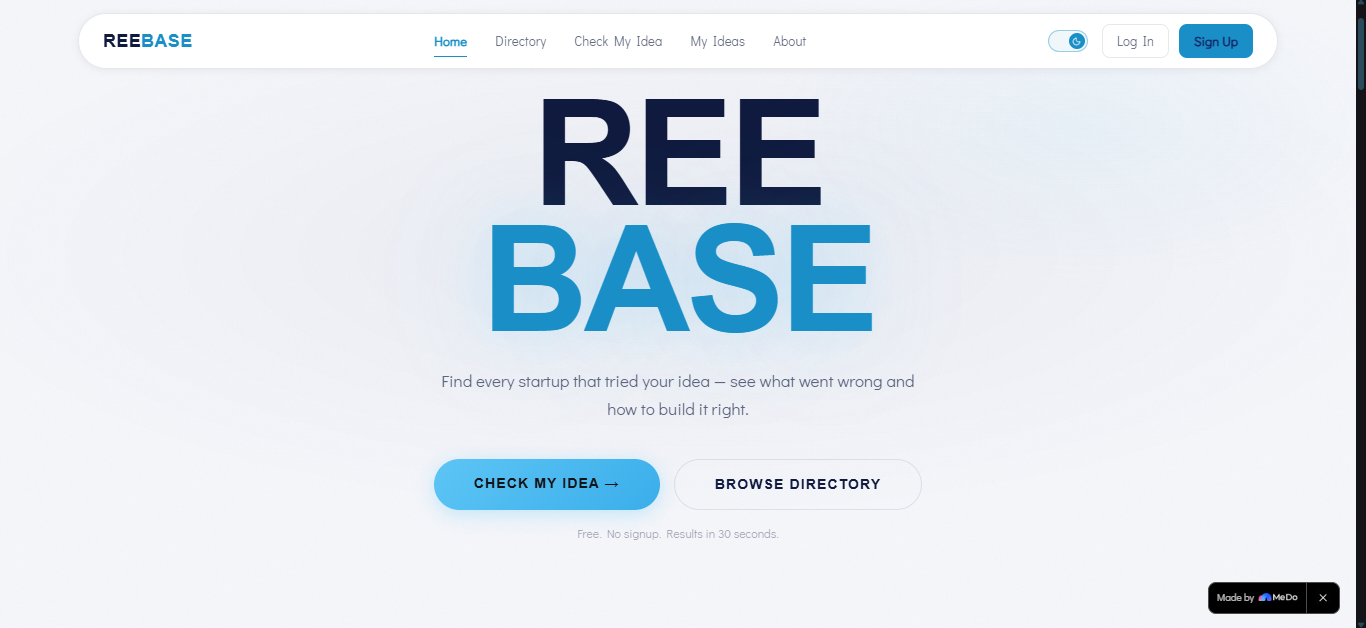
REEBASE
-
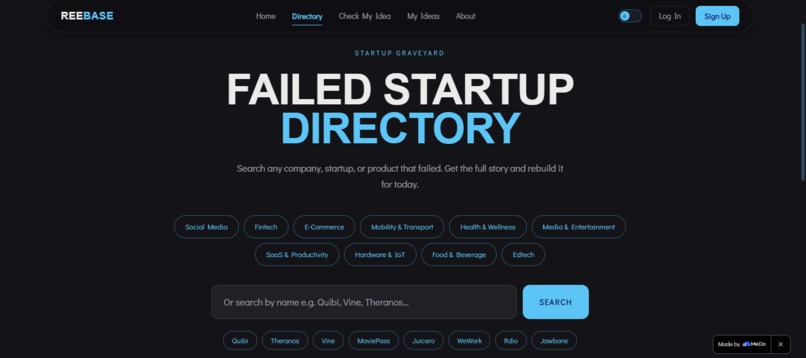
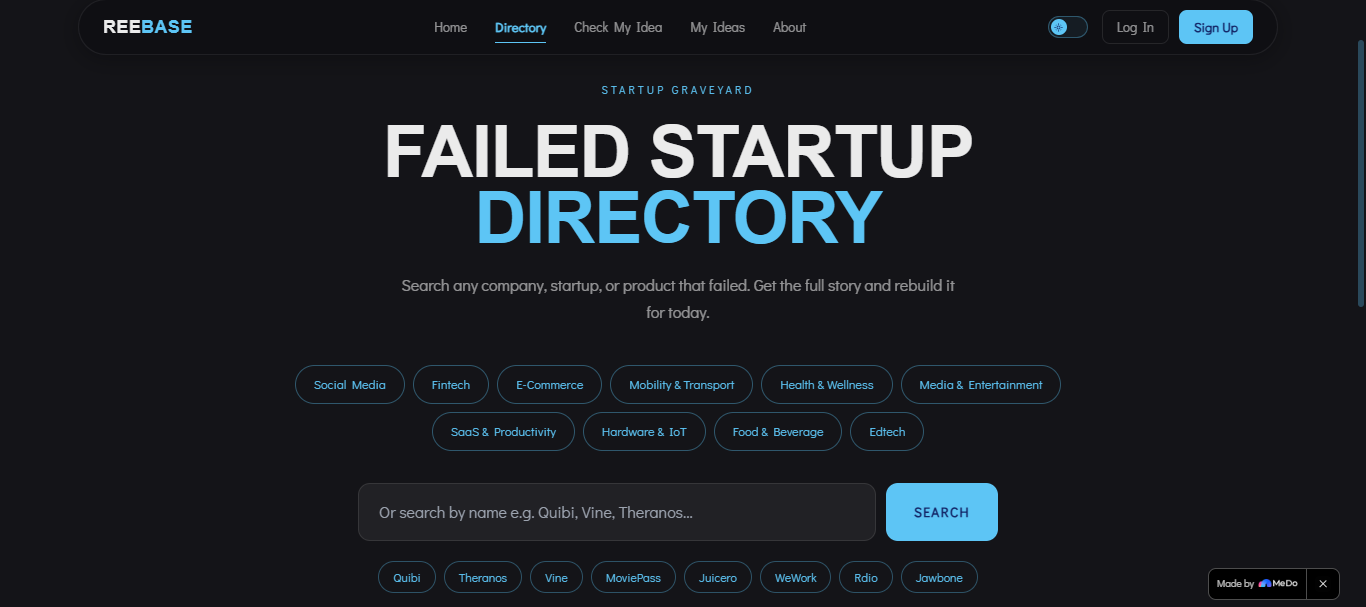
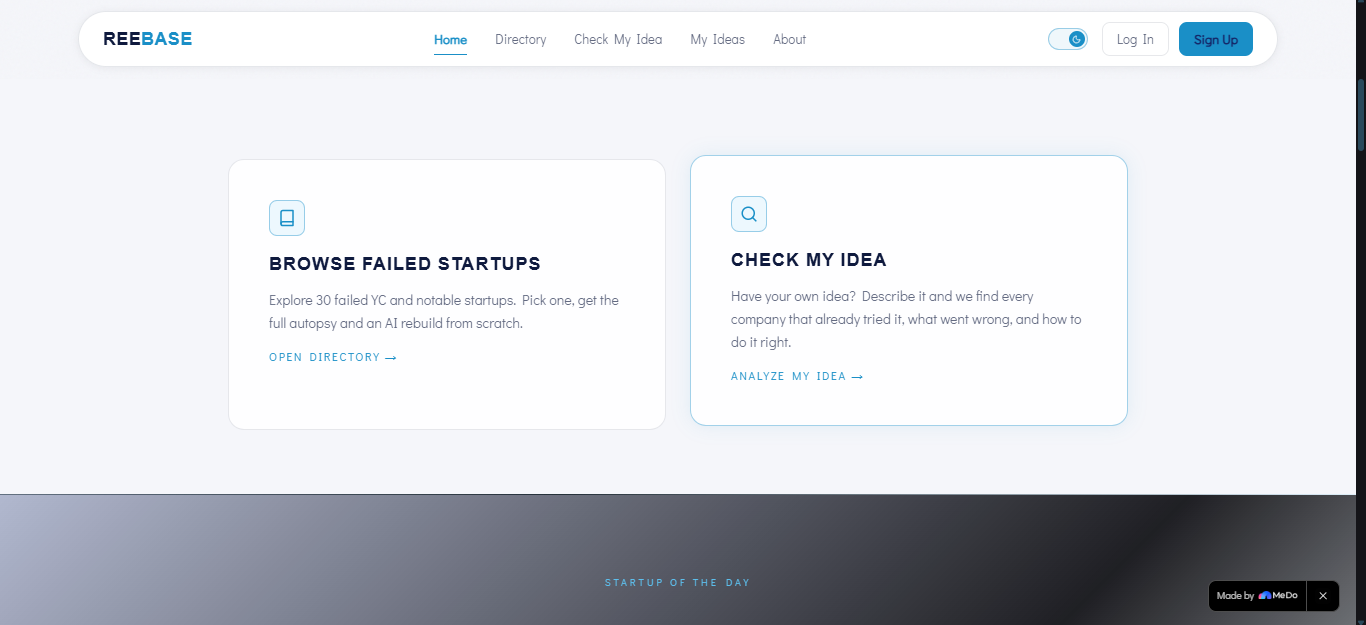
Directory: Failed startups.
-
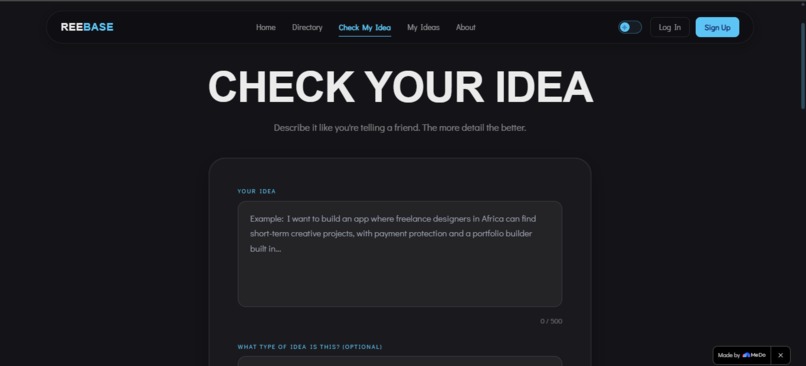
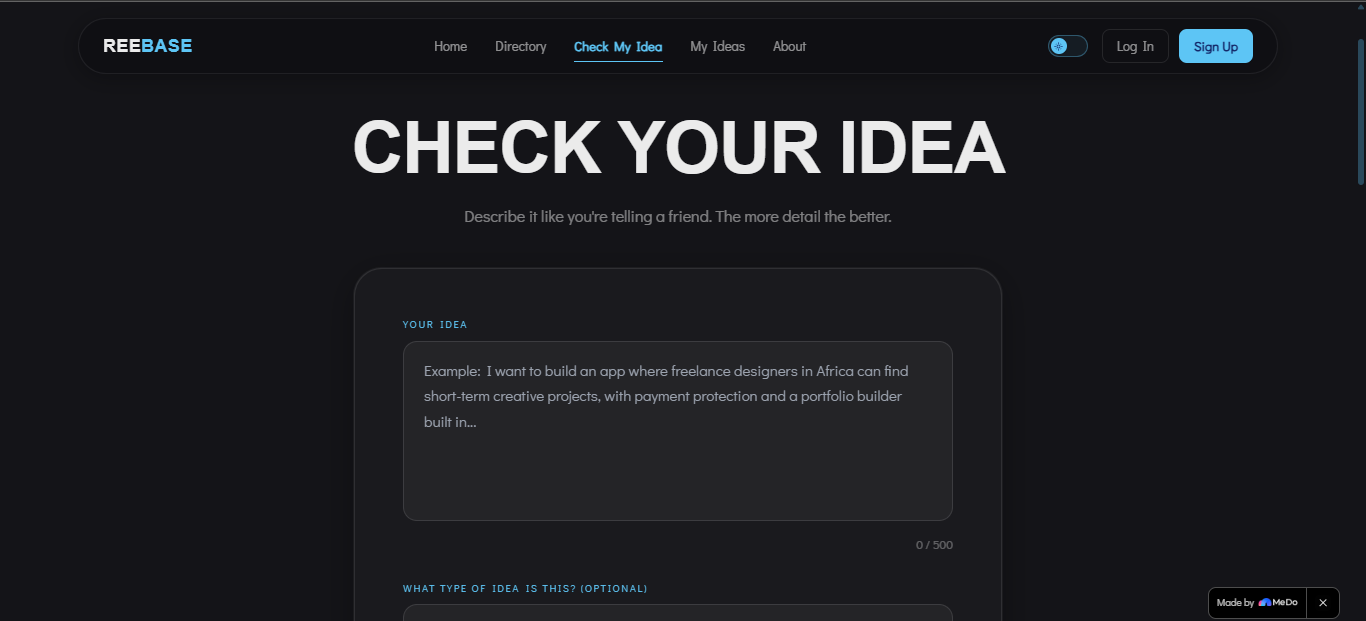
Check idea: Where idea meets real real data to start up.
-
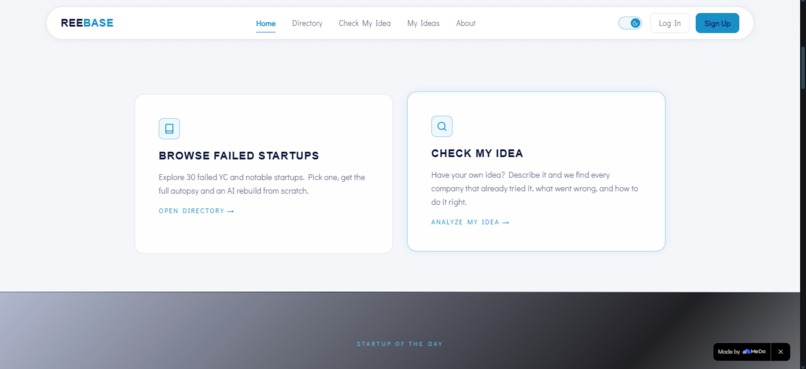
Two major features
-
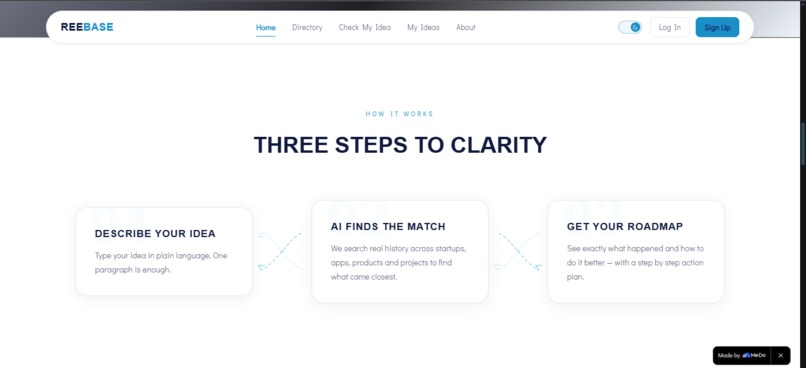
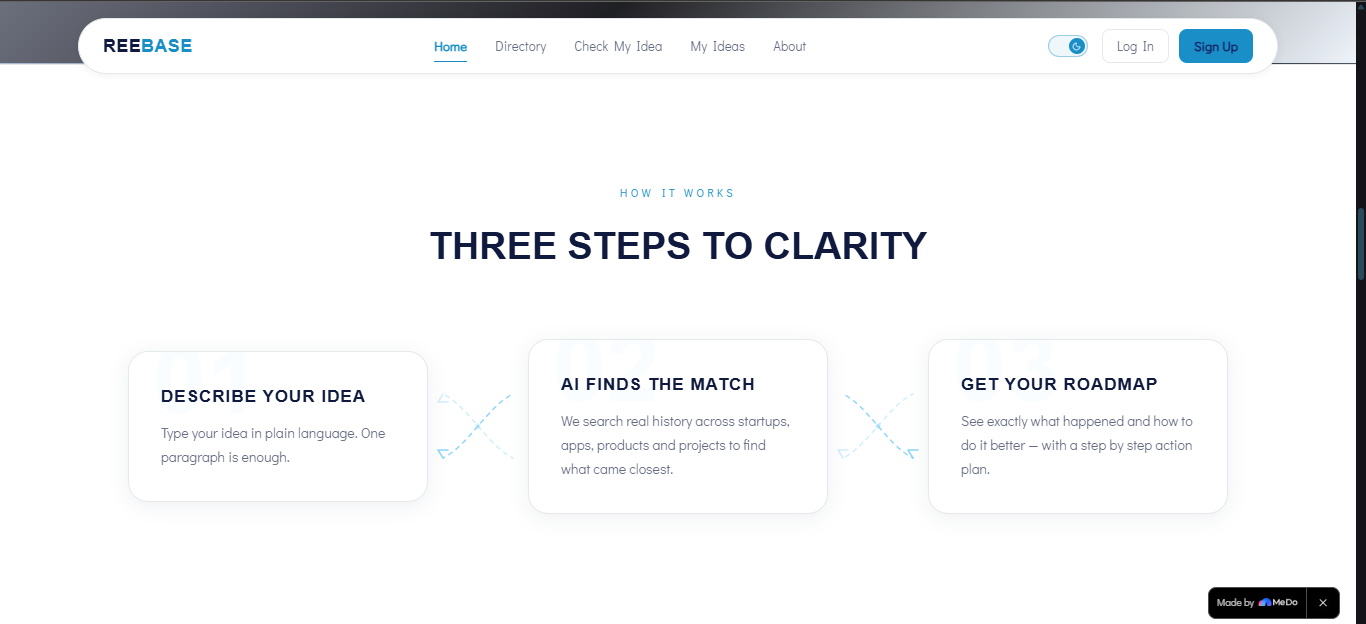
How its done.
Inspiration
Most founders discover their idea has already been tried after they have spent months building it. The data exists. The post-mortems exist. The Wikipedia articles, the TechCrunch obituaries, the founder interviews — all of it is out there. Nobody had put it together in one place and connected it directly to a founder's specific idea. I kept watching brilliant people repeat the same mistakes that Quibi, Vine, MoviePass, and dozens of well-funded companies had already documented in painful detail. That frustration became REEBASE. The name comes from the idea of re-basing your thinking —
starting from what actually happened, not what you hope will happen.
The Problem It Solves
"The number one cause of startup failure is building something nobody wants — or that somebody already proved doesn't work." Most founders discover their idea has been tried before after they have already built it. They spend months, sometimes years, repeating mistakes that are fully documented in the public record. The data exists. The post-mortems exist. The Wikipedia articles, the founder interviews, the TechCrunch obituaries — all of it exists. Nobody had put it together in one place, made it searchable, and connected it directly to the founder's specific idea.
REEBASE does exactly that.
What it does
REEBASE is an AI-powered idea intelligence engine with two entry points: The Failed Startup Directory Search any company that failed — Quibi, Theranos, Vine, MoviePass, any of them. REEBASE searches the web in real time, pulls verified data from Wikipedia, and generates a full case study covering:
- The founding story and why it seemed like a great idea
- A detailed timeline from launch to shutdown
- What went wrong — with specific evidence, not surface-level observations
- The single fatal mistake that killed the company
- Your Opportunity — how to build something better in the same space today Check My Idea Describe any idea in plain language. REEBASE finds three real companies that attempted something similar, cross-analyzes all three for common failure patterns, and delivers a full research report including:
- Risk Score (0–100) based on market saturation and historical failure density
- Market overview with Africa-specific opportunity analysis
- Side-by-side comparison table across all three companies
- A phased roadmap — Validate, Build, Launch, Grow
- Final verdict and the single most important action to take this week Every analysis exports as a structured multi-page PDF report with a cover page, case studies, comparison table, roadmap, and final verdict — all properly paginated and formatted. ---
How we built it
REEBASE was built entirely through MeDo using natural language prompts. Every page, component, route, database table, and API integration was generated by describing what I wanted in plain English. The core analysis pipeline: Tools and APIs used: | Layer | Tool | |---|---| | App Builder | MeDo | | AI Engine | Groq API — Llama 3.3 70B Versatile | | Historical Data | Wikipedia REST API | | Live Research | MeDo Web Search Plugin | | Market Context | MeDo News Plugin | | Database | MeDo Built-in Database | | PDF Generation | jsPDF | | Deployment | MeDo One-Click Deployment | The most impressive thing MeDo generated was the entire async analysis pipeline in a single structured prompt — parallel API calls, error handling, JSON parsing,
state management, and navigation all wired together correctly.
Challenges we ran into
API Rate Limits
Running five to six Groq calls per analysis hit rate limits during heavy testing. The solution was a key rotation system — two API keys rotate automatically when one returns a 429 error, with exponential backoff as a fallback. MeDo generated the rotation logic from a description of the problem.
JSON Parsing
AI models do not always return perfectly clean JSON.
REEBASE uses a three-layer parsing system:
Raw response → Strip markdown → JSON.parse() →
Regex extract JSON block → Safe fallback defaults
This made every AI call resilient without
crashing the user experience.
Wikipedia CORS Policy
Direct calls to the Wikipedia REST API from the browser
are blocked by CORS. The fix was switching to the
MediaWiki query API with &origin=* appended —
allowing cross-origin browser requests without a proxy server.
Structured PDF Generation
Building a real multi-page PDF without window.print()
required a custom layout engine using jsPDF —
manually tracking Y positions, calculating page breaks,
rendering colored stat cards, comparison tables,
and phase roadmaps across seven pages.
MeDo generated the initial structure and I refined
each section through follow-up prompts.
Making the Rebuild Feel Forward-Looking
Early versions of the rebuild section felt like
they were trying to revive the dead company.
The framing needed to shift completely —
from "here is what Quibi could have been"
to "here is how YOU build something better in this space."
That reframe changed everything about how the feature felt.
Accomplishments that we're proud of
Real data, not hallucinations. Every case study pulls from live web search results and Wikipedia simultaneously before Groq generates the analysis. The AI synthesizes real sources — it does not invent company histories.
The live directory search. Instead of a pre-loaded list, the directory searches the web in real time for any company the user types. Groq extracts structured data from the search results and populates the cards dynamically. Type any failed startup name and it finds it.
Three-company cross-analysis. Most research tools find one match. REEBASE finds three, then analyzes the pattern that runs through all of them — the shared root cause that no single case study would reveal. A structured PDF that looks like a consulting report. Seven pages. Cover with risk score. Executive summary. Three company case studies. Comparison table. Phased roadmap. Final verdict.
Generated in seconds and downloaded instantly.
What we learned
Prompt engineering is real engineering. The quality of what MeDo generates is directly proportional to the precision of the prompt. Learning to write structured, outcome-focused, example-driven prompts was the primary skill of this build.
Split large AI tasks into smaller calls. One massive Groq prompt asking for everything always failed or returned incomplete data. Breaking the analysis into focused calls — concept extraction, match finding, case study, roadmap — made each call more reliable and the output richer.
Defensive AI coding matters as much as the AI calls themselves. Every external API call needs a fallback. Every JSON parse needs error handling. Every loading state needs a timeout. The user should never see a raw error message. Building resilience around AI calls was as important as the calls themselves.
Framing shapes everything. The technical features of REEBASE did not change much across iterations. What changed was how they were framed. "Rebuild this startup" felt wrong. "Your opportunity in this space" felt right. Same data. Completely different product experience.
What's next for REEBASE
A growing database of analyzed companies. Every startup analyzed gets stored and improves the results for the next user who searches for something similar. Over time REEBASE builds its own proprietary dataset of failure patterns.
Founder community features. Let users share their analyses, comment on rebuilds, and discuss the opportunities they see in failed startup spaces. The best ideas come from conversation.
Investor-ready exports. Generate a one-page investment memo from any analysis — showing the market gap, the differentiation strategy, and why now is the right time. Built for founders who need to pitch fast.
African startup index. A dedicated directory of African startups that attempted various ideas — what worked, what did not, and what the continent-specific lessons are for founders building here today.
API access for accelerators. Let startup accelerators and incubators run every applicant's idea through REEBASE before their interview — so mentors arrive already knowing the historical context and can focus the conversation on what matters.
REEBASE is just getting started. The graveyard is full. The lessons are waiting.
Built with MeDo — #BuiltWithMeDo
Built With
- build-in-database
- groq
- jspdf
- llama
- medo
- node.js
- react
- rest
- tailwind
- typescript
- vite
- wikipedia

Log in or sign up for Devpost to join the conversation.