-
-
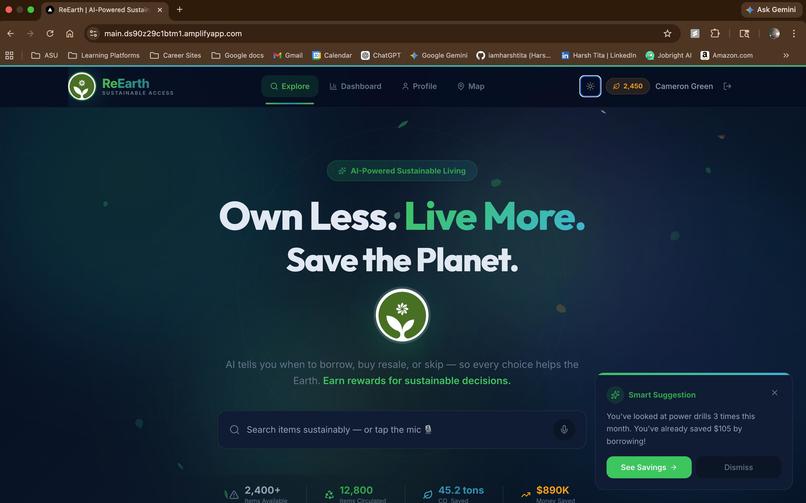
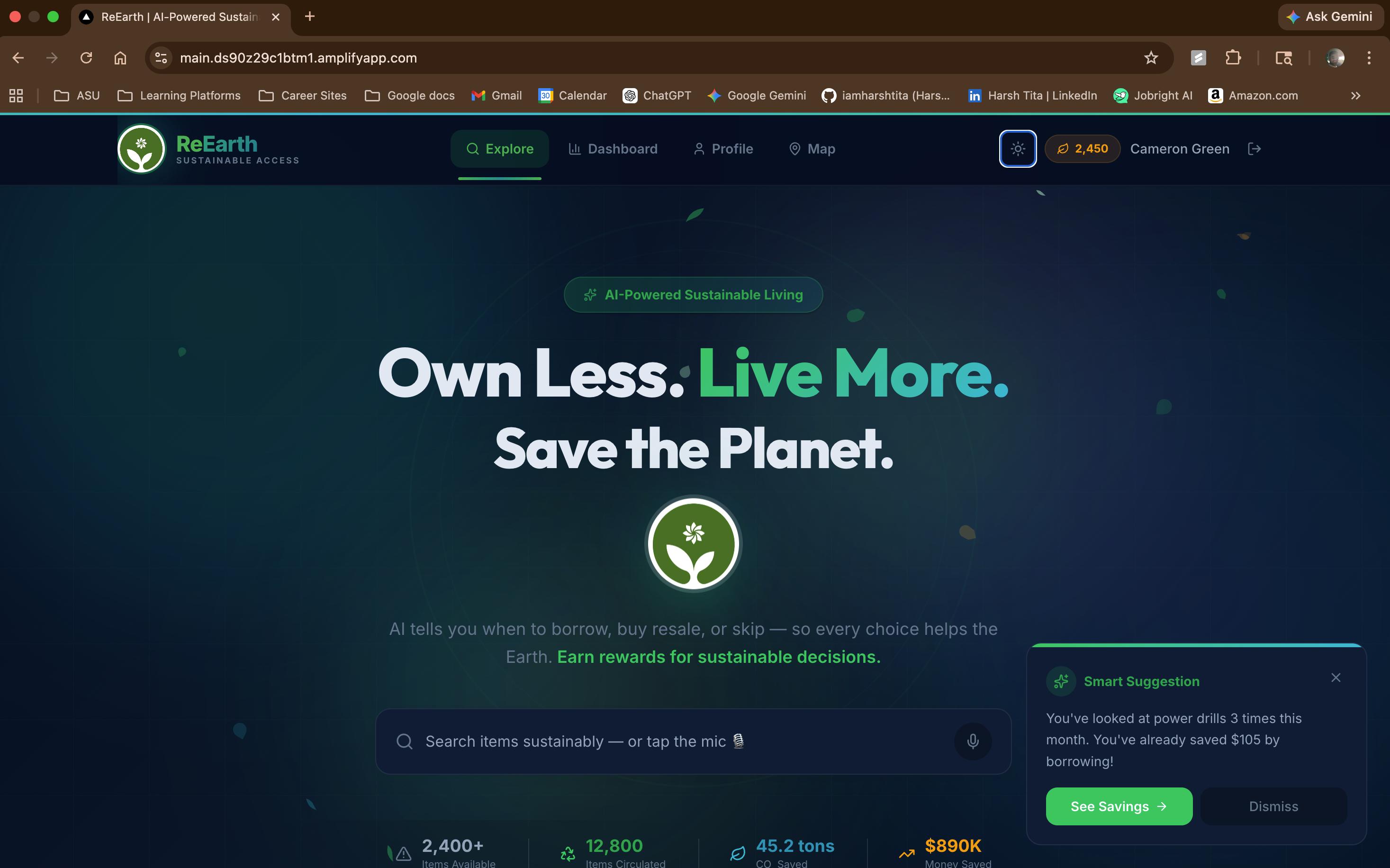
Dark mode feature of our app.
Inspiration
We look around today and see a world dominated by hyper-consumerism, fast fashion, and e-waste. The traditional model of "buy, use once, store forever" is fundamentally breaking our planet. We wanted to build something that shifts the narrative from the restrictive "stop buying things" to a more empowering Access Economy.
The inspiration for ReEarth came from the idea that sustainability shouldn't be a sacrifice rather it should be smart, seamless, and rewarding. We wanted to use AI not just to sell more products, but to fundamentally optimize how we consume, guiding users toward borrowing or buying resale, and rewarding them for making the green choice.
Additionally, we were inspired by behavioral economics, the idea that small nudges and incentives can drastically change human decision-making. ReEarth applies this by making sustainable choices the easiest and most rewarding option.
What it does
ReEarth is an AI-powered sustainable access platform that helps users decide whether to borrow, buy resale, or skip a purchase entirely.
When a user searches for an item, our AI Decision Engine analyzes the intent and recommends the most eco-friendly and economical route. If they choose to proceed, they can rent the item by the day or buy it secondhand.
Every sustainable transaction calculates the actual carbon emissions saved and rewards the user with "Green Points." Our CO₂ tracker uses the following formula to calculate your net positive impact:
$$\Delta CO_2 = \sum_{i=1}^{n} \left[ E_{mfg}(i) - \left( E_{ops}(i) + d_i \cdot \epsilon_{transport} \right) \right]$$
Where \(E_{mfg}\) is the avoided emissions of manufacturing a brand new item, \(E_{ops}\) represents the operational carbon cost of processing the resale/rental, and \(d_i \cdot \epsilon_{transport}\) calculates the last-mile delivery emissions for the transaction.
We also incorporate a lightweight scoring model to rank recommendations:
\( Score = w_1 \cdot Cost + w_2 \cdot Convenience + w_3 \cdot CO_2^{saved} \)
Users can view local listings on an interactive map, track their lifetime environmental impact on a personalized dashboard, and get gentle lifecycle nudges to keep the circular economy flowing.
The system:
- Analyzes user search intent using AI
- Recommends the most sustainable option
- Tracks CO₂ savings
- Rewards users with green points
- Provides voice search and map-based item discovery
We estimate carbon savings using:
$$ CO_2^{saved} = CO_2^{new} - CO_2^{reuse} $$
We also model sustainable consumption efficiency as:
\( Sustainability\ Score = \frac{Utility}{Environmental\ Impact} \)
How we built it
We architected ReEarth as a fully serverless, event-driven platform on AWS, prioritizing scalability and separation of concerns.
- Frontend: We built a highly responsive UI using Next.js 16, utilizing React components for things like the
RecommendationBadgeandNudgeAlert. This is fully deployed and hosted on AWS Amplify. - Backend Infrastructure: Everything is provisioned as Infrastructure as Code (IaC) using AWS CDK (TypeScript). We deployed 12 independent Python Lambda functions, each handling a single domain behind an AWS API Gateway. Data is stored in 5 distinct Amazon DynamoDB tables.
- The Brains (AI & Voice): We integrated Amazon Bedrock (Nova Lite) to power our natural language search and the intelligent decision engine. For accessibility, we used ElevenLabs for text-to-speech voice narrations, storing audio assets in S3.
- Third-Party Integrations: We secured the platform using Auth0 with a custom JWT Lambda Authorizer. Payments are handled via Stripe Checkout, and we leveraged Amazon Location Service for mapping nearby listings.
We followed a strict microservices + least-privilege IAM model, ensuring each Lambda function only accesses the resources it absolutely needs.
Challenges we ran into
Integrating so many distinct cloud services and external APIs within a hackathon timeframe was a massive hurdle.
- Serverless Security: Setting up the Auth0 RS256 JWT validation inside a custom Lambda Authorizer required meticulous IAM role and permission tuning to ensure zero-trust security without breaking the frontend flow.
- Prompt Engineering the Decision Engine: Getting Amazon Bedrock to consistently output structured, helpful advice (Borrow vs. Buy vs. Skip) rather than generic text required heavy prompt refinement and guardrails.
- State Management: Syncing the Next.js frontend state with the asynchronous backend events especially updating the user's real-time eco-score dashboard immediately after a Stripe checkout event proved tricky to get right.
- Latency Optimization: Coordinating multiple services (Bedrock, DynamoDB, Stripe, Lambda) without degrading user experience required careful API design and response handling.
Accomplishments that we're proud of
We are incredibly proud of building a truly production-ready, full-stack application.
A user can speak into their microphone, have ElevenLabs and Bedrock process their query, view dynamically retrieved DynamoDB listings mapped via Amazon Location Service, and securely check out with Stripe.
Building a 12-microservice backend with strict least-privilege IAM roles via AWS CDK from scratch is a massive technical win for our team.
We also successfully combined AI + sustainability + marketplace + behavioral nudges into one cohesive platform which is something rarely seen in typical hackathon projects.
What we learned
- AWS CDK is a superpower. Defining our infrastructure in TypeScript allowed us to rapidly tear down and rebuild our environment without clicking through the AWS console.
- AI for Behavioral Economics: Presenting users with the quantifiable environmental impact before they click buy is a powerful psychological tool for reducing impulsive consumption.
- Seamless Audio Streams: Managing audio buffers from ElevenLabs, storing them in S3, and serving them rapidly to the Next.js frontend taught us a lot about handling binary data in serverless environments.
- System Design at Scale: Designing loosely coupled microservices significantly improves maintainability and scalability.
What's next for ReEarth: AI Sustainable Access Economy
- Peer-to-Peer (P2P) Lending: Expanding the platform so users can effortlessly list their own underutilized items using AI-assisted image recognition to auto-fill product details.
- Carbon Offsets: Integrating an API to allow users to spend their accumulated "Green Points" on verified global carbon offset projects directly within the dashboard.
- Native Mobile App: Porting the Next.js web application to React Native to take full advantage of native device cameras and push notifications for return reminders and local geo-fencing alerts.
- Hyper-Personalized AI: Using historical user behavior to build predictive models that proactively suggest sustainable alternatives before a user even searches.
- Community Layer: Building local sustainability communities where users can share, review, and collaborate within neighborhoods.
- AI Return Inspection (Video Upload): In the future, borrowers will be able to upload a return video of the item, and our AI model will analyze the video for damages, defects, or missing components before the item is returned to the lender, ensuring trust and transparency in the peer-to-peer lending process.
Our long-term vision is to make access better than ownership and turn sustainability into the default global behavior.
Built With
- amazon-bedrock
- amazon-cdk
- amazon-cloudwatch
- amazon-dynamodb
- amazon-location-service
- amazon-web-services
- amplify
- api
- auth0
- aws-amplify
- aws-api-gateway
- aws-cdk
- aws-iam
- aws-kms
- aws-secrets-manager
- awslambda
- bedrock
- css
- database
- dynamodb
- elevenlabs
- iam
- nextjs
- s3-buckets
- stripe
- tailwind
- typescript

Log in or sign up for Devpost to join the conversation.