Inspiration
Emissions from ruminant livestock in California are responsible for ≈40% of the state's total methane emissions. As a California-based company, this is scary for us. This fear led us to fall in hate with this problem and we devoted our time to find a solution. Methane is a greenhouse gas produced by cows during digestion and is about 28 times more potent than carbon dioxide as a contributor to global warming. This discovery is what inspired us to start our company. With our mission to reduce emissions from ruminant livestock, we are determined to positively impact the environment.
What it does
We discovered that supplementing cow feed with red seaweed could reduce methane emissions from cows by up to 80%. Asparagopsis taxiformis is a type of red seaweed that grows in warm waters around the world. It has been found to be very effective in reducing methane emissions when used as a supplementation in cow feed. A bioactive substance made by the Asparagopsis Taxiformis species of seaweed called bromoform stops methane production by blocking a particular enzyme in the gut during feed digestion. This substance isn’t included in regular cow feed which is why these methane emissions are so high. Supplying the cows with this seaweed could not only reduce methane emissions but also provide other nutrients for the cows that their regular feed does not have. This might be a great way to help reduce the impact of cattle farming on the environment.
How we built it
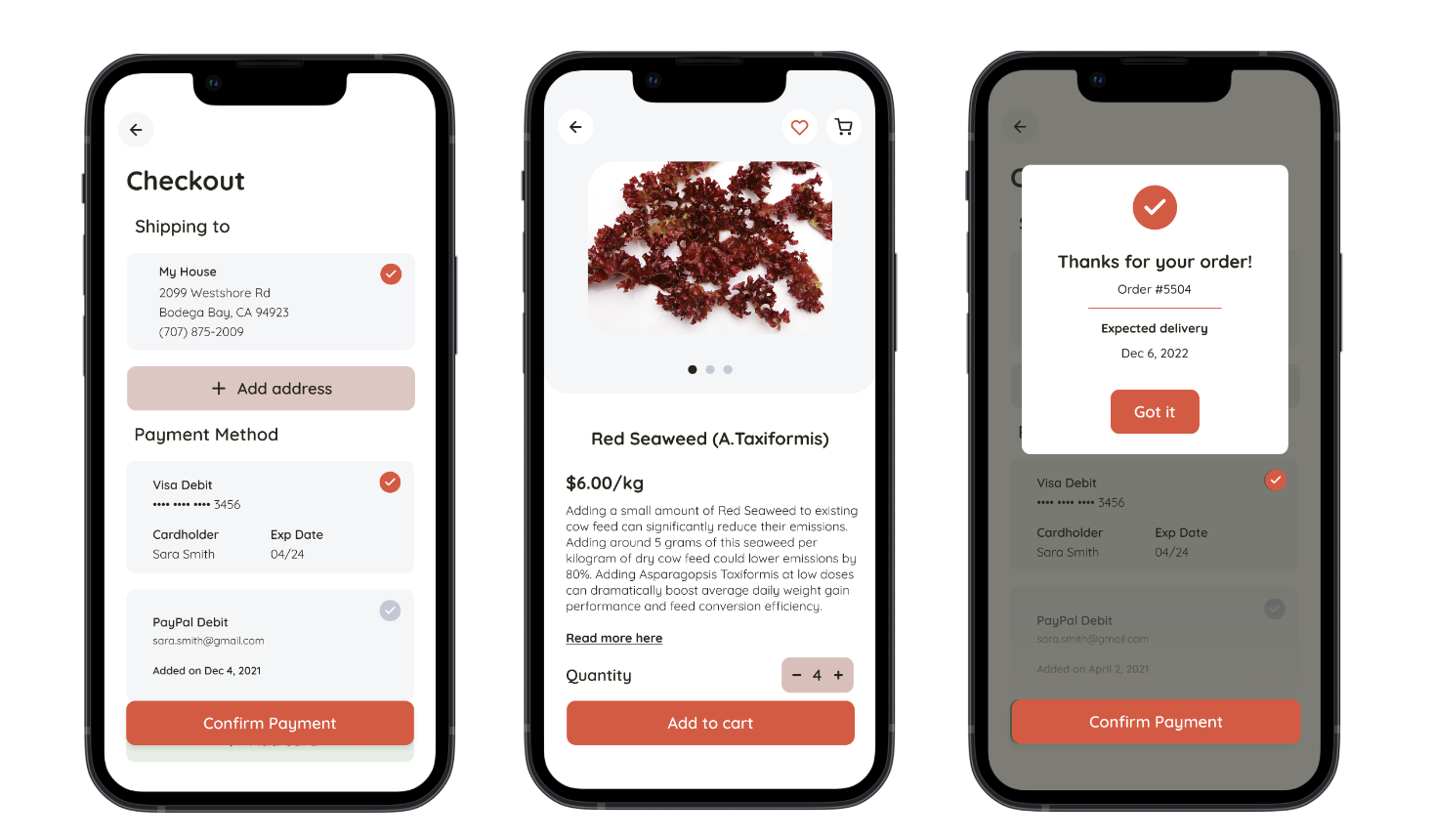
We are developing an app that allows farms in California to purchase seaweed in a powder form so that distributing Asparagopsis taxiformis is much more effective and intuitive
Challenges we ran into
One of the biggest challenges we ran into was managing multiple tasks at once and ensuring each task was completed on time. We had to learn how to prioritize tasks and delegate them to different team members in order to ensure that everything was finished on time. We also had to develop new systems and processes to help me keep track of everything and stay organized, especially when it came to developing the UI, putting together our pitch deck, and most importantly, getting good-quality feedback. Finally, we faced a challenge in finding ways to motivate the team to stay on track and meet deadlines. We had to learn how to provide support and encouragement to each other in order to ensure that everyone was working towards the same goal, and ultimately we are super proud of what we put together and how we came together as a team!
Accomplishments that we're proud of
Our biggest accomplishment from this hackathon was the successful completion of the project. We were able to develop an MVP for an application that allowed farmers to easily connect with Asparagopsis Taxiformis producers to securely purchase feed additives for a low cost. Additionally, we were able to collaborate and create a thorough memo of our entire idea and execution during the allotted time, which we're very proud of. Lastly, the hackathon gave us the opportunity to network with other hackers and learn new skills and ideas. We’re also proud that covered pretty much all aspects of the rubric, but most importantly touching on how indigenous people can get involved as farming is an extremely abundant opportunity, specifically for tribes in California. We found that with our idea, the gross income rate for the new aquaculture system could increase which gives a massive opportunity for indigenous people as well.
What we learned
We learned a lot from this hackathon, including the importance of teamwork, creative problem-solving, and staying organized. We also learned a lot of new UI techniques and improved our ML skills when testing out different datasets to predict a rough estimate of our cost if we expanded this throughout California. Additionally, we got to practice working with a team and collaborating on ideas, which along with networking, was our favorite part of the social and community experience. Overall, this hackathon was a great learning journey that we will carry with us into future endeavors!
What's next for Redtide Farming
We created an in-depth implementation plan that consists of 4 different phases which would then be our potential next steps for our startup.
Phase 1- Research and development in plant Culture and infrastructure.
Phase 2- Trial run in California with the Straus Family Creamery lab.
Phase 3- We launch the first 5-6 lab farms on the west coast of California to distribute the red seaweed more effectively.
Phase 4- Expanding our farms and our startup to the entirety of California to provide asparagopsis taxiformis to most/all cow farms.
Team
All of us come from different parts of the world accompanied by varying experiences. Where we live and the skillsets we already had were put to good use during this hackathon. Our team member, Sharana, had a scope on the issue because she lives in California and understands America's reliance on the burger industry. On the other hand, Girik and Sambhav, from Canada brought in a realistic perspective on the issue and how implementation would work. Rather than thinking "adding seaweed will solve this problem", we ventured deep into the underlying technical issues with the implementation of our solution: the production. Our aim was not to create a solution but to have one ready to be executed. Girik helped us build out the financial aspect and keep cheap costs and a profitable business model in mind, while Sambhav brought in the scientific specifics on how the red seaweed would improve cow diets. Sharana contributed by researching different production methods.
Built With
- ai
- figma
- machine-learning
- python


Log in or sign up for Devpost to join the conversation.