-
-
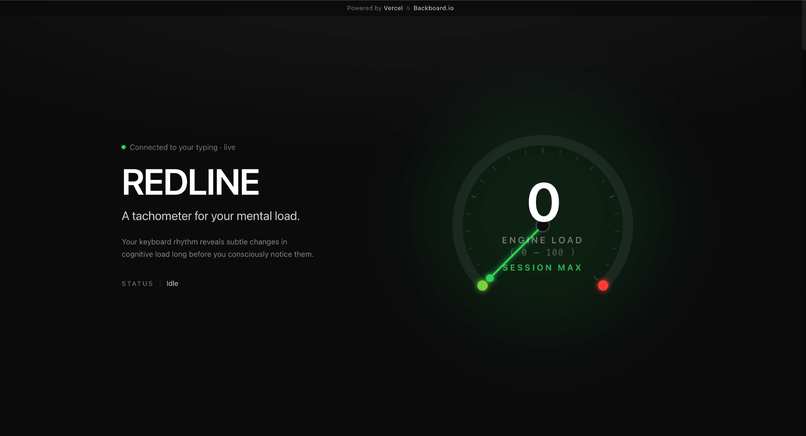
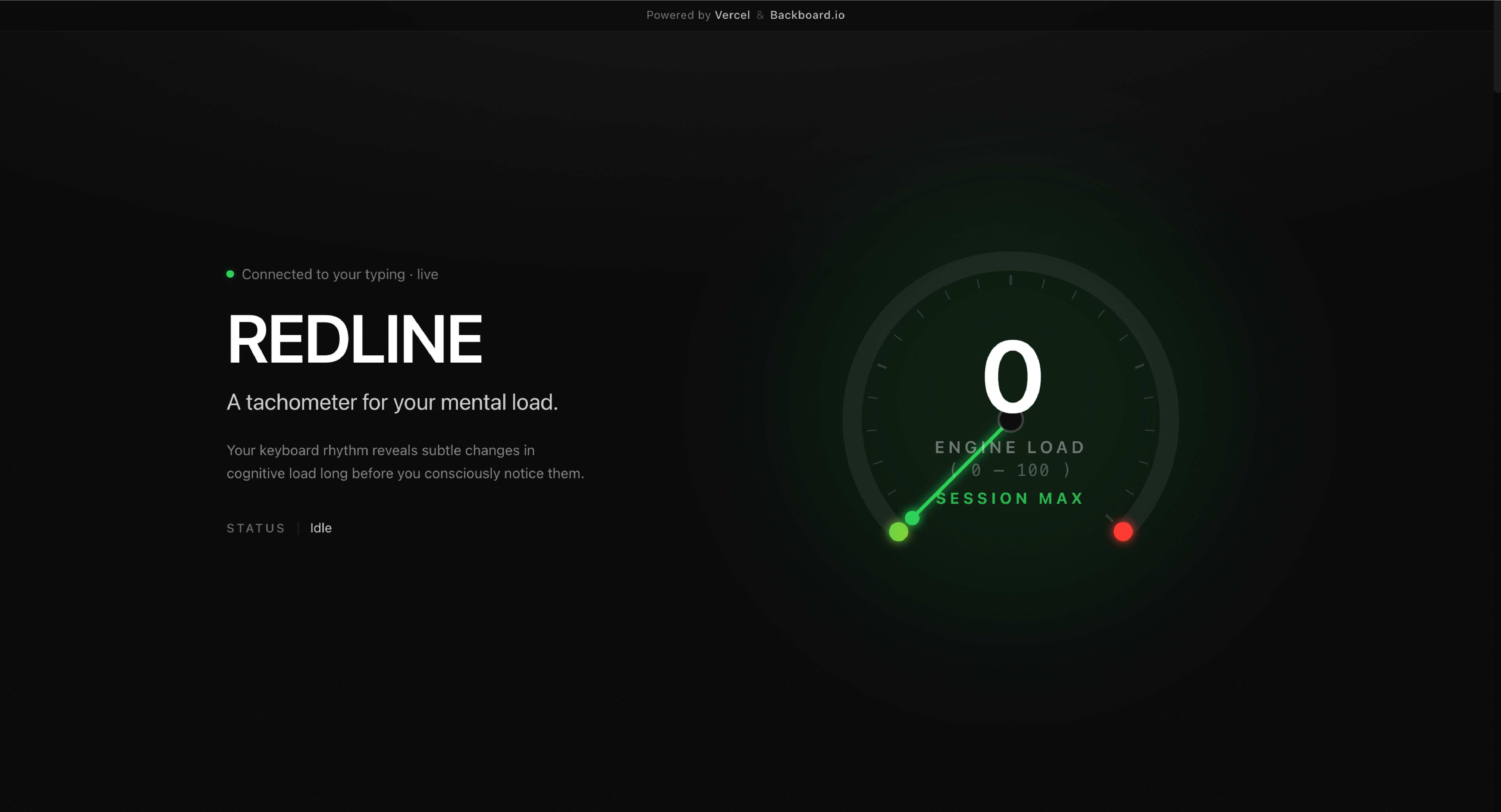
Redline Dashboard (Stress-Level Engine Score)
-
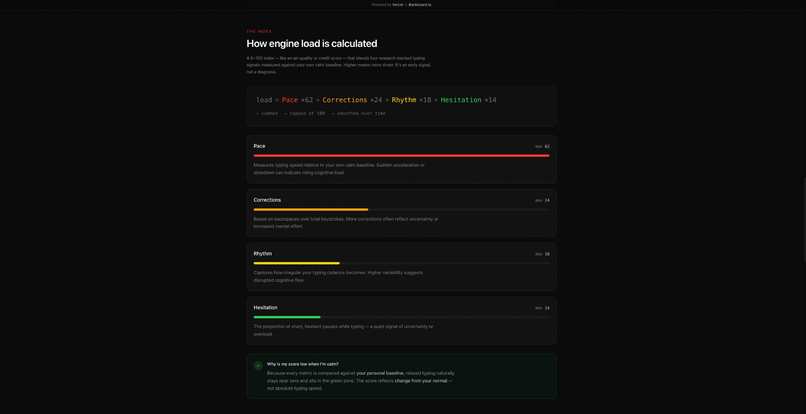
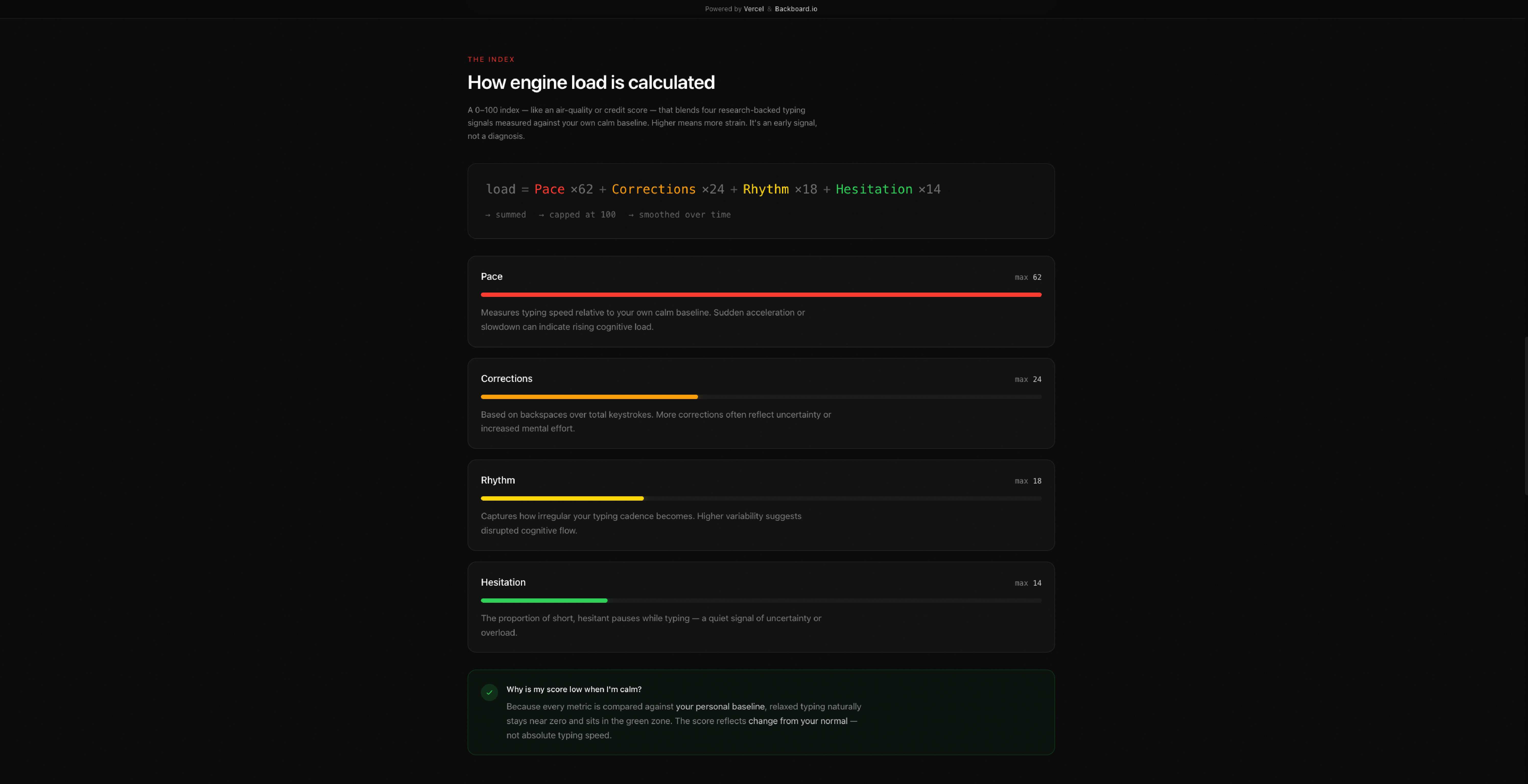
Data Processing (Engine Score Calculations)
Inspiration
Burnout usually isn't recognized until it's already become a serious problem. We asked ourselves whether there was a way to detect it earlier, and found the answer in something people already do every day: typing. Decades of research show that stress leaves measurable fingerprints on keystroke behavior. Acute stress often causes people to type in fast, error-prone bursts, while mental fatigue and cognitive overload lead to slower typing, longer hesitations, and more corrections. Researchers at ETH Zurich found that stressed typists also pause more frequently than relaxed ones, making typing patterns a surprisingly reliable behavioral signal. That means your keyboard can function like a check-engine light for mental strain, surfacing changes before you're even aware of them. We built our system around this idea, transforming an everyday activity into a passive, privacy-conscious early warning signal with no surveys, wearables, or interruptions required.
What it does
Redline is a check engine light for your mind. You turn it on before you start writing, and a small tachometer appears on the page that reads your typing timing, never your actual words. It scores your mental load from 0 to 100 by combining four signals from your keystrokes, each weighted by how strongly it reflects strain: pace contributes up to 62 points, corrections up to 24, rhythm up to 18, and hesitation up to 14, summed and capped at 100. Every one of those signals is measured against your own calm baseline, which you set during a short calibration, so the score reflects how far you have drifted from your normal rather than how fast you happen to type. As that drift grows, the needle climbs from green into the redline. When you finish a session, an AI coach reviews it and suggests a few simple ways to recover, and a dashboard turns the data into trends you can actually see.
How we built it
We built two pieces that talk to each other. The first is a Chrome extension, written in plain JavaScript, that listens to the timing between your keystrokes (never the characters), turns it into the four signals, and renders the live tachometer in a shadow DOM so no website's styling can break it. A quick three round calibration learns your calm baseline first. The second is the dashboard, built with Next.js, React, Tailwind, and Framer Motion, with all the gauges and charts hand drawn as animated SVG. The AI coach runs server side through Backboard so it can remember your history across sessions, and the whole thing is deployed on Vercel. The extension and the website stay in sync through a small bridge, so the dashboard shows your real recorded data instead of a mockup.
Challenges we ran into
Honestly, a lot. Our first scoring attempt averaged over too long a window, so the needle barely moved when you sped up and the whole thing felt broken, which forced us to rebuild it around your most recent keystrokes instead. The calibration had a sneaky bug where typing during the gap between rounds skipped rounds and threw off the math, so slow typing somehow scored high. Chrome fought us too, since one attempt to make the gauge appear everywhere quietly reset the extension's permissions and stopped it from loading at all. And getting the dashboard to stay in sync with what the extension actually recorded took a few tries, because reloading the extension would silently disconnect any open tab. Most of the work was less about building features and more about making the signal trustworthy.
Accomplishments that we're proud of
The thing we are proudest of is the demo moment that makes people lean in: you flip the toggle, type a calm sentence and the needle sits in the green, then type fast and frantic with a bunch of backspaces and it visibly swings into the redline, live, with no faked data. Beyond that, we are proud that it stays genuinely private by reading timing instead of content, that the score is grounded in real research rather than a vibe, and that the coach gives warm, useful advice instead of a clinical label. And we managed to make it actually look and feel like a real product, not a hackathon prototype.
What we learned
We learned that the keyboard is a surprisingly honest window into how someone is doing, and that the trick is comparing against a person's own baseline rather than chasing a universal threshold, since calm looks different for everyone. We picked up a lot about the quirks of building a Chrome extension, from capturing keystroke timing to how easily the wrong permission can break everything. We also learned that framing matters: a "stress score" sounds made up until you treat it like an air quality index or a credit score, an invented scale built on real inputs, and then it clicks. Most of all, we learned to be careful and honest in this space, and to present Redline as an early signal worth noticing, not a diagnosis.
What's next for Redline
This is a hackathon project, so what we built is really just the first signal, and there is so much room to grow. With more time, we want to fold in many more inputs and tailor the picture of someone's mental state far more precisely. A natural next step is mouse movement, since research already shows that stressed people move the pointer more erratically and less directly. We also want to bring in wearables like Omi's watch, so physical signals can sit alongside typing behavior and make the coach's advice even more grounded. The bigger goal is to keep layering gentle, passive signals until Redline can genuinely help people understand themselves and make small changes that add up to better lives.
Built With
- backboard
- chrome
- framer-motion
- javascript
- next.js
- node.js
- react.js
- tailwindcss
- typescript
- vercel

Log in or sign up for Devpost to join the conversation.