-
-
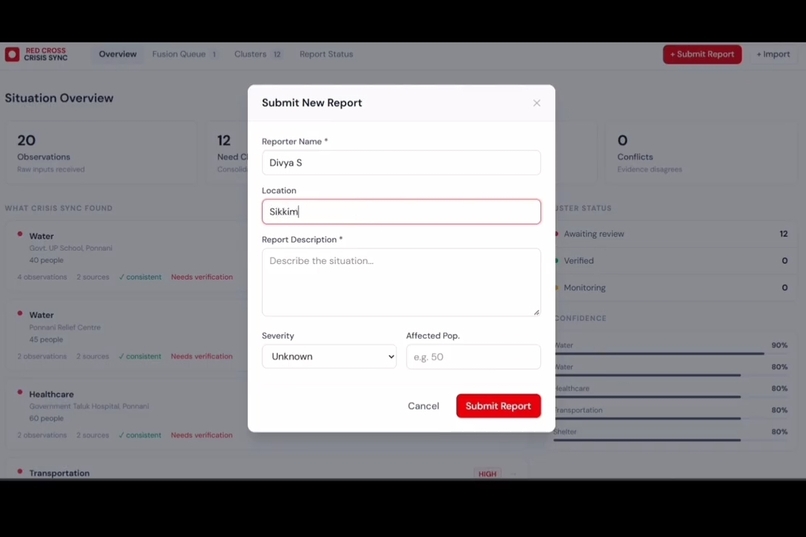
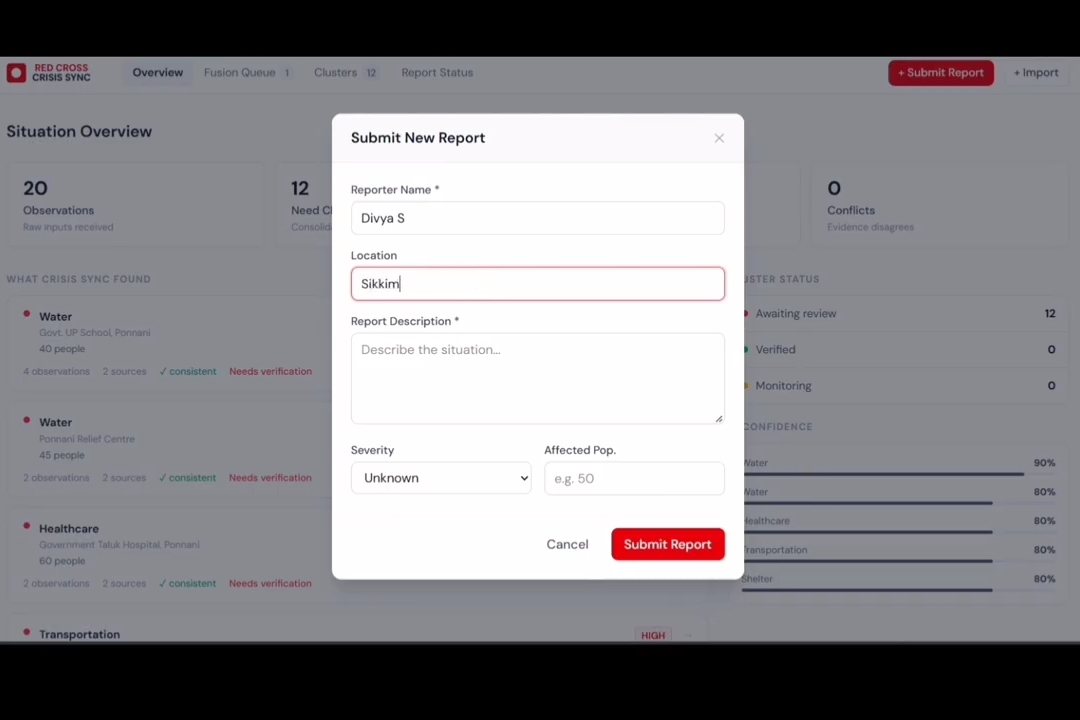
Submit Report
-
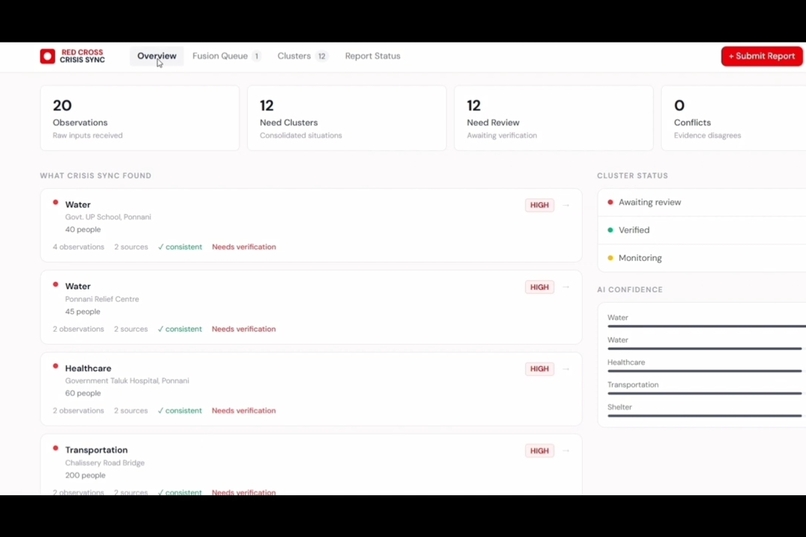
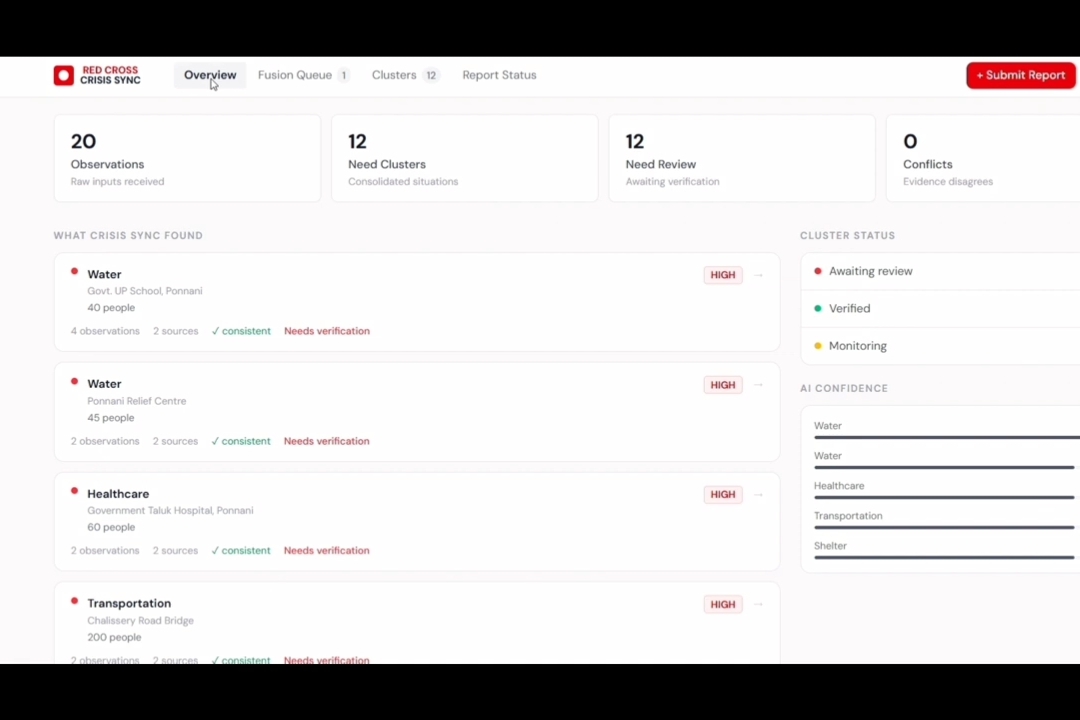
Overview -dashboard
-
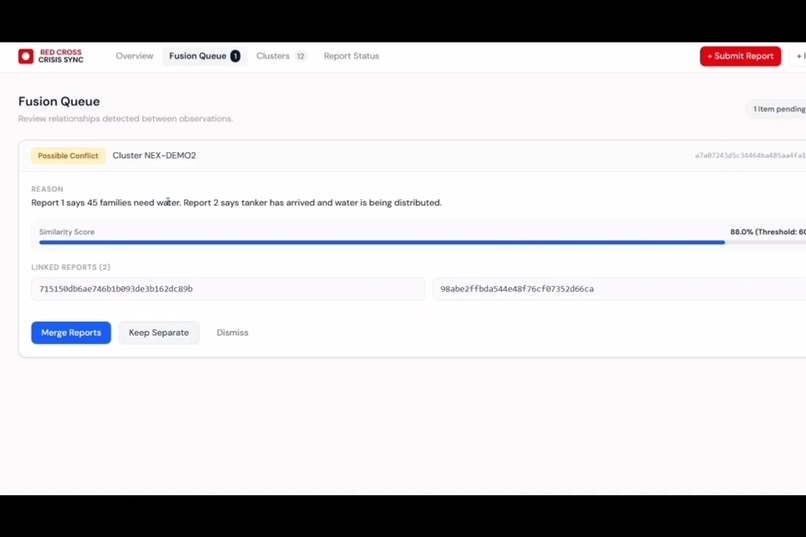
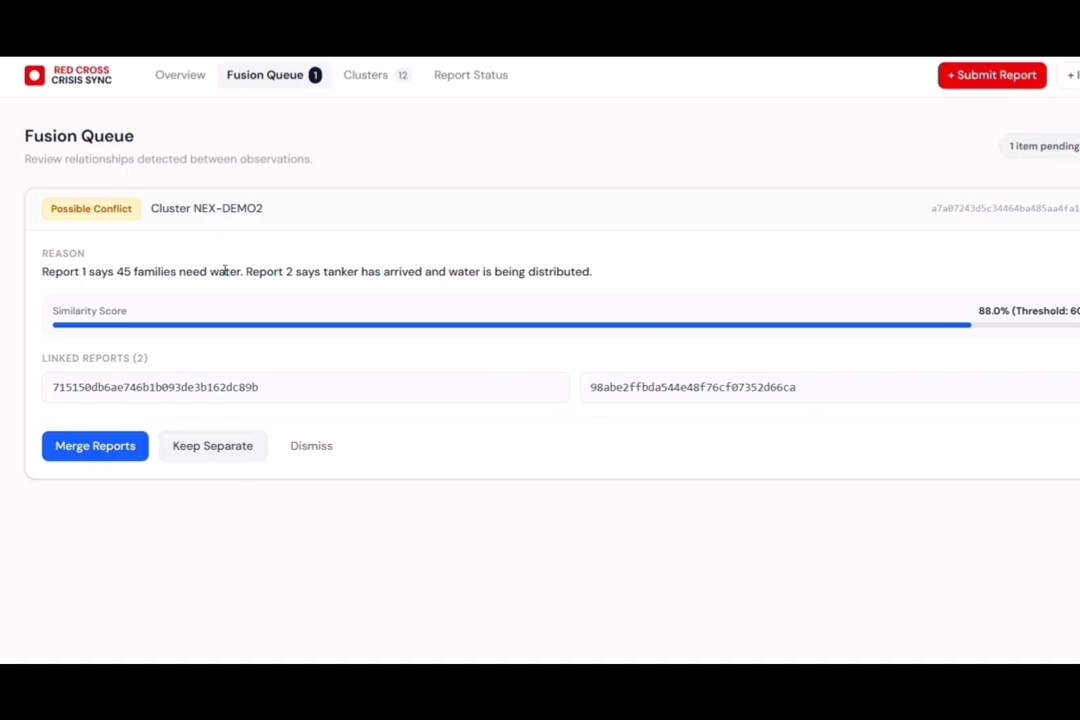
Fusion Queue
-
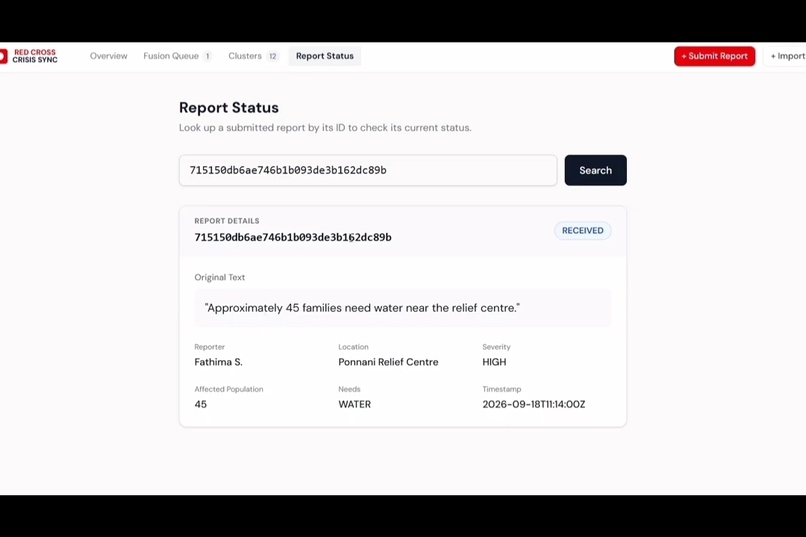
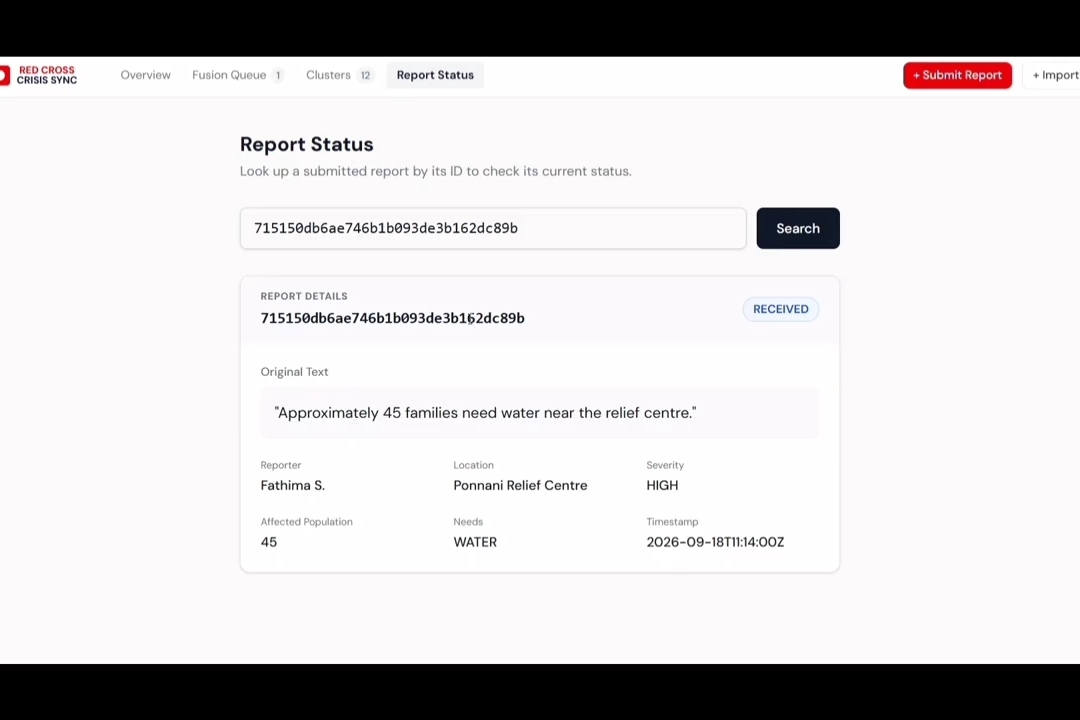
Report Status
-
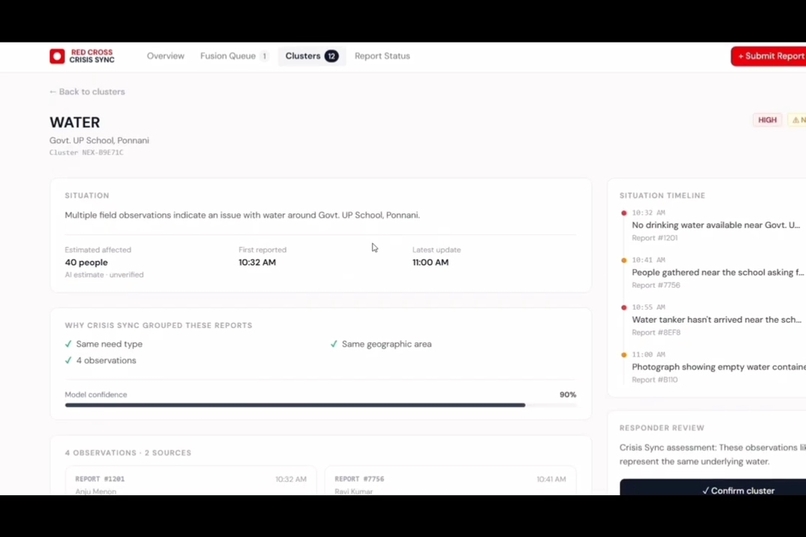
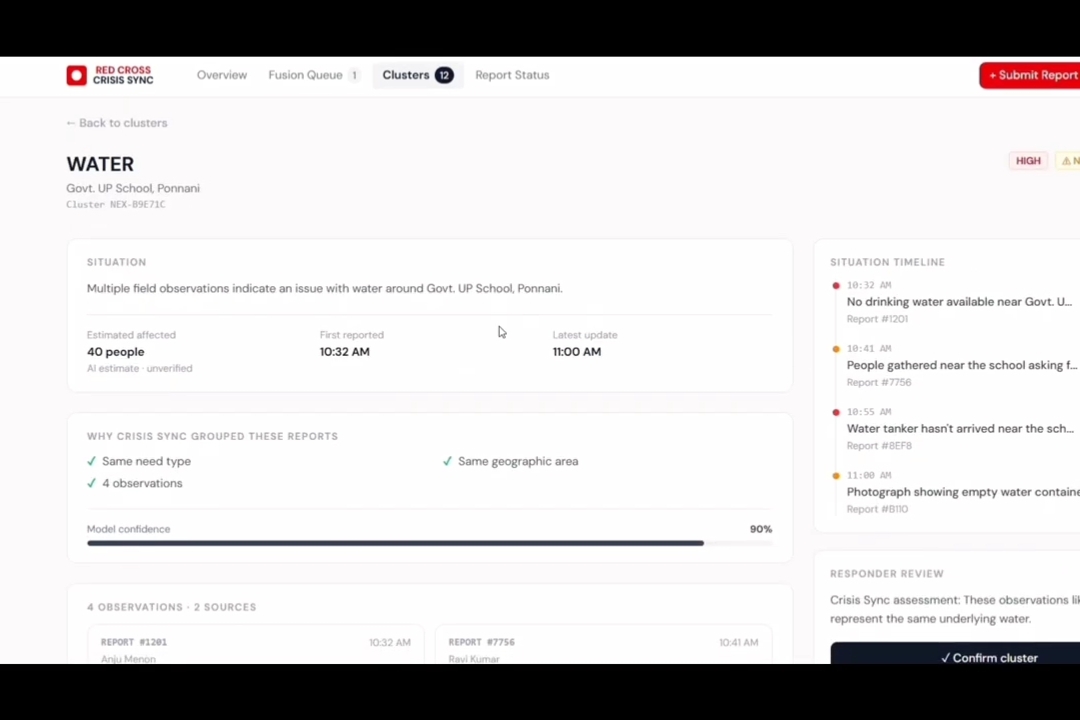
Cluster details
Inspiration
During disasters and humanitarian emergencies, the International Federation of Red Cross and Red Crescent Societies (IFRC) and National Societies have to deal with large amounts of information about the needs of affected communities. Field reports can be unstructured, incomplete, and difficult to process quickly.
We were inspired by the idea of using AI to help the humanitarian response ecosystem turn these reports into clear, structured information about essential needs. Our main goal with RedCross CrisisSync is to support the IFRC's humanitarian mission by making the process of understanding and organizing needs faster and more efficient.
What it does
RedCross CrisisSync is an AI-powered humanitarian needs assessment and coordination platform.
Users can submit reports describing the conditions and requirements of affected communities. The system uses AI to analyze these reports and identify essential needs such as:
- Food
- Water
- Shelter
- Medical assistance
- Sanitation
- Clothing
- Other essential relief requirements
The extracted information is presented in a structured format, helping humanitarian teams understand reported needs more efficiently.
Our core workflow is:
$$ \text{Humanitarian Report} \rightarrow \text{AI Analysis} \rightarrow \text{Need Extraction} \rightarrow \text{Structured Information} $$
The broader vision is to develop this into a solution that can support IFRC and Red Cross/Red Crescent National Societies in humanitarian information management and response coordination.
How we built it
We built RedCross CrisisSync as a full-stack web application.
Frontend
- React
- TypeScript
- Vite
- Tailwind CSS
Backend
- Python
- FastAPI
- Pydantic
- Uvicorn
AI
- Google Gemini API
The React frontend provides the user interface, while the FastAPI backend manages application logic, REST APIs, data processing, and communication with the Gemini API.
We designed the system so that a humanitarian report can move through the complete pipeline—from submission to AI analysis and structured presentation—within a single platform.
Challenges we ran into
One of our biggest challenges was dealing with the ambiguity and variability of humanitarian reports. Real-world reports may contain incomplete information, different descriptions of the same need, or information that requires human interpretation.
Another challenge was ensuring that AI-generated results are useful without treating them as unquestionable facts. This made us think carefully about the role of AI in humanitarian applications: AI should assist humanitarian personnel, not replace their judgment.
We also faced technical challenges while integrating a React frontend, FastAPI backend, REST APIs, and the Gemini AI service into one working system.
Accomplishments that we're proud of
We are proud of turning an idea focused on humanitarian information overload into a working AI-powered full-stack platform.
Our key accomplishments include:
- Building a functional web-based humanitarian needs assessment system.
- Integrating Google Gemini into a real-world humanitarian workflow.
- Connecting a React/TypeScript frontend with a Python/FastAPI backend.
- Creating a structured process for extracting essential needs from reports.
- Designing the project with the IFRC and Red Cross/Red Crescent humanitarian ecosystem as the long-term target.
- Demonstrating how generative AI can be applied beyond conversational interfaces to support humanitarian information management.
Most importantly, we are proud that the project focuses on a meaningful problem where better information processing can potentially support people affected by disasters.
What we learned
RedCross CrisisSync taught us that building an AI application is not simply about connecting an API to a user interface.
We learned how to:
- Integrate generative AI into a practical workflow.
- Build and connect a modern React frontend with a FastAPI backend.
- Design REST APIs for communication between application components.
- Process unstructured information into structured data.
- Think about AI reliability, ambiguity, and human verification.
- Design technology around the needs of a real-world humanitarian ecosystem.
- Consider how a prototype can evolve toward a larger-scale platform suitable for organizations such as IFRC.
Most importantly, we learned that responsible AI in humanitarian settings must keep humans in the loop.
What's next for RedCross CrisisSync
Our next goal is to move RedCross CrisisSync from a prototype toward a more robust humanitarian information platform aligned with the needs of the IFRC and Red Cross/Red Crescent National Societies.
Future development could include:
- More robust humanitarian needs classification.
- Multilingual and voice-based report submission.
- Improved handling of incomplete and conflicting reports.
- Stronger validation and human-review mechanisms for AI-generated results.
- Secure authentication and role-based access.
- Persistent, scalable data storage.
- Integration with existing humanitarian information systems and workflows.
- Analytics to help identify changing patterns in reported needs.
- Evaluation with realistic humanitarian datasets and, where possible, feedback from humanitarian practitioners.
Our long-term vision is for RedCross CrisisSync to become a reliable AI-assisted layer for humanitarian needs information—helping IFRC and its network process critical information faster while keeping humanitarian expertise and decision-making at the center.
Built With
- ai/ml
- api-integration
- bycrypt
- fastapi
- gemini-api
- javascript
- npm
- pydantic
- pytest
- python
- react
- restapi
- tailwindcss
- typescript
- uvicorn
- vercel
- vite


Log in or sign up for Devpost to join the conversation.