-
-
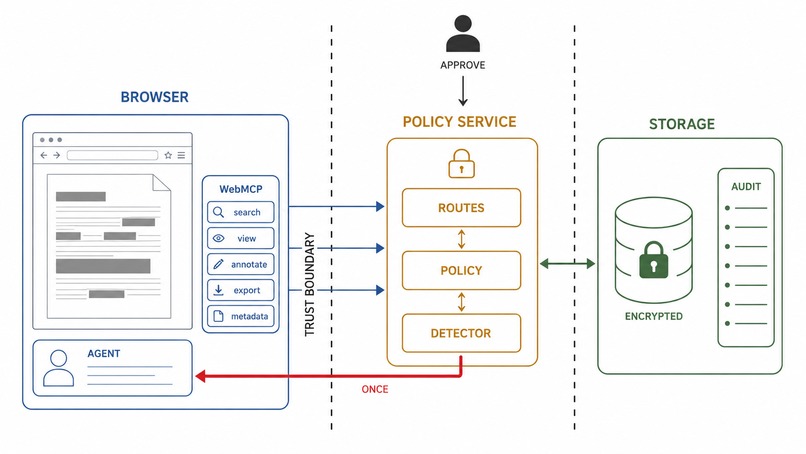
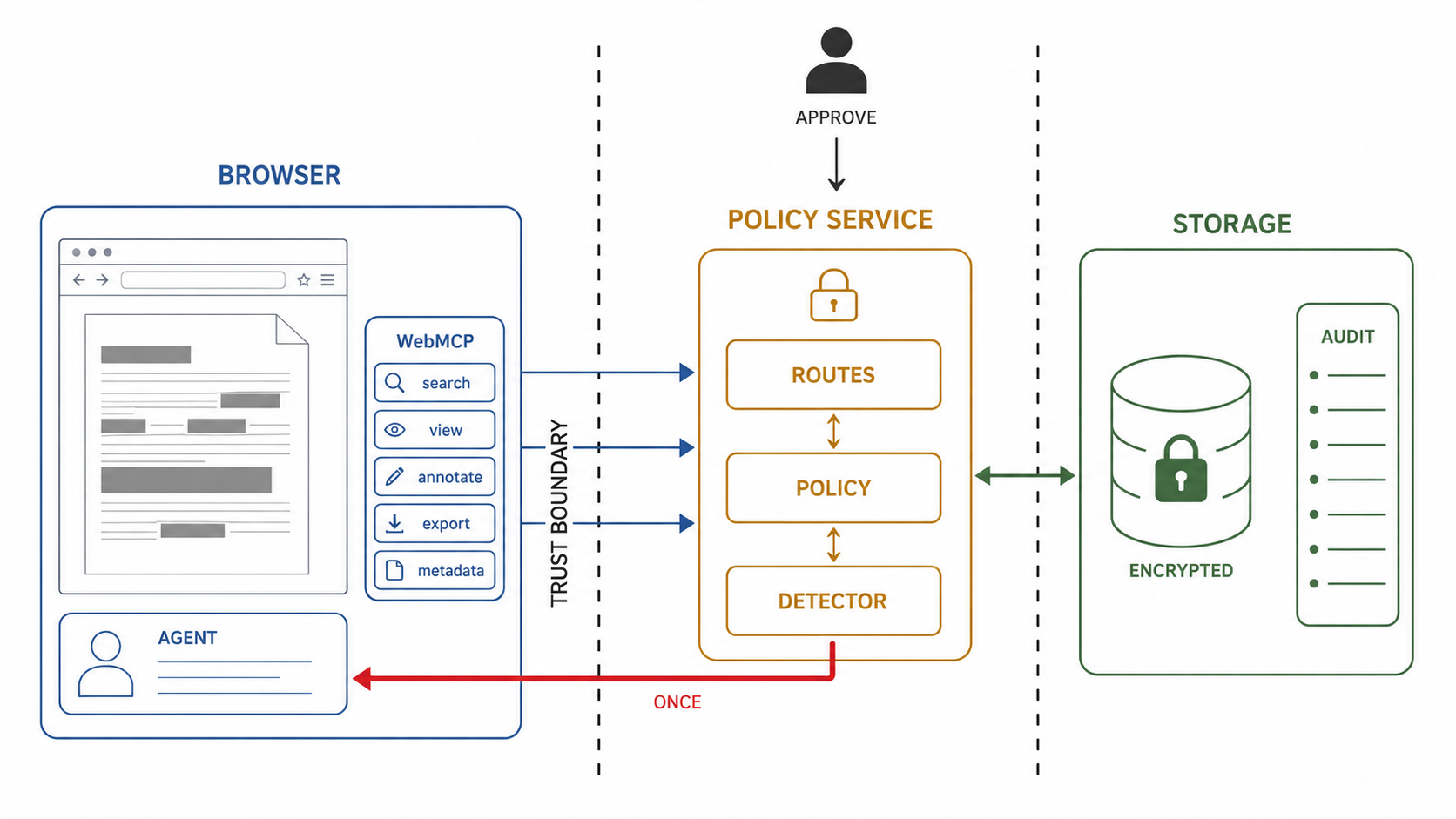
arhitecture
Inspiration
WebMCP lets browser-based AI agents call tools directly on the page a user is looking at — which is powerful, but also a little terrifying when that page contains sensitive documents. Redaction tools today assume a human is the only reader. The moment an agent can call verify_field or read_document, redaction stops being a UI concern and becomes a security boundary problem: what happens when the "user" reading your masked document is an LLM that can be prompted, jailbroken, or simply mistaken?
We built Redactly to answer that question directly: can a document viewer expose real WebMCP tools to an agent — verify, request-unmask, challenge a redaction — without ever letting a raw sensitive value leak into the DOM, browser storage, logs, or an agent's context by accident?
What it does
Redactly is a document viewer that exposes five WebMCP tools bound to the currently open document:
request_document_view— returns the masked document, paginated by cursor.verify_without_reveal— lets an agent check whether a guessed value matches a redacted field without ever returning the field itself (rate-limited, so it can't be used as a brute-force oracle).request_field_unmask— asks a human owner to approve revealing a specific field. Approval creates a grant that can be consumed exactly once; a second attempt returnsalready_consumed, not the value.challenge_redaction— lets an agent argue a field was mis-classified (e.g., a false-positive PII detection). A human approval flips the field to non-sensitive for that session only — it never rewrites the underlying model's global output.get_redaction_audit_log— a read-only, cursor-paginated trail of every view, verification, unmask, and challenge event.
Every reveal is a server-side, at-most-once event: once a value is returned to a tool call, Redactly has no way to un-send it, so the whole system is designed around never handing it out casually. A same-page approval modal drives the human side of the demo; in a production deployment that approval channel would move out-of-band, since a browser agent could otherwise observe the same page the human is approving on.
How we built it
- Frontend: Next.js App Router, with the document viewer as the sole route the WebMCP tools are registered against — tools are torn down on unmount, and pending fetches are aborted rather than left running.
- Backend: A FastAPI policy service that owns all raw text, ONNX-based PII detection, and the state machines for reveals and challenges. The detector's raw-inference route is internal-only and deliberately never exposed as a tool.
- Data model: Documents are stored AES-GCM encrypted. Redacted fields are referenced by random per-session
public_refvalues, never a real placeholder-to-value map — so nothing outside the trusted API process can resolve a field back to its text. Equality checks forverify_without_revealgo through a canonical, domain-separated HMAC compared in constant time, so the endpoint can't be turned into a brute-force oracle. - Reveal consumption: Grants are consumed inside a
BEGIN IMMEDIATEtransaction with a conditionalUPDATE ... WHERE state = 'READY', so under concurrent requests exactly one caller gets the value and every other caller getsalready_consumed— verified with a 50-way concurrency test against a synthetic sentinel value. - Audit trail: Every state mutation and its audit event commit in the same transaction, so there's no window where an action succeeds but goes unlogged. Audit metadata is allowlisted so raw values, verification guesses, and session tokens structurally cannot end up there.
Challenges we ran into
The core challenge was designing for an adversarial reader that isn't a browser — it's a language model that might be prompted (by us, by a compromised page, or by the document text itself) to try to exfiltrate a value. That reshaped almost every decision:
- Treating document text itself as untrusted input, since it can contain adversarial instructions aimed at the agent reading it.
- Making sure a "read-only" tool actually is read-only —
verify_without_reveallooks harmless but is a textbook equality oracle if not rate-limited and constant-time. - Deciding that unmask has to be at-most-once, not just access-controlled — because once an agent has a value in its context, revocation is meaningless.
- Keeping model confidence scores out of the normal masked view entirely, while still surfacing them during a challenge review, so the classifier's internals aren't leaking through the "harmless" viewing path.
What we learned
Building for an AI-agent caller changes the security model even when the underlying stack (Next.js, FastAPI, SQLite) is completely ordinary. The interesting design work isn't the CRUD — it's things like proving a reveal grant is consumed exactly once under concurrency, or writing an invariant test that greps every non-reveal response, log line, and audit row for a leaked sentinel value. WebMCP makes it trivially easy to hand an agent real capabilities on your page; it does not make it easy to reason about what an agent will do with them, and that gap is where most of our design time went.
What's next for Redactly
- Move human approval to a genuinely out-of-band channel (push notification / separate authenticated device) so a browser-resident agent can't observe or race the approval UI.
- Add real user authentication and document ownership, replacing the session-cookie isolation used for the hackathon demo.
- Expand the canonicalization rules for
verify_without_revealto more field types (dates, phone formats, addresses) beyond the current type-aware set. - Publish the concurrency and no-raw-leak invariant tests as a reusable test suite other WebMCP tool builders can adapt.
Built With
- ai-agents
- app-router
- fastapi
- mcp
- nextjs
- onnx
- pii-detection
- pydantic
- python
- sqlite
- typescript
- webmcp

Log in or sign up for Devpost to join the conversation.