-
-
Intro
-
Outro
Inspiration
As automation and AI agents become more capable, they are quietly taking over more aspects of our daily lives. Everything from writing emails and scheduling meetings to recommending decisions and generating ideas, is now handled by AI agents.
While these systems increase convenience and productivity, they introduce a subtle psychological risk: people may gradually lose their sense of agency, which is the feeling that they are the ones directing their actions and shaping outcomes.
Psychology research describes the sense of agency as a fundamental part of motivation, confidence, and wellbeing. But today, we have no way to perceive when that sense is weakening.
Act explores this idea by imagining a future where humans gain a new perceptual capability, an ability to feel their agency in an automated world.
What it does
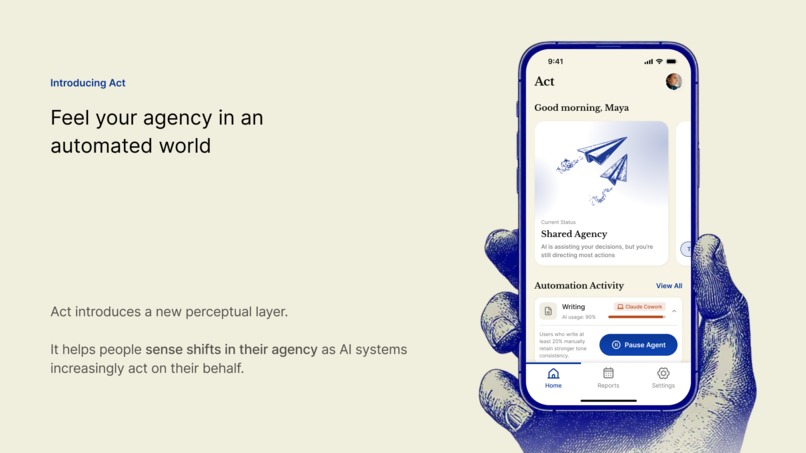
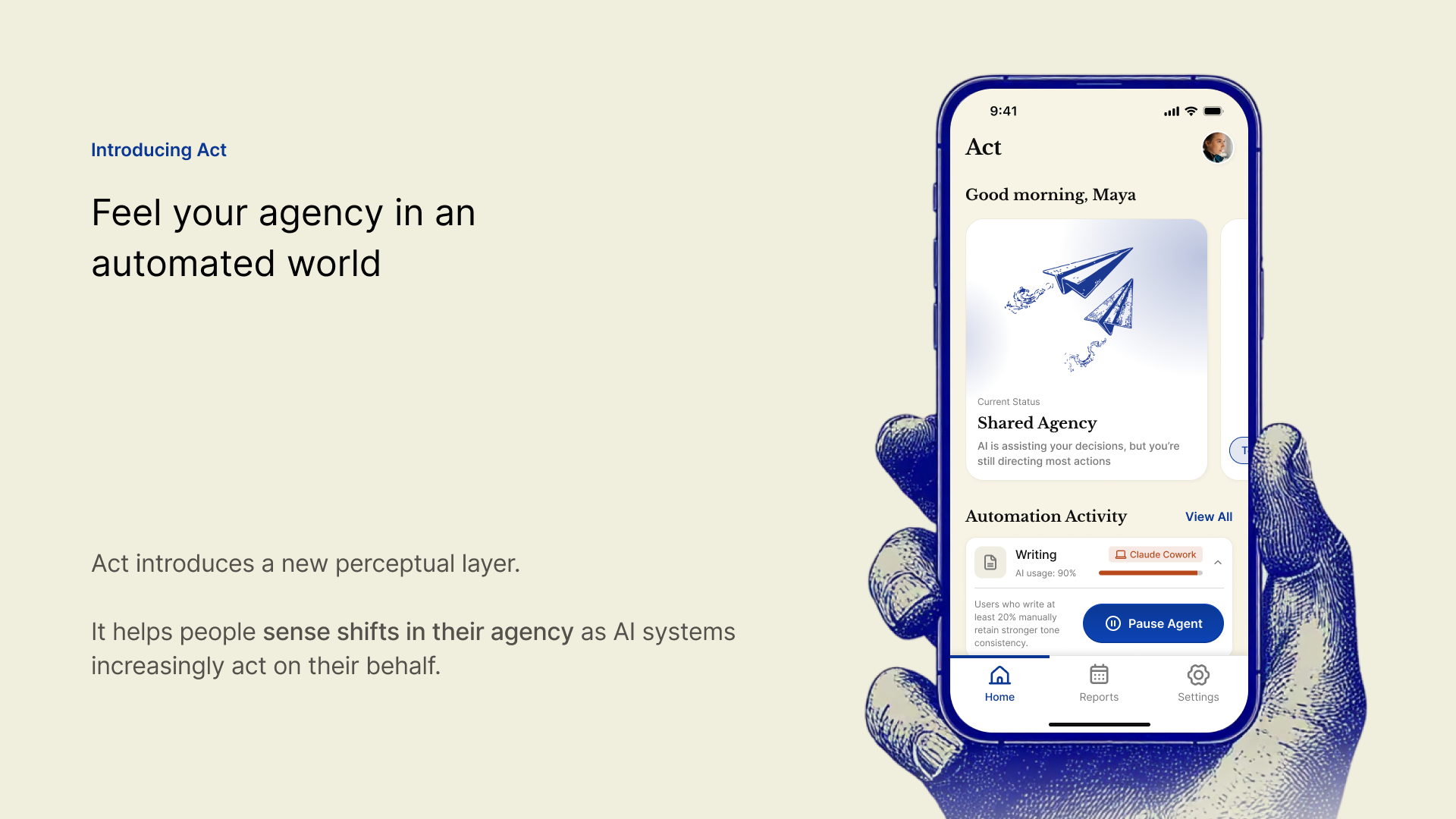
Act is a speculative system that helps people sense, track, and restore their sense of agency. It detects patterns across a user’s digital interactions, identifying when actions are: initiated by the user, shared with AI assistance, delegated to automation, or passively approved.
These patterns are translated into perceivable signals that represent four agency states:
- Leading : the user is actively directing actions
- Shared Agency : the user collaborates with AI
- Delegating : automation performs most tasks
- Drifting : the user passively approves automated decisions
Act communicates these states through an ambient interface across a mobile app and wearable device. The system also provides reflective insights and gentle interventions that encourage small moments of intentional action, helping users regain control and rebuild their sense of agency.
How we built it
Act was designed as a speculative product prototype using a combination of products.
The interface and visual system were designed in Figma Design, with interactive graphs and state transitions prototyped using Figma Make. We generated the brand visuals using Midjourney v6. Figma Slides was used to create the presentation slides.
Challenges we ran into
One of the biggest challenges was designing for a conceptual and invisible experience.
Unlike fitness trackers or productivity apps, the sense of agency is a psychological state that cannot be directly measured. We had to carefully think about how behavioral signals, such as automation patterns and decision approval loops, could act as proxies for shifts in agency.
Another challenge was avoiding the trap of turning agency into a performance score. We wanted Act to support reflection and awareness rather than judging users or gamifying behavior.
Accomplishments that we're proud of
We are proud of transforming an abstract psychological concept, the sense of agency, into a tangible product experience.
Through Act, we explored how invisible cognitive states could be translated into perceptible signals through interface design, ambient feedback, and reflective data visualization.
We’re also proud of the narrative approach we used to communicate the concept. By following Maya’s story, we were able to show how automation can gradually shift a person’s relationship with their own decisions.
Finally, we’re proud of building an interactive prototype using Figma Make that demonstrates how this idea could feel in practice.
What we learned
This project helped us explore the intersection of design, psychology, and emerging AI systems.
We learned that the future of human–AI interaction may not just be about efficiency, but about preserving fundamental human experiences such as agency, autonomy, and intentionality. We also learned the importance of designing systems that augment human awareness rather than replace human decision-making. Finally, this project reinforced how powerful storytelling can be when presenting speculative design ideas.
Built With
- figmadesign
- figmamake
- figmaslides
- midjourney


Log in or sign up for Devpost to join the conversation.