Inspiration
Data storage is very vital in today's world. We see countless instances on a daily basis where data breaches occur. This shows us how vulnerable our info is. It is important to keep our data as private as possible and out of unauthorized users.
What it does
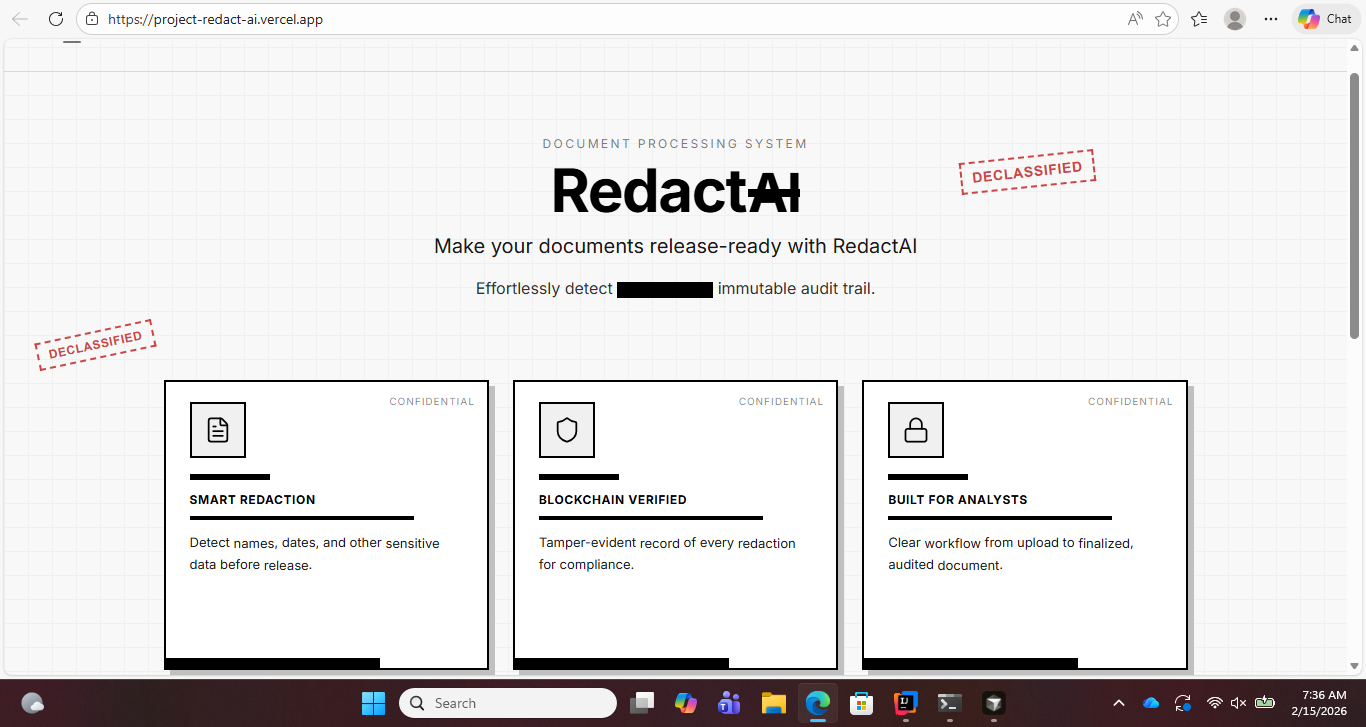
The RedactAI dashboard redacts sensitive info from the pdf file that the user drags and drops on the dashboard. The user can then export the redacted copy to download on to their device. There is also an entity list that you can toggle to include or exclude from the main redaction page.
How we built it
The project is built on Next.js (App Router) and React for a server-rendered, component-driven frontend, with TypeScript providing static typing, improved DX, and safer refactoring across the codebase. PDF processing and in-browser manipulation (parsing, editing, and redaction) is handled by pdf-lib, which enables precise modifications of PDF documents client-side. Generative AI features (entity detection, redaction suggestions, and contextual transforms) are powered by Google Gemini API, allowing the app to call Gemini models for NLP and document understanding.
Challenges we ran into
Trying to make changes and push them to GitHub at the same time can ruin your code
Accomplishments that we're proud of
A clean professional UI/UX that is easy for the user to use and navigate. A platform where users can make sure their data is not open and redacted.
What we learned
The importance of data privacy. Not all data needs to be shared with everyone. Redaction makes it so only the necessary data is visible.
What's next for RedactAI
Make it so RedactAI can redact more types of categories. Make is so we can authorize the user via login so that the data is more secure.
Built With
- gemini
- javascript
- next.js
- react


Log in or sign up for Devpost to join the conversation.