-
-
Gameplay
Inspiration
What defines a simulation as opposed to a game? Seriousness? Accuracy? Education? When we asked this question, an element that was prevalent across all of these defining characteristics was immersion: becoming so truly invested in an experience, that you almost forget it's just a game. After we settled on this metric, the next foundational discussing was over purpose. Did we just want to give people a good time? Sure, entertainment is important, but it should be reinforcing a foundation that exemplifies true purpose.
What it does
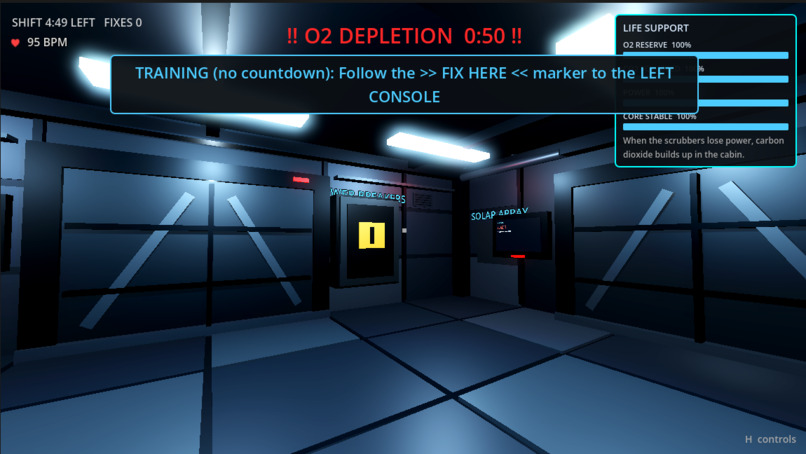
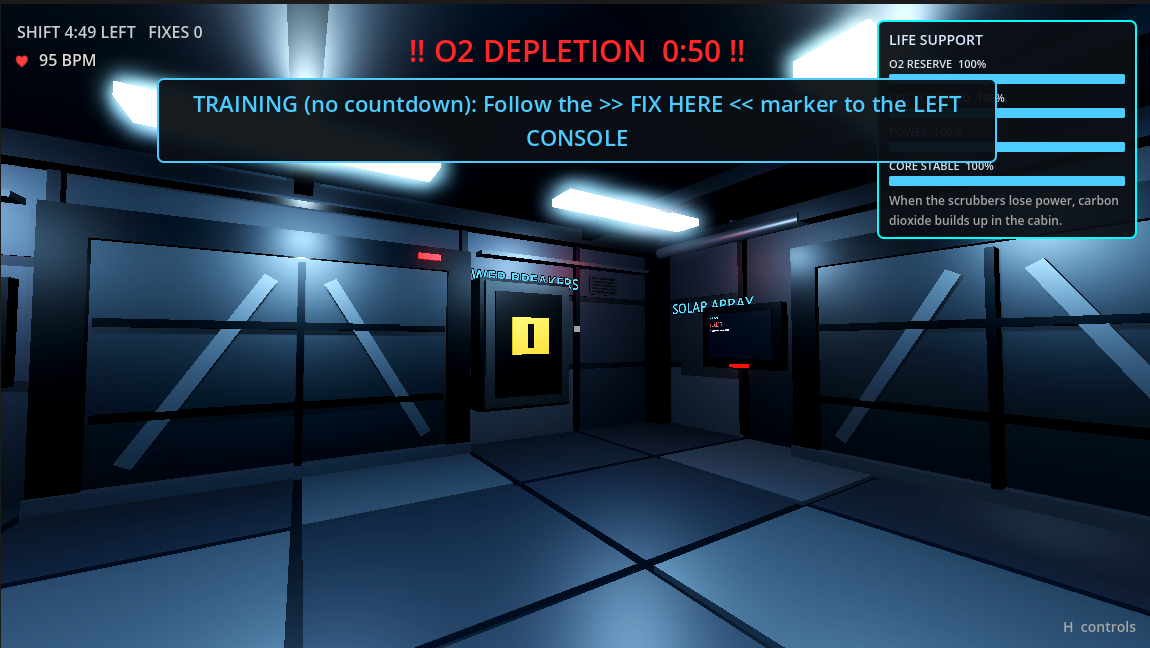
You're alone in a habitat module for one five-minute shift, and its life-critical systems keep failing: reactor, power, oxygen, CO2 and Martian dust storms. Each failure has a countdown, and you fix it by hand at its station.
Break: Live NASA solar-flare data (DONKI) matters. A real M- or X-class flare shortens every countdown and causes a mid-shift blackout. Fix: Every crisis has two hands-on minigames, eight in all, such as rebuilding the Apollo 13 CO2 scrubber adapter step by step or balancing reactor coolant loops. Power is fixed physically: open the breaker box and cycle the main breaker off, then on. Learn: One mistake kills you instantly, and the mission log names the real incident your mistake mirrors: Apollo 1, Apollo 13, Soyuz 11, SL-1, Chernobyl and more. When you fix something, a card shows how a real crew survived the same kind of emergency. HAL, the ship's computer, and Sam, a crewmate on the radio, guide you in ElevenLabs voices. Your heart rate climbs under pressure; above 120 BPM your hands shake, and you hold B to breathe. Play with keyboard and mouse, a PS5 DualSense with haptics, or a PS Vita that also shows live ship telemetry.
How we built it
Godot 4.7 and typed GDScript. The whole room, its props and the monitors are built in code from Godot primitives, with no downloaded or AI-generated art. Systems talk through global signals: a malfunction manager, minigame host, mission log, voice, sound, stress, haptics and settings. We used two external APIs, NASA DONKI for solar flares and Open Notify for people in space, plus ElevenLabs (a sponsor) to voice the 38 lines we wrote. The PS Vita controller is a VitaSDK app in C that talks to the game over UDP.
AI assistance, disclosed in our README: Claude planned, wrote task tickets and reviewed code; Gemini (Google Antigravity) implemented most features from those tickets; some of us also used GPT Codex and GitHub Copilot. We tested every change: 70 automated headless tests, including a full end-to-end shift.
Challenges we ran into
Peripherals were the hardest part. With no prior VitaSDK experience, getting a PS Vita to talk to the game over UDP took most of a night, and venue Wi-Fi blocks devices from reaching each other. Merging five people's work in one Godot project also took discipline: we kept scenes small, built UI in code, and leaned on automated tests to catch breakage after every merge.
Accomplishments that we're proud of
We are proud of the full simulation feel we were able to achieve through the combination of a complete game cycle, visual and audio effects, haptics, controller compatibility, and backstory.
What we learned
We learned the importance of coordination on a task as complex as this, with various components that go beyond the scope of a normal video game project.
What's next for Red Alert
One aspect we _ reallllly _ wanted to explore was haptic feedback. As we mentioned, a simulation should first and foremost immerse the user into your world. There is no better way to do so than providing a physical stimulus. We started with incorporation of controllers with vibration, but we heavily considered using a TENS unit to provide a (safe and medically sound) electrical pulse to the user. Not only does blur the line between the tangible and intangible world, but research suggests that haptic feedback is incredibly beneficial in attaining technical skills. Cherif et. al discuss this in their article, "The role of haptic feedback in acquiring, retaining, and transferring basic technical skills in VR simulators." Even without a graphically or functionally complex simulation, merely adding this physical elements strengthens the mind-body connection involved in defusing dangerous scenarios. Had we more time, money, and investors, I could see this project expanded to build training systems for high-risk jobs, such as police, firefighters, and EMS.
Built With
- c
- claude
- codex
- copilot
- gdscript
- gemini
- godot
- nasa-donki
- open-notify
- vitasdk

Log in or sign up for Devpost to join the conversation.