-
https://github.com/BhaveshGajengi1/RecycLink

Inspiration
Recycling is one of the simplest actions individuals can take for sustainability, yet it remains ineffective at scale due to confusion, lack of incentives, and poor verification. Many people want to recycle but do not know whether an item is recyclable, how to dispose of it correctly, or whether their effort actually makes a difference.
We were inspired by this gap between intention and impact. RecycLink was born from the idea that if technology can guide users, verify actions, and reward positive behavior, sustainability can become both easier and more trustworthy.
What it does
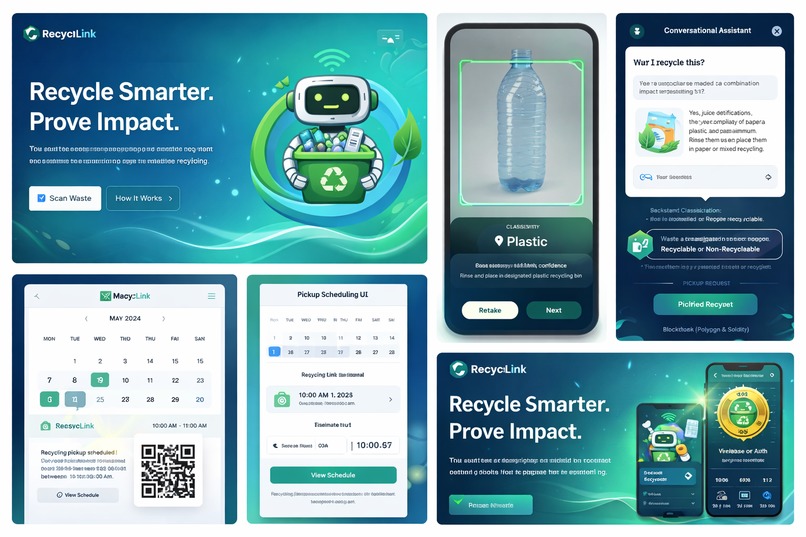
RecycLink is an AI-powered waste segregation and recycling verification platform that helps users identify recyclable waste, schedule pickups, and receive verifiable on-chain proof of their recycling actions.
Users can:
- Take a photo of waste items to instantly identify recyclability using AI
- Ask questions through a conversational assistant (e.g., “Can this be recycled?”)
- Schedule a recycling pickup
- Receive a blockchain-backed digital badge as proof of verified recycling
- Track their environmental impact through a dashboard
Each successful pickup is confirmed and recorded transparently, ensuring trust and accountability.
How we built it
RecycLink was built as a full-stack system with modular components:
- Frontend: Next.js (React) for a responsive web app and PWA experience
- AI / ML: Image classification using HuggingFace models for waste recognition
- Conversational AI: OpenAI / Gemini for user queries and guidance
- Backend: Node.js and Express for APIs, scheduling, and logic
- Database & Auth: MongoDB and Firebase Authentication
- Blockchain: Solidity smart contracts deployed using Hardhat on Polygon testnet
- Design & UX: Figma for UI design and Canva for visuals and demo assets
When a recycling pickup is verified, a smart contract mints a lightweight digital badge on-chain, providing transparent and tamper-proof proof of impact.
Challenges we ran into
- Accurate waste classification: Differentiating visually similar materials required careful model selection and confidence handling.
- Blockchain usability: Ensuring users could benefit from blockchain without dealing with wallet complexity or gas fees.
- Fraud prevention: Designing a simple yet reliable pickup verification flow using QR codes and timestamps.
- Time constraints: Delivering a functional, end-to-end prototype within hackathon limits.
Each challenge pushed us to simplify the user experience while maintaining technical robustness.
Accomplishments that we're proud of
- Built a working AI-powered waste classification system
- Integrated blockchain to create verifiable recycling proofs
- Designed a clean, intuitive user experience
- Delivered a complete end-to-end prototype with real functionality
- Aligned sustainability goals with real-world usability
What we learned
- Sustainability solutions must be simple, trustworthy, and rewarding
- Blockchain works best when it stays invisible to the end user
- Clear UX and storytelling are as important as strong technology
- Small, well-integrated features can create meaningful real-world impact
What's next for RecycLink
- Partnering with local recycling vendors and NGOs
- Expanding the dataset for higher classification accuracy
- Adding real-world reward redemptions (vouchers, certificates)
- Making the app fully offline-first for low-connectivity regions
- Scaling RecycLink as a Smart India sustainability platform
RecycLink is our step toward making responsible recycling easy, verifiable, and impactful.
Built With
- canva
- express.js
- figma
- firebase-authentication
- flask
- hardhat
- huggingface-transformers
- ipfs
- javascript
- mongodb
- next.js
- node.js
- openai-api
- polygon-(testnet)
- python
- react
- solidity


Log in or sign up for Devpost to join the conversation.