-
-
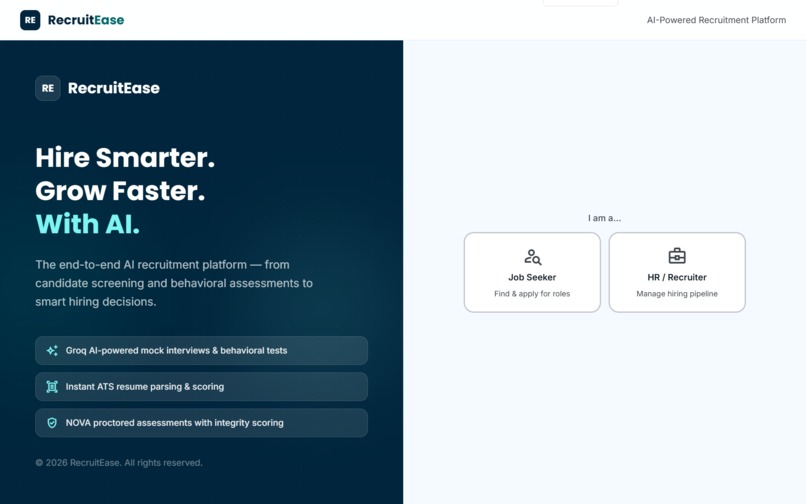
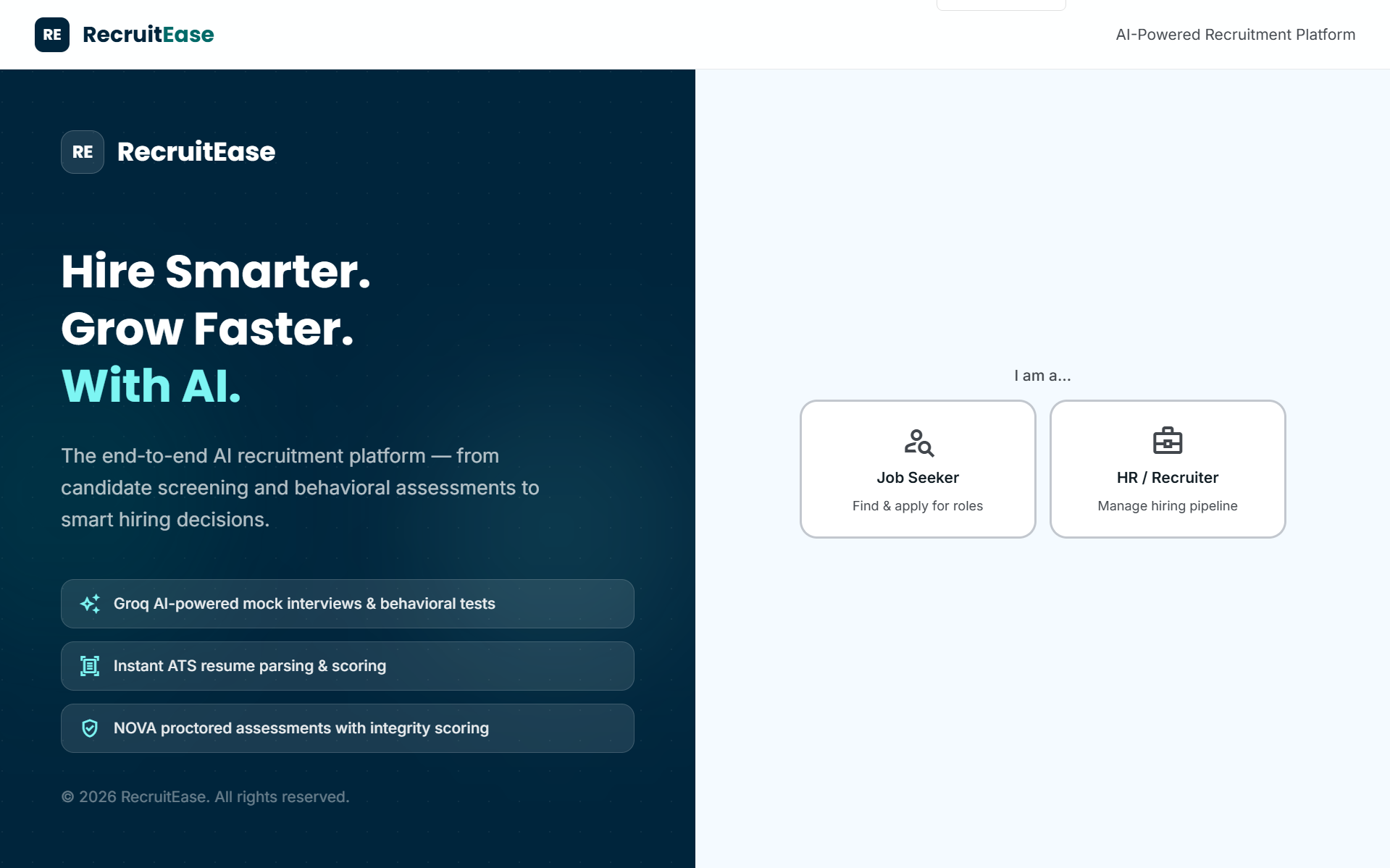
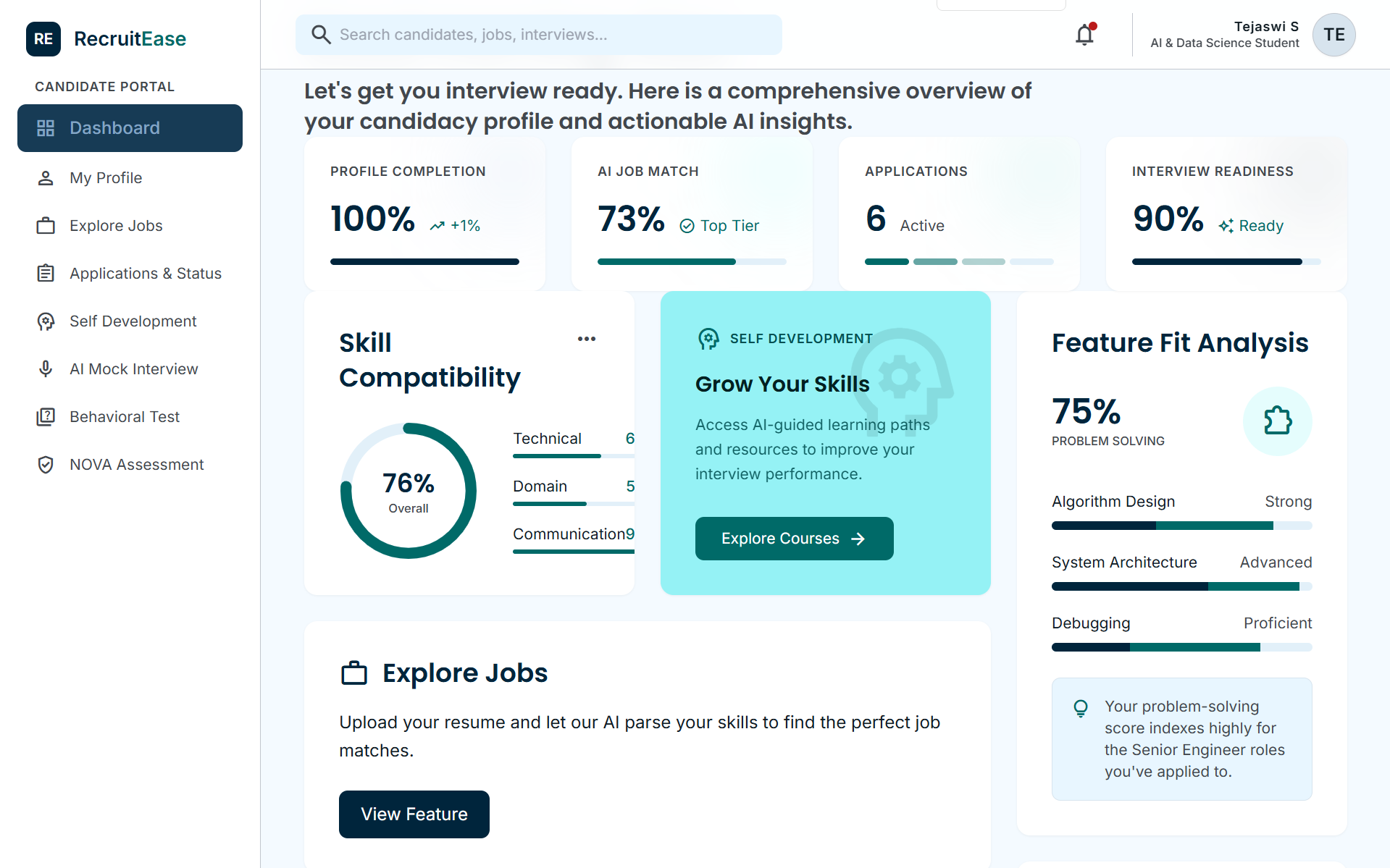
RecruitEASE landing page introducing AI-powered recruitment and candidate screening.
-
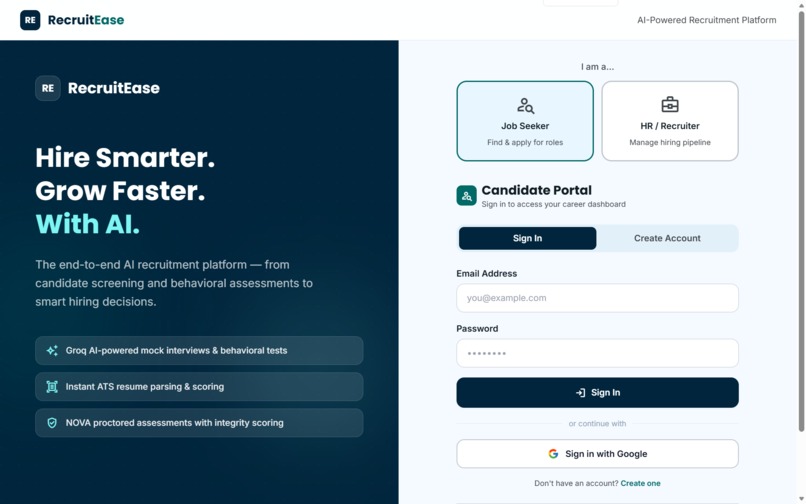
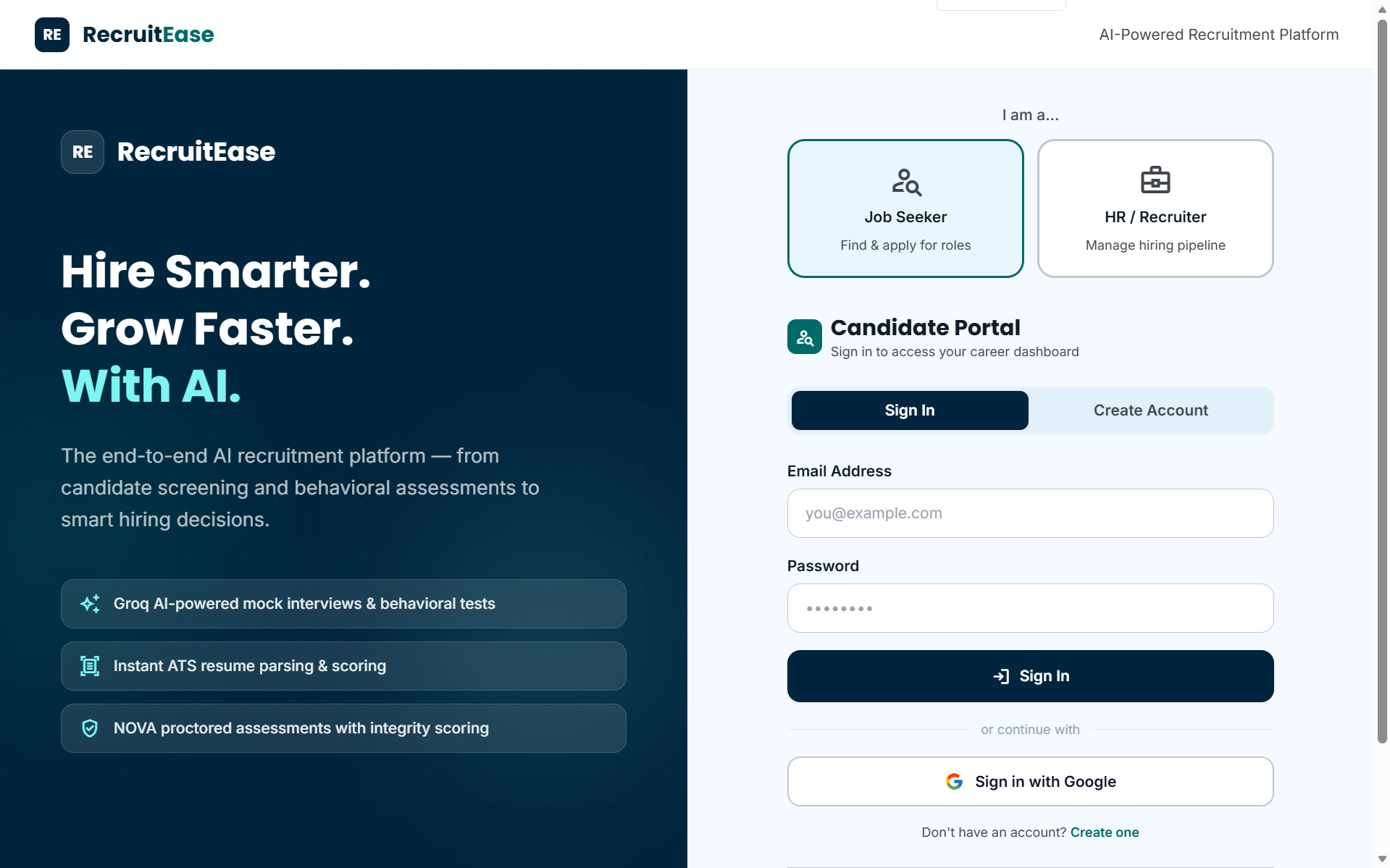
Candidate login and secure authentication interface for accessing RecruitEASE.
-
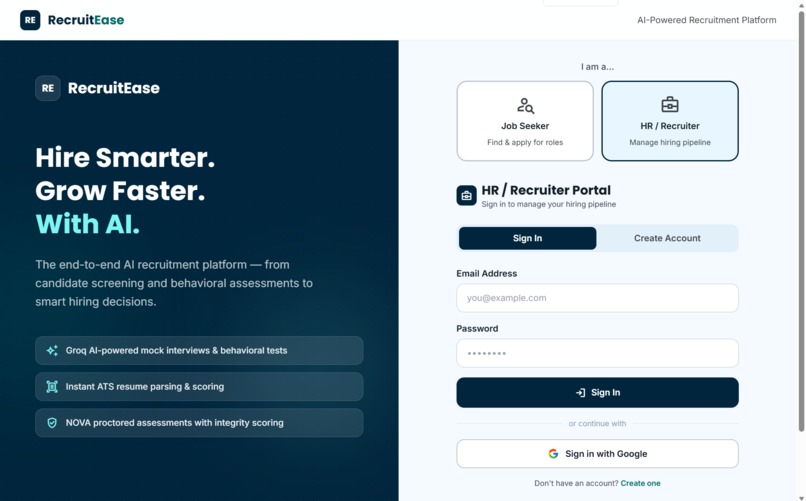
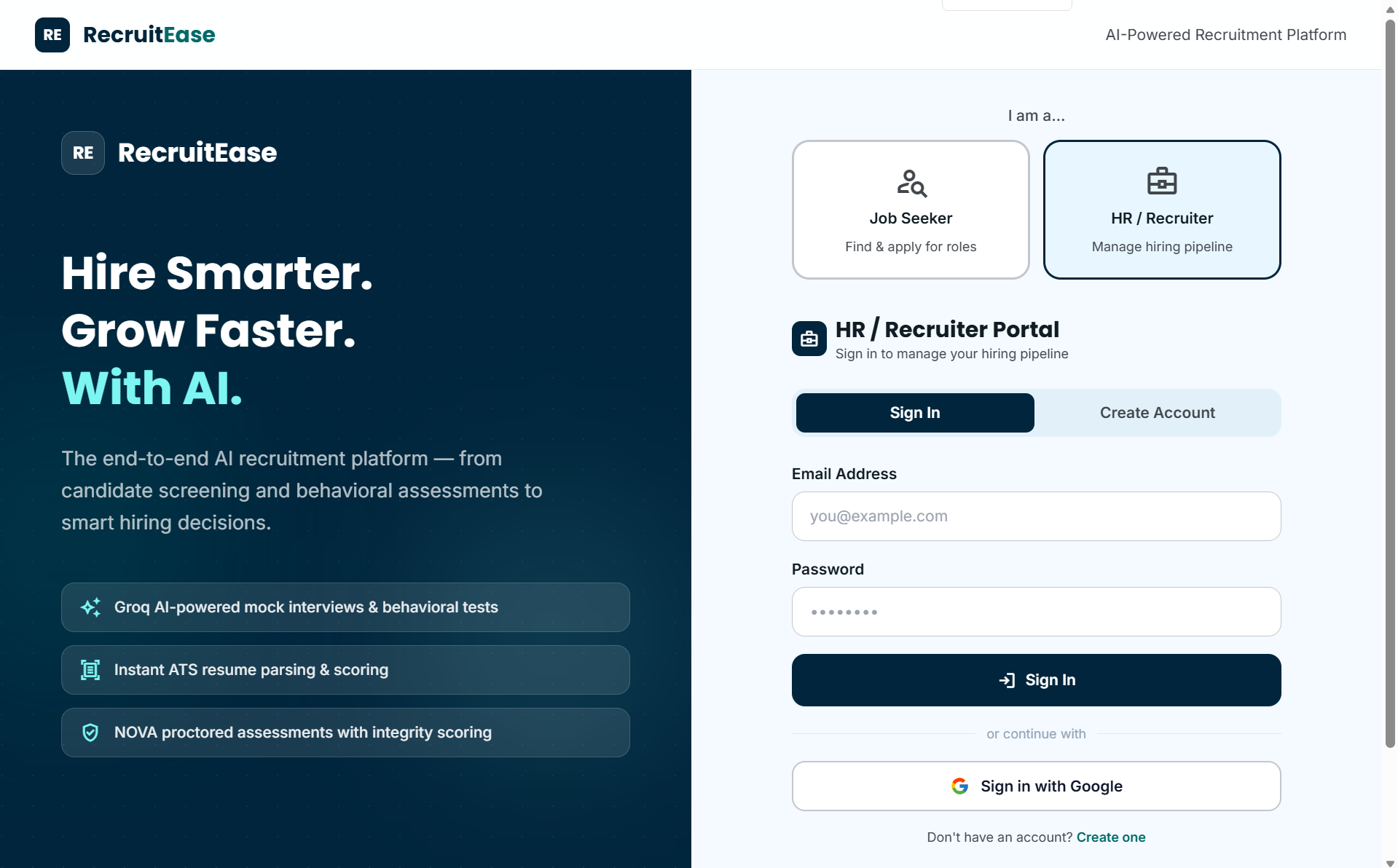
Recruiter login and secure authentication interface for accessing RecruitEASE.
-
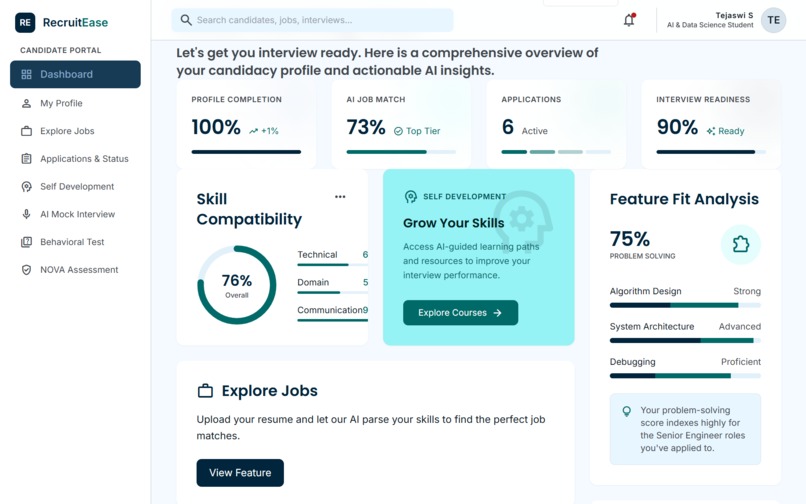
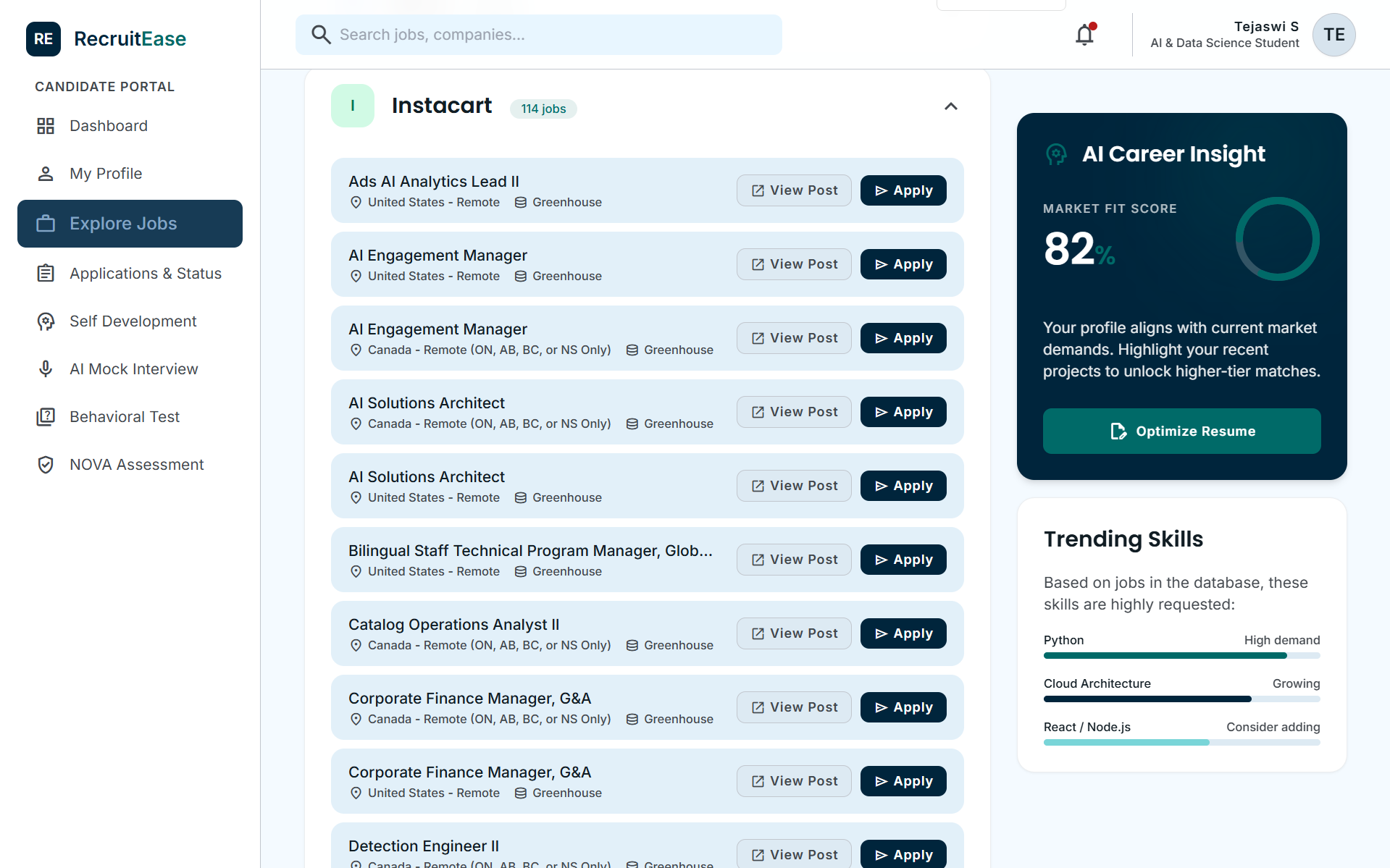
Candidate dashboard displaying available job opportuniti
-
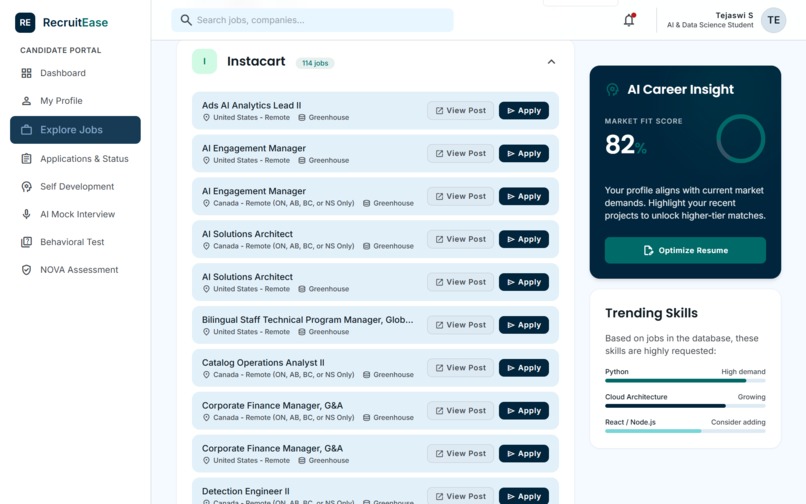
Candidate applying for a selected job through the RecruitEASE application interface.
-
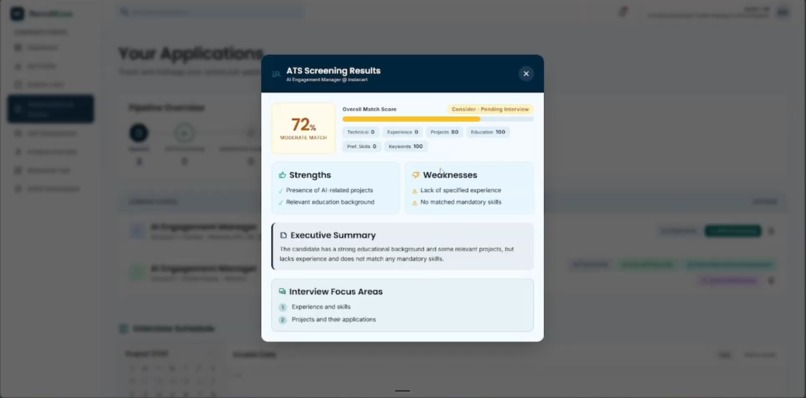
Resume screening interface for uploading a candidate resume and selecting the relevant job.
-
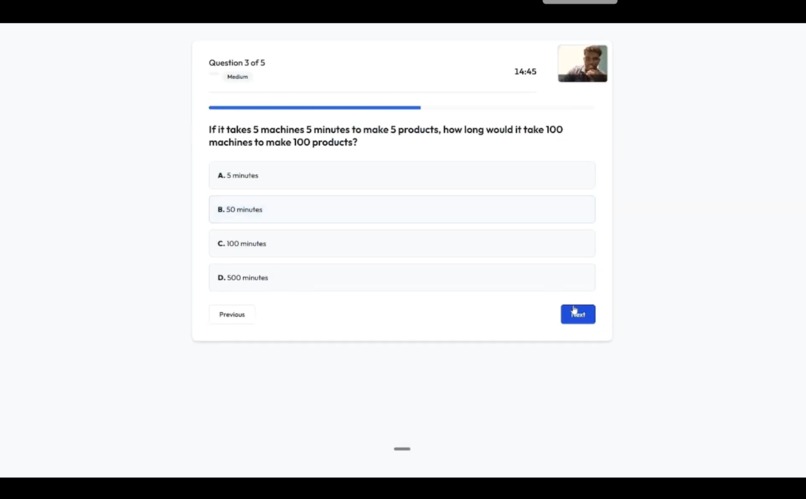
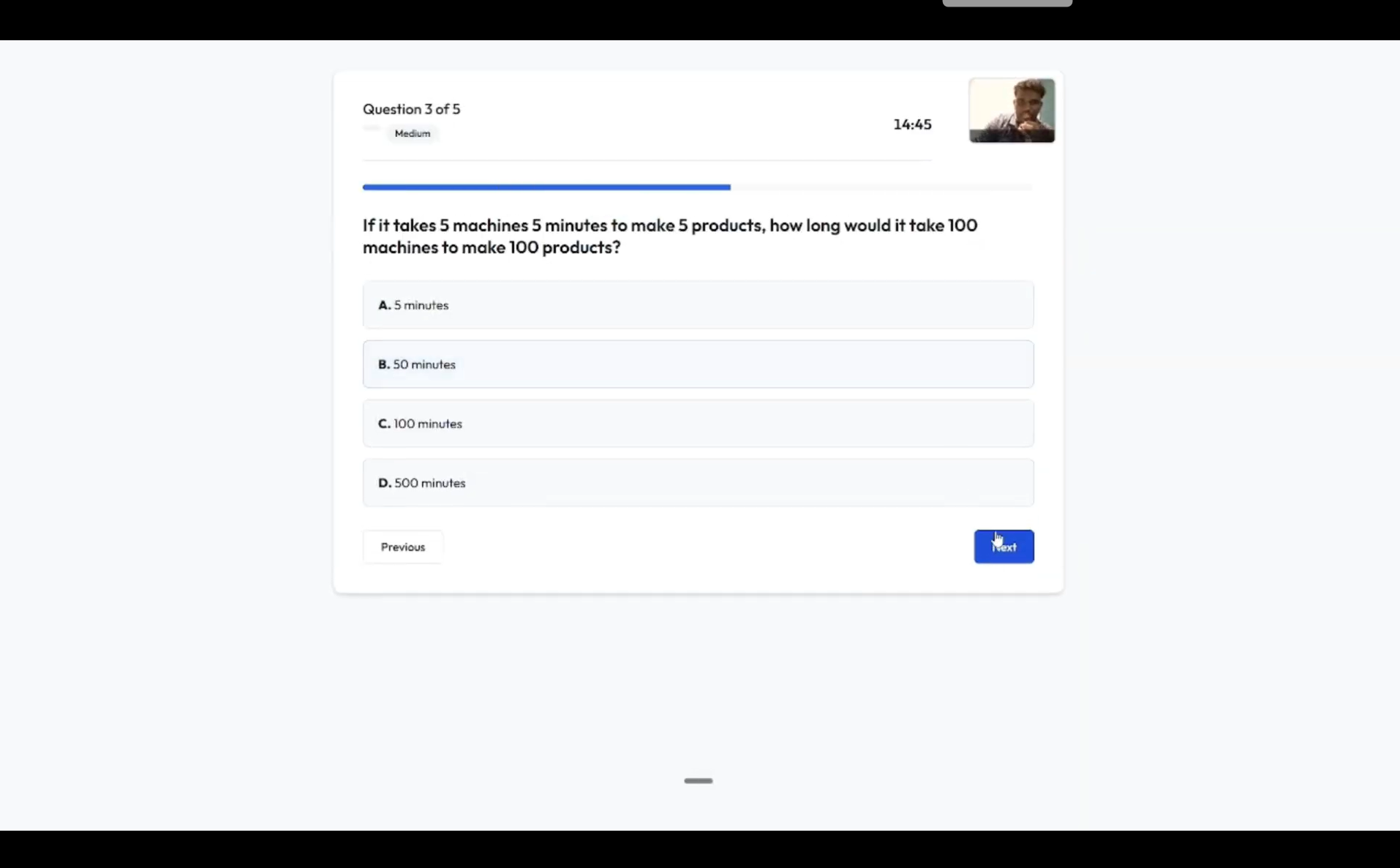
Candidate assessment interface displaying AI-generated questions and evaluation progress.
-
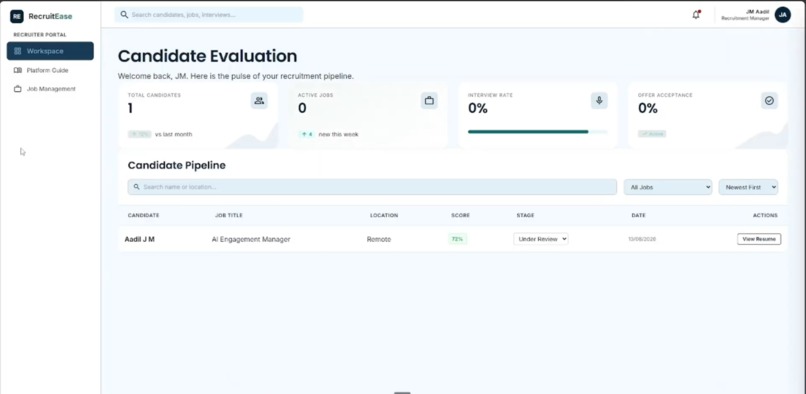
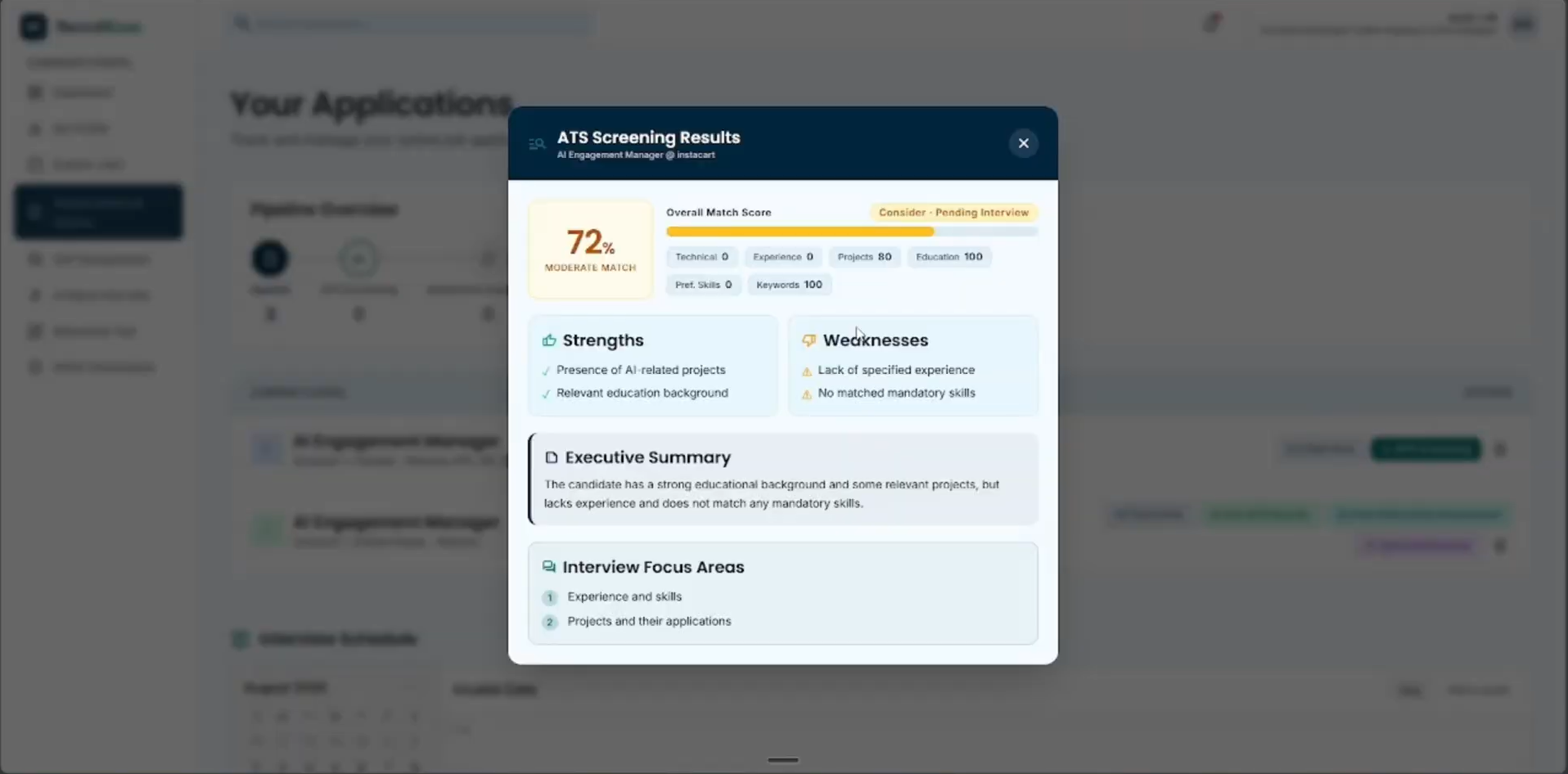
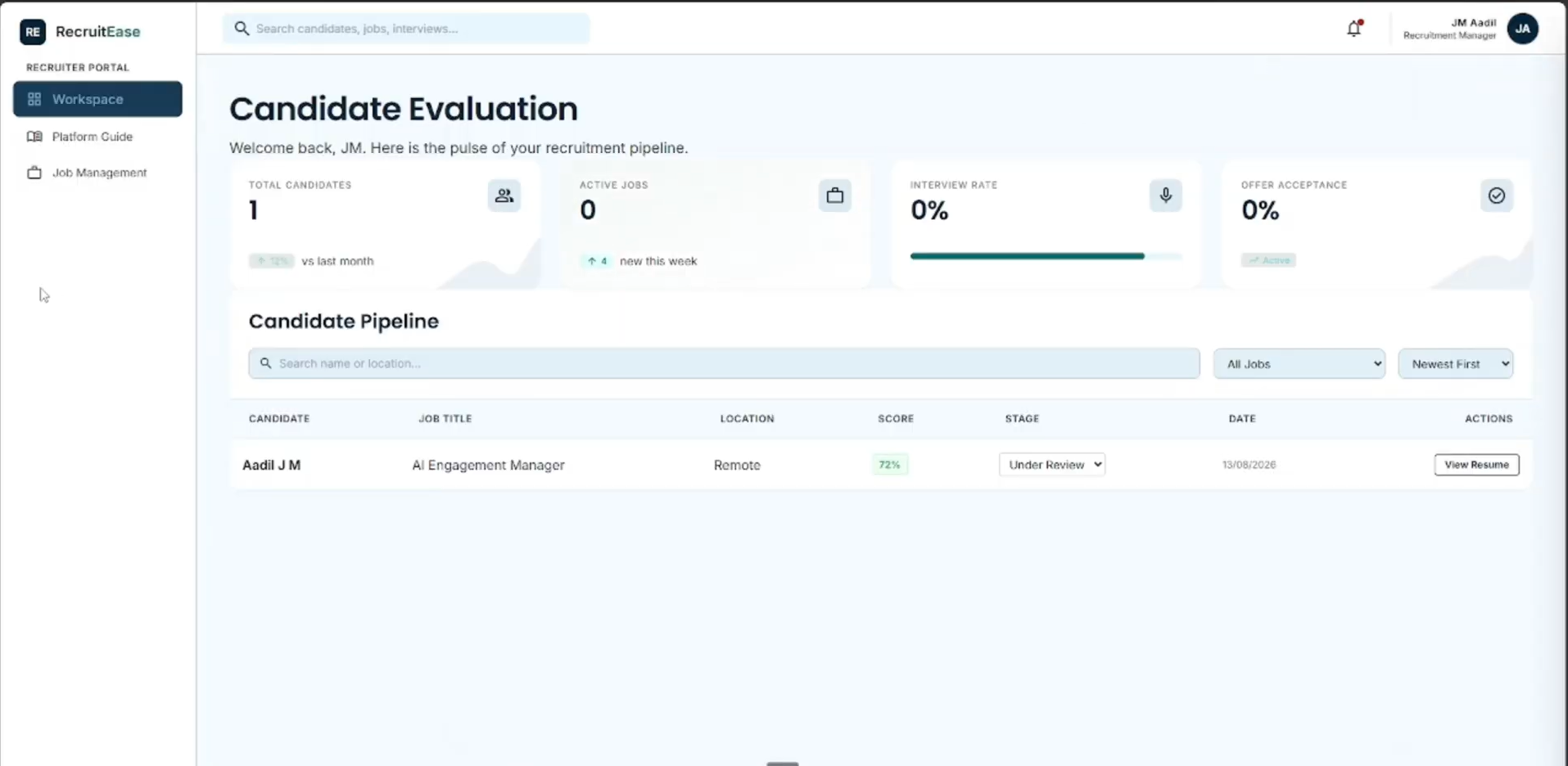
Candidate details and screening status available for further HR evaluation.
-
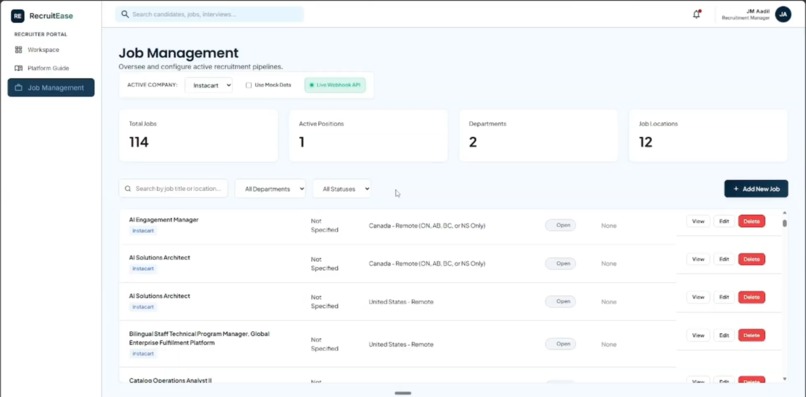
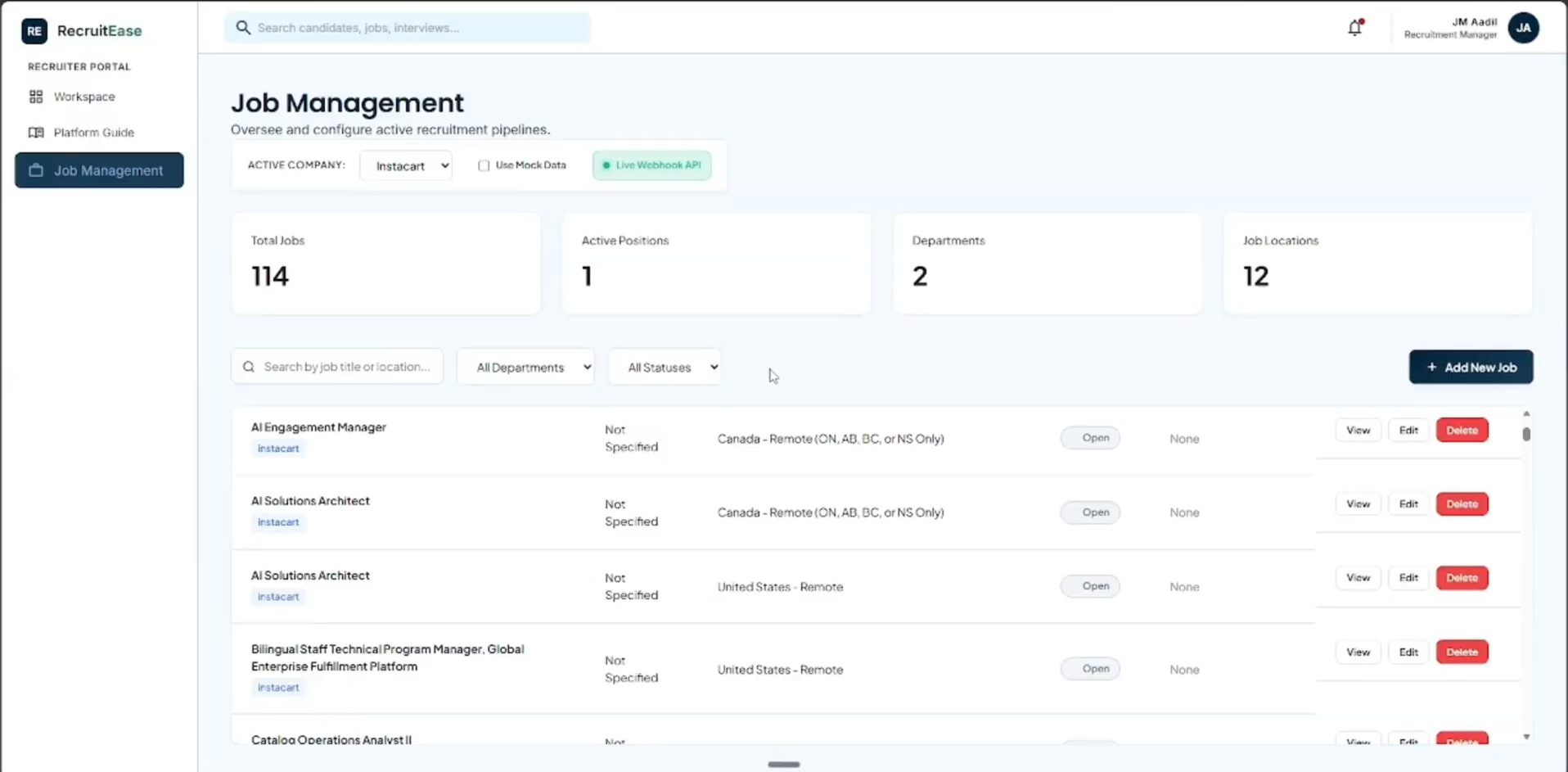
Job details and candidate management interface for tracking recruitment applications.
Inspiration
Recruitment can become difficult to manage when the number of applications increases. HR teams often spend significant time reviewing resumes, comparing candidate profiles with job requirements, conducting assessments, and tracking applications.
We identified this as a breakpoint in the recruitment process: the existing workflow may work, but it becomes repetitive, time-consuming, and difficult to scale as candidate volume grows.
This inspired us to build RecruitEASE, an AI-assisted recruitment platform designed to reduce repetitive recruitment tasks while keeping HR decision-making at the center.
What it does
RecruitEASE brings multiple recruitment activities into one workflow:
Candidate Application → Resume Screening → Assessment → HR Management
For resume screening, the system retrieves the candidate information and the corresponding job requirements using job_id. The retrieved information is then compared using the Groq API, generating structured results such as:
- Overall candidate score
- Technical and experience scores
- Matched and missing skills
- Strengths and weaknesses
- Candidate summary
- Interview focus
- Recommendation and status
For assessments, RecruitEASE uses two separate LLM stages. The first generates questions 1–5, while the second generates questions 6–10. Splitting the generation into smaller stages helps keep the questions focused and reduces the possibility of inconsistent or hallucinated output.
The HR management module allows HR users to manage job information and track candidates through the recruitment workflow.
How we built it
RecruitEASE was developed using a modular architecture where different responsibilities are handled by separate components.
Frontend: Provides the candidate and HR interfaces.
Backend/API workflows: Handle request processing, business logic, data retrieval, and communication between components.
Groq API: Used for LLM-based resume evaluation and assessment generation.
Supabase/PostgreSQL: Used to store structured job and recruitment information. PostgreSQL provides relational data management, making it suitable for connecting candidates and jobs through identifiers such as job_id.
OAuth: Used for secure user authentication.
Webhooks and APIs: Used for communication between the frontend and backend workflows.
A key part of our implementation is the job_id relationship. When a job is created, its requirements are stored with a unique identifier. When a candidate applies for that job, the identifier allows the backend to retrieve the correct job requirements and use them during candidate evaluation.
This prevents the system from comparing a candidate against unrelated job requirements.
Challenges we ran into
One of our main challenges was handling unstructured candidate information and converting it into information that could be consistently evaluated.
Another challenge was handling LLM responses. AI-generated responses are not always returned in a format that can be directly consumed by the frontend. We therefore introduced backend processing steps to structure and prepare the required information before sending it to the application.
Maintaining the relationship between candidates and their respective jobs was another important challenge. We addressed this using job_id to connect application data with the correct job requirements.
We also faced challenges with assessment generation. Generating all questions in a single LLM request could result in less consistent output, so we divided the process into two focused generation stages.
Accomplishments that we're proud of
We are proud to have transformed a real recruitment problem into a working end-to-end prototype.
Our key accomplishments include:
- Building both candidate and HR workflows
- Implementing AI-assisted resume screening
- Retrieving the correct job requirements using
job_id - Generating structured candidate evaluation results
- Building a separate AI-assisted assessment workflow
- Splitting assessment generation into two LLM stages
- Implementing OAuth authentication
- Building HR job management functionality
- Connecting the different components through APIs and backend workflows
Most importantly, we built RecruitEASE around a specific recruitment breakpoint rather than simply adding AI as a feature.
What we learned
Building RecruitEASE taught us that developing an AI-powered application involves much more than connecting an LLM to a frontend.
We learned how to:
- Provide AI models with relevant context before evaluation
- Structure and process AI-generated responses
- Break complex AI tasks into smaller workflow stages
- Design relationships between application data and job requirements
- Separate frontend, backend, database, and AI responsibilities
- Think about reliability and scalability while designing workflows
- Apply system design concepts to solve an actual business problem
One of our biggest takeaways was that good system design is about making different components work together reliably to solve a real problem.
What's next for RecruitEASE
We see RecruitEASE as a foundation for a more complete AI-assisted recruitment platform.
Our future plans include:
- More advanced candidate ranking and filtering
- Improved assessment and evaluation capabilities
- HR analytics and recruitment insights
- More comprehensive candidate tracking
- Stronger validation of AI-generated outputs
- Integration with additional recruitment platforms
- Improved scalability for larger candidate volumes
Our long-term goal is to make recruitment faster, more structured, and less repetitive, while ensuring that AI supports HR professionals rather than replacing human judgment.
Where recruitment breaks, RecruitEASE fixes.
Built With
- ai
- api
- css
- groq
- html
- javascript
- llm
- natural-language-processing
- oauth
- postgresql
- react.js
- rest
- supabase
- webhooks

Log in or sign up for Devpost to join the conversation.