Inspiration
ReCraft was inspired by the growing global challenge of waste management and the immense potential of creative upcycling. We recognized a disconnect between individuals and businesses with surplus materials and the talented upcyclers who could transform these "waste" items into valuable, beautiful products. The goal was to create a platform that not only facilitates this connection but also fosters a vibrant community dedicated to sustainability and innovation. We believe that by making it easier to repurpose materials, we can significantly reduce landfill waste and promote a circular economy, turning trash into treasure.
What it does
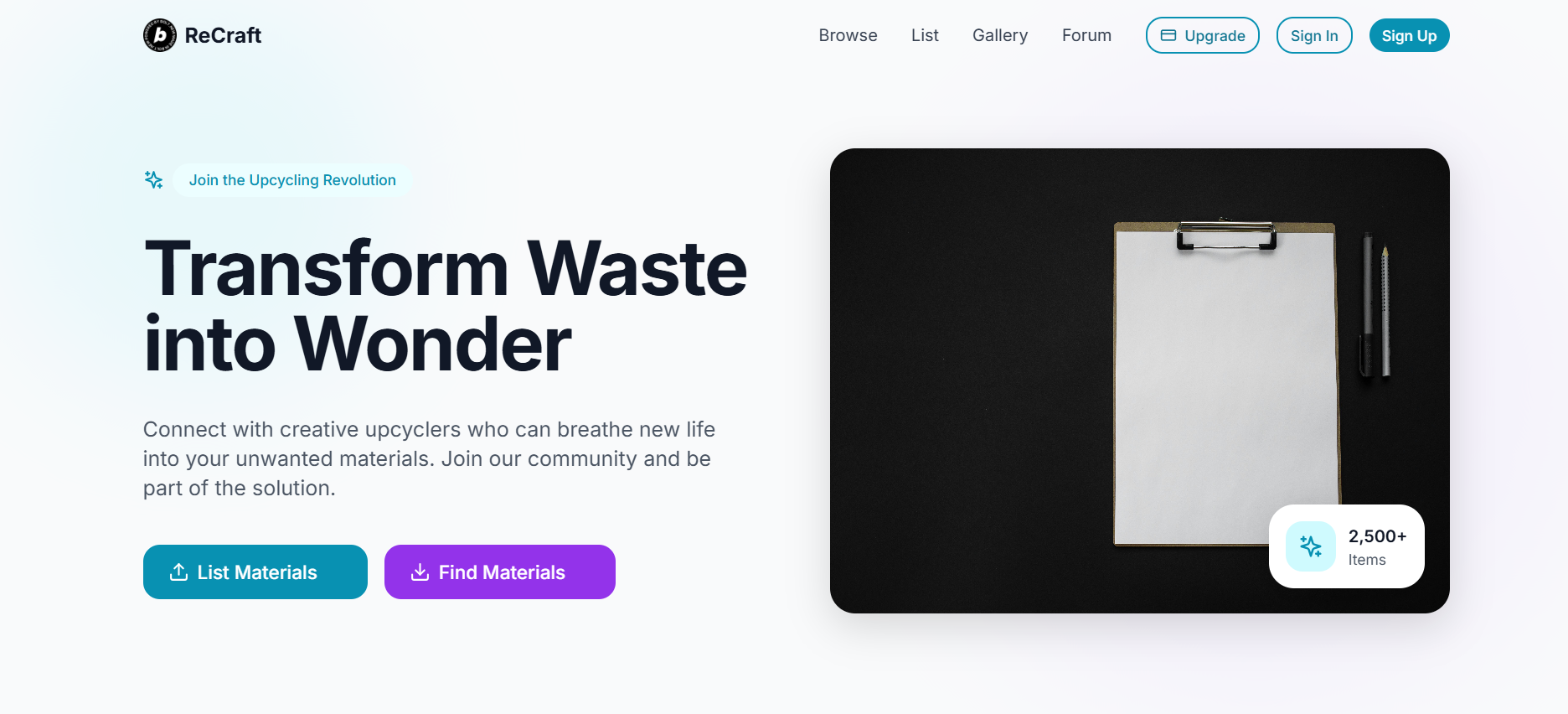
ReCraft is a comprehensive upcycling platform designed to connect people with waste materials to creative upcyclers. It offers a wide range of functionalities to support this ecosystem:
Material Listings: Users can easily list waste materials, complete with photos, detailed descriptions, and location information. Material Discovery: A robust browsing and search system allows users to find available materials with advanced filtering options. Claims System: Interested upcyclers can request materials, specifying their intended use and coordinating pickup details. Project Gallery: A showcase for before-and-after transformations, allowing upcyclers to document and share their creative projects. Community Forum: Users can engage in discussions, ask for help, share tips, and brainstorm ideas in categorized threads. Direct Messaging: Private communication channels enable direct interaction between users for material exchanges or collaborations. User Profiles: Comprehensive profiles display user activity, ratings, skills, and contact information. Notifications: Real-time updates keep users informed about claims, messages, and forum activity. Image Management: Supports multiple image uploads for listings and projects, with storage optimization. Rating System: A reputation system based on successful exchanges and project quality. Subscription Tiers: Offers Free, Premium, and Pro membership levels with varying features and limits. Payment Integration: Secure processing for premium features and subscriptions. Mobile Responsive: Optimized for seamless use across all device sizes.
How we built it
ReCraft is built as a modern web application using a robust and scalable technology stack:
Frontend: Developed with React 18 and TypeScript for a type-safe and component-based architecture. Tailwind CSS is used for efficient and highly customizable styling, ensuring a consistent and appealing user interface. React Router handles declarative navigation, while Lucide React provides a comprehensive set of icons. React Dropzone simplifies file uploads. Backend & Database: Supabase serves as the complete backend solution, providing a PostgreSQL database with Row Level Security (RLS) for secure data access. It also powers real-time subscriptions for live updates and handles file storage for all images. Key Libraries: We leverage @supabase/supabase-js for seamless interaction with Supabase services. React's Context API is utilized for global state management, and custom hooks encapsulate reusable data fetching and logic.
Challenges we ran into
During the development of ReCraft, we encountered several challenges:
Real-time Data Synchronization: Ensuring that material statuses, message threads, and forum updates were instantly reflected across all user interfaces required careful implementation of Supabase's real-time subscriptions and efficient state management. Robust Row Level Security (RLS): Designing and implementing granular RLS policies for each table was crucial to ensure data privacy and prevent unauthorized access, especially given the sensitive nature of user profiles and material claims. Secure File Uploads and Storage: Managing image uploads, ensuring proper file types, sizes, and secure storage within Supabase buckets, along with defining appropriate access policies, presented a significant challenge. Complex State Management: Handling the intricate state across various features, such as user authentication, material claims workflows, and project interactions, required a well-structured approach using React Context and custom hooks to maintain predictability and prevent bugs. Third-Party Integrations: Integrating external services like Stripe for payment processing involved understanding their APIs, handling webhooks, and ensuring secure transaction flows. User Experience for Diverse Interactions: Balancing the needs of material listers, material claimers, and project creators, while providing intuitive interfaces for each role, required iterative design and development.
Accomplishments that we're proud of
We are particularly proud of several key accomplishments in building ReCraft:
Comprehensive Full-Stack Solution: Successfully integrating Supabase to provide a complete backend, database, authentication, and storage solution, allowing for rapid development and deployment. Secure and Scalable Architecture: Implementing robust Row Level Security and efficient database indexing ensures that the platform is secure by design and can scale to accommodate a growing user base and material listings. Intuitive User Interface: Leveraging Tailwind CSS and React, we've created a clean, modern, and highly responsive user interface that is both aesthetically pleasing and easy to navigate. Real-time Engagement: The successful implementation of real-time messaging, notifications, and forum updates significantly enhances user engagement and fosters a dynamic community environment. Empowering Sustainability: Creating a platform that directly contributes to reducing waste and promoting creative reuse, aligning technology with a positive environmental impact. What we learned Throughout the development process, we gained valuable insights:
Supabase Ecosystem Mastery: We deepened our understanding of Supabase's capabilities, from database management and RLS to authentication, storage, and real-time features, recognizing its power as a full-stack backend. React Best Practices: Reinforcing the importance of component reusability, effective state management with hooks and context, and optimizing performance in a complex React application. Security by Design: The critical role of implementing security measures like RLS from the ground up, rather than as an afterthought, to protect user data and maintain platform integrity. User-Centric Development: The necessity of continuously iterating on features based on potential user workflows and feedback to create a truly valuable and enjoyable experience. Scalability Considerations: Understanding how early architectural decisions impact future scalability, especially concerning database queries, image storage, and real-time data handling. What's next for Recraft ReCraft has an exciting roadmap for future enhancements:
AI-powered Material Matching: Implementing artificial intelligence to intelligently match available materials with upcyclers based on project needs and skills. Augmented Reality Project Visualization: Exploring AR features to allow users to visualize how upcycled projects might look in their own spaces. Blockchain-based Carbon Credit Tracking: Integrating blockchain technology to track and reward users for their environmental impact through upcycling. Mobile App Development: Expanding the platform to native iOS and Android applications for an even more seamless mobile experience. Advanced Analytics Dashboard: Providing users with detailed insights into their impact, material usage, and project performance. Integration with Local Recycling Centers: Partnering with recycling centers to expand the network of available materials and facilitate larger-scale repurposing efforts
Built With
- postgresql
- react
- supabase
- tailwind


Log in or sign up for Devpost to join the conversation.