-
-
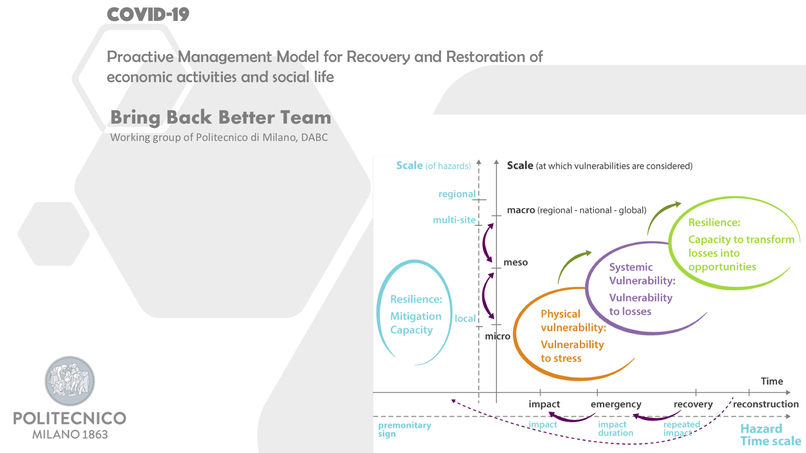
Bring Back Better
-
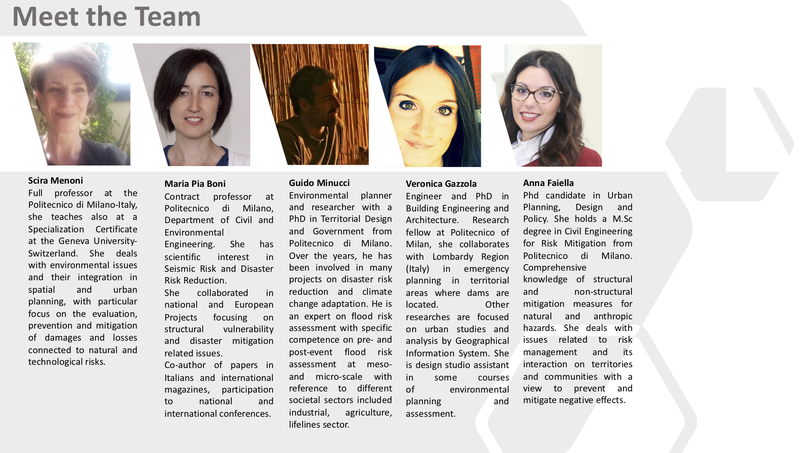
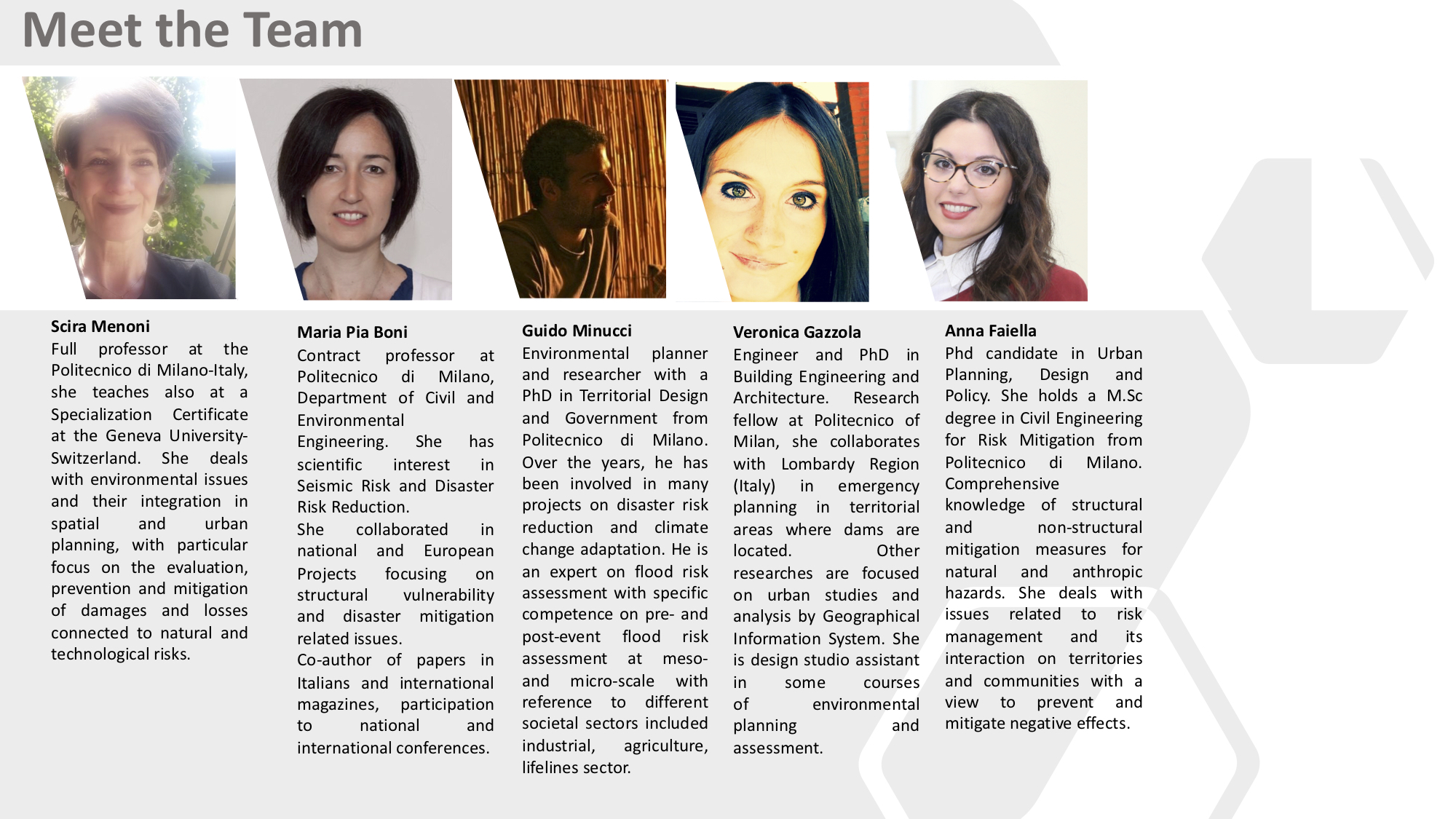
Meet the Team
-
Aim & Approach
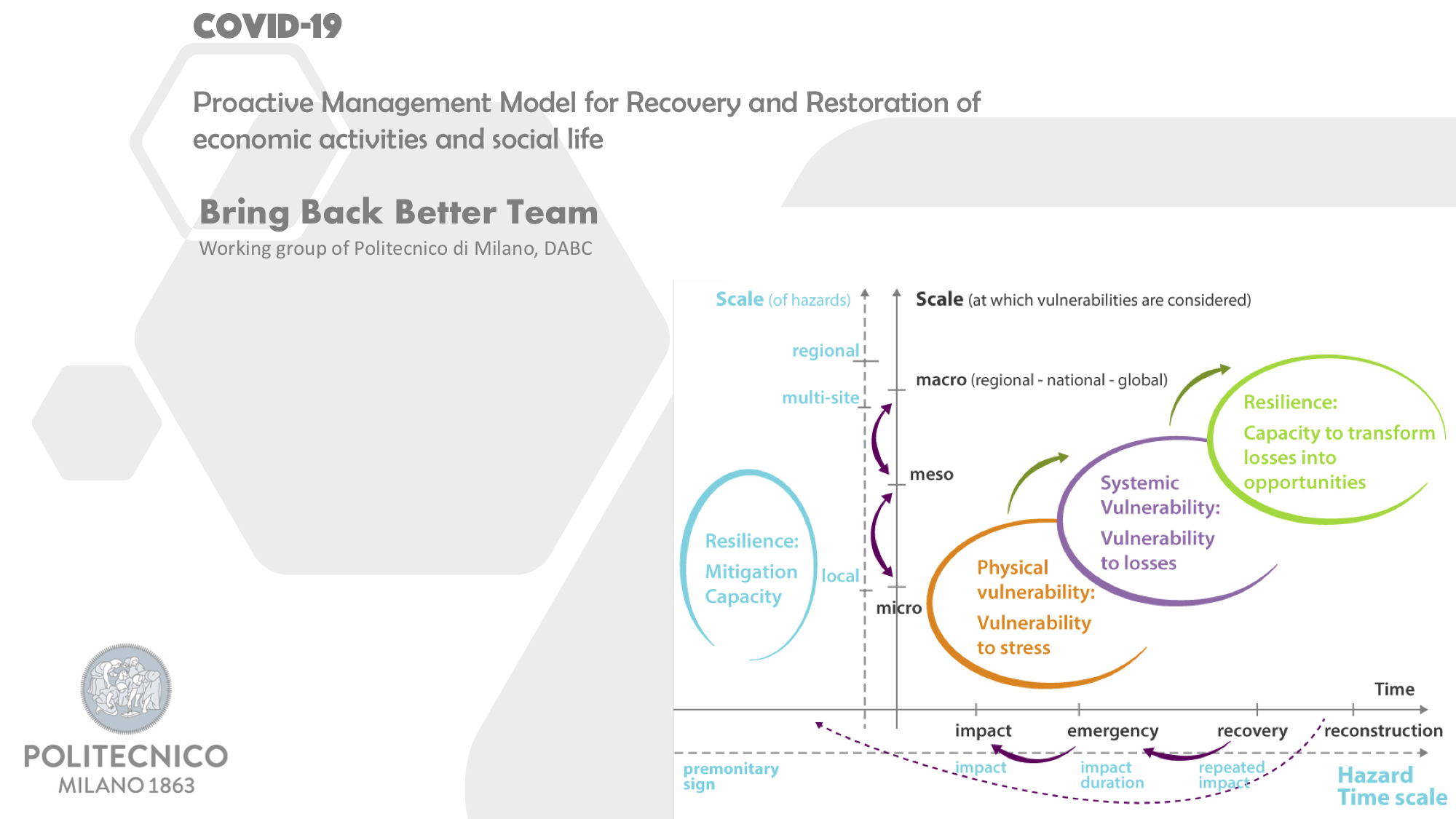
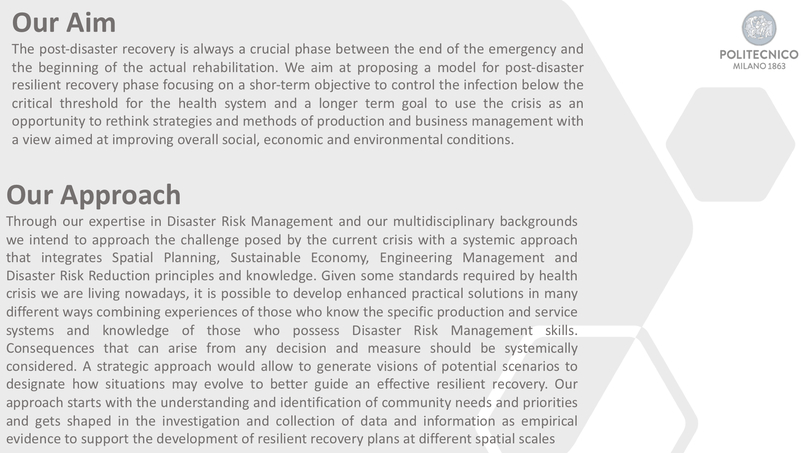
Our Aim The post-disaster recovery is always a crucial phase between the end of the emergency and the beginning of the actual rehabilitation. We aim at proposing a model for post-disaster resilient recovery phase focusing on a shor-term objective to control the infection below the critical threshold for the health system and a longer term goal to use the crisis as an opportunity to rethink strategies and methods of production and business management. We aim at proposing a process oriented model of co-production of mitigation measures at the individual business level to be mainstreamed in guidelines that can be used by all businesses of the same type.
Our Approach Through our expertise in Disaster Risk Management and our multidisciplinary backgrounds we intend to approach the challenge posed by the current crisis with a systemic approach that considers together the specific features of different types of businesses, the need to reach workplaces with public transport, the need to keep the infection rate low enough not to overwhelm the health care capacity of hospitals. We want to propose a co-production process together with trade associations through first the creation of working groups involving representatives of different types of businesses, epidemiologists, managers of transportation networks to identify key indicators related to how mitigation measures can be implemented in each type of business. Such indicators relate for example to the number of workers per square meters, possibility to shift between workers team, possibility to partially keep homeworking, commuting modality, age. We propose to integrate such indicators with indicators to monitor and surveille workers' health at a community level, to check if mitigation measures are working or not, and in case of infection to trace the cause of infection. The idea is that the guidelines to be produced with the results of the initial questionnaire to identify key indicators for mitigation measures at each type of business and first pilot test should be adapted dynamically according to the results of the health monitoring. The guidelines, initially developed with pilot firms can be then shared with all businesses of the same type at the city , regional and national levels. Apps and IT tools can facilitate the management of each step of the guidelines production and implementation, however they need to be thought according to specific requirements emerging from the focus groups and the consultation regarding the feasibility and effectiveness of implemented mitigation measures.
Challenges we ran into It was very hard to operationalize a process innovation service. This requires more time than a product and probably requires some testing before delivering a video in a short time. We came with an idea that has been shaping in the last couple of weeks and that we have just started sharing with people from trade associations. For this type of results, the Hackaton has been interesting in forcing us to accelerate the development of the initial idea, however the process and the procedure we were not familiar with looked a bit chaotic and time too compressed. We should have needed to save time on trying to understand how the Hackaton works and reach quicker people who could have discussed with us this idea from some businesses interested in following the idea of delivering guidelines for mitigation measures.
Accomplishments we are proud of We are really proud of having been able to accomplish a first level operationalization of the initial idea we had despite of the fact it was our first time. We learned really fast and teams members worked really hard and very committed during the week end after weeks of very hard work as going online for teaching and research has been a real challenge.
What we learned We have learned a lot in those two days. First what is a Hackaton and how it works; we have hosted a couple of at the university but for us it was the first time participating. Second our mentor helped us understand how the initial idea could have been translated into a tool that could permit a first level operationalization. Third we have better understood the difference between designing a product and a process. The latter requires more time to be operationalized and the canvas that has been proposed by the mentor is interesting but needs some adaptation to a more social innovation objective.
What is next We hope to continue working with the Lombardia Trade Association with which we have already an ongoing project on disaster risk reduction that we wished to re-direct now towards the development of mitigation measures at the level of individual businesses in order to provide support for the recovery from the lockdown. We wish to reach other organisations at the national level with which we already had prior contacts in seminars where we were invited to propose and develop guidelines for different types of businesses. We think to do this through focus groups to identify key questions for each type of business and then develop the guidelines to be applied in pilots and then, if working, extended to all firms of the same type. Co-producing guidelines and test them in parallel requires certainly more time than develop an app and give it to people to use, however the involvement and discussion with those who will be really in charge of applying the guidelines is necessary because only owners and workers know the vulnerabilities and the requirements of their own business. We can provide a systemic perspective that is currently missing.
What are we hoping for the future We hope that the European Commission takes the lead in coordinating the management of the Covid 19 crisis in a proactive way, for example proposing a similar hackaton for more research oriented results, identifying not only products but also paths of more sustainable research. In our view the crisis has shown that our research practice should change: more oriented towards useful knowledge (i.e. studying coronavirus even though not considered a particularly breaking through topic) and in the meantime aware that we need more quality and less quantity. Quality research cannot take ages, but the time needed to reflect, acquire new knowledge and not just information, requires time that cannot be compressed beyond a certain limit, as the time needed to develop and test a vaccine. Similarly, social innovation cannot happen overnight and requires consultation, collaboration and learning from each other. The time spent though in learning and experiencing better ways of conducting interdisciplinary research and working with different social groups, including the business organisations we are aiming at in our project, will be rewarded by longer term benefits for all.



Log in or sign up for Devpost to join the conversation.