Inspiration
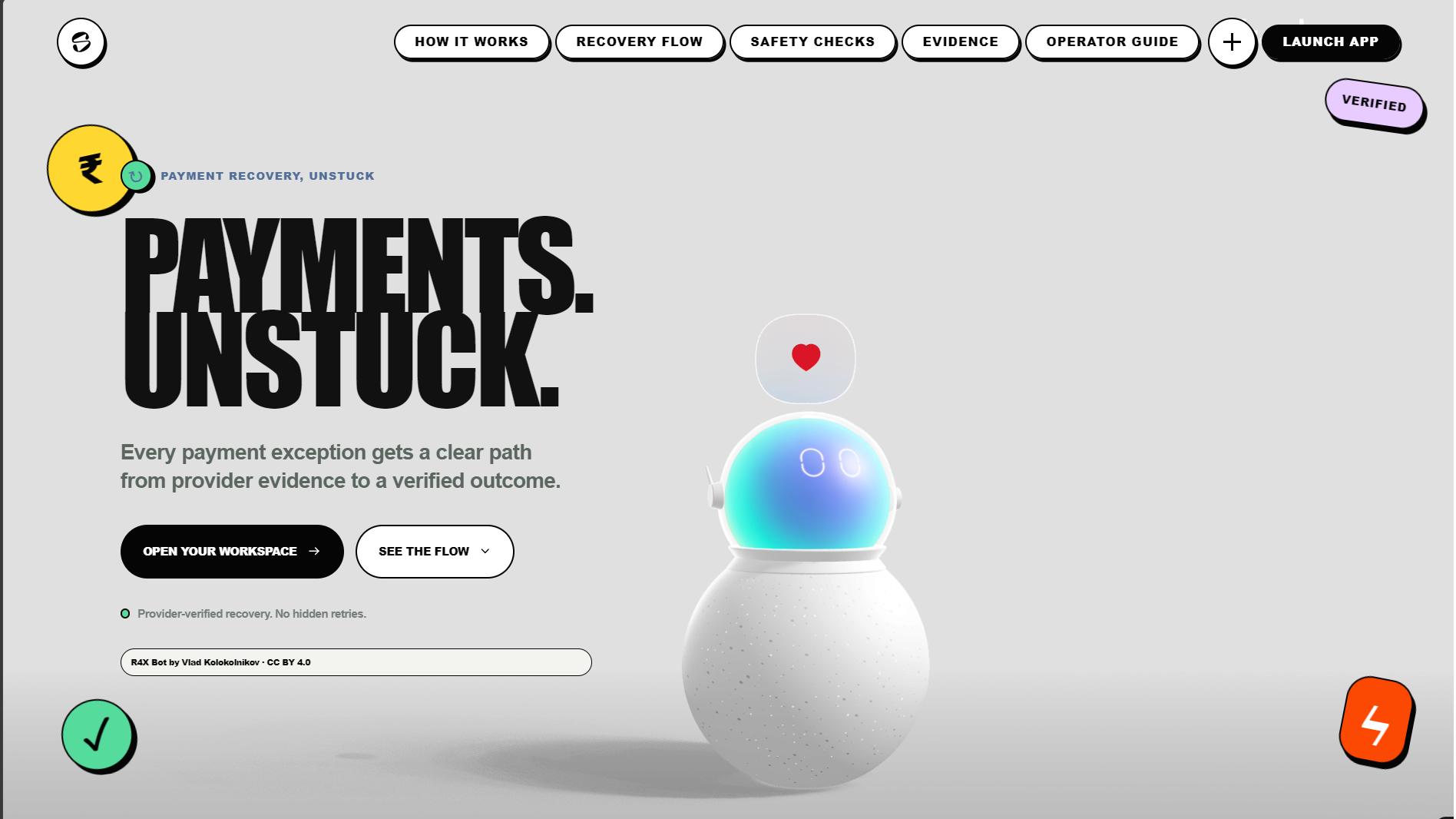
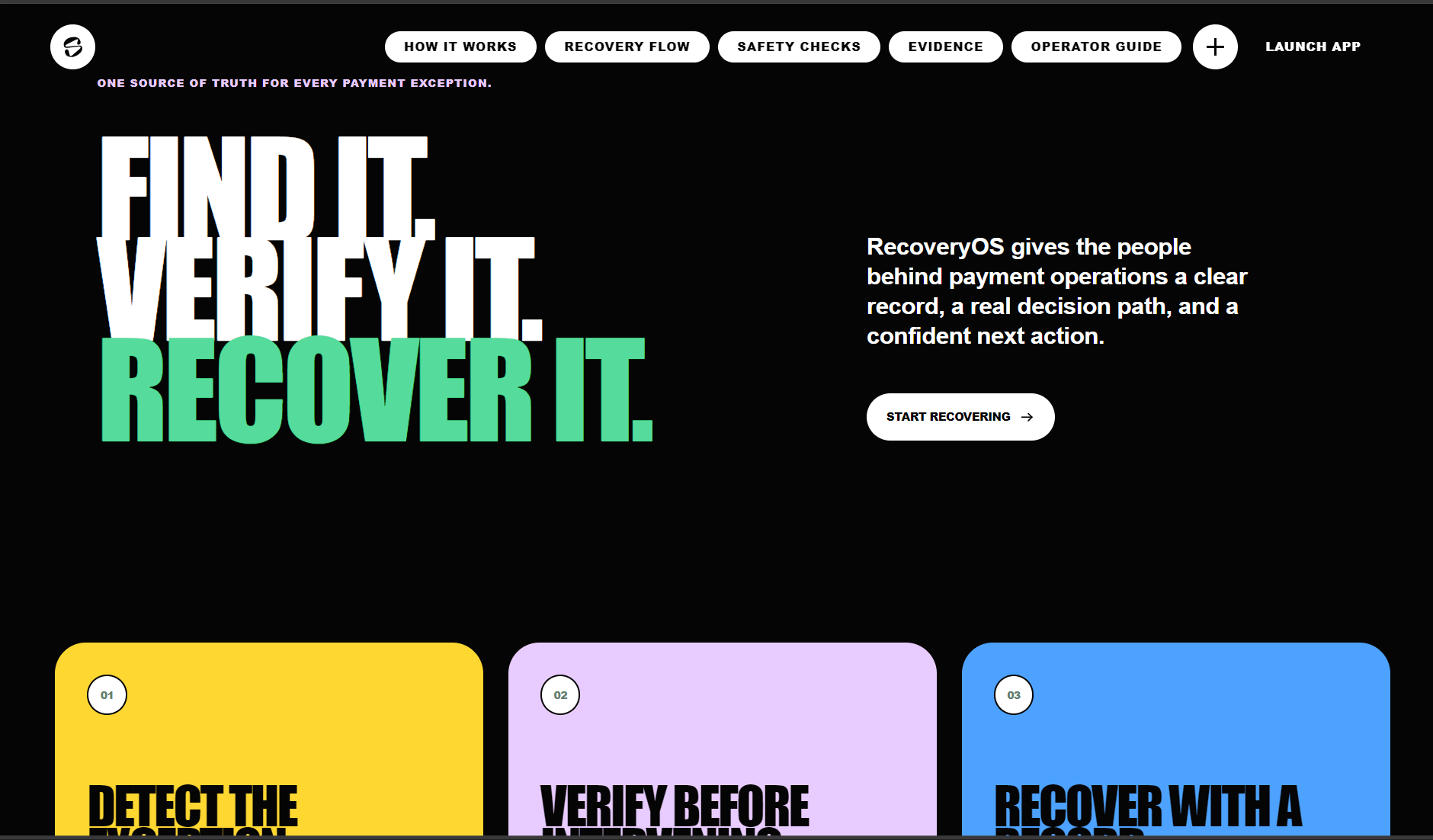
Payment failures are rarely simple “failed payments.” They can be late captures, duplicate attempts, network issues, pending states, or genuine customer drop-offs. Teams often respond with blind retries or fragmented dashboards, which can create duplicate charges and reduce trust. I built RecoveryOS to make recovery deliberate: start with provider evidence, apply safety checks, choose a controlled next step, and preserve a complete audit trail.
What it does
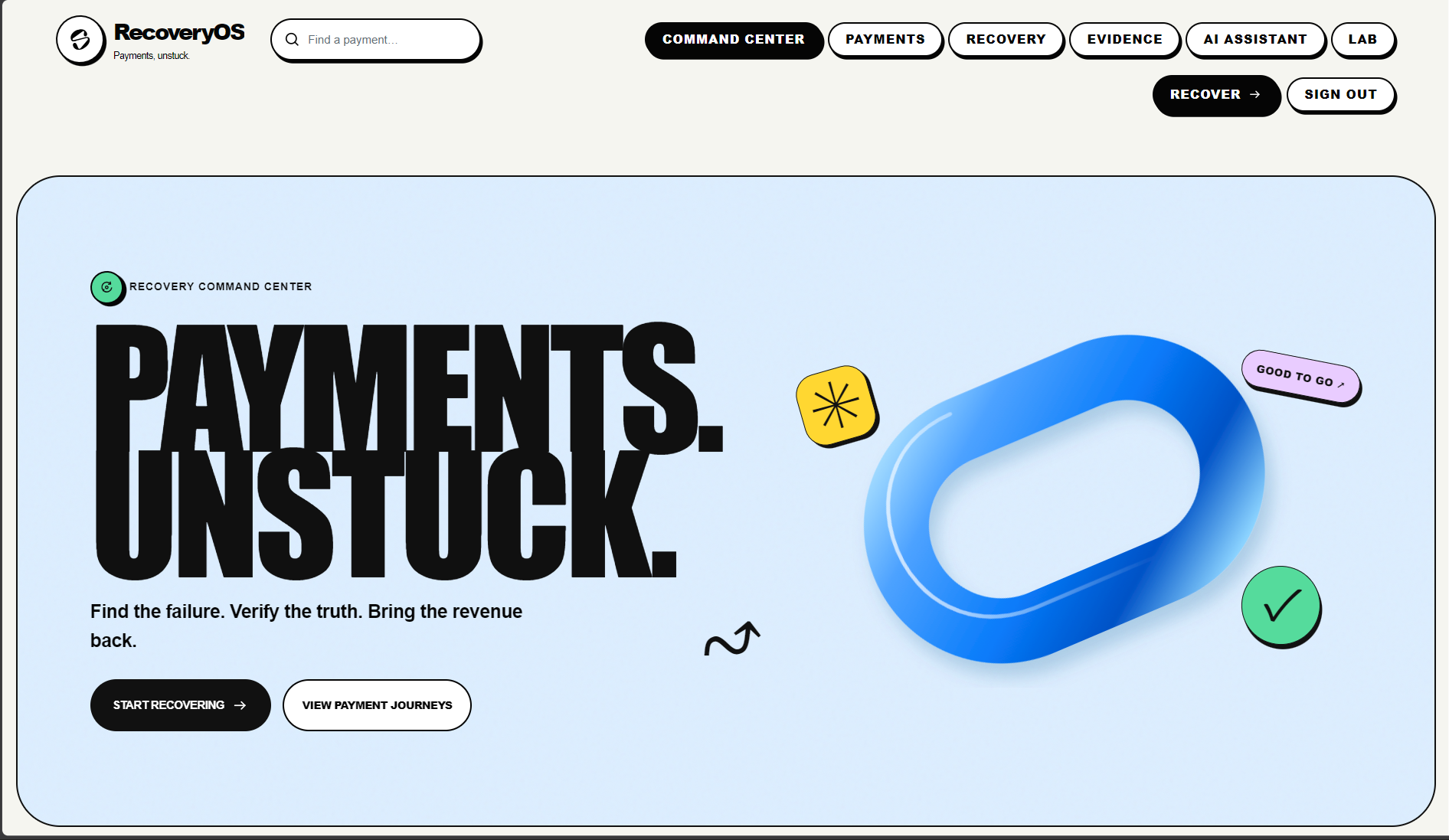
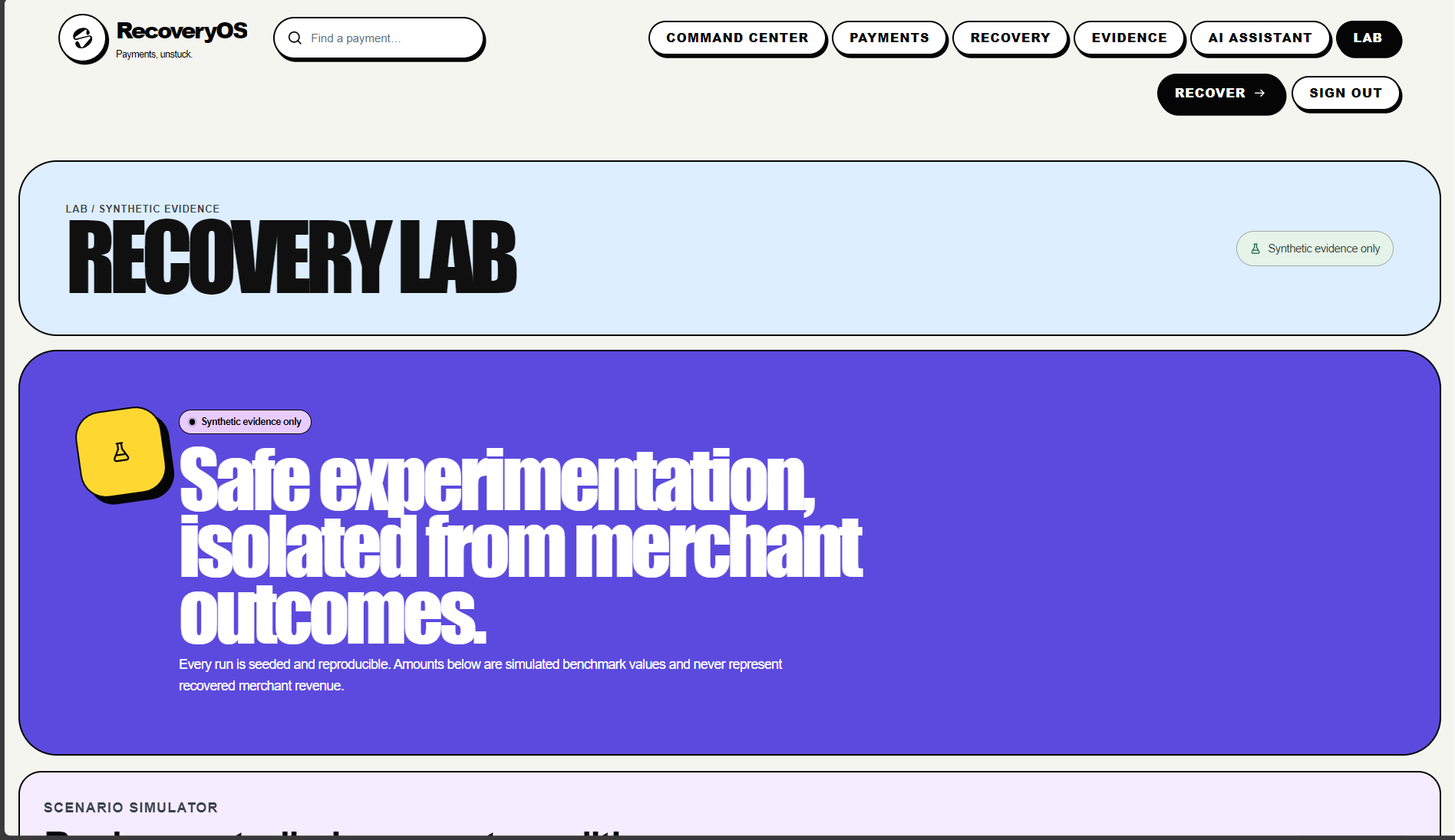
RecoveryOS is an operator workspace for investigating payment exceptions and recovering eligible revenue safely. It connects payment journeys, provider verification, recovery workflows, decision evidence, and outcome tracking.
The platform identifies payment states that may need attention, prevents unsafe or duplicate actions, and uses a contextual-bandit policy to rank recovery options. Operators can inspect every recommendation and action, while automated workflows remain guarded by eligibility checks, grace periods, idempotency, exact-amount constraints, and audit records.
How I built it
I built RecoveryOS as a Next.js application with a protected operator workspace and production deployment on Vercel. Payment and recovery data is stored in PostgreSQL through a typed database layer, while Razorpay Test Mode provides payment-provider integration.
Key components include:
- Signed Razorpay webhook handling and event deduplication
- Payment journeys, incidents, workflows, decisions, and audit records
- Database-backed operator dashboards and payment search
- Safe recovery-link creation with provider verification
- Delayed verification workflows
- A contextual-bandit policy for ranking recovery actions
- Groq-powered, read-only operator explanations
- Session-protected routes and server-side environment configuration
Challenges I ran into
The hardest part was not creating a payment dashboard - it was making recovery safe. A payment marked as failed can still capture later, and repeated intervention can create duplicate recovery attempts or customer confusion.
I had to handle race conditions, duplicate webhook delivery, delayed provider updates, and deployment-specific environment configuration. During production deployment, I also fixed empty configuration values that caused build failures, login failures due to a missing session secret, and database errors caused by a missing database URL.
Accomplishments that I'm proud of
I am proud that RecoveryOS is more than a mock dashboard. The deployed system supports real operator login, database-backed payment journeys, provider-oriented recovery flows, and auditable decision-making.
Most importantly, recovery actions are not hidden behind opaque automation. Every workflow is designed to be explainable, traceable, and constrained by safety checks.
What I learned
I learned that financial automation should optimize for correctness and reversibility before speed. A “successful” recovery action is only valuable if it is justified by reliable evidence and does not introduce additional risk.
I also learned that contextual decision systems need careful warm-start data, explicit safeguards, and human-readable reasoning. Deployment taught us that environment configuration is part of the product: authentication, database access, and provider secrets must be validated as carefully as application logic.
What's next for RecoveryOS
RecoveryOS currently supports Razorpay Test Mode as its first payment-provider integration. This focused scope helped us build and validate safe recovery workflows around one provider’s evidence model first. Next, we plan to extend the platform to support additional payment gateways, allowing teams to use the same evidence-driven recovery workspace across multiple providers.
I also plan to add multi-merchant support, stronger role-based access, more provider integrations, configurable recovery playbooks, proactive incident alerts, and a more complete operations analytics layer.
Built With
- bandits
- contextual
- css3
- drizzle
- groq
- linucb
- machine-learning
- neon
- next.js
- node.js
- orm
- postgresql
- qstash
- razorpay
- react
- rest
- tailwind
- typescript
- upstash
- vercel
- webhooks
- zod

Log in or sign up for Devpost to join the conversation.