-
-
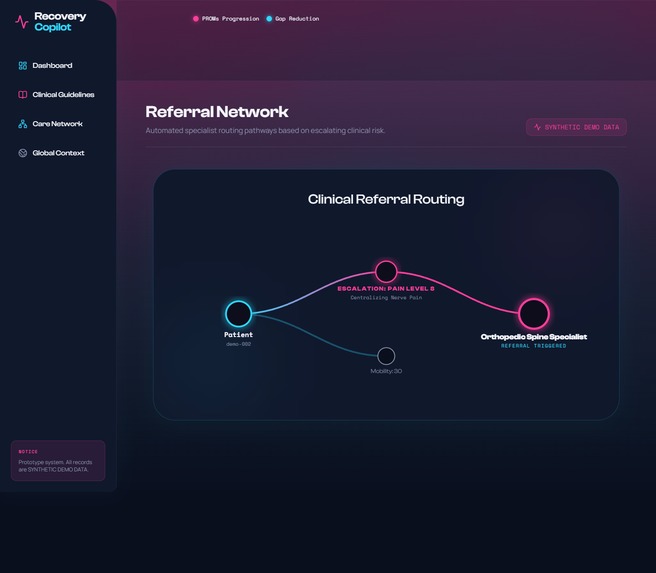
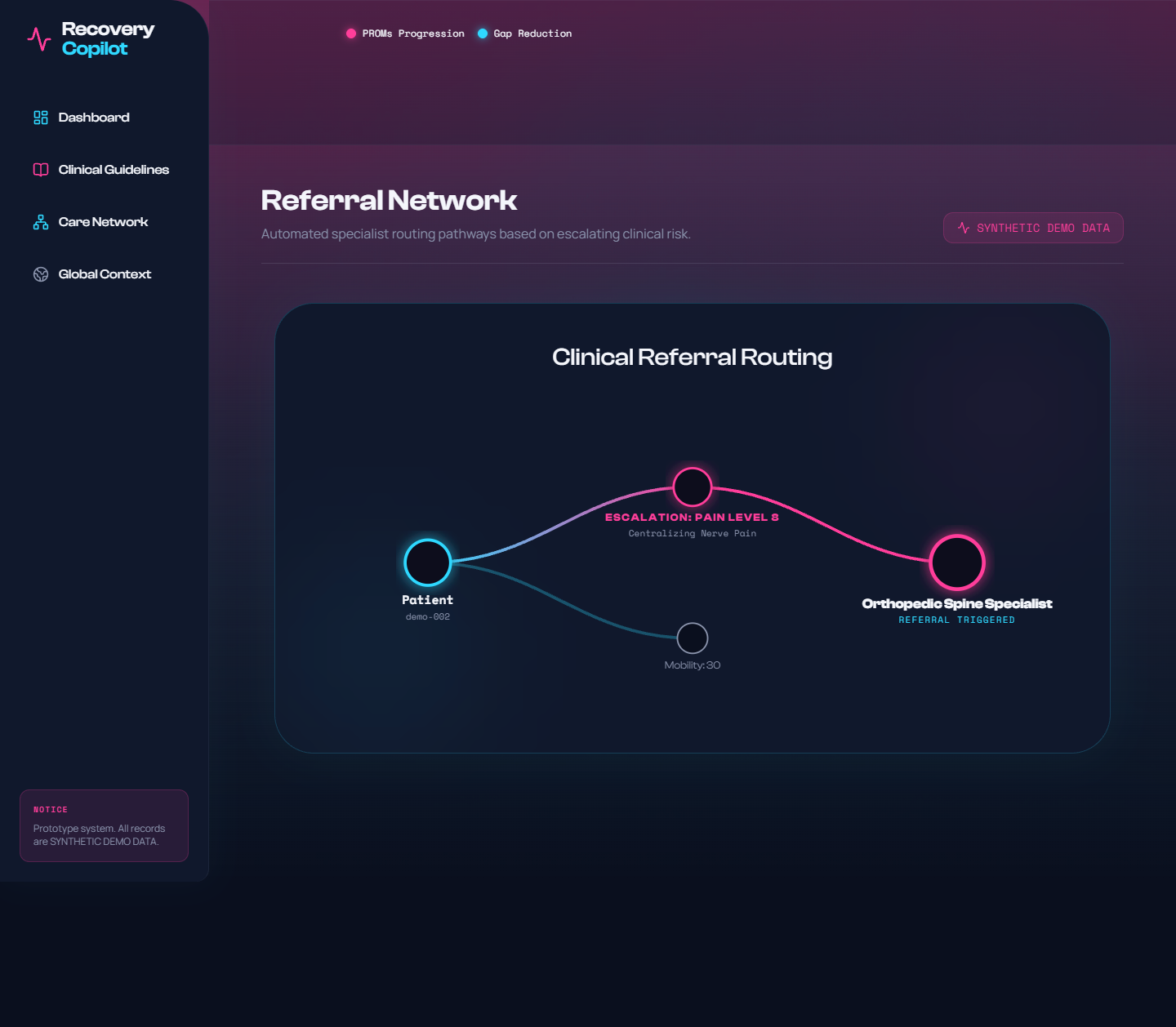
Specialist Referral Graph
-
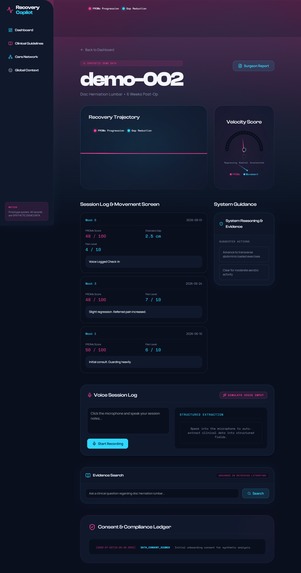
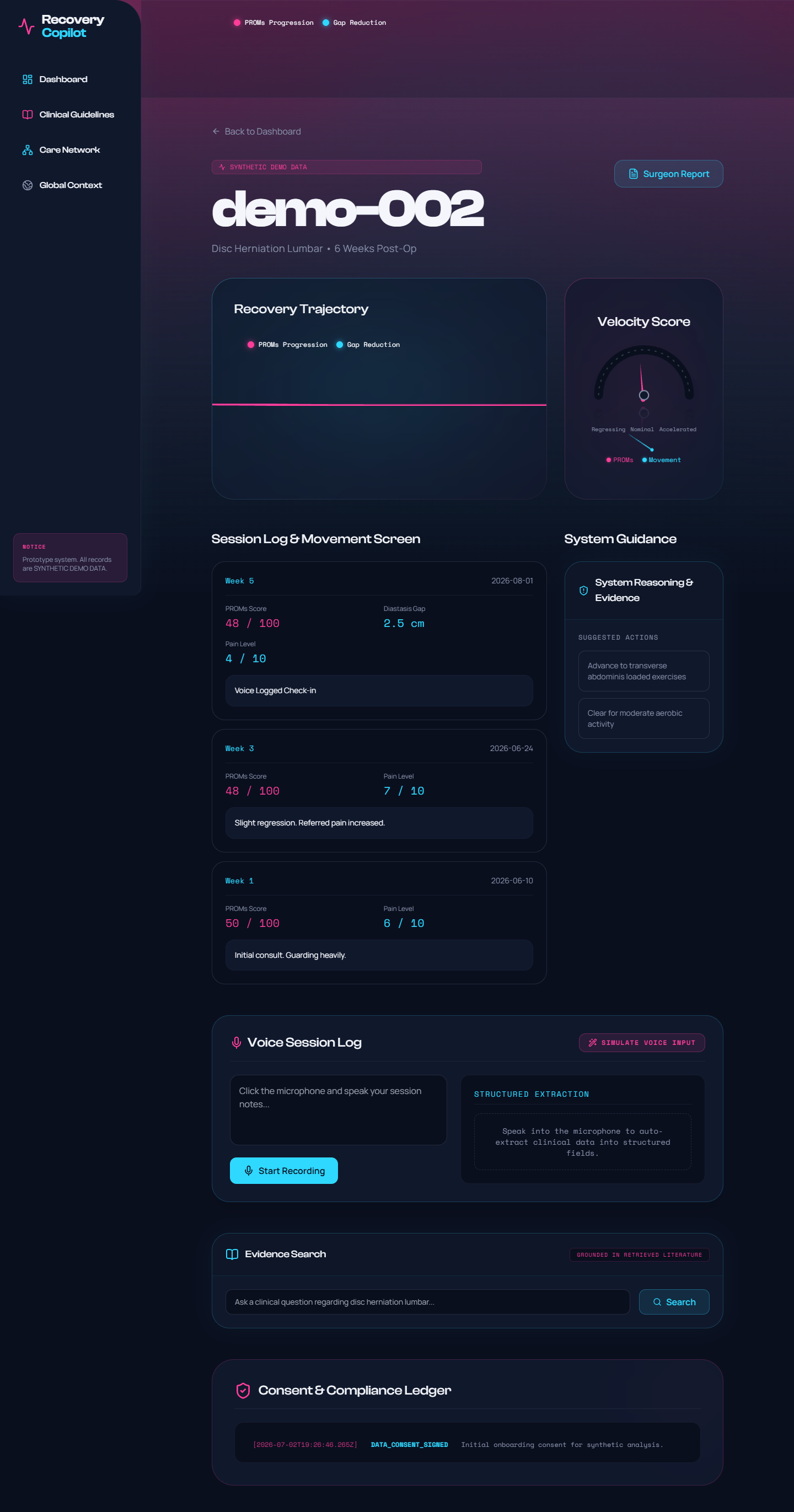
Client Detail & Explainability Trace
-
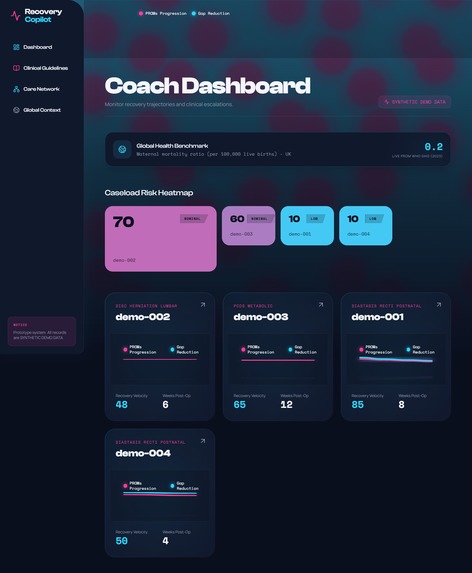
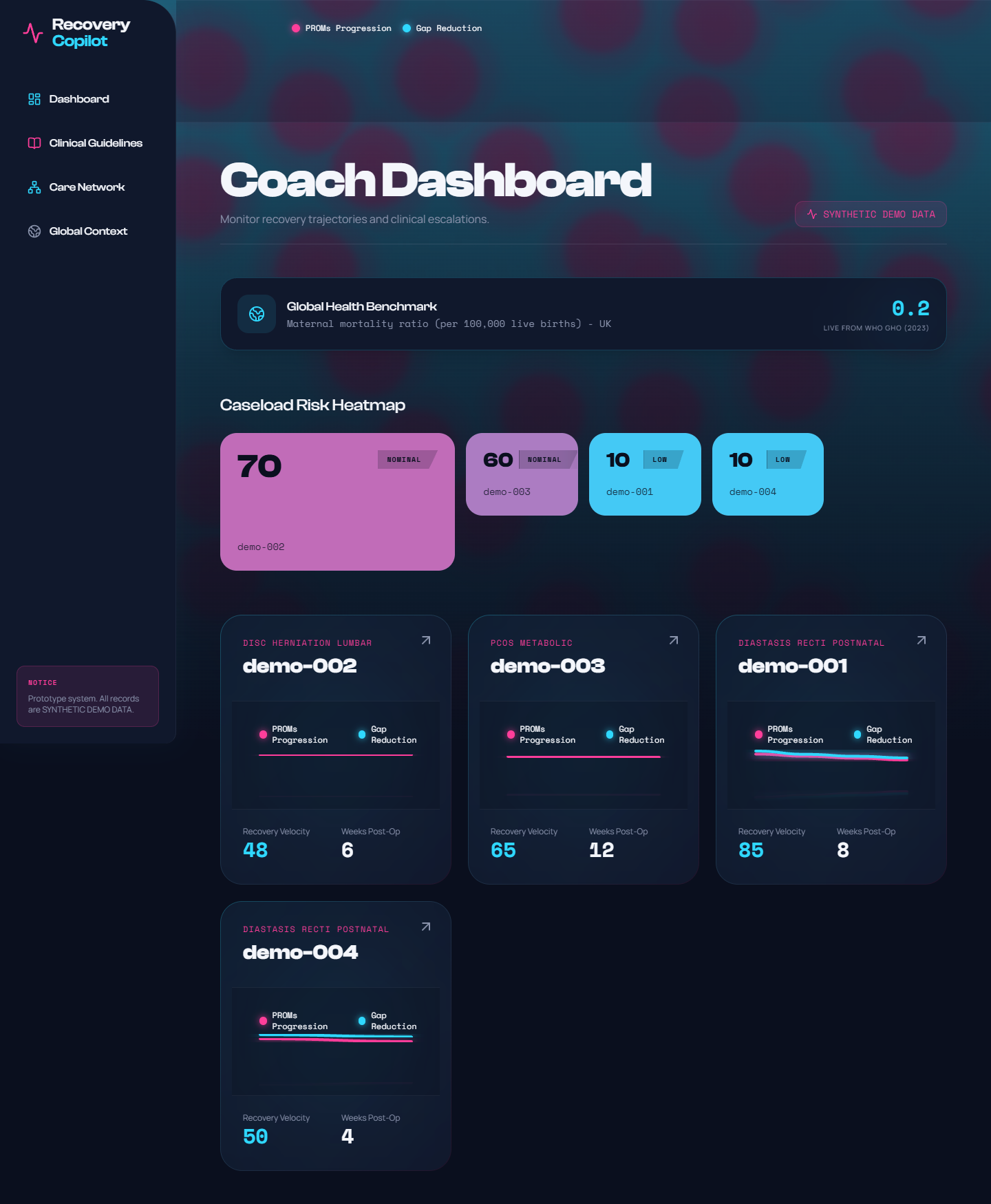
Dashboard
-
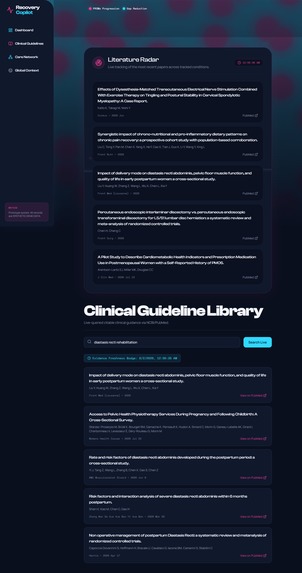
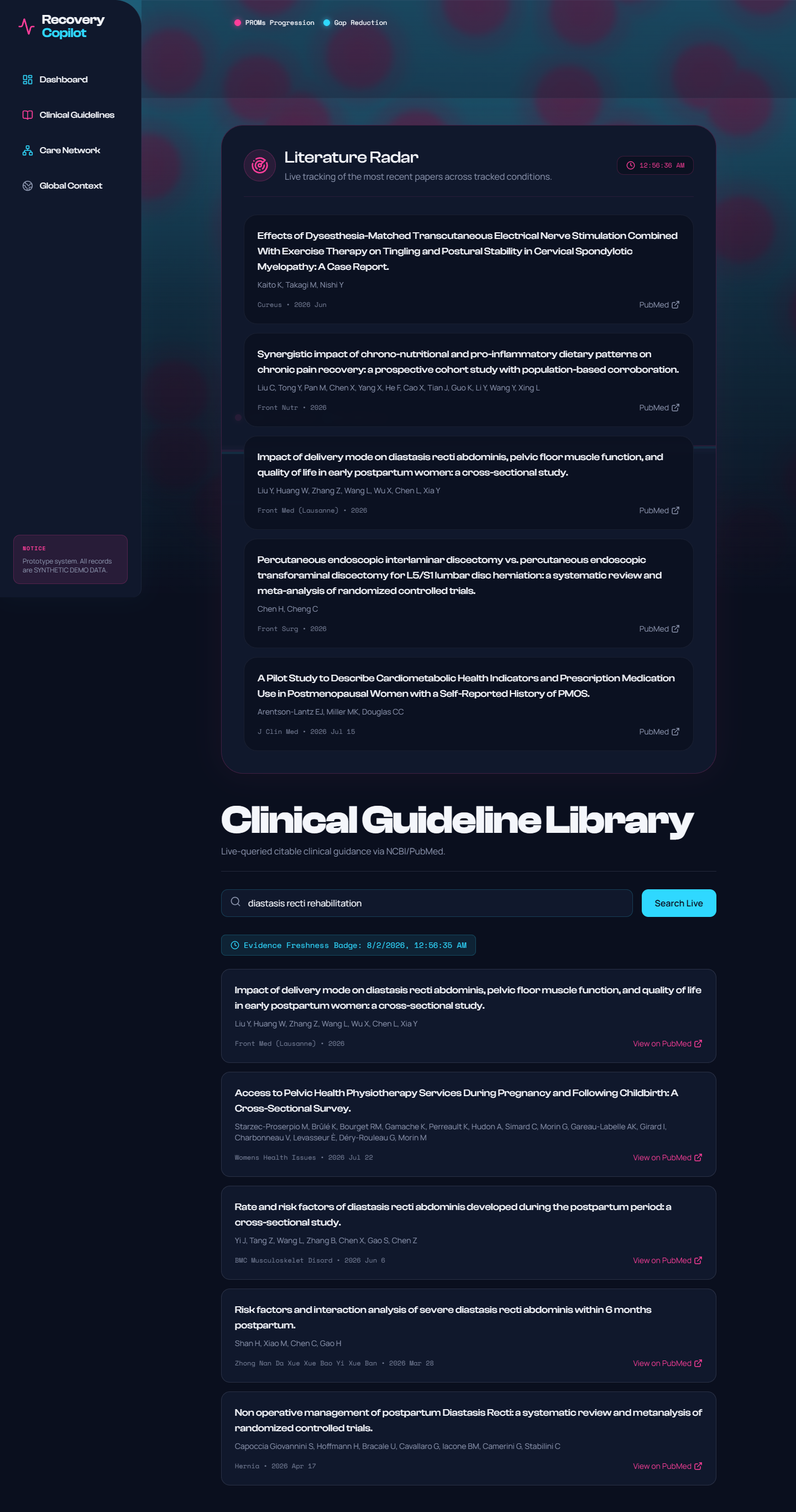
Live Clinical Evidence Library
Inspiration
Post-surgical and postnatal recovery is tracked informally today — progress notes live in WhatsApp threads, spreadsheets, or a coach's memory, with no structured audit trail a surgeon can review. This gap is especially stark in women's health surgical recovery (C-section, diastasis recti, pelvic floor rehab), which is almost entirely ignored by existing MSK-focused rehab technology.
This project draws directly on 16 years of real clinical fitness case experience — 50+ prenatal clients, 40+ postnatal diastasis recti recoveries, 30+ PCOS/thyroid cases, and disc herniation rehabilitation — built by a REPs UK Registered Medical Fitness & Corrective Exercise Specialist. We set out to turn that informal, undocumented clinical judgment into a structured, evidence-traceable system a surgeon could actually trust.
What it does
Recovery Copilot is a multi-page clinical decision-support platform for post-surgical and postnatal rehabilitation:
- Recovery Trajectory & Velocity Score — tracks PROMs and movement-screen data over time, computing a composite recovery score
- Clinical Evidence Search — a retrieval engine (not a chatbot) that live-queries PubMed/NCBI for literature matching a client's condition and question, returning answers built only from real retrieved abstracts with inline PMID citations
- Literature Radar — surfaces the newest published research across tracked conditions on every page load, with a live "fetched at" timestamp as proof it's real
- Global Context Widget — pulls a live indicator from the WHO Global Health Observatory API to frame individual recovery against real population-level data
- Caseload Risk Heatmap — an asymmetric, urgency-weighted dashboard view flagging which clients are trending toward complications
- Voice Session Log — coaches dictate session notes via the Web Speech API; a parser extracts structured PROMs data live, which recalculates that client's risk score in real time
- Referral Network Graph — visually traces a flagged symptom to the right specialist
- Consent & Compliance Ledger — a real-time audit trail of data-access events, reinforcing GDPR/MDR-aware handling
- Surgeon One-Tap Report — a clean, print-ready clinical summary export
All patient data shown is clearly labeled synthetic demo data — real patient health information was never used, by design.
How we built it
Built with Next.js 14 (App Router) and TypeScript, developed largely through Google Antigravity's agentic workflow — defining strict project-wide design and data rules in an AGENTS.md file, then iterating through planning, execution, and browser-verified QA passes.
Two live external data sources are wired server-side to avoid any fabricated content: NCBI's PubMed E-utilities (esearch/esummary/efetch) for clinical literature, and the WHO Global Health Observatory OData API for population-level context. If either source is unavailable, the UI shows an explicit "source unavailable" state rather than a silently faked number.
The visual identity — a blue/pink neon signal-trace aesthetic with Clash Display, Manrope, and Space Mono typography, ambient duotone video backgrounds, and glass/glow depth — was deliberately built against a "no generic AI dashboard" ruleset: no purple gradients, no default Inter font, no uniform card grid, no cookie-cutter charting libraries. Deployed on Vercel.
Challenges we ran into
Server-only Node modules (
fs/path) were initially imported into a Client Component, breaking the build — required separating data-reading logic into API routes so client-side widgets fetch rather than import directlyNo LLM API key was available for the Evidence Search feature, so instead of a hallucination-prone generative chatbot, we built a precision retrieval system that ranks and extracts real PubMed sentences — a constraint that ended up producing a more trustworthy, fully-verifiable feature than a generic LLM wrapper would have
Getting the first design pass to move past a "generic AI dashboard" look took an explicit second pass: ambient depth, asymmetric layout, and a real type hierarchy, rather than flat panels and a uniform grid
Wiring the Voice Session Log so a dictated symptom actually recalculates and moves a client's position on the Caseload Risk Heatmap in real time, not just saving a note
Accomplishments that we're proud of
Every clinical claim in the app is traceable to a real, live-queried source — not a single hardcoded citation or mocked dataset in the product. Built a rehab-tech tool grounded in an underserved niche (women's health surgical recovery) backed by real 16-year clinical case volume, with a visual identity distinctive enough to not look AI-generated, and a full compliance-aware framing (GDPR, UKCA/MDR Class I) that most hackathon health projects skip entirely.
What we learned
Constraints produced better design decisions than freedom did — not having an LLM API key forced a more defensible, explainable evidence feature; an explicit "do not look generic" ruleset forced real design decisions instead of AI-default patterns. We also learned how much clinical credibility comes from small honest details — showing a "source unavailable" state instead of faking data, labeling synthetic patients clearly — rather than from feature count alone.
What's next for Recovery Copilot
- Formal data-sharing exploration with NICE (UK) and HSE (Ireland) for live guideline integration beyond PubMed literature
- A pilot with a single rehab centre or surgical team using real, consented, de-identified case data
- Clinician-facing EHR/FHIR export for the Surgeon Report
- Expanding tracked conditions beyond diastasis recti, disc herniation, and PCOS/thyroid
Built With
- clinical-decision-support
- digital-health
- framer-motion
- gdpr
- google-antigravity
- healthcare
- medical-technology
- ncbi-e-utilities
- next.js
- node.js
- pubmed
- react
- rest-api
- svg
- tailwind-css
- typescript
- vercel
- web-speech-api
- who-global-health-observatory-api
- women's-health


Log in or sign up for Devpost to join the conversation.